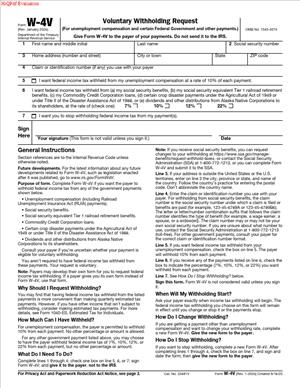
Form W-4V – Voluntary Withholding Request
Fill out nowJurisdiction: Country: United States | Province or State: Federal
Form W-4V – Voluntary Withholding Request is a federal tax form used to ask for federal income tax to be withheld from certain government payments. If you receive specific types of benefits, this form lets you choose to have tax taken out before the money reaches you.
You use this form when withholding is not automatic, but you want to avoid a large tax bill later. It gives you a way to spread out your tax payments over the year.
This document matters because many government payments are taxable. If you do not arrange withholding, you may owe tax when you file your return. That can lead to an unexpected balance due.
Form W-4V – Voluntary Withholding Request helps you manage that risk. It is a simple election, but it affects your cash flow and tax planning for the year.
What is Form W-4V – Voluntary Withholding Request?
Clear definition
Form W-4V – Voluntary Withholding Request is a written request you submit to a federal agency to withhold a flat percentage of federal income tax from certain government payments. It does not calculate your tax. It only tells the payer how much to withhold from each payment.
The form applies only to specific types of payments defined by federal tax rules. You cannot use it for wages, pensions, or private payments. It is limited to designated government benefits.
When accepted, the agency withholds the percentage you choose and sends that amount to the federal government as income tax withholding. The withheld amounts appear on the tax reporting form you receive for that year.
Who typically uses this form?
You typically use this form if you receive unemployment compensation, Social Security benefits, certain agricultural program payments, or other listed federal payments that qualify for voluntary withholding.
Retirees receiving Social Security benefits often use this form to manage income taxes during retirement. People receiving unemployment benefits also use it to prevent a tax balance at filing time.
Farmers or landowners who receive certain federal program payments may submit this form to align withholding with expected annual income. Individuals receiving specific disaster or commodity payments may also use it when eligible.
You are the person who completes and signs the form. The paying agency processes it and applies the withholding to future payments.
Why might you need this form?
You might need this form if you expect to owe federal income tax on your benefits and want taxes withheld automatically. Without withholding, you may need to make estimated tax payments on your own.
If you prefer predictable net payments, voluntary withholding can help. It spreads tax payments across the year instead of leaving you with a lump sum due when filing your return.
You may also use this form if your overall income has increased. For example, if you have part-time work in addition to benefits, your total taxable income may push you into a higher tax bracket.
Some people choose to withhold to avoid penalties that can apply when too little tax is paid during the year. Voluntary withholding can reduce that risk by ensuring regular tax payments.
Typical real-life scenarios
- You are laid off and begin receiving unemployment compensation. You know unemployment benefits are taxable. Instead of setting money aside manually, you submit the form to have a fixed percentage withheld from each payment.
- You retire and begin collecting Social Security benefits. You also withdraw funds from a retirement account. Because your combined income may make part of your Social Security taxable, you request withholding to reduce the chance of owing tax at year-end.
- You participate in a federal agricultural support program and receive periodic payments. You expect to owe income tax on those payments. You file the form, so the agency withholds a set percentage before sending you the funds.
- You receive certain government payments after a disaster or under a federal commodity program. The payments are taxable under federal law. You use voluntary withholding to manage the tax impact during the year.
When would you use Form W-4V – Voluntary Withholding Request?
You use this form when you receive eligible government payments and want federal income tax withheld from those payments. It applies only when withholding is optional and not already required.
You might use it at the start of receiving benefits. For example, when your unemployment benefits begin, you can submit the form early so withholding applies to future payments.
You may also use it midyear. If your financial situation changes, such as starting a new job or losing other income, you might decide to begin or adjust withholding from your benefits.
This form is commonly used by retirees, unemployed individuals, farmers, and others receiving federal benefit payments. It is not limited to one profession or age group. It depends on the type of payment you receive.
You can also use the form if you previously declined withholding but later realize you may owe tax. Submitting it allows you to start withholding going forward.
If you want to stop voluntary withholding, you generally submit a new form indicating that you no longer want withholding. The change usually applies to future payments, not amounts already paid.
Legal characteristics of Form W-4V – Voluntary Withholding Request
Form W-4V – Voluntary Withholding Request is an official federal tax document. It becomes effective when properly completed, signed, and accepted by the paying agency.
For the form to work as intended, your identifying information must match the agency’s records. This usually includes your name and taxpayer identification number. Errors in these details can delay processing or cause rejection.
You must select from the permitted flat percentage options listed on the form. The withholding rates are fixed percentages. If you write at a different rate or alter the form, the agency may not process your request.
The form generally applies only to future payments. It does not retroactively change withholding on payments already issued. Timing matters, especially if you are trying to manage taxes late in the year.
Common problems include missing signatures, incomplete information, or submitting the form to the wrong office. Some agencies require the form to be mailed to a specific address or submitted in a specific way.
This form does not change whether your benefits are taxable. It only affects how tax is paid during the year. It also does not replace your annual tax return. You still must file a return if required.
Federal rules govern this form because it relates to federal income tax withholding. State tax treatment may differ. Some states tax certain benefits, while others do not. This form does not address state withholding.
Is it legally binding?
Yes, once properly submitted and processed, the election you make on the form directs the paying agency to withhold federal income tax according to your selection. The agency relies on your signed request to apply withholding.
Your signature confirms that the information is accurate and that you are requesting voluntary withholding. The agency acts on that authorization for future payments.
However, the form does not create a contract in the traditional sense between you and the agency. It is an administrative tax election. You can typically change or revoke it by submitting a new form.
The amounts withheld under this request are treated as federal income tax withheld for the year. They are credited to you when you file your federal tax return.
How to fill out Form W-4V – Voluntary Withholding Request
Step 1 – Review the eligible payment types
Before filling out the form, confirm that the payment you receive qualifies for voluntary withholding under this document. The form lists the types of payments that are eligible. Make sure your benefit fits within those categories.
Step 2 – Enter your full legal name
Write your full legal name as it appears in the records of the agency paying you. This helps match your request to your existing account and avoids processing delays.
Step 3 – Provide your taxpayer identification number
Enter your Social Security number or other required taxpayer identification number in the space provided. Double-check the number for accuracy. An incorrect number can prevent the agency from applying your request.
Step 4 – Provide your mailing address
Fill in your current mailing address. Use the address where you receive official correspondence. This ensures the agency can contact you if there is a question about your submission.
Step 5 – Select the withholding percentage
Choose one of the flat percentage options listed on the form. You must select from the provided rates. Do not write in a custom percentage. The selected rate will apply to each eligible payment going forward.
Step 6 – Sign and date the form
Sign your name in the signature line. Add the date you are signing. Your signature authorizes the agency to begin withholding federal income tax at the percentage you selected.
Step 7 – Submit the form to the correct agency
Send or deliver the completed form to the federal agency that issues your payments. Follow any instructions provided with your benefit materials about where to submit the form. Withholding typically begins after the agency processes your request and applies it to future payments.
Legal terms you might encounter in Form W-4V – Voluntary Withholding Request
- Voluntary withholding: This means you are choosing to have federal income tax taken out of certain government payments you receive. It is not automatic. You must actively request it using this document, and you select the percentage to be withheld from each payment.
- Eligible government payments: These are specific types of federal or state payments that qualify for voluntary withholding. Only certain payments can be covered, such as unemployment compensation or certain social security benefits. You must confirm your payment type is listed before submitting the form.
- Taxpayer Identification Number (TIN): This is your Social Security number or other assigned taxpayer number. It connects your withholding request to your tax record. If the number does not match your name in federal records, the request may be rejected or delayed.
- Withholding percentage: Instead of choosing a dollar amount, you select a fixed percentage from the options provided on the form. That percentage will be applied to each eligible payment. You cannot create a custom percentage.
- Payor: The payor is the agency or office that sends you the eligible payment. You submit this document directly to the payor, not to the tax authority’s central office. The payor is responsible for applying the withholding to future payments.
- Effective date: This refers to when the withholding actually begins. It usually applies to payments issued after the payor processes your request. It does not typically change payments that were already sent before processing.
- Revocation: Revocation means canceling your prior withholding request. You can usually revoke by submitting a new form indicating you want to stop withholding. The change applies prospectively, not retroactively.
- Signature under penalties of perjury: When you sign, you confirm the information is true and correct. Providing false information can result in penalties. Your signature makes the request official and actionable.
- Federal income tax withholding: This is the portion of your payment sent directly to the federal government as a prepayment of your annual income tax. It reduces the amount you may owe when you file your tax return. It may also reduce or eliminate underpayment penalties.
FAQs
Do I send Form W-4V – Voluntary Withholding Request to the tax authority?
No. You send this document to the agency that pays you the eligible benefit. The payor is responsible for processing your request and applying withholding to your future payments. If you send it to the wrong office, nothing will change until the correct payor receives and processes it.
When does the withholding start after I submit this form?
Withholding usually starts with payments issued after the payor has processed your request. There is often a short administrative delay. Check your next payment statement to confirm whether the withholding appears, and contact the payor if it does not.
Can I choose any percentage I want?
No. You must select one of the specific percentages listed on the document. If you mark more than one percentage or write in your own number, the payor may reject the request. Make sure only one option is clearly selected.
What if my name or Social Security number does not match government records?
If your name and taxpayer identification number do not match official records, the payor may be unable to apply the request. Double-check that your name is written exactly as it appears on your Social Security card and that the number is correct. Even a small typo can delay processing.
Do I need to attach any other documents?
In most cases, you do not need to attach additional paperwork. However, the payor may require identity verification if your account information does not match. Review any instructions from the paying agency to confirm whether they require supporting documentation.
Can I stop or change the withholding later?
Yes. You can submit a new request to stop or change the percentage. The updated Form W-4V – Voluntary Withholding Request will replace your prior election once processed. Changes apply only to future payments, not amounts already issued.
Will this affect my state income taxes?
This document applies only to federal income tax withholding. It does not automatically change state tax withholding. If you want state taxes withheld, you must check whether your state offers a separate process.
What happens if I sign but forget to date the form?
An undated document may be treated as incomplete. The payor might return it to you or delay processing. Always confirm that you have signed and dated the request before submitting it so it can be accepted without interruption.
Checklist: Before, During, and After Form W-4V – Voluntary Withholding Request
Before
- Confirm that your payment type qualifies for voluntary withholding.
- Review your most recent payment statement to verify the payor’s name and address.
- Locate your Social Security card or official tax document to confirm your exact legal name and number.
- Decide which withholding percentage fits your tax situation.
- Check whether you previously submitted a withholding request.
- Read the form instructions carefully to understand processing timelines.
- Make sure you know where to send or deliver the completed form.
During
- Print clearly using black or blue ink if completing by hand.
- Enter your full legal name exactly as it appears in official records.
- Provide your correct taxpayer identification number without transposing digits.
- Fill in your current mailing address accurately.
- Select only one withholding percentage option.
- Review each field to ensure nothing is left blank if required.
- Sign your name in the designated signature area.
- Date the form with the current date.
After
- Make a complete copy of the signed form for your records.
- Submit the form directly to the payor, not to a general tax office.
- Note the date you submitted the document.
- Monitor your next payment statement for the withholding change.
- Store confirmation letters or notices from the payor.
- Keep copies with your annual tax records.
- Follow up with the payor if withholding does not begin within a reasonable time.
- Update your personal budgeting records to reflect the reduced payment amount.
Common mistakes to avoid with Form W-4V – Voluntary Withholding Request
- Mistake: Sending the form to the wrong office because you assume all tax forms go to the same place, which delays processing and prevents withholding from starting, so do not forget to confirm the correct payor address before mailing.
- Mistake: Writing an incorrect Social Security number due to a simple typo, which can cause rejection or misapplied records, so do not forget to verify each digit against an official document.
- Mistake: Selecting more than one withholding percentage because you are unsure which to choose, which may invalidate the request, so do not forget to mark only one clear option.
- Mistake: Forgetting to sign and date the form because the rest of the information seems complete, which makes the request unenforceable, so do not forget that your signature activates the document.
- Mistake: Expecting withholding to apply to past payments, which leads to confusion about unchanged prior amounts, so do not forget that changes apply only to future payments.
- Mistake: Failing to keep a copy of the submitted form, which makes it hard to prove what you requested if a dispute arises, so do not forget to store a complete copy in your records.
- Mistake: Assuming federal withholding covers state taxes as well, which can result in unexpected state tax bills, so do not forget to check your state’s separate requirements.
- Mistake: Not reviewing payment statements after submission because you assume it was processed, which can allow errors to continue unnoticed, so do not forget to confirm the change on your next issued payment.
What to do after filling out Form W-4V – Voluntary Withholding Request
Once you complete the form, focus on proper submission and follow-through. Your goal is to make sure the withholding starts smoothly and matches what you requested.
- Step 1: Make a clear copy of the signed and dated form for your records.
- Step 2: Confirm the correct mailing address or submission method for your payor.
- Step 3: Submit the form using the method accepted by the payor, such as mail or in-person delivery if available.
- Step 4: Record the date you sent or delivered the document.
- Step 5: Allow reasonable processing time before expecting changes.
- Step 6: Review your next payment statement to confirm the selected percentage is being withheld.
- Step 7: Compare the withheld amount to the percentage you selected to ensure it is accurate.
- Step 8: Store any confirmation notice or updated payment statement with your tax records.
- Step 9: Adjust your personal budget to reflect the new net payment amount.
- Step 10: Reevaluate your withholding later in the year if your income or tax situation changes.
If you notice that withholding has not started after a reasonable period, contact the payor directly. Have your copy of the submitted form available. Be ready to confirm your name, taxpayer identification number, and the percentage you selected.
Keep your records organized. At tax filing time, you will report the total federal income tax withheld from these payments. Your annual tax statement from the payor will reflect the amounts withheld. Compare it against your records to confirm accuracy.
If you later decide to change or stop withholding, complete a new request and repeat the same careful submission process. Treat each update as a fresh record. Consistency and documentation protect you if questions arise later.
Disclaimer: This guide is provided for informational purposes only and is not intended as legal advice. You should consult a legal professional.