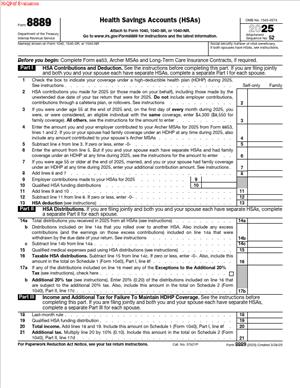
Form 8889 – Health Savings Accounts (HSAs)
Fill out nowJurisdiction: Country: United States | Province or State: Federal
Form 8889 – Health Savings Accounts (HSAs) is a federal tax form used to report contributions to and distributions from a Health Savings Account. You complete it as part of your individual income tax filing. It connects your HSA activity to your overall tax return.
If you have an HSA, this form helps determine how much of your contributions are deductible. It also shows whether any money you took out is taxable. The information flows directly into your Form 1040.
This form matters because HSAs receive special tax treatment. Contributions may reduce your taxable income. Qualified withdrawals are generally tax-free. Errors can lead to additional taxes or penalties.
You typically deal with this form if you were covered by a high-deductible health plan during the year. Even if you only contributed a small amount or made a single withdrawal, you may need to file it.
Understanding how the form works makes the filing process clearer. It also helps you avoid common mistakes, such as reporting the wrong contribution amount or missing a required calculation.
What is Form 8889 – Health Savings Accounts (HSAs)?
Clear definition
Form 8889 – Health Savings Accounts (HSAs) is an IRS tax form used to calculate and report HSA contributions, deductions, and distributions for a tax year. It determines how much of your HSA contribution you can deduct and whether any distributions are taxable.
The form has two main functions. First, it calculates your allowable HSA contribution and any deductible amount. Second, it reports money you withdrew and determines if any part is subject to income tax or an additional tax.
It works together with other tax documents, such as your Form 1040 and information forms you receive from your HSA custodian. The numbers you enter affect your total income and tax liability.
Who typically uses this form?
You use this form if you had an HSA in your name at any point during the tax year. This includes people who contributed directly, had employer contributions, or took distributions.
Employees with high-deductible health plans often file it. Self-employed individuals with qualifying coverage also use it. Retirees who still contribute or take withdrawals from an HSA may need it as well.
If your employer made contributions to your HSA, those amounts are usually shown on your Form W-2. Even though the money came from your employer, you still report it on this form.
Spouses who both have HSAs generally file their own Form 8889. An HSA is individually owned, even if you are married and covered under a family plan.
Why might you need this form?
You need this form to claim the HSA deduction. Without it, you cannot properly calculate how much of your contribution reduces your taxable income.
You also use it to show that your withdrawals were for qualified medical expenses. If you do not report distributions correctly, the IRS may treat them as taxable income.
The form also calculates any excess contributions. If you contributed more than allowed, this form helps determine the amount subject to an additional tax.
If you became eligible or ineligible for HSA contributions during the year, this document captures that change. It reflects partial-year eligibility and special rules that may apply.
Typical real-life scenarios
- You started a new job that offers a high-deductible health plan with an HSA. You and your employer both contributed during the year. At tax time, you use this form to calculate your total allowed contribution and deduction.
- You are self-employed and opened an HSA to manage medical costs. You made monthly contributions from your business income. This form helps you determine how much of those contributions are deductible on your individual return.
- You used money from your HSA to pay for a medical procedure and prescription costs. You must report the total amount withdrawn. The form then helps show that the distribution was for qualified expenses and not taxable.
- You accidentally contributed more than the annual limit. When completing the form, you discover the excess amount. The form calculates the portion that may be subject to an additional tax unless corrected.
- You turned 55 during the year and made a catch-up contribution. The form includes a separate calculation for this additional amount and determines whether you stayed within the allowed limit.
- You changed from individual to family coverage mid-year. The form accounts for the months you were eligible under each type of coverage and adjusts your contribution limit accordingly.
When would you use Form 8889 – Health Savings Accounts (HSAs)?
You use this form when preparing your annual federal income tax return if you had any HSA activity during the year. HSA activity includes contributions, employer funding, rollovers, or withdrawals.
You also use it when you want to claim the above-the-line deduction for HSA contributions you made with after-tax money. This deduction reduces your adjusted gross income.
If you received a distribution from your HSA, even if you spent it on medical expenses, you typically report it. The form determines whether any part is taxable or subject to an additional tax.
You may need it when you have only employer contributions and did not personally deposit money. Employer contributions still count toward your annual limit and must be reported.
If you lost eligibility for part of the year, such as by enrolling in other health coverage, you use this form to calculate your reduced contribution limit. The same applies if you gained eligibility during the year.
In general, the form is used by individuals, not businesses. Even if your business contributes to your HSA, you report the activity on your personal tax return.
Legal characteristics of Form 8889 – Health Savings Accounts (HSAs)
This form is a required part of your federal tax filing if you had HSA activity. Its effectiveness depends on accurate and complete information. It becomes part of your signed tax return.
The form must match information reported by your HSA custodian and, if applicable, your employer. Differences between your entries and the information the IRS receives may trigger questions or corrections.
Common problems include entering the wrong contribution limit, forgetting to include employer contributions, or misclassifying distributions. These errors can lead to notices, additional tax assessments, or penalties.
The form reflects federal tax rules. Some states follow federal HSA treatment closely, while others may differ. State income tax reporting may require separate adjustments, but this form itself is federal.
This document does not open or manage your HSA. It does not authorize withdrawals or contributions. It only reports activity that has already occurred.
It also does not prove that your expenses were qualified. You are generally responsible for keeping your own records to support how you used HSA funds.
Is it legally binding?
Form 8889 becomes legally binding as part of your signed federal income tax return. When you sign your return, you declare that the information is true and correct to the best of your knowledge.
The numbers you report can affect your tax liability. If the information is inaccurate, the IRS may adjust your return and assess additional tax, interest, or penalties.
The form itself is not a contract between you and another party. It is a reporting document required by federal tax law. Its legal effect comes from being part of your official tax filing.
If you amend your tax return later, you may also need to amend this form. The corrected version then replaces the earlier filing for that tax year.
How to fill out Form 8889 – Health Savings Accounts (HSAs)
Step 1 – Gather your HSA and tax documents
Collect your Form W-2, which may show employer HSA contributions. Obtain the information form from your HSA custodian that reports total contributions and distributions for the year. Have records of any additional contributions you made directly and receipts for medical expenses paid from the HSA.
Review your health coverage history for the year. Note the months you were covered by a high-deductible health plan and whether you had individual or family coverage.
Step 2 – Complete Part I for contributions and deductions
Enter the type of coverage you had and the months you were eligible. This determines your annual contribution limit. The form provides lines to calculate a reduced limit if you were only eligible for part of the year.
Add together all contributions made to your HSA. This includes your direct contributions and those made by your employer. Include any catch-up contribution if you were age 55 or older and eligible.
Compare your total contributions to your allowed limit. If your contributions exceed the limit, the form calculates the excess amount. It also determines the deductible portion of your contributions, which flows to your main tax return.
Step 3 – Complete Part II for distributions
Enter the total distributions you received from your HSA during the year. This amount is typically shown on the information form from your HSA custodian.
Indicate how much of the distribution was used for qualified medical expenses. Only qualified expenses are generally excluded from income. The form then calculates any taxable portion.
If you were under age 65 and used funds for non-qualified expenses, the form computes an additional tax. This amount is added to your total tax on your return.
Step 4 – Review additional taxes and carryovers
If you had excess contributions from a prior year, the form includes lines to carry them forward and calculate any continuing additional tax. Carefully follow the sequence of lines, as earlier entries affect later calculations.
Confirm that all limits and totals reflect your coverage and contribution history. Small errors in earlier lines can change the final deductible amount or additional tax.
Step 5 – Transfer amounts to your main tax return
After completing the calculations, transfer the deductible HSA contribution to the appropriate line on your Form 1040. Also, transfer any additional tax calculated for excess contributions or non-qualified distributions.
Check that these amounts match the figures on Form 8889. Consistency between forms helps prevent processing delays.
Step 6 – Review for accuracy before filing
Read through each line to confirm that you included all contributions and distributions. Verify that employer contributions from your Form W-2 are properly reflected.
Make sure your eligibility months and coverage type are accurate. Once you are satisfied that the information is complete and correct, include the form with your federal tax return when you file.
Legal terms you might encounter in Form 8889 – Health Savings Accounts (HSAs)
- Eligible Individual: This refers to a person who qualifies to contribute to an HSA for the tax year. On this form, your eligibility depends on having a high deductible health plan and no disqualifying coverage. If you were not eligible for the entire year, you must calculate contributions month by month.
- High Deductible Health Plan (HDHP): An HDHP is a health insurance plan that meets specific minimum deductible and maximum out-of-pocket limits for the year. Your eligibility to contribute is tied directly to enrollment in an HDHP. You may need to confirm coverage dates with your insurer to complete the form accurately.
- Contribution Limit: This is the maximum amount you are allowed to contribute to your HSA for the year. The limit depends on whether you had self-only or family coverage and your age. The form walks you through calculating your personal limit based on months of eligibility.
- Catch-Up Contribution: If you were age 55 or older by the end of the tax year, you may contribute an additional amount. This is entered separately and added to your regular contribution limit. You must ensure you actually made this extra contribution before claiming it.
- Excess Contribution: This is any amount you contributed above your allowed limit. The form calculates excess contributions and any penalty that may apply. If you do not correct an excess, it can trigger additional taxes in future years.
- Distribution: A distribution is money you withdraw from your HSA. In Part II of the form, you report total distributions and determine how much was used for qualified medical expenses. Any non-qualified use may be subject to tax and an additional penalty.
- Qualified Medical Expenses: These are medical costs that can be paid or reimbursed tax-free from your HSA. You must use your own records to confirm how much of your distribution was used for qualified expenses. The form requires you to enter that amount to determine if any part is taxable.
- Additional Tax: This is an extra tax applied in certain situations, such as excess contributions or nonqualified distributions. The form calculates this amount if it applies to you. You then transfer the result to the appropriate line on your main tax return.
- Carryover: If you had excess contributions from a prior year that were not corrected, they carry forward. The form includes lines to account for these amounts. Failing to include prior excess can lead to underreporting penalties.
- Last-Month Rule: This rule may allow you to contribute the full annual limit if you were eligible on the first day of the last month of the year. However, you must remain eligible during a testing period. The form includes calculations to ensure you meet this requirement.
FAQs
What documents do I need in front of me before completing this form?
You need your year-end HSA statement showing total contributions and distributions. You also need any tax form reporting HSA activity from your employer or HSA trustee. Confirm the coverage type (self-only or family) and the months you were eligible so you can enter accurate figures.
Where do I report employer contributions versus my own contributions?
Employer contributions are usually listed on your wage statement and must be included in the total contribution amount. In this document, you combine employer and employee contributions when calculating your limit, but only certain amounts are deductible. Carefully match the numbers to avoid double-counting.
How do I know if I exceeded my contribution limit?
You compare your total contributions for the year to your calculated annual limit on the form. If contributions are higher than the allowed amount, the excess will show up during the calculation steps. This form guides you through determining whether a penalty applies and how much must be carried forward.
What if I used HSA money for something that was not a qualified medical expense?
You must report the full distribution and then enter the portion used for qualified expenses. The difference is treated as taxable income and may trigger an additional tax. This form calculates that extra amount so you can transfer it correctly to your main return.
Do I need to attach proof of medical expenses when I file Form 8889 – Health Savings Accounts (HSAs)?
You generally do not attach receipts or medical bills to this form. However, you must keep your records in case you are asked to substantiate the qualified expenses you claimed. Your entries on this form should match your personal documentation exactly.
What happens if my name or Social Security number does not match my main tax return?
This document must match the identifying information on your primary tax return. If there is a mismatch, processing delays can occur. Double-check spelling and numbers before filing to avoid rejection or requests for correction.
If I did not take any distributions, do I still need to complete this document?
Yes, if you contributed to an HSA during the year, you still use this form to calculate your allowed deduction. Even with zero distributions, the contribution section must be completed accurately. If you had no contributions and no distributions, you generally do not file it.
How do I know where to transfer the final numbers from this form?
At the end of the calculation, specific lines instruct you to move amounts to designated lines on your main tax return. Follow those transfer instructions carefully. Review both documents side by side to ensure consistency before submission.
Checklist: Before, During, and After Form 8889 – Health Savings Accounts (HSAs)
Before
- Confirm you were enrolled in a qualifying high-deductible health plan.
- Gather year-end HSA account statements.
- Obtain wage statements showing employer HSA contributions.
- Verify your age for catch-up contribution eligibility.
- Review prior year returns for any excess contribution carryovers.
- Confirm the months you were HSA-eligible.
- Separate records of qualified and non-qualified medical expenses.
During
- Enter identifying information exactly as shown on your main tax return.
- Calculate monthly eligibility before determining annual limits.
- Include both employer and personal contributions in total contributions.
- Apply catch-up contribution only if age-qualified.
- Carefully subtract qualified medical expenses from total distributions.
- Check whether any excess contributions trigger additional tax.
- Follow the line-by-line transfer instructions to your main tax return.
After
- Review calculations for arithmetic errors.
- Confirm transferred amounts match your main tax return entries.
- Make a copy of the completed form for your records.
- Store medical expense receipts with your tax documents.
- Monitor any excess contribution carryover for next year.
- Confirm your tax filing was accepted if filed electronically.
- Calendar reminders for future contribution limits.
Common mistakes to avoid with Form 8889 – Health Savings Accounts (HSAs)
- Mistake: Reporting only your personal contributions and forgetting employer contributions, which happens because employer amounts are pre-tax, leading to excess contribution errors and penalties; do not forget to include all contributions shown on your wage statement.
- Mistake: Claiming the full annual limit without adjusting for partial-year eligibility, which occurs when you overlook coverage start or end dates, causing overcontributions and additional tax; do not forget to calculate eligibility month by month.
- Mistake: Treating all distributions as tax-free without confirming qualified expenses, which happens due to missing receipts, resulting in unexpected taxable income and penalties; do not forget to verify and document each expense.
- Mistake: Ignoring prior-year excess contributions, which often happens because taxpayers assume the issue resolved itself, leading to repeated penalties; do not forget to check prior returns for carryover amounts.
- Mistake: Entering incorrect identifying information, which can occur from copying errors, causing processing delays or rejection; do not forget to match your name and Social Security number exactly to your main return.
- Mistake: Forgetting to transfer calculated amounts to the correct lines on your main tax return, which happens when forms are prepared separately, leading to incomplete or inaccurate filing; do not forget to review both documents together before submission.
What to do after filling out Form 8889 – Health Savings Accounts (HSAs)
Once you complete the calculations, pause and review the entire document from top to bottom. Look for skipped lines, inconsistent numbers, or math errors. Even small entry mistakes can affect your tax outcome.
- Step 1: Compare every contribution and distribution figure to your official HSA statements.
- Step 2: Verify that employer contributions match what is reported on your wage statement.
- Step 3: Confirm that any calculated deduction is properly entered on your main tax return.
- Step 4: Double-check whether any additional tax from excess contributions or nonqualified distributions is correctly transferred.
- Step 5: Make a complete copy of the finished form for your records.
- Step 6: Keep all supporting documents, including medical receipts and account statements, organized with your annual tax file.
- Step 7: Submit the form together with your federal income tax return using your chosen filing method.
- Step 8: If filing electronically, confirm that your return was accepted and keep the confirmation notice.
- Step 9: If you owe additional tax due to HSA issues, plan payment promptly to reduce interest and penalties.
- Step 10: If you discovered an excess contribution, consider corrective action through your HSA trustee before the next filing deadline.
- Step 11: Track any carryover amounts so you can address them in the next tax year.
- Step 12: Review your HSA contribution strategy for the current year to avoid repeating errors.
Taking these steps helps you close the loop. You protect yourself from future notices and ensure your HSA continues to work as a tax-advantaged tool rather than a source of penalties.
Disclaimer: This guide is provided for informational purposes only and is not intended as legal advice. You should consult a legal professional.