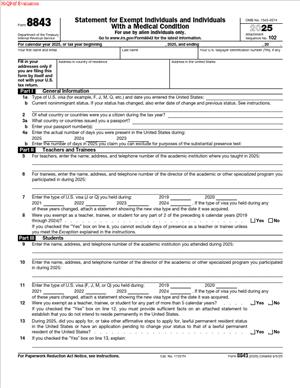
Form 8843 – Statement for Exempt Individuals and Individuals with a Medical Condition
Fill out nowJurisdiction: Country: United States | Province or State: Federal
Form 8843 – Statement for Exempt Individuals and Individuals with a Medical Condition is a federal tax document used by certain non‑U.S. citizens who are present in the United States. It helps explain why days spent in the country should not count toward the “substantial presence test” for U.S. tax residency.
If you are an international student, teacher, trainee, or a person temporarily unable to leave the United States because of a medical condition, this form may apply to you. It is not a tax return. Instead, it is a statement attached to a tax filing or submitted on its own in specific situations.
This document matters because U.S. tax residency rules depend heavily on how many days you are physically present in the country. Without this form, certain days may count toward making you a U.S. resident for tax purposes.
Filing this statement can affect how you are taxed. It may determine whether you are treated as a resident or nonresident for federal income tax purposes in a given year.
The form is administered by the federal Department of the Treasury, Internal Revenue Service. It is used nationwide and applies under federal tax law.
What is Form 8843 – Statement for Exempt Individuals and Individuals with a Medical Condition?
Clear definition
Form 8843 – Statement for Exempt Individuals and Individuals with a Medical Condition is a federal tax statement used to claim that specific days of physical presence in the United States should not be counted toward the substantial presence test.
The substantial presence test is a formula used to decide whether you are considered a U.S. resident for tax purposes. It generally looks at how many days you were physically present in the country over a three-year period.
This form allows certain individuals to explain that they fall into a category of “exempt individuals” or that they were unable to leave the United States due to a medical condition. “Exempt” in this context does not mean exempt from tax. It means exempt from counting days toward residency.
The document is structured to capture your visa type, the number of days you were present, and the reason those days should not be included in the residency calculation.
Who typically uses this form?
This form is commonly used by international students in F, J, M, or Q visa status. It is also used by teachers and trainees temporarily present in the United States under certain exchange visitor programs.
Professional athletes temporarily in the country to compete in charitable sports events may also fall within its scope in limited cases.
In addition, individuals who were physically present in the United States but could not leave because of a medical condition that arose while they were in the country may use this document to explain their situation.
Even individuals who had no U.S.-source income during the year may need to submit this form if they meet the criteria for exempt status. In those cases, it may be filed by itself rather than attached to a full income tax return.
Why might you need this form?
You might need this form to avoid being treated as a U.S. resident for tax purposes when you do not meet the long-term residency criteria. Without it, your days in the United States may be automatically counted.
If you are treated as a resident for tax purposes, you may be subject to U.S. tax on your worldwide income. If you are treated as a nonresident, you are generally taxed only on certain U.S.-source income.
The form creates a written record of your visa category and the time period during which you qualify as an exempt individual. This record can support your tax position if questions arise later.
If you were unable to leave the United States due to a sudden illness or medical issue, the form provides a way to document that those days should not be counted toward the substantial presence test.
Typical real-life scenarios
- You are an international student who arrived in the United States in August for a graduate program. You had part-time campus employment and received a small amount of income. You prepare a federal tax return and attach this form to show that your days in the United States do not count toward residency under the substantial presence test.
- You are a research scholar under an exchange visitor program. This is your second year in the United States. You need to document your visa status and the number of years you have claimed exemption from counting days. You complete this form as part of your annual tax filing.
- You spent several months in the United States as a student but had no income at all during the year. Even though you are not required to file a full income tax return, you still complete and submit this statement to report your exempt status.
- You were visiting the United States and intended to leave before meeting the substantial presence threshold. During your stay, you developed a medical condition that prevented travel for several weeks. You use this document to explain that those additional days were due to a medical condition that arose while you were in the country.
When would you use Form 8843 – Statement for Exempt Individuals and Individuals with a Medical Condition?
You would use this form when you need to formally claim that certain days of presence in the United States should not be included in the substantial presence calculation.
This often arises during annual tax season, when you are preparing a federal income tax return and determining whether you are a resident or nonresident for tax purposes. The form is typically completed at the same time as your income tax filing, if you have one.
If you are an international student, you may use this form each year during the period in which your visa category qualifies you as an exempt individual. The number of years you can claim this status may be limited, depending on your visa type and prior presence in the United States.
Teachers and trainees in exchange programs may use the form during their initial qualifying years. After a certain period, days in the United States may begin to count toward the substantial presence test, even if you remain in a similar visa category.
If you had no income for the year but were present in the United States under a qualifying visa, you may still use this form as a stand-alone submission. In that situation, it serves as your only required federal tax document for that year.
If you experienced a medical condition that prevented you from leaving the country as planned, you would use the form in the year those additional days occurred. It allows you to describe the condition and the period during which you were unable to depart.
Legal characteristics of Form 8843 – Statement for Exempt Individuals and Individuals with a Medical Condition
This form is a federal tax statement made under penalties of perjury. By signing it, you are declaring that the information provided is true, correct, and complete to the best of your knowledge.
Its effectiveness depends on accurate reporting. This includes correctly identifying your visa status, dates of entry and presence, and the number of years you have previously claimed exempt status. Incomplete or inconsistent information may delay processing or lead to follow-up questions.
A common issue arises when individuals misunderstand the meaning of “exempt individual.” In this context, it refers only to exemption from counting days under the substantial presence test. It does not automatically exempt you from filing a tax return or paying tax.
Errors in calculating days present in the United States can create problems. The substantial presence test uses a specific formula that considers days from the current year and prior years. If the underlying day count is incorrect, the conclusion about residency may also be incorrect.
For medical condition claims, the form generally requires that the condition arose while you were in the United States. If the condition existed before arrival, those days may not qualify for exclusion. The explanation must clearly describe the circumstances and time period involved.
This document operates under federal law and applies uniformly across all states. State tax residency rules are separate and may follow different standards. Filing this form does not automatically determine your state tax status.
The form does not change your immigration status. It is used solely for federal income tax residency purposes. It does not extend your visa, authorize employment, or grant any immigration benefit.
Is it legally binding?
Yes, in the sense that it is a signed statement submitted to a federal tax authority under penalties of perjury. By signing, you are legally attesting to the truthfulness of the information provided.
The form itself does not create a contract between you and the government. Instead, it serves as a formal declaration that affects how your tax residency is determined under existing law.
If the information is later found to be incorrect or misleading, there may be consequences under federal tax rules. This is why careful and accurate completion is important.
Its legal effect comes from how it interacts with the substantial presence test. When properly completed and submitted, it can support your position that you are a nonresident for tax purposes for that year.
How to fill out Form 8843 – Statement for Exempt Individuals and Individuals with a Medical Condition
Step 1 – Provide your identifying information
Enter your full name exactly as it appears on your immigration documents. Include your U.S. taxpayer identification number if you have one, such as a Social Security number or individual taxpayer identification number. Provide your current U.S. address and, if required, your foreign address.
Step 2 – Indicate your visa type and status
Identify the visa category under which you were present in the United States during the tax year. This may include student, teacher, trainee, or another qualifying classification. Enter the dates you entered and were present in the country during the year.
Step 3 – Complete the applicable section for your category
The form contains separate parts for different types of exempt individuals. Complete only the section that applies to your situation. For example, students generally complete the student section, while teachers and trainees complete a different part.
Provide the name and address of the academic institution or sponsoring organization connected to your visa status. Include the number of calendar years you have previously claimed exempt status in the United States.
Step 4 – Report prior years of presence if required
Certain sections ask about your presence in earlier years. Carefully review your travel history and count the number of days you were physically present in the United States during each relevant year. Accuracy here is important because prior years may affect your current eligibility for exempt status.
Step 5 – Explain any medical condition, if applicable
If you are claiming that you were unable to leave the United States due to a medical condition, complete the medical condition section. State the date the condition began and the date you were able to leave or intended to leave.
Describe the condition in general terms and confirm that it arose while you were in the United States. Ensure that the period you list matches the days you are excluding from the substantial presence calculation.
Step 6 – Review and sign the form
Read through the entire form before signing. Confirm that all dates, visa details, and prior year information are consistent and complete. Sign and date the statement where indicated to certify that the information is true and correct.
After signing, attach the form to your federal income tax return if you are required to file one. If you are not filing a return, prepare it as a stand-alone submission for the applicable tax year.
Legal terms you might encounter in Form 8843 – Statement for Exempt Individuals and Individuals with a Medical Condition
- Exempt Individual: In this document, an “exempt individual” does not mean exempt from tax. It refers to someone whose days in the United States are not counted for the substantial presence test because of their visa category, such as certain students, teachers, or trainees. You must identify your category correctly because it determines which section you complete and how your days are treated.
- Substantial Presence Test: This is the formula used to decide if you are considered a resident for tax purposes based on the number of days you were physically present in the United States over a specific period. This form supports your position that certain days should not be counted. The information you enter directly affects how this test applies to you.
- Visa Status: Your visa status describes the category under which you entered and stayed in the United States, such as student or exchange visitor. You must report the correct visa type and the dates it was valid during the year. Errors here can lead to incorrect residency classification.
- Medical Condition: For this document, a medical condition refers to a health issue that arose while you were in the United States and prevented you from leaving as planned. You must explain the condition and the time period that affected your ability to depart. The condition must be specific and tied to actual dates.
- Residency Status: This term refers to whether you are treated as a resident or nonresident for federal income tax purposes. The form helps clarify your status by documenting why certain days should not count toward residency. Your residency status determines which tax return you file, if any.
- Closer Connection: Although not the main focus of this document, closer connection refers to stronger personal or economic ties to another country. Your entries about your home address and immigration status may support your broader residency position. Accuracy in these details matters for the overall tax analysis.
- Calendar Year: The reporting period for this document is the calendar year, January 1 through December 31. You must count your days of presence within this exact timeframe. Do not mix fiscal year or academic year dates with calendar year dates.
- Identifying Information: This includes your full legal name, taxpayer identification number if you have one, and current address. The information must match your official records. Inconsistent spelling or number errors can cause processing delays.
- Signature Under Penalties of Perjury: When you sign, you declare that the information is true and complete to the best of your knowledge. This statement has legal significance. You should review every entry before signing.
FAQs
Do I need to file Form 8843 – Statement for Exempt Individuals and Individuals with a Medical Condition if I did not earn any income?
Yes. If you are an exempt individual for the year or you are claiming days excluded because of a medical condition, you generally must file this document even if you had no U.S. income. It records your days of presence and your visa category. The obligation is tied to your status and physical presence, not just income.
Where do I enter the dates I was physically present in the United States?
You will find a section that asks for the number of days you were present during the current year and sometimes prior years. You do not list every single date. Instead, you calculate and enter totals based on your travel records. Make sure the totals match your passport stamps, travel history, and any entry-exit records you have.
What if I do not have a Social Security number or a taxpayer identification number?
There is a space to enter a number if you have one. If you do not, you generally leave that field blank unless instructed otherwise in the form’s instructions. Do not invent or guess a number. Make sure your name and address are clearly printed so your filing can be matched to your records.
Do I need to attach medical records if I am claiming a medical condition?
This document asks you to explain the medical condition and the exact dates it prevented you from leaving. You usually do not attach detailed medical records unless specifically required. However, you should keep documentation in your personal records in case you are asked to support your explanation later.
What address should I use on this form?
Use your current mailing address at the time you file. This is where any correspondence related to this document would be sent. Make sure the address is complete, including apartment numbers or postal codes, and that it matches the address used on any related tax return.
What happens if my name is spelled differently on my passport and on other records?
You should use your legal name as it appears on your official immigration documents. Consistency is critical. If you have used different versions of your name, make sure the name on this document matches your primary identification number, if you have one, to avoid processing issues.
If I am filing a tax return, do I send this document separately?
If you are required to file a federal income tax return for the same year, you generally attach this document to that return. If you are not filing a tax return, you send this document by itself. Follow the mailing instructions for the correct destination and keep proof of mailing.
Will I receive confirmation that this form was accepted?
In most cases, you will not receive a separate confirmation notice just for filing this document. Acceptance is typically reflected in the processing of your overall tax filing, if you submitted one. Keep a complete copy and proof of mailing so you can demonstrate that you filed it on time if questions arise.
Checklist: Before, During, and After Form 8843 – Statement for Exempt Individuals and Individuals with a Medical Condition
Before
- Confirm your visa category for the calendar year.
- Gather passport stamps and travel history for all entries and exits.
- List all days you were physically present in the United States.
- Verify your full legal name as shown on immigration documents.
- Locate your taxpayer identification number, if you have one.
- Review prior years’ filings to check consistency in reporting.
- Confirm whether you also need to file a federal income tax return.
During
- Enter your name and address exactly as they appear on official records.
- Carefully total your days of presence for the correct calendar year.
- Complete only the section that applies to your visa category.
- Provide accurate dates for visa status and changes, if any.
- Clearly explain any medical condition and the dates affected.
- Double-check that all required fields are completed.
- Read the declaration statement before signing.
After
- Make a complete copy of the signed form for your records.
- Attach it to your tax return if you are filing one.
- Confirm the correct mailing address if sending it separately.
- Mail it using a method that provides proof of delivery.
- Store copies of supporting travel and medical documents.
- Mark your calendar with the filing date for future reference.
- Monitor any correspondence related to your tax status.
Common mistakes to avoid with Form 8843 – Statement for Exempt Individuals and Individuals with a Medical Condition
- Mistake: Assuming “exempt individual” means you do not have to file, which happens because the term sounds optional; this can lead to failure to document your exempt days and possible incorrect residency classification, so do not forget that exempt refers to counting days, not filing requirements.
- Mistake: Miscounting days of presence due to missing travel records, which often happens when you rely on memory; this can affect your residency status calculation, so do not forget to verify dates against official entry and exit records.
- Mistake: Completing the wrong section for your visa type because of confusion about status labels; this can cause inconsistent records and follow-up questions, so do not forget to match your exact visa category to the correct part of the form.
- Mistake: Leaving the taxpayer identification number field blank when you actually have one, often due to oversight; this may delay processing, so do not forget to include your correct number if it has been issued to you.
- Mistake: Providing vague explanations for a medical condition, which happens when you do not include specific dates; this weakens your claim to exclude days, so do not forget to clearly state when the condition began and ended.
- Mistake: Forgetting to sign and date the form, which is common when assembling multiple documents; this can result in the form being treated as incomplete, so do not forget your signature under penalties of perjury.
What to do after filling out Form 8843 – Statement for Exempt Individuals and Individuals with a Medical Condition
Once you complete the form, pause before sending it. Review every entry with fresh eyes. Small errors in dates or numbers can create larger problems later.
Start by confirming that your totals for days of presence are correct. Recalculate them using your travel documents. Make sure the calendar year is correct on every line where a year is requested.
- Step 1: Make a full copy of the signed and dated form for your personal records.
- Step 2: If you are filing a federal income tax return, attach the form to that return in the correct order.
- Step 3: If you are not filing a tax return, prepare the form for separate mailing to the appropriate processing address.
- Step 4: Use a mailing method that gives you proof of the date sent and delivery confirmation.
- Step 5: Keep copies of your passport pages, visa documents, and travel history with your copy of the form.
- Step 6: Retain any medical documentation that supports the dates you listed, even if you did not submit it.
- Step 7: Note the filing deadline you met and keep proof that you filed on time.
- Step 8: Watch your mail for any correspondence requesting clarification or additional information.
- Step 9: If you move after filing, update your mailing address with the appropriate authority so you do not miss important notices.
- Step 10: Keep this year’s filing with prior years’ documents to maintain a consistent record of your residency status history.
You should store your copy and supporting documents for several years. Residency status can affect future filings. Having a clear paper trail helps you answer questions quickly and confidently.
If you later discover an error, address it promptly. Review the instructions for correcting previously filed information. Acting early can reduce complications.
Finally, use what you learned this year to prepare for the next. Track your travel days in real time. Keep a simple log. Staying organized makes completing this document much easier in the future.
Disclaimer: This guide is provided for informational purposes only and is not intended as legal advice. You should consult a legal professional.