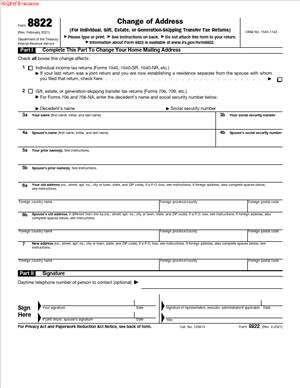
Form 8822- Change of Address (For Individual, Gift, Estate, or Generation-Skipping Transfer Tax Returns)
Fill out nowJurisdiction: Country: United States | Province or State: Federal
Form 8822- Change of Address (For Individual, Gift, Estate, or Generation-Skipping Transfer Tax Returns) is the document you use to notify the federal tax authority that your mailing address has changed. It ensures that tax notices, refund checks, and other official correspondence go to the right place.
If you have recently moved, this form helps keep your tax records current. It is used for individual income tax matters and certain gift, estate, or generation-skipping transfer tax filings. It does not change your address with other government agencies.
You might be completing this form because you do not want to miss an important letter. Tax notices often have deadlines. If they go to your old address, you may not see them in time.
This document is especially important if you are expecting a refund, responding to a tax issue, or handling matters for an estate. A correct address reduces delays and confusion.
What is Form 8822- Change of Address (For Individual, Gift, Estate, or Generation-Skipping Transfer Tax Returns)?
Clear definition
Form 8822- Change of Address (For Individual, Gift, Estate, or Generation-Skipping Transfer Tax Returns) is a written notice that updates your mailing address in federal tax records. It tells the tax authority where to send future correspondence related to your individual, gift, estate, or generation-skipping transfer tax matters.
The form records both your old address and your new address. This allows your account to be matched correctly and updated without affecting other taxpayers with similar names.
It is not a tax return. You are not reporting income or calculating tax. You are simply updating contact information connected to your tax account.
Who typically uses this form?
Most often, individuals use this form after moving to a new home. This includes taxpayers who file annual income tax returns under their own Social Security numbers.
Executors or personal representatives may also use it when managing an estate. If the mailing address connected to an estate tax return changes, this form can be used to update that information.
In some cases, individuals responsible for gift tax or generation-skipping transfer tax filings complete the form to ensure ongoing correspondence reaches them at the correct location.
You do not need to be in business to use this document. It is designed primarily for individuals and estate-related filings, not corporations or partnerships.
Why might you need this form?
You might need this form if you moved after filing a tax return and did not include your new address on a subsequent return. Filing the form creates a direct record of your address change in your tax account.
If you are involved in an audit, payment plan, or other tax review, accurate contact information becomes even more important. Notices about deadlines, requests for documents, or balance statements are sent by mail.
You may also need this form if you expect future communication about a gift or estate tax filing. Estate matters can remain open for some time, and correspondence may continue long after the initial filing.
Another reason is mail delivery reliability. Even if you have mail forwarding in place, forwarded mail may be delayed or stop after a set period. This form updates the address at the source.
Typical real-life scenarios
- You sell your home and move to another state. After moving, you realize you filed your most recent tax return using your old address. To avoid missing refund information or follow-up letters, you complete the form to update your records.
- You are separated or divorced and no longer live at the address used on your last jointly filed return. You want future correspondence related to your own tax matters sent to your new residence. Submitting the form reflects your individual mailing address.
- You are serving as executor of a parent’s estate. The estate’s mailing address was originally your parents’ home, but that property has been sold. You provide a new mailing address so future estate tax notices are directed to you or another appropriate location.
- You filed a gift tax return last year. Since then, you relocated for work. You want to ensure any follow-up questions or confirmations reach you without delay, so you update your address using this document.
When would you use Form 8822- Change of Address (For Individual, Gift, Estate, or Generation-Skipping Transfer Tax Returns)?
You use this form after your mailing address changes, and you want federal tax records updated independently of your next tax return. If you are not planning to file another return soon, this document serves as a direct update.
It is commonly used when a move happens mid-year. For example, you may move in the summer but not file your next income tax return until the following spring. Rather than waiting, you can submit this form to keep records current.
It may also be used when you change only your mailing address but not your physical residence. Some people receive mail at a separate address, such as a trusted family member’s home. If that mailing location changes, the form reflects the update.
Executors and personal representatives may use it when estate administration shifts to a different mailing location. If responsibility for handling estate matters transfers to someone else, an address update can help prevent lost correspondence.
You might also use the form if prior mail was returned as undeliverable. An address correction helps avoid further disruption in communication.
Legal characteristics of Form 8822- Change of Address (For Individual, Gift, Estate, or Generation-Skipping Transfer Tax Returns)
This form functions as an official written notice. Its effectiveness depends on accurately identifying information and a proper signature. When processed, it updates the mailing address linked to the taxpayer’s account.
For the form to be accepted, the identifying details must match existing records. This usually includes your full name and taxpayer identification number. Mismatched numbers, incomplete names, or missing prior address information can delay processing.
A common issue is failing to sign the form. An unsigned submission may not be processed because there is no confirmation that the request came from an authorized person.
Another frequent problem is listing the wrong type of tax return. The form distinguishes between individual income tax matters and certain gift or estate tax matters. Marking the correct category helps ensure the address is updated in the right account.
Processing times may vary. During that period, mail could still be sent to the old address. This does not invalidate your request, but it may create a temporary overlap.
This form does not change your address with other federal or state agencies. It applies only to the specific federal tax records covered by the document. It also does not change your name, filing status, or tax obligations.
Is it legally binding?
Form 8822- Change of Address (For Individual, Gift, Estate, or Generation-Skipping Transfer Tax Returns) is not a contract between you and the government. It does not create new legal duties. Instead, it serves as a formal notification.
When you sign and submit the form, you are declaring that the information provided is accurate to the best of your knowledge. That declaration carries weight because tax documents are signed under penalties of perjury.
If the information is false or intentionally misleading, that could create legal consequences. However, the purpose of the form itself is administrative. It updates contact information rather than establishing rights or transferring property.
For estates, the signature must come from an authorized representative. The legal effect depends on that authority. If someone without proper authority signs, the update may not be processed.
How to fill out Form 8822- Change of Address (For Individual, Gift, Estate, or Generation-Skipping Transfer Tax Returns)
Step 1 – Identify the type of return involved
At the top of the form, indicate whether the address change relates to individual income tax returns or to gift, estate, or generation-skipping transfer tax returns. Select the category that matches the tax matter connected to your account. This ensures the update is applied correctly.
Step 2 – Provide your full name and identification number
Enter your full legal name as it appears on your most recent tax return. Include your taxpayer identification number, such as a Social Security number. If the form relates to a joint return, include the spouse’s name and identification number where requested.
Step 3 – List your old address
Write the complete address currently on file. This typically matches the address used on your last filed return. Including the full prior address helps match your request to the correct account.
Step 4 – Enter your new address
Provide your new mailing address in full. Include apartment or unit numbers if applicable. Double-check spelling and numbers to reduce the risk of misdirected mail.
Step 5 – Indicate the date of the move
Some versions of the form request the date when your new address became effective. Enter the month, day, and year of the move. This helps clarify the timeline of your address change.
Step 6 – Address special situations for joint filers or representatives
If you filed jointly and only one spouse is changing address, indicate this clearly if the form allows. If you are signing as an executor or other representative, provide your title or role as requested.
Step 7 – Sign and date the form
Sign your name in the signature section and enter the date of signing. If the form relates to a joint return and both parties are changing address, both may need to sign. Review all entries before signing to confirm accuracy.
Step 8 – Prepare the form for submission
After completing and signing the document, make a copy for your records. Ensure all pages are included and legible. The form is then ready for mailing to the appropriate processing location indicated in the instructions that accompany it.
Legal terms you might encounter in Form 8822- Change of Address (For Individual, Gift, Estate, or Generation-Skipping Transfer Tax Returns)
- Taxpayer Identification Number (TIN): This is your Social Security number or Individual Taxpayer Identification Number. The IRS uses it to match your new address to your tax account. If the number does not match IRS records, your address update may not be processed correctly.
- Joint Return: A joint return is a tax return filed together by married spouses. If you previously filed jointly, each spouse may need to sign this document, depending on who is changing addresses. The IRS keeps separate address records for each spouse’s tax account.
- Estate: An estate is the legal entity created when a person dies and their assets are administered. If you are updating the address for an estate, you must identify the estate’s name and employer identification number. The address change ensures future estate tax correspondence goes to the correct representative.
- Gift Tax Return: This refers to a tax return filed to report certain gifts made during your lifetime. If you move after filing a gift tax return, updating your address helps ensure you receive any IRS notices related to that filing.
- Generation-Skipping Transfer (GST) Tax: This is a tax on transfers made to someone who is more than one generation below you, such as a grandchild. If you have filed returns involving GST tax, this document ensures the IRS sends related correspondence to your current address.
- Authorized Representative: This is a person you legally authorize to act on your behalf before the IRS. If a representative is handling your tax matters, you may need to coordinate address updates so that records are consistent. This document does not automatically change a representative’s address on file.
- Effective Date: This is the date your new address becomes valid for IRS records. You provide the date you moved. The IRS uses this to determine where to send correspondence for specific tax periods.
- Prior Address: This is the last address the IRS has on record for you. Listing it accurately helps the agency locate your existing account. If the old address does not match IRS records, processing may be delayed.
- Fiduciary: A fiduciary is someone who manages the financial affairs of another person or an estate. If you are acting as a fiduciary, you may file this document to update the address linked to the account you oversee. You must clearly indicate your role and authority.
FAQs
Do I need to file Form 8822- Change of Address (For Individual, Gift, Estate, or Generation-Skipping Transfer Tax Returns) if I already changed my address on my last tax return?
If you have already filed a tax return showing your new address and the IRS has processed it, you may not need this form. The key issue is whether the IRS has updated your address in its system. If you are unsure whether your most recent return has been processed, submitting this document can help avoid missed notices. Check that the name and identification number on this form match exactly what appears on your last filed return.
Can my spouse and I use one form if we are moving to the same new address?
You can generally use one document if both of you are changing your address to the same location and you previously filed jointly. Both spouses should review the information carefully. If only one spouse is changing addresses, that person may need to file separately. Make sure each Social Security number is entered correctly so the IRS updates both accounts.
What address should I list if I receive mail at a P.O. box but live somewhere else?
You should list the address where you want the IRS to send mail. If you use a P.O. box for reliable delivery, enter that as your new address. Be consistent with how you list the street, apartment number, or box number to avoid confusion. The IRS will use the address exactly as you provide it on this form.
How do I indicate the date my address change becomes effective?
You will enter the date you moved to your new address. This helps the IRS determine where to send notices issued after that date. Use the actual move-in date, not the date you are filling out the paperwork. Make sure the date is complete and clearly written.
Do I need to attach proof of my new address?
This document does not typically require you to attach a lease, utility bill, or other proof. You are certifying that the information is accurate when you sign it. However, keep your own records in case there is ever a question about when you moved. The IRS relies on the information you provide.
What if I am changing the address for an estate or someone I represent?
You must clearly identify the estate or person and provide the correct identification number. Indicate your role, such as executor or fiduciary, and sign in that capacity. Ensure that the name listed matches prior filings exactly. The IRS will update the address connected to that specific account.
How long does it take for the IRS to process this document?
Processing times vary. The IRS must receive and enter the information into its system before it becomes effective. During that period, some correspondence may still go to your old address. It is wise to monitor both addresses if possible until you are confident the change has been recorded.
Will this form update my address for all federal agencies?
No. This document updates your address with the Internal Revenue Service only. Other federal or state agencies maintain separate records. You must contact each agency directly to update your address with them.
Checklist: Before, During, and After Form 8822- Change of Address (For Individual, Gift, Estate, or Generation-Skipping Transfer Tax Returns)
Before
- Confirm the exact name and identification number used on your most recent tax return.
- Locate your prior address exactly as it appeared on IRS filings.
- Determine whether the change applies to you, your spouse, an estate, or another account.
- Verify your correct new mailing address, including apartment or unit numbers.
- Confirm your actual move date.
- Review whether you previously filed jointly and whether both spouses need to sign.
- Gather any prior IRS correspondence showing your current address on record.
During
- Check the box that matches the type of return connected to your address change.
- Print your name and identification number clearly and legibly.
- Enter your old address exactly as previously filed.
- Enter your new address completely, including ZIP code.
- Provide the effective date of your move.
- Indicate your fiduciary capacity if filing for an estate or another person.
- Review every line for spelling errors or number transpositions.
- Sign and date the form in the correct place.
After
- Make a complete copy of the signed document for your records.
- Mail the form to the correct IRS address listed in the instructions.
- Note the date you mailed it and keep proof of mailing.
- Monitor both your old and new addresses for IRS mail.
- Check future IRS correspondence to confirm the new address appears correctly.
- Store the copy with your tax records for the year of the move.
- Update your address separately with any state tax agency if needed.
Common mistakes to avoid with Form 8822- Change of Address (For Individual, Gift, Estate, or Generation-Skipping Transfer Tax Returns)
- Mistake: Entering the wrong Social Security number because you are working from memory, which can cause the IRS to update the wrong account or reject the change; do not forget to double-check the number against an official document.
- Mistake: Listing a new address without apartment or unit information, often due to oversight, which may result in undelivered mail; do not forget to include every part of the mailing address.
- Mistake: Failing to have both spouses sign when required, usually because one assumes a single signature is enough, which can delay processing; do not forget to review signature requirements for joint filers.
- Mistake: Using a nickname or name variation that does not match IRS records, which can create account mismatches; do not forget to use the exact legal name from your tax return.
- Mistake: Forgetting to indicate the move date, which is often skipped when rushing, may create confusion about when the change should apply; do not forget to enter the full and accurate date.
- Mistake: Assuming the change applies to all tax types automatically without checking boxes carefully, which may leave some accounts unchanged; do not forget to mark the correct return categories.
- Mistake: Mailing the form to the wrong address because you relied on outdated instructions, which can delay processing; do not forget to verify the correct mailing location before sending.
- Mistake: Not keeping a copy for your records, often due to treating it as routine paperwork, which leaves you without proof of submission; do not forget to retain a signed copy.
What to do after filling out Form 8822- Change of Address (For Individual, Gift, Estate, or Generation-Skipping Transfer Tax Returns)
Once you complete and sign the document, your job is not quite finished. You need to make sure it reaches the IRS and that your records stay organized.
- Step 1: Review the entire form one last time for accuracy, focusing on names, identification numbers, and both addresses.
- Step 2: Make a clear copy of the signed form for your personal tax file.
- Step 3: Check the official instructions to confirm the correct mailing address based on your location.
- Step 4: Mail the form using a method that provides proof of mailing, so you can show when it was sent.
- Step 5: Record the mailing date in your calendar or tax file.
- Step 6: Monitor your mail at both the old and new addresses for several weeks.
- Step 7: Review any new IRS correspondence to confirm that your updated address appears correctly.
- Step 8: Keep a copy of the submitted form with your tax records for the year you moved.
- Step 9: Update your address separately with state tax agencies or other government offices, since they do not receive this change automatically.
Stay organized. Address changes seem simple, but they directly affect where sensitive tax information is sent. Taking a few careful follow-up steps reduces the risk of missed notices, penalties, or delays in refunds.
Disclaimer: This guide is provided for informational purposes only and is not intended as legal advice. You should consult a legal professional.