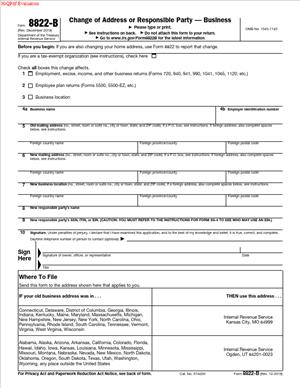
Form 8822-B – Change of Address or Responsible Party — Business
Fill out nowJurisdiction: Country: United States | Province or State: Federal
If your business has moved or changed who is in charge, the IRS needs to know. Form 8822-B – Change of Address or Responsible Party — Business is the document used to report those updates. It keeps your business records accurate at the federal level.
Form 8822-B – Change of Address or Responsible Party — Business is not a tax return. It does not calculate taxes or request refunds. It simply updates key identification details linked to your Employer Identification Number (EIN).
This form matters because the IRS uses your address and responsible party information to send notices, process filings, and confirm identity. If the information on file is wrong, you may miss important correspondence.
You might be filling this out after moving offices, changing owners, or appointing a new person to control business finances. Understanding what the form does will help you complete it accurately and avoid delays.
What is Form 8822-B – Change of Address or Responsible Party — Business?
Clear definition
Form 8822-B – Change of Address or Responsible Party — Business is a federal IRS form used to report a change in a business mailing address, business location, or responsible party. It updates the IRS record connected to your business’s EIN.
The “responsible party” is generally the individual who controls, manages, or directs the entity and its funds. This person may be an owner, officer, partner, or managing member, depending on the type of business.
The form creates an official update in IRS records. It links the new information to the same EIN already assigned to your business.
Who typically uses this form?
Businesses and other entities with an EIN commonly use this form. This includes corporations, partnerships, limited liability companies, sole proprietorships with employees, nonprofits, and certain trusts or estates.
You may complete the form if you are the current responsible party or an authorized representative. In many cases, the person signing is an officer, owner, or partner with authority to act for the entity.
Even small or single-owner businesses may need to file this document if their address changes or if control of the business shifts to another individual.
Why might you need this form?
You may need this form to ensure the IRS sends notices to the correct address. If your business relocates and you do not update your address, tax documents and letters may go to your old location.
You may also need it when there is a change in the person who has ultimate control over the business. For example, if a new owner acquires the company, the IRS record should reflect that change.
Keeping this information current helps prevent identity issues. If IRS records do not match the person interacting with the agency, it can slow down processing or create verification problems.
Accurate information also supports smooth communication. When the IRS sends balance notices, filing reminders, or other correspondence, you want them delivered to the correct place and person.
Typical real-life scenarios
- A corporation moves from one office building to another in the same city. The company continues operating under the same EIN, but its mailing address changes. Form 8822-B – Change of Address or Responsible Party — Business is used to report that update.
- A limited liability company is sold to a new managing member. The EIN remains the same, but the individual who controls the company’s finances changes. The business files the form to name the new responsible party.
- A nonprofit organization appoints a new executive director who now has authority over funds and decision-making. The organization updates the responsible party information with the IRS to reflect this leadership change.
- A partnership relocates its principal place of business to another state. Even though state registrations are handled separately, the IRS must still be notified of the new address using this form.
- A sole proprietor with employees moves their home office to a new residence. Because the business uses an EIN and the mailing address changes, the proprietor files the form to update federal records.
When would you use Form 8822-B – Change of Address or Responsible Party — Business?
You use this form when the IRS record for your EIN no longer matches your current business information. This typically happens after a physical move, a change in mailing address, or a shift in control.
If your business changes only its trade name but keeps the same legal name and address, this form may not be necessary for that specific update. It is focused on addressing and responsible party changes.
When ownership transfers but the entity itself continues to exist, this filing is commonly used to identify the new individual who controls or manages the entity. This applies whether the business is structured as a corporation, partnership, or limited liability company.
If you close one office and open another, and the primary business address changes, this form may be part of your administrative update process. The IRS keeps one main address on file for correspondence.
You might also use it if the responsible party’s personal name changes due to marriage or another legal name change, and that person continues in the same controlling role. The IRS records need to match the current legal identification.
In some situations, you may have recently obtained an EIN but later realize that the address or the responsible party information provided was incorrect. This form can be used to correct that record so future filings align with accurate details.
Legal characteristics of Form 8822-B – Change of Address or Responsible Party — Business
This form functions as an official notification to a federal agency. Its effectiveness depends on accurate and complete information. The IRS updates its records based on what you provide.
For the filing to be accepted, it generally must include the correct legal name of the entity, the EIN, the old information on file, and the new updated information. Missing or inconsistent details can delay processing.
The signature is important. An authorized individual must sign the form. If someone without proper authority signs it, the IRS may not accept the update or may request additional verification.
Timing can also affect how smoothly the update is processed. If you wait a long time after a change occurs, you may receive correspondence at the old address before the new information is recorded.
This form does not change your business structure. It does not create a new EIN. It does not transfer assets or ownership by itself. It only updates IRS records tied to an existing EIN.
It also does not automatically update records with state tax agencies or other federal agencies. Separate filings may be required for those entities.
Although this is a federal form, certain details about responsible parties may differ slightly depending on entity type. For example, the responsible party for a corporation is often a principal officer, while for a partnership it may be a general partner. The form itself does not define corporate governance rules; it records the information you provide.
Is it legally binding?
Form 8822-B – Change of Address or Responsible Party — Business is legally significant because it updates official IRS records. When you sign and submit it, you are certifying that the information provided is true and correct to the best of your knowledge.
The form does not create contractual obligations between private parties. It does not function as an agreement between owners or partners. Instead, it serves as a formal declaration to the government.
Its legal effect is administrative. Once processed, the IRS relies on the updated address and responsible party information for communication and identification purposes. Providing false or misleading information can lead to penalties or further review.
The signature under penalties of perjury gives the document its formal weight. That certification is what makes the submission legally meaningful in the federal system.
How to fill out Form 8822-B – Change of Address or Responsible Party — Business
Step 1 – Identify the type of change
Begin by indicating whether you are reporting a change of address, a change of responsible party, or both. Read each option carefully and mark the section that matches your situation. This helps the IRS route and process your update correctly.
Step 2 – Enter the current business information
Provide the full legal name of the business exactly as it appears on IRS records. Include the Employer Identification Number. If the business uses a trade name or doing-business-as name, include it in the space provided. Accuracy here is critical because the EIN links all records together.
Step 3 – Provide the old address or old responsible party information
Enter the previous address or the name of the former responsible party as it currently appears in IRS records. This allows the IRS to match your update with the correct account. If the prior information is incomplete or inconsistent, processing may take longer.
Step 4 – Enter the new address information
If you are changing the address, write the new mailing address clearly. Include street address, city, state, and ZIP code. Ensure it is an address where the business can reliably receive official mail. This becomes the primary address for IRS correspondence once updated.
Step 5 – Enter the new responsible party details
If you are reporting a change in the responsible party, provide the full legal name of the new individual. Include identifying information requested on the form, such as a taxpayer identification number. The person listed should be the individual who ultimately controls, manages, or directs the entity and its funds.
Step 6 – Provide contact information if requested
Some versions of the form request a contact phone number. Provide a number where the IRS can reach the business or authorized individual if clarification is needed. This can reduce delays if questions arise during processing.
Step 7 – Review the entire form for accuracy
Before signing, read through every entry. Confirm that the legal name matches IRS records and that the EIN is correct. Check spelling, numbers, and addresses carefully. Small errors can lead to mismatched records.
Step 8 – Sign and date the form
An authorized person must sign and date the form. This is often an owner, officer, partner, trustee, or managing member. By signing, you certify that the information is accurate. Include your title or role within the business as requested.
Step 9 – Submit the form to the appropriate address
Mail the completed form to the IRS address listed in the form’s official instructions. Use the correct mailing address based on your business location if different addresses are provided. Keep a copy of the signed form for your records in case you need to confirm the update later.
Legal terms you might encounter in Form 8822-B – Change of Address or Responsible Party — Business
- Employer Identification Number (EIN): This is the unique nine-digit number assigned to your business by the Internal Revenue Service. On this form, the EIN is the primary way the agency identifies your business account. If you enter the wrong EIN, your change may be applied to the wrong entity or rejected.
- Responsible Party: This is the individual who ultimately owns or controls the business entity, or who exercises effective control over it. The form asks for the name and identifying number of the responsible party. This is not just a manager in title; it must be the person with real authority over financial and operational decisions.
- Social Security Number (SSN): If the responsible party is an individual, you must provide their SSN. This number links the responsible party to the business’s EIN in the IRS system. Accuracy matters because a mismatch can delay processing.
- Individual Taxpayer Identification Number (ITIN): If the responsible party does not have an SSN, an ITIN may be used instead. This ensures the IRS can properly identify the person associated with the business. You must enter the correct number type and digits.
- Business Address: This is the mailing address where the IRS sends official correspondence. The form distinguishes between your old address and your new address. You must clearly indicate which one is being changed.
- Location Address: This refers to the physical location of your business, if different from the mailing address. Some businesses operate in one place but receive mail elsewhere. The form may ask you to clarify both.
- Effective Date: This is the date the address or the responsible party change took effect. You must enter the actual date of the change, not the date you are filing. The IRS uses this to update your records accurately.
- Entity Type: This describes your business structure, such as corporation, partnership, or limited liability company. The IRS records your change under your entity classification. Make sure it matches what is on file.
- Authorized Signer: This is the person who signs the form. The signer must have authority to act for the business, such as an owner, corporate officer, or partner. An unauthorized signature can result in rejection.
- Third-Party Designee: Some forms allow you to name someone the IRS can contact about the filing. If included, this section lets you authorize another person to discuss the change. You must clearly provide their name and contact details if you choose this option.
FAQs
Do I need to file this form if my business moves, but the EIN stays the same?
Yes. Your EIN does not change just because your address changes. If your mailing address or location address changes, you use this document to update the IRS records connected to that EIN. Make sure you enter both the old address and the new address exactly as they appear in your records so the update is applied correctly.
How do I know who qualifies as the responsible party?
You look at who has ultimate control over the entity. This is the person who owns or controls the business or has effective authority over major decisions. It is not simply the person who handles day-to-day tasks. When completing Form 8822-B – Change of Address or Responsible Party — Business, you must list the individual’s full legal name and identifying number, and confirm that they truly meet the definition.
What effective date should I enter for the change?
Enter the actual date the change happened. For an address change, use the date you began operating or receiving mail at the new address. For a responsible party change, use the date control or ownership shifted. Do not guess. Check your internal records so the date matches your business documents.
Can I use this form to change my business name?
No. This document is for updating your address or the responsible party information. If your legal name has changed, that is handled through a different process depending on your entity type. You should still complete this form if your address or the responsible party has also changed, but it does not, by itself, update the legal name on file.
Who is allowed to sign this document?
The signer must have authority to act on behalf of the business. That usually means an owner, corporate officer, partner, or managing member. Before signing Form 8822-B – Change of Address or Responsible Party — Business, confirm that the person signing has formal authority under your organizational documents. An unauthorized signature can delay processing.
Do I need to attach supporting documents when I file?
Generally, you do not attach proof of the address change or ownership change. The IRS relies on the information you provide. However, you should have internal documents, such as meeting minutes or transfer agreements, in case questions arise. Keep those in your records, even if you do not submit them with this form.
How long does it take for the IRS to update my records?
Processing times vary. After mailing the form, allow several weeks for the update to appear in your account. You will not always receive a separate confirmation letter. Monitor your future IRS correspondence to confirm it is sent to the new address or reflects the updated responsible party information.
What happens if I do not file Form 8822-B – Change of Address or Responsible Party — Business after a change?
If you do not update your information, IRS notices may go to the wrong address. That can cause missed deadlines, penalties, or unresolved tax issues. If the responsible party is outdated, it can also create confusion about who is authorized to act for the business. Filing promptly keeps your records accurate and reduces risk.
Checklist: Before, During, and After Form 8822-B – Change of Address or Responsible Party — Business
Before
- Confirm your business’s exact legal name as registered with the IRS.
- Locate your correct EIN from prior tax filings or IRS correspondence.
- Verify the old address exactly as it appears in IRS records.
- Confirm the full legal name and identifying number of the responsible party.
- Determine the accurate effective date of the change.
- Review your organizational documents to confirm signer authority.
- Check whether both mailing and location addresses need updating.
During
- Clearly mark whether you are changing the address, the responsible party, or both.
- Enter the EIN carefully and double-check all digits.
- Write the old address exactly as previously reported.
- Provide the complete new address, including suite or unit numbers.
- Enter the responsible party’s full legal name without abbreviations.
- Provide the correct SSN or ITIN for the responsible party.
- Insert the correct effective date of the change.
- Review every field for legibility and completeness before signing.
After
- Make a complete copy of the signed form for your records.
- Mail the form to the correct IRS address listed in the instructions.
- Note the mailing date in your compliance calendar.
- Monitor incoming mail to confirm it reaches the new address.
- Inform your accountant or tax preparer that the update was filed.
- Update your internal compliance checklist to reflect the change.
- Keep related documents, such as ownership transfer records, with your tax files.
Common mistakes to avoid with Form 8822-B – Change of Address or Responsible Party — Business
- Mistake: Entering the wrong EIN because you rely on memory instead of checking official records, which can cause the IRS to reject or misapply the change, so do not forget to verify the EIN directly from prior filings.
- Mistake: Listing a manager as the responsible party when they do not have ultimate control, which happens due to confusion about titles and can lead to inaccurate IRS records, so do not forget to confirm who truly owns or controls the entity.
- Mistake: Using a nickname or abbreviated name for the responsible party, which often occurs out of habit and may cause identification mismatches, so do not forget to use the full legal name exactly as it appears on government identification.
- Mistake: Providing the date you completed the form instead of the actual effective date of the change, which can create inconsistencies in IRS records, so do not forget to check your internal documents for the correct date.
- Mistake: Forgetting to sign the form or having someone without authority sign it, which happens when forms are prepared quickly and can result in rejection, so do not forget to confirm signer authority before mailing.
- Mistake: Failing to keep a copy of the submitted form, which often happens during routine administrative updates and leaves you without proof of filing, so do not forget to store a signed copy in your permanent records.
What to do after filling out Form 8822-B – Change of Address or Responsible Party — Business
Once you complete the form, slow down. The steps you take next matter just as much as the information you entered.
- Step 1: Review the entire document one more time for accuracy. Confirm names, numbers, and the effective date.
- Step 2: Make at least one clear copy of the signed form for your records. Digital and paper copies are both useful.
- Step 3: Prepare the envelope using the correct mailing address listed in the official instructions for your location.
- Step 4: Mail the form using a method that provides proof of mailing if you want confirmation that it was sent.
- Step 5: Record the date you mailed the form in your compliance or tax calendar.
- Step 6: Monitor your business mail over the next several weeks to ensure correspondence is arriving at the new address.
- Step 7: Check future IRS notices to confirm the responsible party or address information reflects the update.
- Step 8: Inform your internal team, bookkeeper, or tax professional that the change has been reported.
- Step 9: Update your internal corporate records to match what you reported, including operating agreements or corporate minutes if applicable.
- Step 10: Store the copy of the filed form with your annual tax documents for that year.
Taking these steps helps you create a clear paper trail. If questions arise later, you will be able to show when and how you notified the IRS of the change.
Disclaimer: This guide is provided for informational purposes only and is not intended as legal advice. You should consult a legal professional.