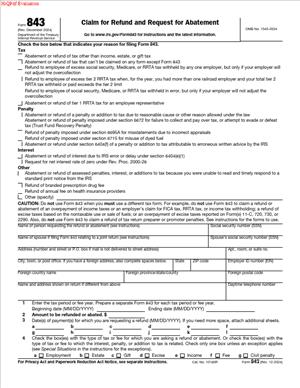
Form 843 – Claim for Refund and Request for Abatement
Fill out nowJurisdiction: Country: United States | Province or State: Federal
Form 843 – Claim for Refund and Request for Abatement is a federal tax form used to ask the Internal Revenue Service to return certain payments or remove specific penalties and interest. You use it when you believe you paid too much or were charged something in error.
This form is not for correcting a simple math mistake on a tax return. It is designed for specific types of claims that cannot be handled through an amended income tax return. It gives you a structured way to explain what happened and why you believe a correction is justified.
If you are preparing to complete Form 843 – Claim for Refund and Request for Abatement, you likely already received a notice or made a payment that does not seem right. The form allows you to formally request a refund or an abatement, which means a reduction or removal of a penalty or interest.
Filing this form starts a review process. The agency evaluates your explanation and supporting documents before making a decision. Clear and accurate completion is important because your written explanation is the main basis for review.
What is Form 843 – Claim for Refund and Request for Abatement?
Clear definition
Form 843 – Claim for Refund and Request for Abatement is a written request to the federal tax authority asking for money back or for certain charges to be removed. It covers specific taxes, penalties, interest, and fees that are not handled through other standard tax forms.
The form serves two main purposes. First, it can request a refund of overpaid tax or other eligible amounts. Second, it can ask for an abatement, which is the cancellation or reduction of assessed penalties or interest.
It is a standalone filing. You complete it separately from your regular tax return, and it must clearly identify the tax period, the type of tax or penalty involved, and the exact amount in question.
Who typically uses this form?
Individuals use this form when they believe they overpaid certain taxes or were wrongly assessed penalties. This may include self-employed taxpayers, employees, retirees, or anyone who received a notice about penalties or interest.
Businesses also use this form. Employers may file it to request refunds of employment taxes or to seek relief from payroll-related penalties. Small business owners often use it when correcting payroll reporting issues or disputing penalty assessments.
Executors, trustees, and other fiduciaries may use it on behalf of estates or trusts. In those cases, the person filing must clearly identify their authority to act for the taxpayer.
Tax professionals often prepare this form for clients, but it is also designed for self-represented individuals who are handling their own tax matters.
Why might you need this form?
You might need this form if you paid a penalty that you believe should not have been assessed. For example, you may have filed late due to circumstances beyond your control and want to request penalty relief.
You may also use it if you paid more tax than required for a specific category not covered by an amended income tax return. In some cases, payments were applied incorrectly or made in error.
Another reason is interest abatement. If interest accrued because of an error or delay that was not your fault, you can explain the situation and request that the interest be reduced or removed.
The form gives you space to explain your reasoning in detail. That explanation is central to the review process.
Typical real-life scenarios
- You filed payroll tax returns for your small business and later discovered that you accidentally paid the same liability twice. The payments were processed, but the extra amount was not automatically refunded. In this case, you may use the form to request a refund of the duplicate payment.
- You received a notice assessing a failure-to-file or failure-to-pay penalty. You believe you had reasonable cause because of a serious illness, natural disaster, or other significant disruption. You may use the form to request abatement of that penalty and related interest.
- You made a payment for a specific excise or employment tax under the wrong identification number or for the wrong period. As a result, your account shows a balance due, even though you already paid. The form can be used to request a correction and a refund if applicable.
- You were assessed interest that resulted from a delay in processing or a correction that took place long after you filed accurately and on time. If you believe the interest arose from circumstances outside your control, you may request an abatement and explain the timeline in detail.
When would you use Form 843 – Claim for Refund and Request for Abatement?
You would use this form when the issue cannot be resolved by filing an amended income tax return. For example, some employment tax issues, certain excise taxes, and specific penalty disputes require a separate filing.
It is commonly used after you receive a notice showing penalties or interest that you disagree with. Instead of ignoring the notice or sending an informal letter, the form provides a structured and recognized way to respond.
Employers often use it after reconciling payroll records and finding overpayments. Individuals may use it when a payment was processed but later determined to be unnecessary or misapplied.
Timing also matters. Refund and abatement requests are generally subject to filing deadlines based on when the tax was paid or assessed. If you are considering filing, you need to identify the relevant tax period and payment dates before completing the document.
The form is typically filed after payment has been made or after a penalty has been formally assessed. It is not a way to delay payment in advance of an assessment. Instead, it addresses amounts already charged or collected.
Legal characteristics of Form 843 – Claim for Refund and Request for Abatement
This form is an official written claim. To be effective, it must clearly state the type of tax or penalty, the tax period involved, the amount in dispute, and the factual and legal grounds for the request.
A vague explanation often leads to delays or denial. If you simply state that the charge is “incorrect” without explaining why, the reviewing agency may not have enough information to act in your favor.
Supporting documentation plays an important role. Payment records, account transcripts, correspondence, and proof of circumstances such as medical records or disaster reports may strengthen your claim. The form itself provides limited space, so attachments are commonly used to give a full explanation.
Common issues that cause rejection include missing signatures, incorrect tax periods, mismatched identification numbers, and failure to state the exact amount claimed. Incomplete forms may be returned without review.
Federal rules govern this form. Procedures and processing times can vary depending on the type of tax involved, but the authority to grant refunds or abatements comes from federal law and regulations.
It is important to understand what the form does not do. It does not automatically stop collection activity. It does not replace a formal appeal in every situation. It is a claim for review, not a guarantee of relief.
Is it legally binding?
When you sign this form, you are declaring under penalty of perjury that the information is true and complete to the best of your knowledge. That declaration carries legal weight.
However, the form itself is not a contract between you and the government. It is a formal request. The reviewing authority evaluates the claim and then issues a determination.
If the claim is approved, the decision results in an adjustment to your account, such as a refund or removal of penalties. If it is denied, you may receive a written explanation outlining the reason.
Your signature confirms that you stand behind the facts presented. False statements or intentional misrepresentations can have serious consequences. Accuracy and clarity are essential.
How to fill out Form 843 – Claim for Refund and Request for Abatement
Step 1 – Enter your identifying information
At the top of the form, provide your full legal name and current address. If you are filing jointly for a tax matter that involves two individuals, include both names as required. Enter your taxpayer identification number, such as a Social Security number or employer identification number, exactly as it appears on prior filings. Accuracy here ensures the claim is matched to the correct account.
Step 2 – Identify the type of tax or fee
Indicate the specific type of tax, penalty, or fee involved. This may include employment tax, certain excise taxes, or assessed penalties and interest. Be precise. If the issue involves a penalty related to a specific tax return, clearly name that return and category.
Step 3 – State the tax period
Enter the exact tax period for which you are requesting a refund or abatement. This may be a calendar year, a quarter, or another defined period. Use the same format that appears on the original return or notice. An incorrect period can delay processing or result in misapplication of your claim.
Step 4 – Enter the amount to be refunded or abated
Clearly state the exact dollar amount you are requesting. Do not estimate. If you are seeking both a refund and an abatement, describe the breakdown in your explanation and ensure the numbers are consistent with your attachments. The amount you enter guides the scope of the review.
Step 5 – Explain your claim in detail
Use the explanation section to describe why you believe the refund or abatement is warranted. Provide a clear timeline of events. Identify relevant notices, payment dates, and circumstances that support your position. If space is limited, attach additional pages and label them clearly. Make sure your explanation connects directly to the amount claimed.
Step 6 – Attach supporting documentation
Include copies of documents that support your statements. This may include payment confirmations, account transcripts, prior correspondence, or records showing reasonable cause for penalty relief. Do not send original documents unless specifically required. Organize attachments in a logical order that matches your explanation.
Step 7 – Sign and date the form
Review the entire form before signing. Confirm that names, identification numbers, tax periods, and amounts are correct. Sign and date the form where indicated. If you are signing on behalf of a business, estate, or other entity, include your title or role to show your authority to act.
Legal terms you might encounter in Form 843 – Claim for Refund and Request for Abatement
- Abatement: An abatement is a reduction or removal of a tax, penalty, or interest that has already been assessed. On this form, you use the abatement request when you believe the IRS should cancel or reduce an amount charged to your account. You must clearly state what should be removed and why.
- Assessment: An assessment is the official recording of a tax debt by the IRS. It is the formal entry that creates the amount you owe. When you request relief, you are challenging all or part of that recorded amount.
- Claim for Refund: This is your formal request to get money back that you believe you overpaid. It applies to certain taxes, penalties, or fees. The form records the exact dollar amount you want returned.
- Reasonable Cause: Reasonable cause is a legally recognized explanation for failing to meet a tax obligation, such as filing or paying on time. You must describe specific facts that show you acted responsibly under the circumstances. Vague statements are not enough.
- Penalty: A penalty is an additional charge imposed for failing to comply with tax rules, such as late filing or late payment. In this document, you must identify the specific penalty and the tax period it relates to. You can request that it be reduced or removed.
- Interest: Interest accrues on unpaid tax and some penalties over time. You may request interest abatement in limited situations, often tied to errors or delays not caused by you. You need to explain why the interest should not have accumulated.
- Tax Period: The tax period is the specific year or quarter connected to the tax or penalty. You must enter this accurately so the IRS can match your request to the correct account record. An incorrect period can delay processing.
- Supporting Documentation: These are the records that back up your explanation. Examples include account transcripts, payment confirmations, medical records, or correspondence. You should attach copies, not originals.
- Statute of Limitations: This is the time limit for filing a refund claim. If you file too late, your claim may be denied even if you are correct. You must ensure your request is submitted within the allowed timeframe.
FAQs
How do I know if I should use Form 843 – Claim for Refund and Request for Abatement instead of another IRS form?
You use this form when you are asking for a refund or reduction of certain assessed taxes, penalties, or interest that are not handled through an amended return. Check the notice you received and confirm what type of charge is listed. If the issue relates to a specific penalty or assessed amount rather than correcting income or deductions, this document is typically the right vehicle.
What exact amount should I enter as the refund or abatement request?
You must enter the precise dollar amount you believe should be refunded or removed. Review your IRS notice or account transcript and identify the specific charge. Do not estimate. If you are disputing multiple charges, total only the amounts you are formally challenging.
What should I include in the explanation section to make my claim clear?
Be specific about dates, events, and actions you took. Identify the tax period, the type of penalty or tax, and why it should not apply. Refer directly to the attached documents and label them clearly. Your explanation should connect the facts to the relief you are requesting.
Do I need to attach proof when I submit this form?
Yes. You should attach copies of any documents that support your position, such as proof of payment, correspondence, or records showing reasonable cause. If you refer to a notice number, include a copy of that notice. Missing attachments can slow review or lead to denial.
Who must sign the form before it is submitted?
You must sign if you are the taxpayer requesting the refund or abatement. If a business is filing, an authorized individual such as an officer or partner must sign. If someone is signing on your behalf, ensure their authority is properly documented and consistent with IRS records.
Where do I send this document after completing it?
The mailing address depends on the type of tax and your location. Review the most recent instructions that apply to this document and confirm the correct submission address. Sending it to the wrong location can delay processing.
How long does it take for the IRS to respond after I file?
Processing times vary depending on the complexity of your request and the current workload. After submission, the IRS will review your explanation and attachments. Keep a copy of everything so you can respond quickly if additional information is requested.
What happens if my request is denied?
If your request is denied, you will receive written notice explaining the decision. Review the explanation carefully and compare it to the facts and documents you submitted. You may have options to provide additional information or pursue further review, depending on the situation.
Checklist: Before, During, and After Form 843 – Claim for Refund and Request for Abatement
Before
- Review the IRS notice or account transcript to confirm the exact charge and tax period.
- Verify that your issue involves a penalty, interest, or specific tax eligible for this request.
- Confirm that you are within the allowed time limit to file a claim.
- Gather supporting documents such as payment records, correspondence, or proof of reasonable cause.
- Calculate the exact amount you want refunded or abated.
- Confirm your name, address, and taxpayer identification number match IRS records.
- Determine who has the authority to sign if filing on behalf of a business or another person.
During
- Enter your identifying information exactly as it appears on prior tax filings.
- Clearly identify the type of tax, penalty, or fee involved.
- State the correct tax period in the required format.
- Write the exact dollar amount of your claim without rounding.
- Provide a detailed explanation with dates and facts.
- Reference and label each attachment in your explanation.
- Sign and date the form in the correct section.
- Double-check all entries for accuracy and completeness.
After
- Make a complete copy of the signed form and all attachments.
- Mail the form to the correct address for your situation.
- Note the mailing date and keep proof of submission.
- Monitor your mail for acknowledgment or follow-up requests.
- Respond promptly if the IRS asks for additional documentation.
- Keep all related records organized with your tax files.
- Track any refund issued and compare it to your requested amount.
Common mistakes to avoid with Form 843 – Claim for Refund and Request for Abatement
- Mistake: Requesting an estimated amount because you have not reviewed your account transcript, which happens when you rely on memory; this can lead to partial denial or delays, so do not forget to verify the exact assessed amount.
- Mistake: Providing a vague explanation such as “I had problems,” which happens when you rush the narrative; this weakens your claim and may result in rejection, so do not forget to include dates, facts, and supporting details.
- Mistake: Forgetting to attach supporting documents because you assume the IRS already has them; this can slow review or cause denial, so do not forget to include copies of key records.
- Mistake: Listing the wrong tax period due to confusion between calendar and fiscal years; this misdirects your claim and delays processing, so do not forget to confirm the exact period from your notice.
- Mistake: Missing the signature line because you focus only on the explanation section; unsigned forms are not processed, so do not forget to sign and date before mailing.
- Mistake: Sending the form to the wrong address because you used an outdated instruction sheet; this can significantly delay handling, so do not forget to confirm the correct mailing location before submission.
- Mistake: Filing after the statute of limitations has expired because you were unaware of the deadline; this can permanently bar your claim, so do not forget to verify you are within the allowable timeframe.
- Mistake: Failing to keep copies of what you submitted because you assume the matter will resolve quickly; this leaves you unprepared if questions arise, so do not forget to retain a full copy for your records.
What to do after filling out Form 843 – Claim for Refund and Request for Abatement
Once you complete the form, slow down before sending it. Review every line carefully. Confirm that your identifying information matches your most recent tax return. Small mismatches can create unnecessary delays.
- Step 1: Make a full copy of the signed form and every attachment for your records.
- Step 2: Organize your copy in a dedicated tax file, along with the IRS notice and any transcripts.
- Step 3: Confirm the correct mailing address based on the type of tax and your location.
- Step 4: Mail the form using a method that provides proof of delivery.
- Step 5: Record the mailing date and tracking number in your records.
- Step 6: Monitor your mail and, if applicable, your tax account for updates or correspondence.
- Step 7: Respond promptly and completely to any request for additional information.
- Step 8: If a refund is issued, compare the amount received to the amount you requested.
- Step 9: If only part of your request is granted, review the explanation carefully and decide your next steps.
- Step 10: Update your internal records to reflect any changes to your tax balance.
Keep your documents for several years, especially if the issue involved penalties or significant amounts. If the adjustment affects your financial records, update those records to match the outcome. Staying organized will make future filings easier and reduce stress if questions arise later.
Disclaimer: This guide is provided for informational purposes only and is not intended as legal advice. You should consult a legal professional.