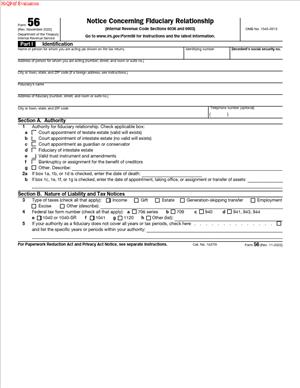
Form 56 – Notice Concerning Fiduciary Relationship
Fill out nowJurisdiction: Country: United States | Province or State: Federal
Form 56 – Notice Concerning Fiduciary Relationship is a federal tax document used to notify the Internal Revenue Service that you are acting in a fiduciary capacity for someone else. It tells the IRS that you are legally responsible for handling another person’s tax matters.
You may be filling out this form because someone has passed away, become incapacitated, or placed you in charge of a trust or estate. In these situations, the IRS needs to know who is authorized to act on behalf of the taxpayer.
This document does not create your authority. It simply reports it. Your authority usually comes from a will, a court order, a trust agreement, or state law.
If you are about to complete this form, you likely want to know what information is required, how it affects tax notices, and what responsibilities come with signing it. This guide explains those points in clear, practical terms.
What is Form 56 – Notice Concerning Fiduciary Relationship?
Clear definition
Form 56 – Notice Concerning Fiduciary Relationship is a written notice to the Internal Revenue Service that a fiduciary relationship has begun or ended. A fiduciary is a person or entity that manages assets or affairs for someone else.
By filing this document, you inform the IRS that you are now responsible for certain tax matters of the individual or entity named in the form. This may include filing tax returns, paying taxes, or responding to IRS notices.
The form can also be used to notify the IRS that your fiduciary role has terminated. For example, this may happen when an estate is closed or a court removes a guardian.
Who typically uses this form?
This form is commonly used by executors of estates. When someone dies, the executor named in the will or appointed by a court often files this notice to inform the IRS of their authority.
Trustees also use this document. If you manage a trust and are responsible for its tax filings, you may submit this notice to establish your role with the IRS.
Guardians or conservators may file it when they are appointed to manage the financial affairs of a minor or an incapacitated adult. Bankruptcy trustees and receivers sometimes use it as well.
In some cases, a business representative acting as a fiduciary for a dissolved corporation or other entity may file this form to handle final tax matters.
Why might you need this form?
The IRS sends tax notices, refund checks, and other correspondence to the taxpayer on record. If you are now legally responsible for that taxpayer’s affairs, the IRS needs to know to communicate with you instead.
Without this filing, the IRS may continue sending notices to the deceased person, incapacitated individual, or entity. That can delay important actions and create confusion.
You may also need to sign tax returns on behalf of the taxpayer. Filing this notice helps clarify your authority to act in that capacity.
In some situations, the IRS may request confirmation of your fiduciary status before discussing account details with you. Submitting this document helps establish that relationship.
Typical real-life scenarios
- A person passes away, and you are named executor in the will. Before you file the final income tax return for the deceased, you submit this notice to inform the IRS that you are handling the estate’s tax matters.
- A court appoints you as guardian for an elderly parent who can no longer manage financial affairs. You now need to address unpaid tax balances and respond to IRS letters on their behalf.
- You become the trustee of a revocable trust after the original trustee resigns. The trust has ongoing tax filing requirements, and you must notify the IRS that you are now responsible.
- A bankruptcy court appoints you as trustee over a debtor’s estate. To manage tax filings during the bankruptcy process, you notify the IRS of your fiduciary status.
- An estate has been fully administered, and all tax matters are resolved. As executor, you file this notice again to inform the IRS that your fiduciary relationship has ended.
When would you use Form 56 – Notice Concerning Fiduciary Relationship?
You use this form when a fiduciary relationship begins. This often happens at the time of a person’s death, upon a court appointment, or when a trustee formally accepts the role.
You may also use it when a fiduciary relationship ends. This could occur when an estate closes, a trust terminates, or a court removes or replaces a guardian.
The timing is usually connected to tax obligations. For example, if a final income tax return must be filed for a deceased person, the executor often submits this notice before or along with that return.
If the IRS has already sent notices regarding unpaid taxes, penalties, or audits, you may file the form to ensure future communications are directed to you in your fiduciary capacity.
Different fiduciary roles may trigger different tax responsibilities. Executors often handle final individual returns and estate tax matters. Trustees commonly manage annual trust income tax filings. Guardians may oversee ongoing filings for an incapacitated person. The purpose of the form is the same in each case: to formally notify the IRS of your role.
Legal Characteristics of Form 56 – Notice Concerning Fiduciary Relationship
This document serves as an official notice to a federal agency. Its effectiveness depends on accurate and complete information. It generally includes identifying details for both the taxpayer and the fiduciary, as well as the type of tax and tax periods involved.
Your authority to act as a fiduciary does not come from this filing. It comes from a legal source such as a will, trust instrument, or court order. The IRS may request supporting documentation if there is any question about your authority.
Common problems arise from incomplete information. Missing taxpayer identification numbers, incorrect names, or unclear tax periods can delay processing. If the IRS cannot match the information to its records, it may not update the account properly.
Another frequent issue is failing to indicate whether the fiduciary relationship has begun or ended. The form allows you to report either event, and selecting the correct status is important for accurate records.
While this is a federal form, the underlying fiduciary authority often depends on state law. For example, probate procedures and guardianship appointments are governed at the state level. The IRS relies on those legal relationships but does not create them.
This form does not grant power of attorney. It is different from a power of attorney document used to authorize someone to represent a taxpayer in dealings with the IRS. It also does not transfer ownership of assets or relieve a fiduciary of potential legal responsibilities under other laws.
Is it legally binding?
Form 56 – Notice Concerning Fiduciary Relationship is not a contract between you and the IRS. It is a formal notification. However, signing and submitting it carries legal significance because you are declaring that you are acting in a fiduciary capacity.
By filing the document, you acknowledge your responsibility to handle certain tax matters for the taxpayer. In many situations, a fiduciary may become personally responsible for certain tax obligations if estate or trust assets are distributed before taxes are paid. That responsibility arises from tax law and fiduciary law, not from the form itself.
The form becomes effective when the IRS processes it and updates its records. Its impact depends on the validity of your underlying authority. If your appointment as executor, trustee, or guardian is legally valid, the notice generally allows the IRS to recognize you as the authorized party for the listed tax matters.
How to fill out Form 56 – Notice Concerning Fiduciary Relationship
Step 1 – Identify the taxpayer
Begin by entering the full legal name of the person or entity for whom you are acting. Include the correct taxpayer identification number, such as a Social Security number or employer identification number. Accuracy here is essential because the IRS matches this information to existing records.
Step 2 – Provide the taxpayer’s last known address
Enter the last known mailing address of the taxpayer. This helps the IRS confirm the account and update correspondence records if needed. Use the address that was most recently associated with the taxpayer’s tax filings unless there has been a formal change.
Step 3 – Identify yourself as the fiduciary
Enter your full legal name and mailing address. This is where the IRS may send future notices related to the tax matters covered by the form. Make sure the information is current and complete.
Step 4 – State the type of fiduciary relationship
Indicate the nature of your role. Examples include executor, administrator, trustee, guardian, conservator, receiver, or other similar positions. Select or describe the role that matches your legal authority.
Step 5 – Describe how the fiduciary relationship was created
Provide the date the relationship began. This is often the date of death, the date of a court appointment, or the date you formally accepted your role under a trust. The date establishes the period during which you are responsible for tax matters.
Step 6 – Specify the type of tax and tax periods involved
Identify the kinds of tax matters you are responsible for, such as income tax, estate tax, employment tax, or other federal taxes. Also, list the applicable tax years or periods. Being specific reduces confusion about the scope of your authority.
Step 7 – Indicate if the fiduciary relationship has ended
If you are filing to report that your role has terminated, enter the date the relationship ended. This may be the date the estate was closed, the trust terminated, or the court discharged you from your duties.
Step 8 – Sign and date the form
Sign the form in your fiduciary capacity and include the date of signature. By signing, you confirm that the information provided is accurate to the best of your knowledge and that you are authorized to act in this role. Ensure all sections are complete before submission to avoid delays in processing.
Legal terms you might encounter in Form 56 – Notice Concerning Fiduciary Relationship
- Fiduciary: A fiduciary is a person or entity authorized to act on behalf of another person regarding financial or tax matters. On this form, you identify yourself as the fiduciary and state the legal basis for your authority. You must clearly show that you have the right to receive tax information and act for the taxpayer.
- Decedent: A decedent is a person who has died. If you are managing the estate of someone who passed away, you will identify the decedent as the taxpayer. The form records that you now handle the decedent’s tax responsibilities.
- Estate: An estate is the legal entity created after someone dies, consisting of their property, debts, and tax obligations. When you act as an executor or administrator, you manage the estate’s tax matters. This document tells the IRS you are responsible for those filings and communications.
- Trust: A trust is a legal arrangement where a trustee manages assets for beneficiaries. If you are the trustee, you may need to notify the IRS that you control tax matters for the trust or for the grantor in certain situations. The form documents when that authority begins and ends.
- Executor: An executor is the person named in a will to handle the estate of someone who has died. If you are the executor, you typically attach proof of your appointment. Your role includes filing final income tax returns and possibly estate tax returns.
- Administrator: An administrator performs a similar role to an executor but is appointed by a court when there is no valid will or no named executor. If you are court-appointed, you state that fact and provide supporting documentation. The IRS relies on this information to recognize your authority.
- Personal Representative: This is a broader term that can include executors, administrators, and others legally authorized to act for a taxpayer. The form may use this term to describe your role. It signals that you have responsibility for handling tax matters during a specific period.
- Termination of Fiduciary Relationship: This refers to the end of your authority to act for the taxpayer. You may use the same form to notify the IRS that your fiduciary role has ended. Providing the exact end date prevents confusion about who is responsible for future tax filings.
- Tax Period: A tax period is the specific year or quarter for which tax returns are filed. On the form, you must identify which tax periods your fiduciary authority covers. Being precise ensures the IRS updates its records correctly.
- Taxpayer Identification Number (TIN): This is the identifying number used by the IRS, such as a Social Security Number or Employer Identification Number. You must enter the correct number for the taxpayer. A mismatch can delay recognition of your fiduciary status.
FAQs
Do I need to file Form 56 – Notice Concerning Fiduciary Relationship every time I become an executor or trustee?
You file this document when you want the IRS to recognize you as the person responsible for the taxpayer’s federal tax matters. If you have been formally appointed as executor, administrator, or trustee and will be handling tax filings or receiving IRS correspondence, you generally use this form to notify the agency. If you never need to communicate with the IRS or manage tax issues, you may not need to file it, but most fiduciaries do so to avoid confusion.
What exact date should I enter as the beginning of my fiduciary relationship?
Enter the date your authority legally started. This is usually the date of death for a decedent, the date listed in court appointment papers, or the effective date in the trust document. Do not guess. Check your official paperwork and copy the exact date shown so the IRS record matches your legal authority.
What documents should I attach to prove my authority?
Attach a copy of the court order, letters testamentary, letters of administration, or the relevant trust instrument pages showing your appointment. Make sure the name of the taxpayer and your name match exactly what you list on this form. Clear attachments help the IRS confirm your authority without sending follow-up letters.
How do I know if the IRS accepted this form?
The IRS does not always send a formal acceptance letter. You will usually know it has been processed when IRS correspondence is addressed to you as a fiduciary. Keep proof of mailing and copies of everything you submitted in case you need to confirm the date you notified the agency.
Do I need to file a separate form for each tax year?
You do not usually file a separate document for each year if your authority covers multiple periods. Instead, list all relevant tax types and periods on this form. If your authority changes or ends later, you should file an updated notice reflecting that change.
What if my name or the taxpayer’s name is slightly different from IRS records?
Use the name exactly as it appears on the taxpayer’s most recent tax return or IRS notice. If your legal name has changed, attach documentation showing the change. Consistency prevents delays caused by identity mismatches in IRS systems.
Can more than one fiduciary be listed?
If co-executors or co-trustees are serving together, each person may need to file a separate notice unless the instructions allow joint reporting. Each fiduciary should clearly state their role and attach proof of appointment. This ensures the IRS recognizes all authorized individuals.
Do I need to file another Form 56 – Notice Concerning Fiduciary Relationship when my role ends?
Yes. When your authority ends, you should notify the IRS so its records reflect the termination date. Filing an updated Form 56 – Notice Concerning Fiduciary Relationship with the end date prevents future notices from being sent to you and clarifies that you are no longer responsible for the taxpayer’s filings.
Checklist: Before, During, and After Form 56 – Notice Concerning Fiduciary Relationship
Before
- Confirm your legal appointment as executor, administrator, trustee, or other fiduciary.
- Gather official documents proving your authority.
- Verify the taxpayer’s full legal name and Taxpayer Identification Number.
- Identify all relevant tax types and tax periods you will manage.
- Check the correct mailing address for the IRS based on the taxpayer’s location.
- Make copies of court orders or trust documents for attachment.
- Review prior IRS correspondence to ensure consistent information.
During
- Enter the taxpayer’s name exactly as shown on prior tax filings.
- Carefully input the correct Social Security Number or Employer Identification Number.
- State the precise date your fiduciary relationship began.
- Select or describe the correct type of fiduciary role.
- List all applicable tax forms and periods clearly.
- Indicate whether the fiduciary relationship is ongoing or terminated.
- Sign and date the form in your fiduciary capacity.
- Double-check all entries for spelling and number accuracy.
After
- Make a complete copy of the signed form and all attachments.
- Mail the form to the appropriate IRS address.
- Keep proof of mailing for your records.
- Monitor incoming mail to confirm IRS correspondence is addressed to you.
- Update your estate or trust records to reflect that notice was sent.
- Calendar important tax filing deadlines under your authority.
- Store the filed copy with other permanent estate or trust documents.
Common mistakes to avoid with Form 56 – Notice Concerning Fiduciary Relationship
- Mistake: Entering the wrong Taxpayer Identification Number because you relied on memory; this happens often and can cause processing delays or misapplied records, so do not forget to verify the number directly from official documents.
- Mistake: Failing to attach proof of fiduciary authority; people assume the IRS will accept their statement alone, which can lead to rejected or ignored filings, so do not forget to include court or trust documentation.
- Mistake: Listing an incorrect start date for your authority; this may create confusion about who is responsible for certain tax periods, so do not forget to copy the exact legal effective date.
- Mistake: Forgetting to notify the IRS when your fiduciary role ends; this can result in continued correspondence and potential liability concerns, so do not forget to file a termination notice.
- Mistake: Using inconsistent names for the taxpayer across documents; this often happens when nicknames or shortened names are used and can trigger identity verification issues, so do not forget to match prior tax records exactly.
- Mistake: Assuming this form replaces a power of attorney; this misunderstanding may limit your ability to represent the taxpayer in certain matters, so do not forget that different forms serve different purposes.
- Mistake: Sending the form to the wrong IRS address; this delays processing and may cause missed deadlines, so do not forget to confirm the correct filing location.
- Mistake: Not keeping copies of what you filed; without records, you cannot prove when notice was given, so do not forget to store signed copies and proof of mailing.
What to do after filling out Form 56 – Notice Concerning Fiduciary Relationship
Once you complete the form, your next focus is documentation and follow-through. The IRS updates its records based on what you submit. Clear organization now prevents problems later.
- Step 1: Make at least one complete copy of the signed form and every attachment before mailing it.
- Step 2: Confirm the correct IRS mailing address based on the taxpayer’s last known address and the type of tax involved.
- Step 3: Mail the form using a method that provides proof of delivery so you can document when the notice was sent.
- Step 4: Place your copy, attachments, and mailing proof in the estate or trust’s permanent file.
- Step 5: Update your internal records to show the exact date you notified the IRS of your fiduciary role.
- Step 6: Monitor incoming mail and confirm that future IRS correspondence is addressed to you as a fiduciary.
- Step 7: Calendar all upcoming tax filing deadlines for the taxpayer, estate, or trust so nothing is missed.
- Step 8: If your authority later changes or ends, prepare and submit an updated notice reflecting the termination date.
- Step 9: Coordinate with any co-fiduciaries to ensure everyone understands who is responsible for ongoing tax matters.
- Step 10: Keep communication records, including copies of any letters you send or receive, in one organized file.
Staying organized protects you. As a fiduciary, you may have personal responsibility for handling tax matters correctly. Clear records show that you provided proper notice and acted within your authority. Careful follow-through helps ensure that the IRS communicates with the right person and that the taxpayer’s obligations are handled smoothly.
Disclaimer: This guide is provided for informational purposes only and is not intended as legal advice. You should consult a legal professional.