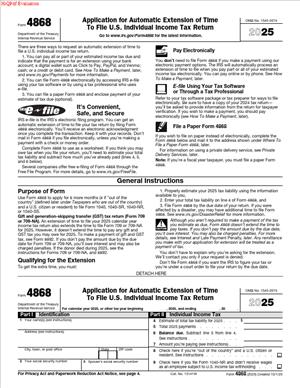
Form 4868 – Application for Automatic Extension of Time To File U.S. Individual Income Tax Return
Fill out nowJurisdiction: Country: United States | Province or State: Federal
Form 4868 – Application for Automatic Extension of Time to File U.S. Individual Income Tax Return is a federal tax form that gives you more time to file your individual income tax return. It is used when you cannot submit your full tax return by the regular filing deadline.
This form does not extend the time to pay your taxes. It only extends the time to file your return. That distinction matters because interest and penalties may still apply to unpaid amounts after the original due date.
You might be waiting on documents, dealing with a family issue, or simply not ready to complete your return. Filing this form can help you avoid a late-filing penalty while you finish preparing your tax information.
If you are handling your own taxes, it is important to understand what this form does and what it does not do. Knowing how it works helps you avoid unnecessary penalties and confusion.
What is Form 4868 – Application for Automatic Extension of Time To File U.S. Individual Income Tax Return?
Clear definition
Form 4868 – Application for Automatic Extension of Time to File U.S. Individual Income Tax Return is a short federal tax document that requests an automatic extension of time to file your individual income tax return. When accepted, it typically gives you an additional six months to submit your completed tax return.
The form requires basic identifying information, such as your name, address, and Social Security number. It also asks you to estimate your total tax liability for the year and the amount you have already paid through withholding or estimated payments.
This is not a request that requires detailed explanations. In most cases, you do not need to state a reason. If the form is properly completed and submitted on time, the extension is generally automatic.
Who typically uses this form?
Individual taxpayers use this form when they cannot meet the regular tax filing deadline. This includes employees, self-employed individuals, retirees, and people with investment income.
Married couples who file jointly may also use this form. In that case, both spouses’ information is included on a single extension request.
People with more complex returns often use this form. For example, someone who owns a small business or has multiple income sources may need more time to gather records.
Taxpayers living abroad may also use this form, even though special timing rules can apply in those situations. The form is still a federal filing tool for individuals.
Why might you need this form?
You might need this form if you are missing key tax documents. Common examples include late-arriving income statements or corrected forms.
You may also need extra time if your financial situation has changed during the year. Divorce, a new job, or the sale of property can make your return more complicated.
Sometimes you simply need more time to review your numbers carefully. Filing an accurate return is often better than rushing and later having to amend it.
If you expect to owe tax but cannot complete your return by the deadline, this form allows you to request more time to file while still submitting a payment with the extension.
Typical real-life scenarios
- You are waiting for a corrected income statement from a financial institution. The original document had errors, and you do not want to file based on incorrect figures. Filing for an extension gives you time to receive the updated information.
- You recently moved and are still organizing your records. Some tax documents were sent to your old address. You need additional time to gather everything before filing.
- You own rental property and are waiting for final expense totals. Without complete numbers, your return would be inaccurate. An extension allows you to finalize those details.
- You experienced a medical emergency close to the filing deadline. Your focus has been on recovery, not paperwork. Filing this form allows you to delay the return without immediately triggering a late-filing penalty.
When would you use Form 4868 – Application for Automatic Extension of Time To File U.S. Individual Income Tax Return?
You would use this form when you know you cannot file your individual income tax return by the standard deadline, which is commonly in mid-April. The form must generally be submitted on or before that original due date to be effective.
If you are self-employed and have estimated tax obligations, you may still use the form to extend the filing date of your annual return. However, estimated tax payments follow their own schedule and are not changed by this extension request.
If you are involved in a complex financial transaction near the end of the year, such as selling a business interest or large investment, you might need more time to calculate the tax impact accurately. The extension allows you to complete that analysis before filing.
Married couples filing jointly may use this form if either spouse is not ready to finalize the return. The extension applies to the joint return as a whole, not to each spouse separately.
If you anticipate owing tax but are short on cash at the deadline, you may still file this form and send a partial payment. The extension covers the filing date, not the payment obligation.
Taxpayers serving in certain situations, such as living outside the country, may already have additional time under separate rules. Even so, some individuals in those circumstances still submit this form to secure a longer extension period.
Legal characteristics of Form 4868 – Application for Automatic Extension of Time To File U.S. Individual Income Tax Return
This form is a federal tax filing that operates under national tax law. When completed accurately and submitted on time, it generally grants an automatic extension of time to file your individual income tax return.
For the extension to be valid, the form must include accurate identifying information. Errors in your name or Social Security number can cause processing problems. The estimated tax amounts should be reasonable based on the information available to you.
A common issue arises when taxpayers misunderstand the payment requirement. The extension applies only to filing the return, not paying the tax. If you owe money and do not pay by the original deadline, interest and possibly penalties may apply, even if the extension is accepted.
Another frequent problem is missing the original filing deadline. If the form is submitted after that date, the automatic extension may not apply. Timing is critical for the extension to be effective.
This form does not change your underlying tax liability. It does not reduce the amount you owe, cancel penalties already incurred, or replace your actual tax return. You must still complete and file your full return by the extended deadline.
While this is a federal form, individual states often have separate rules for state income tax extensions. Some states accept a federal extension automatically, while others require a separate state form. The federal extension does not automatically control state deadlines in every case.
Is it legally binding?
This form is not a contract between you and another party. It is a formal tax filing that triggers a statutory extension when properly submitted.
By signing or submitting it, you declare that the information provided is true and correct to the best of your knowledge. That declaration carries legal weight under federal tax law.
If the information is knowingly false, there may be consequences. For example, significantly understating your estimated tax in a misleading way can create issues. Accuracy and honesty matter.
Once accepted, the extension generally grants you additional time to file your return. However, it does not lock in your estimated numbers. Your final tax liability is determined when you file your completed return.
How to fill out Form 4868 – Application for Automatic Extension of Time To File U.S. Individual Income Tax Return
Step 1 – Provide your identifying information
Enter your full legal name as it appears on your tax records. Include your current mailing address and Social Security number. If you are filing jointly, include your spouse’s name and Social Security number as well. Make sure each number is accurate to avoid processing delays.
Step 2 – Estimate your total tax liability for the year
Review your income statements, prior-year return, and any available records. Estimate your total tax for the year, even if you do not have every document yet. This is your best calculation of what you owe for the full tax year.
Step 3 – Enter total payments already made
Add together any federal income tax withheld from wages or other income. Include estimated tax payments and any amounts already paid toward this year’s tax. Enter the total in the space provided.
Step 4 – Calculate the balance due
Subtract your total payments from your estimated total tax liability. If the result is a positive number, that is the amount you may still owe. This figure helps determine how much to send with your extension request.
Step 5 – Indicate the amount you are paying for the extension
If you are making a payment, enter the amount you are submitting. Paying as much as you can by the original deadline may reduce interest and penalties on any unpaid balance. The extension itself does not eliminate those charges.
Step 6 – Review for accuracy and submit by the deadline
Carefully review all entries before submitting the form. Confirm that names, Social Security numbers, and dollar amounts are correct. Submit the form on or before the regular filing deadline for your tax return to secure the automatic extension.
Legal terms you might encounter in Form 4868 – Application for Automatic Extension of Time To File U.S. Individual Income Tax Return
- Automatic Extension: This is the extra time granted to file your income tax return. When you submit this form by the original deadline, you generally receive an additional six months to file. It does not extend the time to pay any tax you owe.
- Tax Liability: This is your total tax for the year before subtracting payments and credits. On this form, you must estimate this number. It is the foundation for calculating whether you owe more money or are due a refund.
- Total Payments: This refers to the amount already paid toward your taxes. It includes withholding from wages, estimated tax payments, and certain refundable credits. You subtract this from your total tax liability to determine your balance.
- Balance Due: This is the amount you still owe after subtracting total payments from your estimated tax liability. If this number is positive, you should submit a payment with your extension request to reduce penalties and interest.
- Estimated Tax: These are quarterly payments made during the year if you do not have enough tax withheld from income. If you are self-employed or receive income without withholding, these payments directly affect the figures you enter on this document.
- Social Security Number (SSN): This is your taxpayer identification number. The form requires your SSN, and if you are filing jointly, your spouse’s SSN as well. The numbers must match official records to avoid processing delays.
- Electronic Filing (E-file): This is the method of submitting the extension request electronically. When you e-file, you typically receive an electronic confirmation that the extension was accepted.
- Penalties and Interest: These are additional charges that may apply if you do not pay enough tax by the original filing deadline. Filing this form prevents a failure-to-file penalty, but interest and late-payment penalties can still apply to unpaid amounts.
- Joint Return: If you are married and plan to file together, you use both spouses’ identifying information on this extension request. The extension applies to the joint return you plan to file later.
FAQs
Does filing Form 4868 – Application for Automatic Extension of Time To File U.S. Individual Income Tax Return give me more time to pay my taxes?
No. This document only extends the time to file your tax return, not the time to pay. You must estimate what you owe and send payment by the original deadline. If you underpay, interest and possible penalties may apply to the unpaid portion.
What happens if I cannot accurately estimate my total tax?
You are required to make a reasonable estimate based on the information available to you. Use your prior year return, current income statements, and any tax documents you have received. The IRS expects a good-faith effort. A wildly inaccurate estimate may increase the risk of penalties if you significantly underpay.
Do I need to sign this document?
If you file electronically, you generally do not provide a handwritten signature. Instead, you verify your identity through the electronic filing process. If you submit a paper version, follow the instructions carefully to determine whether a signature is required and ensure all identifying details are correct.
How do I know if my extension request was accepted?
If you file electronically, you should receive an electronic acknowledgment confirming acceptance. If you mail this form, you typically do not receive a separate approval notice. Proof of timely mailing and processed payment can serve as evidence that you submitted it on time.
What identifying information must match IRS records?
Your full legal name and Social Security number must match exactly with federal records. If you are filing jointly, your spouse’s information must also match. Even a small error, such as a transposed number, can delay processing or cause rejection.
Can I file this document if I expect a refund?
Yes. Even if you believe you overpaid and expect money back, you may still submit an extension. However, if you are confident that no tax is owed and you can file on time, you may not need to request extra time.
What if I change my address after filing?
The extension itself does not automatically update your address for all purposes. When you later file your full tax return, include your current address there. Make sure the address you enter is accurate at the time you complete this form.
Does this extension change anything in the public record?
No. This document is an administrative filing with the federal tax authority. It does not create a public record like a court filing would. Its main effect is to extend your filing deadline in the agency’s system.
Checklist: Before, During, and After Form 4868 – Application for Automatic Extension of Time To File U.S. Individual Income Tax Return
Before
- Gather all income statements received so far, such as wage and income summaries.
- Review last year’s tax return to estimate current-year liability.
- Calculate total withholding and estimated payments already made.
- Confirm your legal name and Social Security number.
- Verify your spouse’s information if filing jointly.
- Check the original tax filing deadline for the current year.
- Decide whether you will file electronically or by mail.
During
- Enter your full legal name exactly as shown on official records.
- Double-check your Social Security number and your spouse’s, if applicable.
- Carefully estimate your total tax liability.
- Enter total payments made during the year.
- Subtract payments from tax liability to determine the balance due.
- Indicate the amount you are paying with the extension.
- Review all figures for math errors.
- Confirm the correct mailing address or electronic submission method.
After
- Submit payment by the original filing deadline.
- Save proof of submission or electronic acceptance.
- Keep a copy of the completed form for your records.
- Mark your calendar with the extended filing deadline.
- Continue gathering any missing tax documents.
- Prepare your full tax return well before the extended deadline.
- Reconcile your final return with the estimates you made.
- Retain copies with your tax records for future reference.
Common mistakes to avoid with Form 4868 – Application for Automatic Extension of Time To File U.S. Individual Income Tax Return
- Mistake: Thinking the extension gives you more time to pay, which happens because the title emphasizes filing; this can lead to penalties and interest, so do not forget to send payment for any estimated balance due.
- Mistake: Underestimating your tax liability without reviewing income records, which often occurs when you rush close to the deadline; this can increase late-payment penalties, so do not forget to make a reasonable and supportable estimate.
- Mistake: Entering an incorrect Social Security number due to typographical errors; this may cause rejection or processing delays, so do not forget to verify each digit before submitting.
- Mistake: Forgetting to include a spouse’s information when planning to file jointly, which can invalidate the extension for a joint return; do not forget to include both names and identification numbers.
- Mistake: Missing the original filing deadline, often because you assume mailing on the due date is sufficient without proof; this can void the extension, so do not forget to confirm timely submission.
- Mistake: Failing to keep proof of filing or payment, which creates problems if there is a later dispute; do not forget to save confirmation emails, receipts, or mailing records.
- Mistake: Ignoring the extended deadline after filing the extension, which happens when people feel temporary relief; this can result in failure-to-file penalties, so do not forget to prepare and file the full return on time.
What to do after filling out Form 4868 – Application for Automatic Extension of Time To File U.S. Individual Income Tax Return
Once you submit your extension request, shift your focus to completing your full tax return. The extension buys you time. Use it wisely.
- Step 1: Confirm submission. If you filed electronically, check for an acceptance notice. If you mailed it, confirm delivery and keep mailing proof.
- Step 2: Verify payment processing. Make sure any payment you sent has cleared your bank or is reflected in your tax account records.
- Step 3: Store documentation. Keep a digital and paper copy of the completed extension, along with proof of payment.
- Step 4: Calendar the extended deadline. Write it down in multiple places so you do not miss it.
- Step 5: Gather missing documents. Contact payers or financial institutions if you are waiting on corrected or late forms.
- Step 6: Update your income and deduction records. Make sure your internal records match the official documents you receive.
- Step 7: Recalculate your final tax liability carefully. Compare it to the estimate you used for the extension.
- Step 8: File your completed return before the extended deadline. Do not wait until the last day unless absolutely necessary.
- Step 9: Pay any remaining balance immediately when filing the full return. This reduces additional interest.
- Step 10: Retain all related records together, including worksheets used to estimate your tax. Keep them with your annual tax file for future reference or in case questions arise.
Taking these steps ensures that your extension serves its purpose. It gives you structured time to prepare an accurate return, reduce errors, and stay compliant with federal filing requirements.
Disclaimer: This guide is provided for informational purposes only and is not intended as legal advice. You should consult a legal professional.