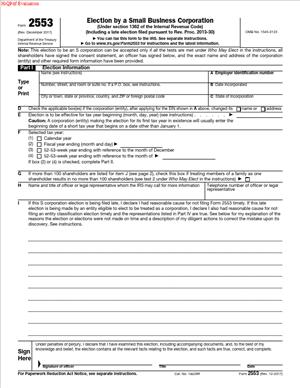
Form 2553 – Election by a Small Business Corporation
Fill out nowJurisdiction: Country: United States | Province or State: Federal
Form 2553 – Election by a Small Business Corporation is the document a corporation files to choose S corporation tax status at the federal level. It is submitted to the Internal Revenue Service, which is part of the Department of the Treasury. This filing changes how your corporation is taxed, not how it is formed.
If you are about to complete Form 2553 – Election by a Small Business Corporation, you are likely looking to have your corporation’s income taxed directly to its shareholders. Instead of the corporation paying federal income tax itself, profits and losses generally pass through to the owners.
This form matters because tax classification affects how income is reported, how losses are treated, and how owners pay themselves. Once accepted, the election shapes your ongoing tax reporting and compliance.
Many small business owners file this form shortly after forming a corporation. Others file it later when their business structure and ownership meet the requirements for S corporation status.
Understanding what this form does and what it does not do helps you complete it accurately and avoid delays or rejection.
What is Form 2553 – Election by a Small Business Corporation?
Clear definition
Form 2553 – Election by a Small Business Corporation is a federal tax election document. It allows an eligible domestic corporation to choose to be taxed as an S corporation under the Internal Revenue Code.
By filing this form, the corporation is asking to be treated as a pass-through entity for federal income tax purposes. The corporation’s income, deductions, and credits are generally reported on the shareholders’ individual tax returns.
The form does not create your corporation. It also does not change your corporation’s legal structure under state law. It only affects federal tax treatment.
Who typically uses this form?
This form is typically used by small business corporations that want pass-through taxation. The corporation must meet certain eligibility rules related to ownership, number of shareholders, and type of stock.
Founders of startups often use it after incorporating. Family-owned businesses commonly file it to simplify how profits are taxed. Professional service corporations may also elect S corporation status if they qualify.
All shareholders must agree to the election. Each shareholder generally signs the form to confirm consent.
Why might you need this form?
You may need this form if you want to avoid what is commonly called double taxation. In a standard C corporation, the corporation pays federal income tax on its profits. Then shareholders may pay tax again on dividends.
With an S corporation election, income typically passes through to shareholders without being taxed at the corporate level. This can change how profits are distributed and reported.
You may also need this form if you want business losses to pass through to shareholders, subject to general tax limitations. This can affect how owners report business losses on their individual returns.
If your accountant or tax preparer has suggested S corporation treatment, this is the filing that makes that election official.
Typical real-life scenarios
- You formed a corporation earlier this year and now want it taxed as an S corporation starting from its first tax year. Filing the election within the required timeframe allows the S corporation status to apply from the beginning of operations.
- You have operated as a C corporation for several years, but now meet the eligibility requirements for S corporation status. You want future profits to pass through to shareholders instead of being taxed at the corporate level.
- Your corporation has a small group of individual shareholders and only one class of stock. The business generates consistent profits, and you want a tax structure that aligns more closely with the owners’ personal income reporting.
- You are reorganizing a closely held corporation and reviewing whether S corporation status better matches your long-term tax planning goals. Filing the election formalizes that shift in tax treatment going forward.
When would you use Form 2553 – Election by a Small Business Corporation?
You use this form when your corporation wants to be treated as an S corporation for federal tax purposes. Timing is important because the election is generally tied to a specific tax year.
Newly formed corporations often file the form shortly after incorporation. The goal is usually to have S corporation status effective for the first tax year.
Existing corporations may use the form to change from C corporation status to S corporation status for a future tax year. The election typically specifies the intended effective date.
All shareholders at the time of the election must consent. This means you would use the form when ownership is settled and each shareholder agrees to the change in tax classification.
Corporate officers, such as the president or another authorized officer, usually complete and sign the form on behalf of the corporation. Shareholders then sign to confirm their consent.
You would not use this form if your business is not organized as a corporation. Other entities, such as limited liability companies, may need a different federal tax classification election before using this form, depending on how they are structured.
Legal Characteristics of Form 2553 – Election by a Small Business Corporation
This form is a formal federal tax election. For it to be effective, the corporation must be eligible, the form must be completed accurately, and all required signatures must be included.
An election is generally effective only if it is filed on time and accepted. Incomplete information, missing shareholder consents, or ineligible shareholders commonly lead to rejection or delay.
Eligibility typically includes limits on the number and type of shareholders. Corporations must generally have only allowable shareholders and only one class of stock. Violations of these requirements can affect the validity of the election.
The form applies at the federal level. State tax treatment may differ. Some states recognize the federal S corporation election automatically, while others require a separate state-level filing. The federal election itself does not guarantee state tax treatment.
This form does not replace corporate governance documents. It does not amend your articles of incorporation or bylaws. It does not create shareholder agreements. It strictly addresses federal income tax classification.
Once accepted, the election remains in effect until it is terminated or revoked according to federal tax rules. Certain events, such as changes in ownership or stock structure, may affect ongoing eligibility.
Is it legally binding?
Yes, once accepted, the election is legally binding for federal tax purposes. The corporation and its shareholders are generally required to report income and losses according to S corporation rules.
Because all shareholders must consent, the signed form reflects agreement among owners about the corporation’s tax status. After acceptance, changing that status usually requires another formal action and may be subject to restrictions.
If the corporation does not meet eligibility requirements, the election may be invalid. In that case, the corporation may continue to be taxed as a C corporation until a valid election is made and accepted.
How to fill out Form 2553 – Election by a Small Business Corporation
Step 1 – Provide basic corporate information
Enter the corporation’s legal name exactly as it appears in its formation documents. Include the mailing address and employer identification number. Confirm that this information matches your most recent federal tax records to avoid processing delays.
Step 2 – Select the effective date of the election
Indicate the tax year for which the S corporation election will begin. Carefully review the date you enter, as it determines when the new tax treatment starts. The effective date must align with the corporation’s tax year.
Step 3 – Confirm eligibility details
Answer the questions about the corporation’s tax year, business activity, and prior elections. These questions help establish that the corporation meets the general requirements for S corporation status. Provide complete and consistent information.
Step 4 – List all shareholders
Provide the name, address, and taxpayer identification number for each shareholder. Include the number of shares owned and the date the shares were acquired. Ensure that every current shareholder is listed as of the effective date of the election.
Step 5 – Obtain shareholder consent signatures
Each shareholder must sign and date the form to show consent to the election. Review the ownership list carefully before collecting signatures. Missing or incorrect signatures are a common reason for rejection.
Step 6 – Authorized corporate officer signature
An authorized corporate officer signs the form on behalf of the corporation. This signature confirms that the information provided is accurate to the best of the officer’s knowledge. Include the officer’s title and contact information.
Step 7 – Review for accuracy and completeness
Before submission, read through the entire form. Verify that names, identification numbers, dates, and share amounts are correct. Confirm that all required signatures are present and legible.
Step 8 – Submit the form to the Internal Revenue Service
Send the completed form to the appropriate Internal Revenue Service processing location based on your corporation’s address. Keep a copy of the signed form and any proof of mailing for your records. Once processed, you will typically receive written confirmation of acceptance or notice of any issues that need to be addressed.
Legal terms you might encounter in Form 2553 – Election by a Small Business Corporation
- S Corporation: This is a corporation that has elected to pass corporate income, losses, deductions, and credits through to its shareholders for federal tax purposes. On this form, you are asking to be treated as an S corporation. The entire purpose of the document is to officially notify the Internal Revenue Service of that election.
- Election: An election is a formal choice you make under tax law. By completing and submitting this form, you are choosing a specific tax classification. The form records the date and details of that choice.
- Effective Date: This is the date when your S corporation status begins. You must clearly state this on the form. The effective date determines which tax year the new classification applies to and affects how income is reported.
- Tax Year: Your tax year is the 12-month accounting period you use to report income and expenses. On this form, you confirm the tax year your corporation follows. Most small corporations use a calendar year, but some use a fiscal year.
- Shareholder Consent: Every shareholder must agree to the S corporation election. The form includes a section where each shareholder signs to show consent. Without these signatures, the election may be rejected.
- Employer Identification Number (EIN): This is the federal tax ID number assigned to your corporation. You must enter the correct EIN on the form. If it does not match IRS records, processing can be delayed.
- Authorized Officer: This is a corporate officer who has the authority to sign documents on behalf of the company. The form must be signed by an authorized officer, such as a president or other designated officer. The IRS relies on this signature as confirmation that the corporation approves the election.
- Ineligible Shareholder: Certain types of owners are not allowed for an S corporation. The form requires you to confirm that all shareholders meet eligibility rules. Listing an ineligible shareholder can invalidate the election.
- Revocation: A revocation is the cancellation of S corporation status. While this form is used to elect S status, the term may appear in related instructions. Understanding revocation helps you know that this choice has ongoing consequences.
- Late Election Relief: This refers to a request to accept your election even if you filed after the standard deadline. The form allows you to explain why you are filing late. You must provide specific information if you are asking for this relief.
FAQs
What happens if I miss the deadline to file this form?
If you miss the standard filing deadline, you may still be able to request late election relief. On the form, you must state the intended effective date and explain why the election was not filed on time. You also confirm that you have acted consistently as an S corporation since that date. The IRS reviews this explanation before deciding whether to accept the late election.
How do I choose the correct effective date on Form 2553 – Election by a Small Business Corporation?
You enter the effective date in the section that asks when the election should begin. This date must align with the start of a tax year or meet timing rules set by the IRS. If you choose a date that does not fit within those rules, the IRS may adjust it or deny the election. Always make sure the date matches how you have been reporting income and operating the corporation.
Do all shareholders really have to sign this document?
Yes. Every person who owns shares at the time of the election must sign the shareholder consent section. Each shareholder provides their name, address, ownership percentage, and signature. If even one required signature is missing, the election may not be valid.
What if a shareholder refuses or forgets to sign?
If a required shareholder does not sign, the election cannot be properly completed. You must resolve the issue before submitting this form. That may mean obtaining the signature or addressing ownership records so they are accurate before filing.
How do I know if my corporation qualifies to file this form?
You review the eligibility questions within the document. It asks you to confirm that you are a domestic corporation, that you have only eligible shareholders, and that you do not exceed the maximum number of shareholders. You also confirm that you have only one class of stock. You must verify each condition before signing.
What information about shareholders do I need to enter?
You must list each shareholder’s full legal name, address, tax identification number, number of shares owned or percentage of ownership, and the date the shares were acquired. This information appears in the shareholder section of the form. Accuracy is critical because the IRS uses this data to confirm eligibility.
Will filing this document change my company’s name or structure?
No. This document only changes how your corporation is taxed at the federal level. It does not change your legal name, corporate structure, or state registration. Those remain the same unless you file separate documents with your state.
How will I know if the IRS accepts my election after I submit Form 2553 – Election by a Small Business Corporation?
The IRS typically sends a written notice confirming whether the election has been accepted. Keep a copy of this form and monitor your mail for confirmation. If you do not receive a response within a reasonable time, you may need to follow up to confirm its status.
Checklist: Before, During, and After Form 2553 – Election by a Small Business Corporation
Before
- Confirm your corporation is eligible for S corporation status.
- Verify that you have no more than the permitted number of shareholders.
- Make sure all shareholders are eligible individuals or entities.
- Confirm you have only one class of stock.
- Gather each shareholder’s legal name, address, and tax ID number.
- Locate your corporation’s EIN and confirm it matches IRS records.
- Decide on the intended effective date of the election.
- Review your corporation’s tax year and accounting period.
During
- Enter the corporation’s full legal name exactly as registered.
- Provide the correct EIN and business address.
- Clearly state the effective date of the election.
- Complete the tax year information accurately.
- List every shareholder with complete ownership details.
- Double-check shareholder tax identification numbers for errors.
- Obtain all required shareholder signatures and dates.
- Have an authorized corporate officer sign and date the form.
- Review the entire document for missing fields or blank sections.
After
- Make a complete copy of the signed form for your records.
- Submit the form using the appropriate filing method.
- Note the date you sent the form.
- Track expected confirmation timing.
- Store shareholder consent records with corporate documents.
- Inform your tax preparer or accountant of the election.
- Adjust payroll tax setup if needed for S corporation treatment.
- Monitor mail for IRS acceptance or follow-up requests.
Common mistakes to avoid with Form 2553 – Election by a Small Business Corporation
- Mistake: Choosing the wrong effective date because you misunderstood the filing deadline, which can cause the IRS to reject or delay the election, so do not forget to confirm the date aligns with the start of your intended tax year.
- Mistake: Leaving out a shareholder’s signature because you assume verbal consent is enough, which can invalidate the election, so do not forget to obtain written consent from every shareholder listed.
- Mistake: Entering an incorrect EIN due to copying errors, which can delay processing or misidentify your corporation, so do not forget to verify the EIN against official IRS records.
- Mistake: Failing to list all shareholders because ownership records are outdated, which can make the election incomplete, so do not forget to confirm current ownership before filing.
- Mistake: Misstating ownership percentages because of informal agreements, which can raise eligibility questions, so do not forget to use documented share allocations.
- Mistake: Assuming state tax status automatically changes with the federal election, which can create compliance gaps, so do not forget to review your state tax requirements separately.
- Mistake: Forgetting the authorized officer’s signature because you focus only on shareholder consents, which can result in rejection, so do not forget that the corporation itself must formally approve the election.
- Mistake: Ignoring late election relief instructions when filing after the deadline, which can lead to denial, so do not forget to include the required explanation and statements if filing late.
What to do after filling out Form 2553 – Election by a Small Business Corporation
Once you complete the form, pause before sending it. Review every page carefully. Look for missing signatures, incomplete shareholder information, or incorrect identification numbers. Small errors can delay processing.
- Step 1: Make a complete copy of the signed form for your corporate records.
- Step 2: Confirm the correct submission method and address based on your corporation’s location.
- Step 3: Send the form using a method that provides proof of delivery, if available.
- Step 4: Record the date you submitted the form in your corporate records.
- Step 5: Monitor your mail for written confirmation from the Internal Revenue Service.
- Step 6: If you receive a notice requesting additional information, respond promptly and keep copies of your response.
- Step 7: Inform your internal bookkeeping team or tax professional that the election has been filed.
- Step 8: Adjust how you track shareholder distributions and compensation to reflect S corporation treatment.
- Step 9: Retain the acceptance notice with your permanent corporate documents.
- Step 10: Review your ongoing compliance obligations each year to maintain eligibility.
After acceptance, operate consistently with S corporation rules. Pay reasonable compensation to shareholder-employees if applicable. Track distributions separately from wages. Maintain clear records of ownership and stock transfers.
Keep your election confirmation in a secure location. You may need it when filing future tax returns or responding to IRS questions. Staying organized now reduces confusion later.
Disclaimer: This guide is provided for informational purposes only and is not intended as legal advice. You should consult a legal professional.