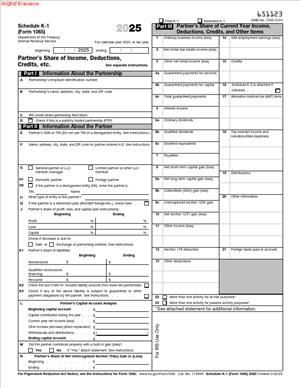
Form 1065 – Schedule K-1
Fill out nowJurisdiction: Country: United States | Province or State: Federal
Form 1065 – Schedule K-1 is a federal tax document used to report a partner’s share of income, deductions, credits, and other items from a partnership. If you are involved in a partnership, this form affects how you report income on your personal tax return.
This document does not stand alone. It is issued as part of the partnership’s annual tax filing. The partnership files Form 1065, and each partner receives a separate Schedule K-1 showing their individual share.
If you are about to review or use this form, you likely want to understand what each box means and how it connects to your own tax filing. The information on it flows directly into your personal return.
Form 1065 – Schedule K-1 matters because it determines how much partnership income you report, even if you did not receive that amount in cash. It can affect your tax liability, estimated payments, and recordkeeping.
Understanding how it works helps you avoid common errors, such as reporting the wrong income category or overlooking special allocations.
What is Form 1065 – Schedule K-1?
Clear definition
Form 1065 – Schedule K-1 is a federal tax schedule used by partnerships to report each partner’s share of the partnership’s financial activity for the year. It breaks down income, losses, deductions, credits, and other tax items allocated to a specific partner.
The partnership prepares one Schedule K-1 for each partner. Each form reflects that partner’s percentage interest and share of results based on the partnership agreement.
This document does not calculate your tax for you. Instead, it provides detailed figures that you transfer to your individual tax return in the correct sections.
Who typically uses this form?
You encounter this form if you are a partner in a general partnership, limited partnership, limited liability partnership, or many multi-member limited liability companies treated as partnerships for federal tax purposes.
Individual partners use the information from the form to complete their personal income tax return. Corporate partners and other entities also use it to complete their own returns.
Partnerships use this schedule to communicate each partner’s allocated share. Even if you are a passive investor with no management role, you may still receive a Schedule K-1.
Tax preparers and accountants also rely on the information in this document when preparing annual returns for both partnerships and partners.
Why might you need this form?
You need Form 1065 – Schedule K-1 because partnership income is generally not taxed at the partnership level. Instead, income “passes through” to the partners.
If you are a partner, you report your share of income or loss whether or not the partnership distributed cash to you. The form shows the specific categories of income, such as ordinary business income, interest, dividends, or capital gains.
You also need it to track items that affect your tax situation beyond one year. For example, it may include information about capital contributions, distributions, and changes in your ownership percentage.
In addition, the form may contain codes and supplemental statements. These provide details required to properly complete other parts of your tax return.
Typical real-life scenarios
- You and two colleagues form a consulting partnership. At the end of the year, the partnership earns a profit. The partnership files its annual return and issues each of you a Schedule K-1 showing your share of the profit based on your ownership percentages.
- You invest in a real estate limited partnership as a passive investor. The property generates rental income and depreciation deductions. You receive a Schedule K-1 reflecting rental income and losses allocated to you.
- You are a member of a multi-member limited liability company that is treated as a partnership for tax purposes. Even though you call it an LLC, for federal tax filing, it operates as a partnership. You receive a Schedule K-1 reporting your share of the company’s results.
- You inherit a partnership interest from a family member. During the year, the partnership reports capital gains and certain credits. Your Schedule K-1 reflects these items, and you use it when completing your personal return.
When would you use Form 1065 – Schedule K-1?
You use this form during tax season when preparing your federal income tax return. The partnership generally provides it after completing its annual filing.
If you are a new partner, you may receive your first Schedule K-1 for the year you joined. If you sold your interest during the year, the form may reflect only part-year activity.
You also rely on this document when calculating estimated tax payments. If your partnership income changes significantly from year to year, the Schedule K-1 helps you adjust those payments.
In some cases, you may refer back to prior-year forms. For example, if you are tracking suspended losses or basis limitations, you may need information from earlier years’ filings.
If you hold interests in multiple partnerships, you may receive several Schedules K-1. Each one must be reviewed separately and reported accurately on your return.
Legal characteristics of Form 1065 – Schedule K-1
Form 1065 – Schedule K-1 is part of a federally required tax filing. The partnership prepares it as part of its annual submission to the Internal Revenue Service. Copies are provided to partners for their own reporting.
For the form to be effective, it must match the partnership’s filed return. The amounts shown on each partner’s Schedule K-1 should reconcile with the totals reported on the partnership’s main return.
Common problems include mismatched identification numbers, incorrect ownership percentages, and missing supplemental statements. Errors can delay processing or lead to notices requesting clarification.
Another issue arises when the partnership agreement allocates income in a way that is not properly reflected on the form. Inconsistent allocations can create reporting discrepancies for partners.
The form itself does not create ownership rights. It reflects allocations based on the partnership agreement and actual financial results. If there is a dispute about ownership or allocations, the underlying agreement governs those matters.
While this is a federal form, states may require similar or additional schedules. The federal Schedule K-1 does not automatically satisfy every state filing requirement.
Is it legally binding?
Form 1065 – Schedule K-1 is not a contract between partners. It does not create obligations by itself. Instead, it reports financial information based on the partnership’s records and agreement.
However, the information on the form is used in legally required tax filings. When the partnership files its return and issues Schedule K-1 forms, it is making formal representations about income and allocations.
Partners rely on that information to complete their own returns. If the amounts are incorrect, it can lead to amended returns, penalties, or disputes among partners.
In that sense, while the form is not legally binding like a contract, it carries legal significance because it forms part of the official tax reporting process.
How to fill out Form 1065 – Schedule K-1
Step 1 – Review the partnership’s basic information
Start with the top section of the form. Confirm the partnership’s name, address, and employer identification number. Make sure this matches the entity in which you hold an interest.
Check the tax year shown on the document. Ensure it matches the year you are preparing your personal return for.
Step 2 – Verify your partner information
Next, review your own details. Confirm your name, address, and identifying number are correct.
Look at your partner type, such as general partner or limited partner. Also, review your profit, loss, and capital percentages. These percentages affect how income and losses are allocated.
Step 3 – Examine Part I and Part II details
Part I focuses on information about the partnership. Part II provides information about you as a partner.
Review any checkboxes indicating whether you are a domestic or foreign partner, and whether you are a disregarded entity or another type of owner. These classifications can affect how the information is reported on your return.
Step 4 – Review Part III income and loss items
Part III lists your share of income, losses, and other items. Each box corresponds to a specific category, such as ordinary business income, rental income, or interest income.
Carefully read each line and any accompanying code. Some entries require you to attach statements or complete additional forms on your personal return.
If an amount is negative, it typically represents a loss. Pay attention to passive activity or at-risk limitations that may affect whether you can deduct that loss.
Step 5 – Check deductions and credits
The form may include separately stated deductions and credits. These can include items such as charitable contributions or certain tax credits.
Each of these items may flow to a different part of your personal return. Review any attached statements that explain how to treat specific codes.
Step 6 – Review capital account information
Many versions of the form include a section showing changes in your capital account. This may list beginning capital, contributions, withdrawals, and ending capital.
Compare these figures to your own records. Differences may require clarification with the partnership before you complete your filing.
Step 7 – Look for supplemental statements
Often, Form 1065 – Schedule K-1 includes attached statements that explain coded entries. Do not ignore these attachments.
Some codes represent multiple possible items. The statement clarifies exactly what type of income, deduction, or credit applies and how it should be reported.
Step 8 – Transfer the information to your tax return
Use the amounts shown on the form to complete the relevant sections of your personal tax return. Each category of income or deduction generally goes to a specific schedule or line.
Enter the figures exactly as shown. Keep a copy of the form and any attachments with your tax records for future reference.
Legal terms you might encounter in Form 1065 – Schedule K-1
- Distributive Share: This is your allocated portion of the partnership’s income, losses, deductions, and credits. It appears throughout Part III of this document. The numbers shown are based on the partnership agreement, not necessarily on how much cash you actually received.
- Guaranteed Payments: These are payments made to a partner for services or the use of capital, regardless of the partnership’s profit. They are listed separately from your distributive share. You report them differently on your personal tax return, so you need to identify them clearly on this document.
- Capital Account: This reflects your financial stake in the partnership. It starts with your initial contribution, increases with income and additional contributions, and decreases with losses and distributions. The capital account section helps you track your equity and potential gain or loss if you exit the partnership.
- Basis: Your basis is your investment in the partnership for tax purposes. It affects how much loss you can deduct and whether distributions are taxable. While the basis is not fully calculated in this document, several boxes provide the numbers you need to compute it.
- Ordinary Business Income (Loss): This is the partnership’s regular operating profit or loss. It is shown in a specific box in Part III. You usually report this on the business income section of your individual return.
- Separately Stated Items: These are income, deductions, and credits that must be reported separately because they receive special tax treatment. Examples include interest income, capital gains, and charitable contributions. Each appears in its own labeled box so you can place it correctly on your return.
- Self-Employment Earnings: Some partnership income is subject to self-employment tax. This amount is typically shown in a specific section of Part III. You use it to calculate additional taxes owed for Social Security and Medicare.
- Section 179 Deduction: This allows a partnership to pass through the cost of certain business property so you can deduct it in the current year. If listed, you must apply your own limitation rules before claiming it. The amount shown is not automatically deductible in full.
- Foreign Transactions: If the partnership has foreign income, taxes, or activities, details will appear in designated boxes and attached statements. These entries affect how you claim foreign tax credits or report foreign income. You must review any supplemental pages carefully.
- Alternative Minimum Tax (AMT) Items: Some income and deductions are treated differently under AMT rules. These amounts are identified separately so you can determine if you owe additional tax under the alternative system. Ignoring them can lead to miscalculations.
FAQs
What should I do if my name or Social Security number is incorrect on this form?
Check Part II, where your identifying information appears. If your name, address, or taxpayer identification number is wrong, contact the partnership immediately and request a corrected document. Do not file your personal return using incorrect identifying information because it may delay processing or cause mismatches in IRS records.
Do I file Form 1065 – Schedule K-1 with my individual tax return?
In most cases, you do not attach this document when filing electronically, but you must use the information from it to complete your return. If you file a paper return, follow the filing instructions to see whether a copy must be included. Keep your copy in your records even if you do not submit it.
Why does this document show income even though I did not receive any money?
This form reports your share of the partnership’s taxable income, not just cash distributions. Partnerships are pass-through entities, so you are taxed on allocated income whether or not it was distributed. Review the distributions section separately to see what cash or property you actually received.
What if I receive more than one Schedule K-1 from the same partnership?
You may receive an amended version if corrections were made after the original was issued. Compare the “amended” box and the tax year listed at the top. Use the most recent corrected version when preparing or amending your return.
Where do I enter the amounts from this form on my tax return?
Each box number corresponds to a specific line or schedule on your individual return. For example, ordinary business income goes to the business income schedule, while interest and dividends go to the appropriate income sections. Follow the box labels and instructions carefully so each amount is placed in the correct part of your return.
What does the capital account analysis tell me?
The capital account section shows your beginning balance, contributions, share of income or loss, withdrawals, and ending balance. It helps you confirm whether the partnership’s records match your understanding of your investment. Review it for accuracy, especially if you contributed property or received distributions during the year.
How do I know if I am considered a general or limited partner?
Part II identifies your partner status. This classification affects whether your income is subject to self-employment tax and how losses are treated. Confirm that the checked box matches your actual role under the partnership agreement.
What should I do with the supplemental statements attached to this document?
Read each attachment carefully because they break down the amounts listed in the summary boxes. You may need the details to apply limitations, compute credits, or complete additional forms. Do not rely only on the main page if attachments are provided.
Checklist: Before, During, and After Form 1065 – Schedule K-1
Before
- Confirm the tax year at the top matches the year you are filing.
- Gather your prior year capital account and basis information.
- Have a copy of the partnership agreement available.
- Collect records of contributions and distributions you made during the year.
- Make sure your personal identifying information is current.
- Set aside any supplemental statements received with the document.
- Review prior year carryforward losses or credits.
During
- Verify the partnership’s name, address, and identification number.
- Check your name, address, and taxpayer identification number in Part II.
- Confirm your partner type is correctly marked.
- Review each box in Part III and note where it belongs on your tax return.
- Separate ordinary income from separately stated items.
- Identify any self-employment earnings amounts.
- Examine capital account changes for accuracy.
- Read all footnotes and attached statements.
After
- Transfer each amount carefully to the correct lines on your tax return.
- Recalculate your basis using current year figures.
- Apply any loss or deduction limitations that apply to you.
- Make copies of the completed return and this document.
- Store digital and paper copies in a secure place.
- Monitor for any corrected or amended versions issued later.
- Update your personal financial records to reflect capital account changes.
Common mistakes to avoid with Form 1065 – Schedule K-1
- Mistake: Reporting only cash distributions and ignoring allocated income because it feels more “real,” which happens when partners focus on bank deposits, leading to underreporting income and potential penalties, so do not forget that taxable income is based on allocation, not cash received.
- Mistake: Entering amounts on the wrong lines of your personal return due to confusion about box numbers, which happens when you rush through Part III, causing miscalculated tax and possible notices, so do not forget to match each box to its correct schedule.
- Mistake: Overlooking self-employment earnings because they are listed separately, which happens when you assume all partnership income is treated the same, resulting in unpaid self-employment tax, so do not forget to review the section that identifies earnings subject to this tax.
- Mistake: Ignoring supplemental statements attached to the form, which happens when you rely only on the summary boxes, leading to incomplete credit or deduction claims, so do not forget to read every attachment carefully.
- Mistake: Failing to track your basis each year because it is not fully calculated on the face of the document, which happens when you assume the capital account equals basis, resulting in disallowed losses or unexpected taxable gains. Do not forget to maintain your own basis worksheet.
- Mistake: Using an outdated or uncorrected version after the partnership issues an amendment, which happens when you file early and do not check for updates, leading to mismatched records, so do not forget to confirm whether an amended box is checked.
- Mistake: Not verifying your partner classification in Part II, which happens when roles change during the year, causing incorrect tax treatment of income and losses, so do not forget to confirm your status matches the partnership agreement.
What to do after filling out Form 1065 – Schedule K-1
Once you have transferred all amounts to your personal tax return, pause and review everything line by line. Small data entry errors can cause processing delays or notices. Make sure totals flow correctly into your adjusted gross income and tax calculations.
- Step 1: Double-check that every box with a number has been addressed on your return, even if the amount is zero or limited.
- Step 2: Recalculate your partnership basis using the beginning basis, plus income and contributions, minus losses and distributions.
- Step 3: Confirm whether any losses are limited and must be carried forward to a future year.
- Step 4: Review your self-employment tax calculation if applicable.
- Step 5: Ensure that any credits passed through are properly claimed and supported by attachments.
- Step 6: Save a complete copy of your filed tax return along with this document and all attachments.
- Step 7: Store both digital and paper copies in a secure location for at least several years, as partnership items may be reviewed later.
- Step 8: Update your personal financial records to reflect the ending capital account balance.
- Step 9: Watch for correspondence indicating the partnership filed an amended return that could affect your numbers.
- Step 10: If you later discover an error, prepare to amend your individual return using the corrected figures.
Staying organized after completion protects you. Partnership reporting often affects future years through carryforwards, basis adjustments, and capital account tracking. Keeping detailed records now makes next year’s filing faster and more accurate.
Disclaimer: This guide is provided for informational purposes only and is not intended as legal advice. You should consult a legal professional.