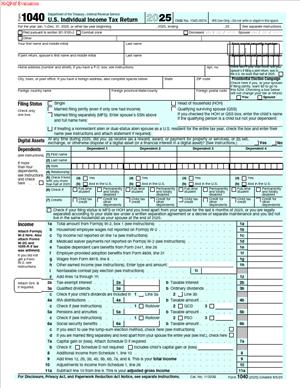
Form 1040 – U.S. Individual Income Tax Return
Fill out nowJurisdiction: Country: United States | Province or State: Federal
Form 1040 – U.S. Individual Income Tax Return is the standard federal income tax form used by individuals in the United States to report income, calculate tax, and determine whether they owe money or are entitled to a refund. If you earn income during the year, this is the document you will likely file.
You use this form to give the federal government a full picture of your financial activity for the year. It brings together your wages, self-employment earnings, investments, credits, and deductions in one place.
For many people, this filing feels overwhelming. The form asks for detailed financial information and requires careful math. Understanding how it works before you start can make the process clearer and more manageable.
This guide walks you through what the form is, when it applies, how it functions legally, and what each step generally involves when you complete it.
What is Form 1040 – U.S. Individual Income Tax Return?
Clear definition
Form 1040 – U.S. Individual Income Tax Return is the primary federal income tax return used by individuals to report annual income and calculate their tax liability. It summarizes your total income, adjustments, deductions, credits, and payments made throughout the year.
The form is structured in sections. Early lines focus on income. The middle sections address adjustments and deductions. Later sections calculate tax owed and apply credits and payments. The final result shows either a balance due or a refund.
It functions as both a reporting tool and a calculation document. You provide financial data, and the form guides you through determining your final tax position for the year.
Who typically uses this form?
Most U.S. residents who earn income use this form. This includes employees who receive wages, self-employed individuals, independent contractors, retirees with taxable income, and investors.
If you receive a wage statement from an employer, earn business income, collect rental income, or receive taxable benefits, you generally report it here. Even if your income is modest, you may still file to claim a refund of taxes withheld.
Students with part-time jobs, gig workers, freelancers, and retirees commonly complete this form. It is not limited to business owners or high earners. It applies broadly to individuals with taxable income.
Why might you need this form?
You use this form to comply with federal tax filing requirements. If your income exceeds certain thresholds for the year, filing is generally required.
Even if you are not required to file, you may submit it to claim a refund. For example, if federal income tax was withheld from your pay, you must file to receive that money back.
You may also need it to claim tax credits. Certain credits can reduce your tax bill or increase your refund. Filing allows you to formally request those benefits.
In addition, lenders, landlords, and financial institutions often request copies of filed tax returns as proof of income. Completing this form creates an official record of your annual earnings.
Typical real-life scenarios
- You work full-time for an employer who withholds federal income tax from each paycheck. At the end of the year, you receive a wage statement summarizing your earnings and withholding. You transfer that information onto the form to calculate whether you owe additional tax or will receive a refund.
- You operate a small side business in addition to your regular job. You track your business income and expenses throughout the year. When filing, you report your net business income and calculate the related tax.
- You are retired and receive income from pensions, Social Security benefits, or investment accounts. Some of this income may be taxable. You use the form to report these amounts and determine your final tax position.
- You had federal tax withheld, but your income was low for the year. After entering your information, the form shows that you overpaid through withholding. Filing allows you to receive the difference as a refund.
- You experienced a major life event such as marriage, divorce, or the birth of a child. These changes can affect filing status, deductions, and credits. The form reflects your updated situation for the year.
When would you use Form 1040 – U.S. Individual Income Tax Return?
You use this form at the end of each tax year to report income earned during that calendar year. The filing season typically begins in January and runs through the spring.
Employees use it after receiving annual wage statements. Independent contractors and freelancers use it after gathering income records and expense documentation. Investors use it after receiving statements showing dividends, interest, and capital gains.
If you changed jobs during the year, worked multiple part-time roles, or combined employment with self-employment, you consolidate all that information on this single return.
You may also use the form if you need to correct a prior filing. In that case, an amended return is typically submitted, but it is based on the original information reported on this document.
Parents claiming dependents, individuals claiming education-related benefits, and taxpayers claiming certain income-based credits use this form to formalize those claims.
In short, you use it whenever you need to report your personal federal income tax situation for the year.
Legal characteristics of Form 1040 – U.S. Individual Income Tax Return
Form 1040 – U.S. Individual Income Tax Return is an official federal tax document. It is issued by the Department of the Treasury—Internal Revenue Service in hard form. It has a prescribed structure, required fields, and a declaration section that you sign under penalty of perjury.
For the form to be valid, it must be complete and accurate. Required identifying information must be provided. Income and other entries must be reported clearly. The form must be signed and dated. An unsigned return is generally not treated as properly filed.
Common problems include math errors, missing schedules, incorrect Social Security numbers, and incomplete income reporting. Omitting required attachments can delay processing. Inaccurate figures can trigger further review or adjustment.
The form operates at the federal level. State income tax returns are separate and may require different forms. While many states follow similar concepts, the federal return does not replace state filing requirements.
This document calculates federal income tax only. It does not address other legal obligations such as payroll tax deposits for employers, state taxes, or local tax requirements.
It also does not automatically settle disputes or grant relief from prior tax debts. If you owe tax from a previous year, that issue is handled separately from the current year’s filing.
Is it legally binding?
Yes. When you sign Form 1040 – U.S. Individual Income Tax Return, you declare that the information provided is true, correct, and complete to the best of your knowledge. This declaration has legal significance.
Your signature confirms that you are responsible for the contents of the return. If you file jointly with a spouse, both parties generally sign and share responsibility for the accuracy of the return.
Once filed, the return becomes part of your official tax record. The government may review it, accept it as filed, or adjust it if discrepancies are identified. If adjustments occur, you are typically notified.
The binding nature of the document comes from your signed declaration and the statutory requirement to report income accurately. Filing establishes your reported tax liability for the year, subject to review under applicable tax rules.
How to fill out Form 1040 – U.S. Individual Income Tax Return
Step 1 – Gather your personal information
Start by collecting your Social Security number, and if filing jointly, your spouse’s number. Have your current mailing address available. You will enter this information at the top of the form.
You will also select your filing status, such as single or married filing jointly. Your status affects tax rates and eligibility for certain deductions and credits.
Step 2 – Collect all income documents
Gather wage statements, records of self-employment income, investment income statements, and any other documents showing money you received during the year. Review each document carefully before transferring figures to the form.
Enter wages, interest, dividends, business income, and other applicable amounts on the corresponding lines. If additional schedules are required for detailed reporting, complete them and carry the totals to the main form.
Step 3 – Report adjustments to income
Certain expenses may reduce your total income before tax is calculated. These are entered in the adjustments section. Examples may include specific retirement contributions or other qualifying amounts.
After entering adjustments, calculate your adjusted gross income. This figure is important because many credits and deductions are based on it.
Step 4 – Choose between standard and itemized deduction
The form allows you to reduce taxable income through a standard deduction or itemized deductions, depending on your situation. Enter the applicable amount on the designated line.
Subtract the deduction from your adjusted gross income to determine your taxable income. This is the amount used to calculate your preliminary tax.
Step 5 – Calculate your tax
Using the taxable income figure, compute your tax using the appropriate tax tables or calculation method for the year. Enter this amount in the tax section of the form.
Add any additional taxes that apply to your situation. This may include certain self-employment taxes or other specific taxes reported on attached schedules.
Step 6 – Apply credits
Enter any tax credits for which you qualify. Credits directly reduce the amount of tax owed. Some credits may be refundable, meaning they can increase your refund even if your tax is reduced to zero.
Carefully follow the instructions for each credit and transfer totals from any required schedules to the main form.
Step 7 – Report payments and withholding
Enter the total federal income tax withheld from your wages and other income. This information appears on your annual income statements.
Include any estimated tax payments made during the year. Add all payments together and enter the total in the payments section.
Step 8 – Determine refund or amount owed
Compare your total tax to your total payments. If payments exceed your tax, the difference is your refund. If your tax exceeds payments, the difference is the amount owed.
Enter the result clearly in the designated area. If receiving a refund, provide the necessary banking information for direct deposit if you choose that option.
Step 9 – Review, sign, and date the form
Before submitting, review every line for accuracy. Confirm that names, Social Security numbers, and calculations are correct. Make sure all required schedules are attached.
Sign and date the return in the signature section. If filing jointly, ensure both spouses sign. Once signed, submit the form according to the filing method you have chosen.
Legal terms you might encounter in Form 1040 – U.S. Individual Income Tax Return
- Adjusted Gross Income (AGI): This is your total income minus specific adjustments allowed by law. On this form, AGI is a key number because many credits, deductions, and phase-outs are based on it. You calculate it before subtracting either the standard deduction or itemized deductions. A small change to income or adjustments can significantly affect your final tax.
- Standard Deduction: This is a fixed dollar amount that reduces your taxable income. You claim it instead of itemizing deductions. The amount depends on your filing status and age. On this form, you enter the standard deduction directly unless you choose to itemize on a separate schedule.
- Itemized Deductions: These are specific deductible expenses you list individually, such as certain medical expenses, mortgage interest, or charitable contributions. You report them on a separate schedule and carry the total to this form. You typically itemize only if the total exceeds your standard deduction.
- Taxable Income: This is the amount of income subject to tax after subtracting adjustments and deductions. It appears after you apply either the standard deduction or itemized deductions. Your tax is calculated based on this number using the applicable tax tables or rate schedules.
- Tax Credit: A tax credit directly reduces the amount of tax you owe. Some credits are nonrefundable, meaning they reduce your tax to zero but no further. Others are refundable, meaning you may receive money back even if you owe no tax. On this form, credits are listed in a specific section after calculating your tax.
- Withholding: This is the amount of federal income tax already taken out of your wages or other payments during the year. You report it using information from your income statements. It counts as a payment toward your total tax and affects whether you receive a refund or owe additional tax.
- Estimated Tax Payments: These are payments you made during the year if you did not have enough tax withheld. Self-employed individuals and others with non-wage income often make these payments. You report the total paid and apply it against your total tax due.
- Refund: A refund occurs when your total payments and credits exceed your total tax liability. On this form, you calculate the refund after subtracting your tax from your total payments. You can choose to receive it by direct deposit or check.
- Amount Owed: This is the balance you must pay if your total tax exceeds your total payments and credits. The form shows where to enter the amount due. You must pay by the applicable deadline to avoid penalties and interest.
- Filing Status: Your filing status determines your tax rates, standard deduction, and eligibility for certain credits. You select it near the top of the form. It must reflect your marital and household situation as of the last day of the tax year.
FAQs
What tax year does this document cover?
You must file this document for a specific calendar year. The tax year is printed at the top of the page. Make sure all income, deductions, and credits you report apply only to that year. Do not mix income from different years, even if you received a document late.
What happens if my name or Social Security number does not match official records?
The name and Social Security number you enter must match exactly with government records. If there is a mismatch, your filing can be delayed or rejected. Check your Social Security card and any prior filings before submitting. Even a small spelling difference can cause processing issues.
Do I need to attach income statements when filing?
If you file a paper return, you generally attach copies of income statements that show federal tax withholding. If you file electronically, you usually keep those documents for your records instead of mailing them. Always confirm that the amounts you enter match the figures on your income documents.
Who must sign this form before it is filed?
You must sign and date the return before submitting it. If you are married and filing jointly, both spouses must sign. An unsigned return is not considered valid and may be returned for correction. The signature confirms that the information provided is true and complete to the best of your knowledge.
How do I know if the Internal Revenue Service accepted my filing?
If you file electronically, you will receive a notice confirming whether your submission was accepted or rejected. Acceptance means the return has passed basic checks, not that it has been fully reviewed. If you file by mail, processing takes longer, and confirmation typically comes through subsequent account updates or correspondence.
Can I correct Form 1040 – U.S. Individual Income Tax Return after I submit it?
Yes, if you discover an error after filing Form 1040 – U.S. Individual Income Tax Return, you can submit an amended return. You must clearly identify the changes and provide corrected amounts. Do not simply send a revised copy of the original document. Wait until the original filing has been processed before amending.
What if I cannot pay the full amount owed when I file?
You should still file this form by the deadline, even if you cannot pay in full. Filing on time helps reduce additional penalties. You can later arrange to pay the remaining balance through available payment options. The key is to report the correct amount owed and avoid ignoring the obligation.
Does filing this form change my public record or legal status?
Filing this document reports your annual income and tax information to the federal government. It does not change your marital status, ownership of property, or other legal records. However, the income figures you report may be referenced in financial applications or other legal proceedings if you choose to share them.
Checklist: Before, During, and After Form 1040 – U.S. Individual Income Tax Return
Before
- Confirm the correct tax year printed at the top of the form.
- Gather all income statements, including wages, interest, dividends, and other earnings.
- Collect records of adjustments, deductions, and credits you plan to claim.
- Verify your Social Security number and legal name as shown on official documents.
- Determine your correct filing status based on your situation at year-end.
- Check whether you will claim the standard deduction or itemize.
- Review prior-year returns for carryovers or estimated payments.
- Ensure you have bank account information ready if you want direct deposit.
During
- Enter your name, address, and Social Security number clearly and accurately.
- Select the correct filing status.
- Report each source of income on the appropriate line.
- Calculate and enter adjustments to arrive at your adjusted gross income.
- Apply the correct deduction amount.
- Compute your taxable income carefully.
- Calculate your tax using the proper tables or rate schedules.
- Enter all eligible credits and verify supporting schedules.
- Report withholding and estimated payments exactly as shown on your records.
- Double-check all math before moving to the final section.
After
- Review every page for missing entries or blank required fields.
- Confirm both spouses signed if filing jointly.
- Make a complete copy of the signed return and all attachments.
- Submit the return by the applicable deadline.
- Save proof of filing or electronic acceptance confirmation.
- Monitor the status of any expected refund.
- Arrange payment promptly if you owe a balance.
- Store your records in a secure location for future reference.
Common mistakes to avoid with Form 1040 – U.S. Individual Income Tax Return
- Mistake: Entering the wrong Social Security number because of a typing error, which often happens when rushing, can delay processing or cause rejection; always double-check each digit before submitting.
- Mistake: Choosing the wrong filing status due to a misunderstanding of marital or household rules, which can change your tax and deduction amounts; do not forget to base your status on your situation as of the last day of the tax year.
- Mistake: Reporting income that does not match official statements because you estimated instead of checking documents, which may trigger notices; always use exact figures from your income records.
- Mistake: Forgetting to include all required schedules, which happens when claiming credits or itemized deductions, leading to incomplete filings; make sure every referenced schedule is attached or properly completed.
- Mistake: Failing to sign and date the return, often overlooked at the end, which makes the filing invalid; never forget that an unsigned return is not processed.
- Mistake: Ignoring a balance due because you cannot pay immediately, which results in additional penalties and interest; remember to file on time and address payment separately.
- Mistake: Using the wrong year’s form by accident, especially when forms look similar, which can cause rejection; always confirm the tax year printed at the top before completing it.
- Mistake: Miscalculating credits or deductions due to skipped instructions, leading to incorrect refunds or amounts owed; do not forget to carefully follow each calculation step.
What to do after filling out Form 1040 – U.S. Individual Income Tax Return
Once you complete the form, pause before submitting it. A careful review now can prevent delays later. Read each line slowly. Confirm that your totals flow correctly from income to taxable income, then to tax, credits, payments, and finally refund or amount owed.
- Step 1: Review all personal details, including your name, address, Social Security number, and filing status.
- Step 2: Recalculate key figures such as adjusted gross income, taxable income, total tax, total payments, and refund or balance due.
- Step 3: Confirm that all required schedules and attachments are completed and included.
- Step 4: Sign and date the return. If filing jointly, ensure both spouses sign.
- Step 5: Make a full copy of the signed return and every attachment for your records.
- Step 6: Submit the return using your chosen method, either electronically or by mailing it to the appropriate processing address.
- Step 7: If filing electronically, save the confirmation of acceptance. If mailing, consider using a method that provides proof of delivery.
- Step 8: If you expect a refund, monitor its status and verify that your bank account information was entered correctly for direct deposit.
- Step 9: If you owe money, arrange payment by the deadline and keep confirmation of your payment.
- Step 10: Store your tax records securely. You may need them for future filings, financial applications, or if questions arise later.
After submission, stay organized. Keep all supporting documents together with your copy of the return. If you receive any correspondence about your filing, respond promptly and keep copies of everything you send. Good recordkeeping now will make next year’s filing much easier.
Disclaimer: This guide is provided for informational purposes only and is not intended as legal advice. You should consult a legal professional.