USCIS Form I-9 – Employment Eligibility Verification
Fill out nowJurisdiction: Country: United States | Province or State: Federal
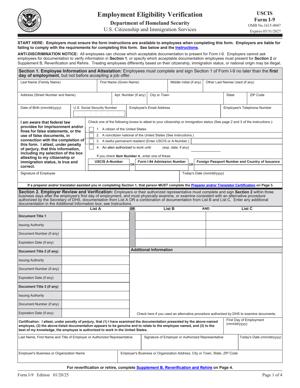
USCIS Form I-9 – Employment Eligibility Verification is a federal document used to confirm that a person hired to work in the United States is authorized to do so. It connects your identity with your legal right to work. Every new hire and employer in the United States interacts with this form at the start of employment.
If you are starting a new job, you will complete part of this form. If you are hiring someone, you are responsible for reviewing documents and completing the employer section. The process is required for most paid positions, regardless of citizenship.
This form matters because it helps ensure that employers hire only individuals who are authorized to work under federal law. It also creates a record showing that the employer verified work authorization in a consistent way.
Even though the form is short, it carries significant responsibility. Errors, missing information, or incomplete documentation can create compliance issues for employers and delays or confusion for employees.
Understanding what the form does and how it works helps you complete it accurately and confidently.
What is USCIS Form I-9 – Employment Eligibility Verification?
Clear definition
USCIS Form I-9 – Employment Eligibility Verification is a federally required employment verification document. It confirms two things: your identity and your authorization to work in the United States.
The form is divided into sections. One section is completed by the employee. Another section is completed by the employer. In some cases, additional sections are used for reverification or rehiring.
The form requires the employee to provide personal information and to attest to their citizenship or immigration status. It also requires the employer to physically examine original documents that prove identity and work authorization.
The document is not submitted to the government in most cases. Instead, employers must keep it on file and make it available for inspection if requested by federal authorities.
Who typically uses this form?
Employees complete this form when they are hired for a new job. This includes U.S. citizens, lawful permanent residents, and noncitizens who are authorized to work.
Employers use the form for every new hire. This applies to businesses of all sizes, nonprofit organizations, and certain government entities. The requirement generally applies whether the employee works full-time, part-time, or for a limited duration.
Human resources staff often handle the employer portion in larger organizations. In smaller businesses, an owner or manager may complete the employer section.
Independent contractors typically do not complete this form for the companies they contract with. The requirement usually applies to individuals who are considered employees under federal employment rules.
Why might you need this form?
You need this form when you begin a new job in the United States. Completion is part of the onboarding process.
Employers need it to document that they verified a new hire’s identity and employment eligibility. Without it, the employer may not have proof that they followed federal verification requirements.
You may also encounter the form again if you are rehired by a former employer within a certain timeframe. In some cases, a previous form may be updated rather than creating a new one.
The form may also be used when employment authorization has an expiration date. In those situations, the employer may complete an additional section to reverify continued eligibility to work.
Typical real-life scenarios
- You accept an offer for a full-time office position. On your first day, you are asked to complete the employee section of the form and present acceptable documents. The employer reviews your documents and completes their section within the required timeframe.
- You are hired for a seasonal retail job during the holidays. Even though the position is temporary, the employer must still complete the form because you are an employee receiving wages.
- You are a lawful permanent resident starting a new job after relocating to another state. Even though you have worked in the United States for years, your new employer must complete a new form for this employment relationship.
- You return to a company you previously worked for. Depending on how much time has passed and whether your work authorization has changed, the employer may complete a new form or update the previous one.
- You have temporary work authorization that will expire in the future. Your employer completes the form at hiring and later updates it to confirm that you remain authorized to work.
When would you use USCIS Form I-9 – Employment Eligibility Verification?
You use this form each time a new employment relationship begins. It applies to most hires made after a job offer has been accepted.
For employees, the form is typically completed at the beginning of employment. The employee section is generally filled out no later than the first day of work for pay.
For employers, the form becomes relevant as soon as someone is officially hired. The employer must examine original documentation within a short period after the employee starts working.
The form is commonly used across industries. Office workers, healthcare staff, construction workers, teachers, hospitality employees, and technology professionals all complete this document when hired.
Remote work arrangements also involve this form. Even if an employee works from home, the employer must still verify identity and work authorization through proper document review procedures.
The form may be used again in situations involving rehire. If an employee leaves and later returns, the employer may update or complete a new form depending on timing and prior records.
It is also used when an employee’s work authorization has an expiration date. In that case, the employer may need to reverify authorization before the previous documentation expires.
Legal characteristics of USCIS Form I-9 – Employment Eligibility Verification
This form is required under federal immigration law. Its legal force comes from statutes that prohibit employers from knowingly hiring individuals who are not authorized to work in the United States.
For the form to be effective, it must be completed fully and accurately. The employee must provide complete personal information and sign the attestation. The employer must review acceptable original documents and record the required details.
Common problems include missing signatures, incomplete fields, incorrect document information, and failure to meet timing requirements. Using expired or unacceptable documents can also create issues.
The form must be retained for a specific period tied to the employee’s hire date and termination date. Employers are generally required to store completed forms and make them available for inspection upon request.
Because this is a federal requirement, the rules apply across all states. However, some states may have additional employment verification processes that operate alongside this form. Those state processes do not replace the federal requirement.
This document does not grant work authorization. It only records that the employer reviewed documents that appear to establish identity and employment eligibility. It also does not replace immigration applications, visas, or permanent resident documentation.
The form does not create an employment contract. It does not define job duties, pay, benefits, or length of employment. Its purpose is limited to verification and recordkeeping.
Is it legally binding?
Yes, in the sense that it is a mandatory compliance document under federal law. Both the employee and the employer are required to complete their respective sections truthfully.
When an employee signs the form, they attest under penalty that the information provided is correct. Providing false information can have serious consequences.
When an employer signs the form, they attest that they examined the presented documents and that, to the best of their knowledge, the employee is authorized to work. This signature creates a legal record of the employer’s verification process.
However, the form is not a contract between the employer and the employee. It does not bind either party to continued employment. It simply documents compliance with federal employment eligibility verification requirements.
How to fill out USCIS Form I-9 – Employment Eligibility Verification
Step 1 – Complete the employee information section
If you are the employee, begin by entering your full legal name, including any other names used if required by the form. Provide your current address, date of birth, and other requested identifying information. Fill in each field clearly and accurately. This section is generally completed no later than your first day of employment for pay.
Step 2 – Attest to your citizenship or immigration status
In the employee section, you must select the statement that describes your status. The options typically include U.S. citizen, noncitizen national, lawful permanent resident, or noncitizen authorized to work. If you select a category that requires additional information, such as an alien registration number or expiration date, enter it exactly as shown on your document.
Step 3 – Sign and date the employee certification
After reviewing your entries for accuracy, sign and date the form in the space provided. Your signature confirms that the information is true and correct to the best of your knowledge. The date should reflect when you completed and signed the employee section.
Step 4 – Complete the preparer or translator section if applicable
If someone assisted you in completing the form due to language or other reasons, that person must complete the preparer or translator section. They provide their name, address, and signature. If you completed the form on your own, indicate that no preparer or translator was used, following the form’s instructions.
Step 5 – Present original documents to the employer
After completing your section, present original, unexpired documents that establish your identity and employment authorization. The form provides categories of acceptable documents. You may present documents from one specified list or a combination of other lists, as described in the form’s instructions. Photocopies are generally not acceptable unless specifically allowed.
Step 6 – Employer reviews the documents in person
The employer examines the documents you present. The review is typically done in your physical presence. The employer checks that the documents appear genuine and relate to you. The employer does not determine immigration status beyond reviewing the documents listed as acceptable.
Step 7 – Employer records document information
In the employer section, the employer enters details from the documents you provided. This usually includes the document title, issuing authority, document number, and expiration date if applicable. The employer must record the information carefully and ensure all required fields are completed.
Step 8 – Employer completes employment details
The employer enters the employee’s first day of employment for pay in the designated field. This date is important because it connects the verification process to the start of the employment relationship. The employer also provides the business name and address in the appropriate section.
Step 9 – Employer signs and dates the certification
Once the document review and entries are complete, the employer signs and dates the employer certification section. The signature confirms that the employer examined the documents and believes them to be genuine and related to the employee. The date reflects when the employer completed this review.
Step 10 – Retain the completed form
After both sections are finished, the employer keeps the completed form in its records. The form is not typically sent to a government agency at the time of completion. It must be stored securely and be available for inspection if required under federal rules.
Legal terms you might encounter in USCIS Form I-9 – Employment Eligibility Verification
- Employment Authorization: This refers to your legal permission to work in the United States. On this form, you must confirm whether you are a citizen, noncitizen national, lawful permanent resident, or an alien authorized to work. Your selection determines what supporting documents you must present.
- Lawful Permanent Resident (LPR): A person who has been granted the right to live and work permanently in the United States. If you select this status in Section 1, you must provide your Alien Registration Number. Your Permanent Resident Card is commonly used as proof.
- Alien Registration Number (A-Number): A unique number assigned to certain noncitizens by immigration authorities. If you are a lawful permanent resident or certain other categories of noncitizen, you will enter this number in Section 1. It is also listed on many immigration documents.
- USCIS Number: A unique identifier issued by U.S. Citizenship and Immigration Services. Some documents, such as Permanent Resident Cards, list a USCIS Number instead of or in addition to an A-Number. You enter the correct number exactly as it appears on your document.
- List A, List B, and List C Documents: These are categories of acceptable documents that prove identity and employment authorization. List A documents prove both identity and work authorization. List B proves identity only, and List C proves work authorization only. The employer records the documents you present.
- Preparer and/or Translator Certification: This section is completed if someone helps you fill out Section 1. The person assisting must provide their name, address, and signature. This confirms they accurately translated or helped complete the information you provided.
- Reverification: This applies when an employee’s work authorization has an expiration date. Employers use Supplement B (formerly Section 3) to reverify continued authorization before it expires. This ensures ongoing compliance with employment eligibility rules.
- Receipt Rule: In limited cases, you may present a receipt instead of the original document if the original was lost, stolen, or damaged. The receipt is temporary. You must later present the actual document within the required timeframe.
- Employer Certification: This is the employer’s attestation that they examined the documents in person and believe them to be genuine and related to the employee. The employer signs and dates this section. It carries legal responsibility for an accurate review.
- Discrimination in Hiring: The form must be completed for all employees, regardless of citizenship status. Employers cannot request specific documents or treat employees differently based on national origin or immigration status. The document process must be applied consistently.
FAQs
Do I need to complete USCIS Form I-9 – Employment Eligibility Verification before my first day of work?
You must complete Section 1 of this document no later than your first day of employment. That means you fill out your personal information and attest to your status on or before the day you start work. The employer completes their portion within three business days after your first day.
What address should I enter if I just moved?
Enter your current physical address where you live at the time you complete Section 1. Do not use a P.O. box. If you move later, you do not update this form for that reason alone, but you should update your employer’s internal records separately.
What if my name on my identity document is slightly different from my current legal name?
You must enter your full legal name in Section 1 exactly as it appears now. If your document shows a prior name, the employer may ask for clarification to ensure the document relates to you. Small differences, like a missing middle name, should be reviewed carefully so the employer can confirm consistency before completing their certification.
Can I choose which documents to present?
Yes. This form includes a list of acceptable documents. You decide which valid document or combination of documents to present from the lists. The employer cannot require a specific document as long as what you present is on the acceptable list and appears genuine.
What happens if my work authorization has an expiration date?
If you indicate that you are authorized to work until a specific date, that date must be entered in Section 1. Before that date passes, the employer must complete the reverification section using updated proof of authorization. If you do not provide renewed documentation in time, you may not be allowed to continue working.
Do I need to attach copies of my documents to this form?
You are not required to attach copies when completing this document unless your employer has a consistent internal policy of copying documents for all employees. The employer records the document title, issuing authority, number, and expiration date directly on the form. If copies are made, they should be kept with the completed record.
What if I make a mistake in Section 1 after I sign it?
If you notice an error, correct it as soon as possible. Draw a single line through the incorrect information, enter the correct information, and initial and date the change. Do not use correction fluid or erase entries, because the record must remain clear and readable.
Is this form filed with a government agency after it is completed?
This document is not routinely submitted to a government office. The employer keeps it on file and must make it available if requested during an inspection. Proper retention and storage are part of the employer’s responsibility under USCIS Form I-9 – Employment Eligibility Verification rules.
Checklist: Before, During, and After USCIS Form I-9 – Employment Eligibility Verification
Before
- Confirm your legal name as it appears on official documents.
- Gather original, unexpired identity and work authorization documents.
- Review the list of acceptable documents, so you know your options.
- Verify your Social Security number for accuracy, if you plan to provide it.
- Know your employment start date.
- Arrange for a preparer or translator if you need help understanding the form.
- Check document expiration dates to avoid last-minute issues.
During
- Complete Section 1 on or before your first day of work.
- Enter your full legal name, address, and date of birth carefully.
- Select the correct citizenship or immigration status box.
- Provide your A-Number or USCIS Number if required for your status.
- Sign and date the employee certification section yourself.
- Ensure any preparer or translator completes their certification fully.
- Present original documents to your employer within three business days.
- Review the employer’s entries for obvious errors before finalizing.
After
- Confirm the employer signed and dated their certification section.
- Check that document numbers and expiration dates were recorded correctly.
- Keep personal copies of the documents you presented for your records.
- Note any future expiration date related to your work authorization.
- Inform your employer of a legal name change if it occurs later.
- Provide updated authorization documents before your current one expires.
- Store any related employment records in a safe place.
Common mistakes to avoid with USCIS Form I-9 – Employment Eligibility Verification
- Mistake: Waiting until after your first workday to complete Section 1, which happens when onboarding feels rushed and can lead to compliance issues; do not forget that you must finish your section by your first day of employment.
- Mistake: Bringing photocopies instead of original documents, often because you assume copies are acceptable, which can delay verification; do not forget that original, unexpired documents are required in most cases.
- Mistake: Selecting the wrong immigration status box due to confusion about terminology, which may require corrections and additional documentation; do not forget to read each status description carefully before checking a box.
- Mistake: Entering an incorrect A-Number or document number because of transposed digits, which can create record inconsistencies; do not forget to double-check every number against your original document.
- Mistake: Forgetting to sign and date the form, which happens when focusing only on document presentation and can invalidate your section; do not forget that your signature confirms the truth of your statements.
- Mistake: Failing to track an upcoming work authorization expiration date, often due to a misunderstanding of verification rules, which can interrupt employment; do not forget to monitor and renew your authorization before it expires.
- Mistake: Allowing someone to help complete Section 1 without completing the preparer or translator certification, which may result in an incomplete record; do not forget that anyone who assists must sign their section.
- Mistake: Using nicknames or shortened names instead of your full legal name, which can cause mismatches with official records; do not forget to enter your complete legal name as it appears on formal documents.
What to do after filling out USCIS Form I-9 – Employment Eligibility Verification
Once the form is complete, your role is not entirely finished. You need to make sure the information stays accurate during your employment.
- Step 1: Review your completed Section 1 for accuracy. Confirm your name, date of birth, address, and status selection are correct.
- Step 2: Verify that the employer completed their section within three business days of your start date. Check that the employment start date listed matches your actual first day of work.
- Step 3: Ensure the document information recorded matches what you presented. Look at document titles, numbers, and expiration dates for errors.
- Step 4: Keep a personal record of which documents you presented. While the employer retains the form, you should know what was used in case questions arise later.
- Step 5: Mark your calendar if your work authorization has an expiration date. Plan ahead to renew any necessary documentation so you can provide updated proof before the expiration.
- Step 6: Notify your employer if you legally change your name. While the original form is not redone for a name change alone, the employer may update records to reflect your new legal name.
- Step 7: Respond promptly if your employer contacts you about reverification. Bring updated original documents before your current authorization expires.
- Step 8: Maintain copies of any new employment authorization documents you receive in the future. This helps you act quickly when reverification is required.
- Step 9: If you discover a past error, request a proper correction rather than creating a new form without explanation. Corrections should be transparent and dated.
- Step 10: Understand that the employer must retain the form for a required period after your employment ends. You do not file it yourself, but you should cooperate if information is requested during your employment.
By staying organized and proactive, you reduce the risk of employment interruptions. Treat this document as part of your long-term employment record, not just a one-day hiring task.
Disclaimer: This guide is provided for informational purposes only and is not intended as legal advice. You should consult a legal professional.