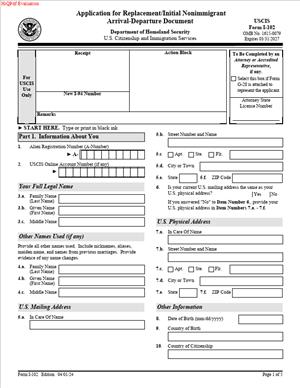
USCIS Form I-102 – Application for Replacement or Initial Nonimmigrant Arrival-Departure Document
Fill out nowJurisdiction: Country: United States | Province or State: Federal
USCIS Form I-102 – Application for Replacement or Initial Nonimmigrant Arrival-Departure Document is used to request a replacement or initial arrival-departure record. This record is commonly known as Form I-94. It shows when you entered the United States and how long you are allowed to stay.
If your arrival-departure record was lost, damaged, or contains incorrect information, this form allows you to ask for a corrected or replacement document. In some situations, it is also used to request an initial I-94 if one was never issued.
This form matters because your I-94 record confirms your lawful admission and your authorized period of stay. Employers, schools, and government agencies often rely on this record. Errors or missing information can create problems with employment, driver’s licenses, benefits, or future immigration filings.
USCIS Form I-102 – Application for Replacement or Initial Nonimmigrant Arrival-Departure Document is filed with U.S. Citizenship and Immigration Services, which operates under the Department of Homeland Security. It is a federal immigration form, and the rules apply across all U.S. states and territories.
What is USCIS Form I-102 – Application for Replacement or Initial Nonimmigrant Arrival-Departure Document?
Clear definition
USCIS Form I-102 – Application for Replacement or Initial Nonimmigrant Arrival-Departure Document is a formal request to issue a replacement or initial Form I-94. The I-94 is the official arrival-departure record for most nonimmigrants admitted to the United States.
The document confirms key details about your entry. It usually shows your date of admission, class of admission, and the date your authorized stay expires, or whether you were admitted for “duration of status.”
When you submit this form, you are asking the government to correct its records or provide proof of your admission. It does not grant a new visa or extend your stay. It focuses only on the arrival-departure record.
Who typically uses this form?
Nonimmigrants who were lawfully admitted to the United States often use this form. This includes people in visitor, student, exchange visitor, temporary worker, or other non-immigrant categories.
Students and exchange visitors may use it if their I-94 was issued with the wrong classification. Temporary workers may need it if the expiration date does not match their approval notice. Visitors may need a replacement if their paper I-94 was lost.
In limited cases, certain nonimmigrants admitted at a land border without receiving an I-94 may request an initial record. The form is not used by U.S. citizens or lawful permanent residents to replace green cards.
Why might you need this form?
You might need this form if your I-94 was lost, stolen, or destroyed. Without it, you may have difficulty proving that you entered the United States lawfully.
You may also need it if your I-94 contains incorrect information. For example, the class of admission may be wrong, or the expiration date may not match your approved petition or status.
Another reason is if you were admitted but never received an I-94 record. In that case, this filing can serve as a request for an initial document that reflects your lawful entry.
Typical real-life scenarios
- You entered the United States as a student. Later, you notice that your I-94 lists you as a visitor instead of a student. This mismatch affects your school enrollment and work authorization. You file this form to request a corrected record.
- You were admitted as a temporary worker with an approval notice valid for two years. Your I-94, however, shows an expiration date several months earlier. You use this form to request a replacement I-94 that matches your approved period of stay.
- You were given a paper I-94 card at a land border. After returning home, you cannot find the card. When applying for a driver’s license, you are asked to show proof of lawful admission. You submit this form to request a replacement.
- You entered years ago and now need proof of your lawful admission for a separate immigration application. You discover that your I-94 was never properly issued. You use this form to request an initial arrival-departure document that reflects your entry.
When would you use USCIS Form I-102 – Application for Replacement or Initial Nonimmigrant Arrival-Departure Document?
You use this form when the issue relates specifically to your arrival-departure record. It is appropriate when the record is missing, damaged, or contains incorrect details that affect your status documentation.
It is often used after admission at an airport, seaport, or land border when the admission details are wrong. It may also be used after an extension or change of status approval if the I-94 portion of the approval notice contains an error.
Students, exchange visitors, and temporary workers may use it to correct classification errors. Visitors may use it to replace a lost document needed for identification or proof of lawful presence.
This form is not used to request an extension of stay, a change of status, or a correction of a visa stamp in your passport. It also does not replace an employment authorization document or a permanent resident card. Each of those requests uses a different form.
Legal characteristics of USCIS Form I-102 – Application for Replacement or Initial Nonimmigrant Arrival-Departure Document
This is a federal immigration filing. It must be completed accurately and signed. The information you provide becomes part of your official immigration record.
The form is considered properly filed when it is submitted with the correct fee, signature, and required supporting documents. Missing pages, unsigned forms, or incorrect fees commonly result in rejection. Inconsistent information can lead to delays or requests for additional evidence.
The form is reviewed under federal immigration law. Because it is federal, the same general rules apply in every state. However, how a corrected or replacement I-94 affects other processes, such as state driver’s license issuance, may vary by state agency practice.
This filing does not grant a new period of stay. It does not forgive overstays or violations. It is limited to replacing or issuing an arrival-departure document that reflects your lawful admission or approved status.
Is it legally binding?
The form itself is a sworn request to the federal government. When you sign it, you are declaring under penalty of perjury that the information is true and correct to the best of your knowledge.
If the application is approved, the replacement or initial I-94 becomes part of your official immigration record. Government agencies may rely on that record to determine your lawful status and authorized stay.
Because you sign the form under penalty of perjury, false statements can have serious consequences. Accuracy is essential. The legal effect comes from the government’s issuance or correction of the I-94, not from the act of filing alone.
How to fill out USCIS Form I-102 – Application for Replacement or Initial Nonimmigrant Arrival-Departure Document
Step 1 – Review the instructions and confirm eligibility
Start by carefully reading the form and its instructions. Confirm that your situation involves a lost, damaged, incorrect, or missing arrival-departure record. Make sure this form matches your specific need, such as a replacement or an initial I-94.
Step 2 – Provide your personal information
Enter your full legal name, mailing address, and physical address if different. Include your date of birth, country of birth, and country of citizenship or nationality. Provide your Alien Registration Number or USCIS online account number if you have one.
Ensure that your name matches your passport and other immigration documents. If you have used other names, list them where requested.
Step 3 – Describe your last entry into the United States
Provide details about your most recent entry. This typically includes the date of entry, the city and state of entry, and the class of admission. Use the information from your passport stamp, approval notice, or any existing I-94 record.
If you are requesting a correction, clearly identify what information is incorrect and what the correct information should be.
Step 4 – Explain the reason for your application
Select or indicate the reason you are filing. This may include a lost or stolen I-94, a damaged document, incorrect information, or failure to receive an I-94 at admission.
If space is provided for explanation, describe what happened in clear, direct language. Include relevant dates and facts. Avoid adding unrelated immigration history unless the form asks for it.
Step 5 – Provide information about your current immigration status
State your current nonimmigrant status and the expiration date of your authorized stay, if applicable. If you were admitted for a duration of status, indicate that as shown on your record.
If you have an approval notice related to your status, provide the receipt number and details as requested. Ensure that this information is consistent with the documents you plan to submit.
Step 6 – Prepare supporting documentation
Gather copies of documents that support your request. This often includes a copy of your passport biographic page, visa page, passport admission stamp, and any prior I-94 record.
If you are requesting a correction, include documents that show the correct information, such as an approval notice. Copies must be clear and readable.
Step 7 – Complete the applicant’s statement and contact information
Indicate whether you read and understood the form in English or used an interpreter. Provide your daytime phone number, mobile number if requested, and email address.
Review every page for accuracy. Check spellings, dates, and numbers. Confirm that all required fields are completed.
Step 8 – Sign and date the form
Sign the form in the space provided. Enter the date of signature. An unsigned form is generally rejected.
If someone helped you complete the form, ensure that the preparer or interpreter section is completed and signed as required.
Step 9 – Assemble the filing package
Place the completed and signed form together with the required filing fee and supporting documents. Keep a complete copy of everything for your records.
Organize the documents in a clear order so that your request and supporting evidence are easy to review. Once assembled, your package is ready for submission under the applicable filing procedures.
Legal terms you might encounter in USCIS Form I-102 – Application for Replacement or Initial Nonimmigrant Arrival-Departure Document
- Arrival-Departure Record (Form I-94): This is the document that shows when you entered the United States, your immigration category, and how long you are allowed to stay. This form is used to request a replacement paper I-94 or an initial I-94 in limited situations. The information you provide must match your most recent entry record.
- Nonimmigrant Status: This refers to a temporary immigration category, such as visitor, student, or temporary worker. On this form, you must identify the exact status you held when you last entered the United States. The status determines whether you are eligible to request a replacement or an initial document.
- Class of Admission: This is the specific code given to your nonimmigrant category at entry, such as B-2, F-1, or H-1B. You must enter this code as it appears on your entry record. An incorrect code can delay processing or lead to a mismatch in your records.
- Date of Last Entry: This is the most recent date you physically entered the United States. The form requires you to list this date exactly as recorded in your immigration history. You may need to check your passport stamp or electronic record to confirm accuracy.
- Port of Entry: This is the airport, land border, or seaport where you were inspected and admitted. The form asks you to identify this location clearly. It helps immigration authorities locate your original entry record.
- Receipt Notice: After you file, you may receive a notice confirming that your application was accepted for processing. This notice contains a receipt number you can use to track your case. Keep it with your immigration documents.
- Immigration Record: This includes your history of entries, exits, and any prior filings. When you complete the form, you are updating or correcting part of this official record. The information must be consistent with your prior applications.
- Supporting Documentation: These are copies of documents you include to prove your identity and entry details. Examples include passport biographic pages, visas, entry stamps, and any prior arrival-departure documents. The form instructions explain what evidence is required for your specific situation.
- Signature Under Penalty of Perjury: When you sign the form, you confirm that everything you wrote is true and correct. False information can result in denial or future immigration consequences. You must sign by hand unless electronic filing instructions state otherwise.
FAQs
Can I use USCIS Form I-102 – Application for Replacement or Initial Nonimmigrant Arrival-Departure Document if I overstayed my visa?
This form is generally used to replace or obtain an arrival-departure record, not to fix an overstay. When completing this document, you must list your last date of entry and your class of admission. If your authorized stay has expired, the form does not automatically extend it. Review your I-94 expiration date before filing and understand that the application does not change that date.
What if I do not remember my exact date of last entry?
You should check your passport admission stamp or your electronic arrival record to confirm the exact date. The form asks for the specific day, month, and year. If you guess and the date does not match government records, processing may be delayed. Always verify before you write the date on this document.
Do I need to submit my original passport with this form?
You typically submit copies, not originals. The instructions for USCIS Form I-102 – Application for Replacement or Initial Nonimmigrant Arrival-Departure Document explain what evidence to include. You should copy the biographic page of your passport and any relevant visa or admission stamps. Keep your original passport in your possession unless specifically instructed otherwise.
How do I explain that my previous arrival-departure document was lost or stolen?
There is a section that asks you to state the reason for your application. Be direct and factual. If it was lost or stolen, clearly say so and provide any details requested, such as when you discovered it was missing. Make sure the explanation matches any police report or written statement you attach.
Can someone else sign the form for me?
You must sign the form yourself unless you are a minor or legally unable to sign. If a preparer helps you complete it, that person must complete the preparer section. The signature confirms that the information is accurate, so do not let someone sign on your behalf unless the form specifically allows it.
What happens if my name is spelled differently on my passport and prior records?
You must write your name exactly as it appears in your current passport in the main name fields. If you have used other names, list them in the section for other names used. Consistency is important because this form updates or replaces part of your official immigration record. Make sure every variation is clearly disclosed.
Will filing this form change my immigration status?
This document does not request a change of status. It is used to replace or obtain an arrival-departure record. When you complete USCIS Form I-102 – Application for Replacement or Initial Nonimmigrant Arrival-Departure Document, you are asking for documentation of your admission, not a new status or extension of stay.
How will I know if my application was accepted for processing?
After you submit the form, you should receive a receipt notice if it is accepted. This notice confirms that the filing was received and includes a tracking number. If your package is rejected due to missing information or incorrect payment, it may be returned to you. Review any notice carefully and keep it with your records.
Checklist: Before, During, and After USCIS Form I-102 – Application for Replacement or Initial Nonimmigrant Arrival-Departure Document
Before
- Confirm that you are eligible to request a replacement or initial arrival-departure document.
- Locate your passport, visa, and any prior arrival-departure records.
- Verify your exact date of last entry and port of entry.
- Confirm your class of admission as shown on your most recent record.
- Review the current filing fee and accepted payment methods.
- Read the full form instructions from start to finish.
- Gather copies of supporting documents you will need to attach.
During
- Type or print clearly in black ink if filing by paper.
- Enter your full legal name exactly as it appears on your passport.
- Provide all other names used, if any.
- Accurately list your date of birth, country of citizenship, and passport details.
- Carefully enter your last entry date, port of entry, and class of admission.
- Clearly explain the reason for your application in the space provided.
- Complete the applicant statement and preparer section, if applicable.
- Review every page for completeness before signing.
- Sign and date the form in the correct place.
After
- Make a complete copy of the signed form and all attachments for your records.
- Assemble the filing package in the order listed in the instructions.
- Include the correct filing fee or payment authorization.
- Mail or submit the package according to the current filing instructions.
- Track delivery if you send it by mail.
- Watch for a receipt notice confirming acceptance.
- Respond promptly to any request for additional evidence.
- Store your receipt notice and final approval with your immigration documents.
Common mistakes to avoid with USCIS Form I-102 – Application for Replacement or Initial Nonimmigrant Arrival-Departure Document
- Mistake: Entering an incorrect date of last entry because you rely on memory, which happens when you do not check your passport or electronic record, leading to record mismatches and delays, so do not forget to verify the exact date before writing it down.
- Mistake: Listing the wrong class of admission because you confuse your visa type with your admission code, which can cause processing issues or denial, so do not forget to copy the code exactly as shown on your entry record.
- Mistake: Forgetting to sign the form, which often happens when you focus on attachments and overlook the signature page, resulting in rejection, do not forget to sign and date in the correct box.
- Mistake: Sending original documents when only copies are required, which happens out of fear that copies are not enough and can risk losing important records, so do not forget to keep your originals unless specifically instructed otherwise.
- Mistake: Failing to include the correct filing fee because you did not check the latest amount, which can lead to the entire package being returned, so do not forget to confirm the current fee before submitting.
- Mistake: Leaving sections blank without confirming they are optional, which happens when you are unsure how to answer and skip the question, causing delays or requests for evidence, so do not forget to review each question and follow the instructions for not applicable responses.
- Mistake: Not keeping a full copy of what you submitted, which often happens when you are in a hurry to mail the package and later need proof of what you filed, so do not forget to save a complete copy for your records.
- Mistake: Providing inconsistent name spellings across documents because you do not review prior filings, which can create confusion in your immigration record, do not forget to list all other names used and keep spellings consistent.
What to do after filling out USCIS Form I-102 – Application for Replacement or Initial Nonimmigrant Arrival-Departure Document
Once you finish the form, pause before you send it. A careful final review can prevent weeks of delay.
- Step 1: Read through every answer slowly and compare it to your passport and prior records. Make sure dates, names, and numbers match exactly.
- Step 2: Confirm that you signed and dated the form in the correct place. If someone helped you, check that the preparer section is complete.
- Step 3: Photocopy or scan the entire package, including the form, supporting documents, and payment confirmation. Store this copy in a safe place.
- Step 4: Assemble your filing package in the correct order. Place the form on top, followed by supporting documents, and then payment if required.
- Step 5: Double-check the filing address or submission method listed in the current instructions. Filing at the wrong location can delay processing.
- Step 6: Send the package using a delivery method that provides confirmation. Keep proof of delivery with your copy of the application.
- Step 7: Monitor your mail and contact information. If you move after filing, you must update your address according to official procedures so you do not miss important notices.
- Step 8: When you receive a receipt notice, review it for accuracy. Confirm that your name is spelled correctly and that the notice reflects the correct type of application.
- Step 9: Keep all correspondence together. Create a simple file with your receipt notice, copies of what you submitted, and any later communications.
- Step 10: If you receive a request for additional evidence, respond by the deadline listed. Provide clear copies and organize your response so it is easy to review.
Staying organized is part of protecting your immigration record. Treat every notice and copy as an important legal document. Careful follow-up helps ensure that your replacement or initial arrival-departure document is issued without unnecessary delay.
Disclaimer: This guide is provided for informational purposes only and is not intended as legal advice. You should consult a legal professional.