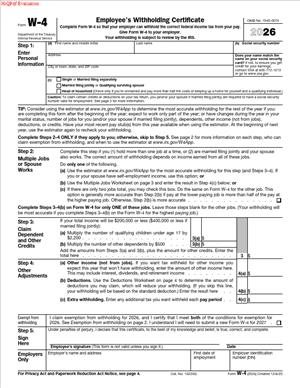
Form W-4 – Employee’s Withholding Certificate
Fill out nowJurisdiction: Country: United States | Province or State: Federal
Form W-4 – Employee’s Withholding Certificate is the document you complete so your employer knows how much federal income tax to withhold from your paycheck. It directly affects the amount of money you take home each pay period and whether you may receive a refund or owe taxes later.
You usually fill out this form when you start a new job. You may also update it when your financial or family situation changes. The information you provide helps calculate your federal income tax withholding under current tax rules.
This form does not determine how much tax you ultimately owe for the year. Instead, it guides how much is withheld in advance from your wages. Your final tax liability is calculated when you file your annual federal income tax return.
If you complete the form carefully, your withholding can more closely match your expected tax bill. If the form is incomplete or inaccurate, you may have too little or too much tax withheld during the year.
Understanding how the form works before you fill it out can help you avoid surprises at tax time and reduce the need for later corrections.
What is Form W-4 – Employee’s Withholding Certificate?
Clear definition
Form W-4 – Employee’s Withholding Certificate is a federal tax document used by employees to tell employers how much federal income tax to withhold from wages. It is completed by the employee and kept by the employer in payroll records.
The form collects basic identifying information and details that affect withholding, such as filing status, multiple jobs, dependents, and other income or deductions. Employers use this information along with federal withholding tables to calculate the amount taken from each paycheck.
The document applies only to federal income tax withholding. It does not replace state or local withholding forms, which may be separate depending on where you work.
Who typically uses this form?
Most employees in the United States complete this form when they begin paid employment. This includes full-time, part-time, seasonal, and temporary workers whose wages are subject to federal income tax withholding.
New hires are the most common users. However, current employees also use the form when they want to adjust their withholding due to life changes. Payroll departments rely on the completed form to process wages accurately.
Independent contractors generally do not use this form because taxes are not withheld from their payments in the same way. Instead, it is designed for workers classified as employees for federal tax purposes.
Why might you need this form?
You need this form so your employer can calculate the correct amount of federal income tax to withhold from your pay. Without it, your employer may be required to withhold at a default rate, which might not reflect your actual situation.
You might also complete a new form if your filing status changes, such as after marriage or divorce. Changes in dependents, additional jobs, or other income sources can also affect withholding and prompt an update.
Submitting an updated form allows your payroll department to adjust withholding going forward. It does not automatically correct amounts already withheld earlier in the year.
Typical real-life scenarios
- You accept a new job after graduating from college. On your first day, you complete onboarding paperwork, including this form, so payroll can begin processing your wages correctly.
- You get married during the year and plan to file a joint tax return. You update your withholding to reflect your new filing status and combined household income.
- You take on a second job in the evenings. Because both jobs withhold taxes separately, you adjust your form to help avoid under-withholding across both positions.
- You have a child and expect to claim a tax credit. You revise your form so that withholding better reflects your updated family situation.
- You previously requested extra withholding to cover additional income, but that income has stopped. You file a new form to reduce the additional amount being withheld from each paycheck.
When would you use Form W-4 – Employee’s Withholding Certificate?
You typically use this form at the start of employment. Employers usually provide it as part of the new hire paperwork before you receive your first paycheck.
You also use the form when your personal or financial situation changes in a way that affects your federal income tax. Common triggers include marriage, divorce, the birth or adoption of a child, or a significant change in income.
If you move from part-time to full-time work, or begin earning income from multiple jobs, you may decide to review your current withholding. The form allows you to update how much is taken from each paycheck.
Employees who receive large bonuses, commissions, or other variable compensation sometimes reassess their withholding during the year. Filing a new form can adjust future payroll calculations.
If you previously claimed exemption from withholding and your situation changes, you may need to submit a new form for the current year. The form reflects your current tax situation, not a permanent election.
Legal characteristics of Form W-4 – Employee’s Withholding Certificate
This form is a federal tax document used within the payroll system. It becomes effective when you complete it, sign it, and submit it to your employer. The employer then applies the information to calculate withholding under federal rules.
For the form to function properly, it must include accurate identifying information, such as your name, address, and taxpayer identification number. Missing or incorrect information can delay processing or lead to default withholding treatment.
Employers generally rely on the information you provide without independently verifying every detail. However, if the form appears invalid on its face or contains obvious errors, payroll may request clarification or correction.
The form is not filed with the federal tax authority in most routine cases. Instead, it is retained by the employer as part of payroll records. In certain circumstances, employers may be required to submit copies or respond to specific withholding notices.
This document does not replace your annual tax return. It does not calculate your final tax or settle your tax obligations for the year. It only affects how much tax is withheld from wages during the year.
Federal law governs this form nationwide. States may have separate withholding certificates for state income tax, which operate under different rules. Completing the federal form does not automatically satisfy state requirements.
Common problems include failing to sign the form, providing inconsistent information, or misunderstanding the multiple jobs section. Errors can result in under-withholding, which may lead to a balance due at tax time, or over-withholding, which reduces take-home pay during the year.
Is it legally binding?
Form W-4 – Employee’s Withholding Certificate is a signed federal tax document. When you sign it, you declare under penalty of perjury that the information you provided is true and correct to the best of your knowledge.
Because it is signed under penalty of perjury, intentionally providing false information can have legal consequences. The form carries legal weight in that it authorizes your employer to withhold federal income tax based on the details you report.
However, the form is not a contract between you and your employer. It does not create employment rights or change the terms of your job. Its legal effect is limited to tax withholding instructions within the payroll process.
If you later discover an error, you may submit a new form with corrected information. The updated document generally applies to future pay periods rather than retroactively changing prior withholdings.
How to fill out Form W-4 – Employee’s Withholding Certificate
Step 1 – Provide your personal information
Enter your full legal name, current address, and taxpayer identification number, typically your Social Security number. This information allows your employer to match the withholding instructions to your payroll record. Select your federal filing status from the available options, as this choice affects the basic withholding calculation.
Step 2 – Account for multiple jobs or a working spouse
If you have more than one job at the same time, or if you are married and both spouses work, review the section that addresses multiple jobs. This part helps adjust withholding so that total taxes withheld from all wages more closely match your combined income level. Follow the instructions within the form carefully to avoid under-withholding across jobs.
Step 3 – Claim dependents, if applicable
If you expect to claim qualifying dependents on your federal income tax return, enter the relevant amounts in the dependents section. This portion generally reflects available tax credits related to children or other qualifying individuals. The entries here reduce the amount of tax withheld from each paycheck.
Step 4 – Make other adjustments, if needed
Use the adjustments section if you have other income not subject to withholding, expect to claim deductions beyond the standard amount, or want extra tax withheld each pay period. Entering additional income can increase withholding. Requesting extra withholding allows you to set a specific additional dollar amount to be taken from each paycheck.
Step 5 – Review your entries for accuracy
Before signing, read through each section to confirm that names, numbers, and selections are complete and consistent. Check that your filing status aligns with your intended tax return status. Make sure any additional withholding amount is clearly written and realistic for your pay schedule.
Step 6 – Sign and date the form
Sign and date the certification section. Your signature confirms that the information provided is true and correct to the best of your knowledge. Without a signature, the form is not valid for payroll purposes.
Step 7 – Submit the form to your employer
Return the completed document to your employer or payroll department according to their instructions. Keep a copy for your records if possible. The updated withholding typically takes effect in a future pay period after payroll processes the submission.
Legal terms you might encounter in Form W-4 – Employee’s Withholding Certificate
- Withholding: This is the portion of your wages that your employer takes out and sends to the government on your behalf. On this form, you adjust how much is withheld from each paycheck. Your entries directly affect your take-home pay and your potential tax refund or balance due.
- Multiple Jobs Worksheet: This refers to the calculation method used when you have more than one job at the same time, or if you and your spouse both work. The worksheet helps you avoid under-withholding by accounting for combined income. You may use the worksheet or an online estimator to arrive at the correct additional amount to withhold.
- Dependent: A qualifying child or other qualifying relative you support who meets certain eligibility rules. In this form, you may enter a total credit amount for dependents. That number reduces the tax withheld from your pay.
- Additional Withholding: This is an extra dollar amount you choose to have withheld from each paycheck. You enter it as a flat amount. It is often used to cover side income, self-employment earnings, or to increase withholding to avoid a year-end tax bill.
- Exempt: This means you claim that no federal income tax should be withheld from your wages. To claim exempt status, you must meet specific income and prior-year refund conditions. If you write “Exempt” on the designated line, your employer will not withhold federal income tax, but other payroll taxes may still apply.
- Nonresident Alien: A person who is not a U.S. citizen and does not meet certain residency tests for tax purposes. Special withholding rules may apply. If this applies to you, you must follow additional instructions before completing this form.
- Tax Credit: A dollar-for-dollar reduction in the tax you owe. In this form, credits for dependents reduce the amount of income tax withheld from your pay. They are different from deductions, which reduce taxable income rather than being taxed directly.
- Deductions: Specific expenses that reduce your taxable income. If you expect to claim deductions greater than the standard deduction, you can reflect that on this form. Doing so may lower the amount withheld from each paycheck.
- Employer Identification Number (EIN): A unique number assigned to your employer for tax reporting purposes. While you do not enter your employer’s EIN on this form, it is used when your employer reports your wages and withholding to the government.
- Certification: The statement you sign at the end of the form. By signing, you confirm that the information is true and complete to the best of your knowledge. Your signature is required for the form to be valid.
FAQs
When does my withholding change after I submit this form?
Your withholding usually changes in the first payroll cycle that your employer can reasonably process after receiving this document. There is no retroactive correction of earlier pay unless your employer chooses to adjust through payroll. Review your next pay stub to confirm the updated withholding amount appears as expected.
Do I send Form W-4 – Employee’s Withholding Certificate to the government myself?
No. You give this form directly to your employer, not to the government. Your employer keeps it in their payroll records and uses it to calculate how much federal income tax to withhold from your wages.
What if I made a mistake after signing and submitting this document?
You cannot edit a form that has already been processed. Instead, complete a new one with the correct information and submit it to your employer. The newest valid form on file controls your withholding going forward.
How do I know if I should check the box for multiple jobs?
You should review whether you have more than one job at the same time or if your spouse also works. This document includes a checkbox and references a worksheet to help you calculate the right withholding. If you skip this step when it applies to you, too little tax may be withheld during the year.
What happens if I claim exempt status incorrectly?
If you claim exempt but do not qualify, too little or no federal income tax will be withheld. That can result in a large balance due when you file your tax return. You must ensure you meet the income and refund conditions before writing “Exempt” on this form.
Does this form affect Social Security and Medicare taxes?
No. This form only controls federal income tax withholding. Social Security and Medicare taxes are calculated under separate rules and are generally withheld at fixed rates based on your wages.
Do I need to attach proof of dependents or deductions?
You do not attach proof to this document when giving it to your employer. However, you should keep your own records in case you need to support your claims when filing your annual tax return. Your employer relies on the amounts you enter and does not verify them.
How often should I update my withholding information?
You should review your entries at least once a year and whenever your financial situation changes. Common triggers include marriage, divorce, the birth of a child, a new job, or a significant pay increase. Submit a new Form W-4 – Employee’s Withholding Certificate whenever your previous entries no longer reflect your situation.
Checklist: Before, During, and After Form W-4 – Employee’s Withholding Certificate
Before
- Gather your most recent pay stub to see current withholding amounts.
- Have your last filed tax return available for reference.
- Confirm your legal name matches your Social Security records.
- Determine whether you have more than one job or a working spouse.
- Count qualifying dependents and verify eligibility.
- Estimate any non-wage income, such as freelance or investment income.
- Review expected deductions beyond the standard deduction.
- Decide whether you want additional withholding each pay period.
During
- Enter your full legal name, address, and Social Security number clearly.
- Select the correct filing status that matches your tax situation.
- Complete the multiple jobs section if it applies to you.
- Calculate and enter the total credit amount for dependents.
- Add other income not from jobs if instructed to do so.
- Enter deductions if you expect to itemize and exceed the standard deduction.
- Specify any additional amount you want withheld from each paycheck.
- Review every line for math errors or skipped fields.
- Sign and date the certification section.
After
- Make a copy or take a clear photo for your records.
- Submit the signed form to your payroll or human resources department.
- Confirm with payroll that it has been received and processed.
- Check your next pay stub for updated withholding amounts.
- Store your copy with your tax records for the year.
- Set a reminder to review withholding before year-end.
- Submit a new form if your income or family situation changes.
- Keep documentation supporting credits or deductions claimed.
Common mistakes to avoid with Form W-4 – Employee’s Withholding Certificate
- Mistake: Leaving the multiple jobs section blank because it seems confusing, which happens when you overlook a second job or a working spouse, leading to under-withholding and a tax bill later—do not forget to actively confirm whether that box or worksheet applies to you.
- Mistake: Claiming exempt without meeting the income requirements, often due to a misunderstanding of prior-year refunds, which can result in zero withholding and a large balance due—do not forget to verify you qualify before writing “Exempt.”
- Mistake: Entering estimated dependent credits without checking eligibility, which happens when you assume all children qualify, causing incorrect withholding—do not forget to confirm each dependent meets the criteria.
- Mistake: Forgetting to sign and date the form, which occurs when you focus only on the numbers, making the document invalid—do not forget that your certification is required for payroll to process it.
- Mistake: Failing to update the form after a life change, such as marriage or a raise, which happens when you assume withholding adjusts automatically, potentially creating a tax shortfall—do not forget to submit a new form when circumstances change.
- Mistake: Adding large additional withholding amounts without reviewing your budget, which can happen when you try to “play it safe,” reducing your take-home pay more than intended—do not forget to balance accuracy with cash flow needs.
- Mistake: Using nicknames or mismatched Social Security numbers, often due to rushing, which can cause payroll reporting issues—do not forget to match your official records exactly.
- Mistake: Ignoring non-wage income like freelance work, which happens when you separate side income from your job mentally, leading to under-withholding—do not forget to account for all taxable income sources.
What to do after filling out Form W-4 – Employee’s Withholding Certificate
Once you complete the form, your job is not quite finished. You need to make sure it is properly delivered, processed, and reflected in your pay.
Start by reviewing every entry one more time. Small errors can affect your withholding for the entire year. Confirm your Social Security number, filing status, dependent amounts, and any additional withholding you entered.
- Step 1: Make a copy or take a clear photo of the signed form for your records.
- Step 2: Submit the original to your employer’s payroll or human resources department.
- Step 3: Ask when the changes will take effect in the payroll cycle.
- Step 4: Review your next pay stub carefully to confirm the new withholding amount.
- Step 5: Compare the updated withholding to your expectations and prior pay stubs.
- Step 6: Store your copy with your annual tax documents in a secure place.
- Step 7: Update your personal budgeting records to reflect any change in take-home pay.
- Step 8: Set a calendar reminder to review your withholding mid-year.
- Step 9: Complete and submit a new form if your income, marital status, or dependents change.
- Step 10: Keep supporting documentation for credits and deductions with your tax records.
You do not file this form with your annual tax return. It stays with your employer. However, the choices you make on it directly affect what appears on your year-end wage and tax statement.
If you notice that too much or too little tax is being withheld after a few pay periods, act promptly. Submit a revised form rather than waiting until tax season. Small adjustments during the year are easier to manage than a large correction later.
Finally, treat this document as a living record. Your financial life changes. Your withholding should change with it. Reviewing and updating it regularly helps you stay in control of your cash flow and avoid surprises when you file your tax return.
Disclaimer: This guide is provided for informational purposes only and is not intended as legal advice. You should consult a legal professional.