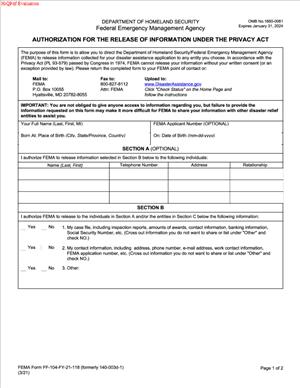
Form FF-104-FY-21-118 – Authorization for the Release of Information under Privacy Act
Fill out nowJurisdiction: Country: United States | Province or State: Federal
Form FF-104-FY-21-118 – Authorization for the Release of Information under Privacy Act is a federal privacy authorization. It allows a government agency to share your personal information with another person or organization you name.
You usually encounter this document when an agency already has records about you. Those records are protected by federal privacy rules. Without your written authorization, the agency generally cannot release them.
This form matters because it controls who can see your information and for what purpose. Once you sign it, the agency may rely on it to disclose records that would otherwise stay private.
You might be filling out this form because someone is helping you with a federal matter. That could be a family member, an advocate, or a professional representative. The form gives the agency permission to talk to that person about your case.
This document belongs to a federal agency within the Department of Homeland Security, specifically the Federal Emergency Management Agency. It is commonly used in situations involving disaster assistance or related federal programs.
Understanding each section before you start helps you avoid delays. Small errors can limit what information is released or cause the agency to reject the submission.
What is Form FF-104-FY-21-118 – Authorization for the Release of Information under Privacy Act?
Clear definition
Form FF-104-FY-21-118 – Authorization for the Release of Information under the Privacy Act is a written consent document. It authorizes a federal agency to release your personal records to a third party.
The form operates under the federal Privacy Act. That law restricts how agencies collect, use, and disclose personal information. This document is the mechanism that allows disclosure when you agree to it.
By completing the form, you identify who may receive your information. You also define what information may be shared and why the disclosure is allowed.
This is not a request for benefits or assistance. It is strictly an authorization related to information handling.
Who typically uses this form/document?
Individuals who have interacted with a federal agency often use this form. This includes people who have applied for, received, or appealed for federal assistance.
People who need help managing their case commonly complete it. That helper could be a relative, a caregiver, or another trusted individual.
Representatives assisting with paperwork or communications often ask for this authorization. Without it, agencies may only communicate directly with you.
In some cases, people use the form to allow an organization to access records. This can happen when coordinating services or resolving an issue tied to federal records.
Why you might need this form/document
You might need this form when you cannot easily manage communications yourself. This includes situations involving health, travel, language barriers, or time constraints.
The form may also be necessary when an agency requires written consent before discussing details. Even simple questions about a file can trigger privacy restrictions.
Sometimes an agency requests this document proactively. This happens when it knows you are working with someone else on your matter.
The form can reduce delays by clearly documenting your permission. It gives agency staff confidence that they can share information without violating privacy rules.
Typical real-life scenarios
After a natural disaster, you apply for federal assistance. A family member helps you follow up on your application. The agency requires written permission before discussing your file with them.
You submit documents to a federal agency and later need help understanding a decision. An advocate contacts the agency on your behalf. The form allows that conversation to happen.
You move or are temporarily displaced and cannot manage communications. You authorize another person to receive updates or records related to your case.
You are working with a community organization coordinating recovery services. The agency needs your consent to share limited information so services align properly.
When would you use Form FF-104-FY-21-118 – Authorization for the Release of Information under Privacy Act?
You would use this form when a federal agency holds records about you, and privacy rules apply. The need arises when someone else must access or discuss those records.
This often occurs during ongoing matters rather than at the start. The agency already has your information, but communication barriers appear later.
People commonly use the form during appeals, follow-ups, or corrections. These stages often involve detailed discussions about records.
The form is also used when roles change. For example, when you decide that someone else will handle communications going forward.
Agencies may request this document when contacted by a third party. Without it, they may decline to confirm or deny details.
The timing matters. Submitting it early can prevent interruptions, but it can also be completed later if circumstances change.
Legal characteristics of Form FF-104-FY-21-118 – Authorization for the Release of Information under Privacy Act
This form derives its effect from federal privacy law. It functions as written consent for a specific type of disclosure.
To be effective, the form typically needs complete identifying information. The agency must be able to match the authorization to your records.
Clear identification of the authorized recipient is critical. Vague descriptions often cause problems because agencies must limit disclosure precisely.
Dates and signatures play an important role. Missing or inconsistent dates can limit how long the authorization is recognized.
Common issues include incomplete fields, unreadable writing, or mismatched names. These problems may delay processing or restrict what is shared.
High-level differences may exist between agencies. Each agency may interpret scope and duration slightly differently, within federal rules.
This document does not transfer rights or decision-making authority. It only addresses information disclosure.
It does not require the agency to take action on your case. It only permits communication or the release of records.
Is it legally binding?
This form is legally effective as an authorization when properly completed. The agency may rely on it to release information as described.
Its binding nature is limited to consent. It does not create obligations beyond allowing disclosure.
The authorization typically applies only to the information and recipients you specify. Anything outside that scope remains protected.
If the form expires or is revoked, the agency may stop releasing information. The effect depends on the terms written into the document.
How to fill out Form FF-104-FY-21-118 – Authorization for the Release of Information under Privacy Act
Step 1 – Identify yourself clearly
Begin by entering your full legal name as it appears in agency records. Consistency helps the agency locate the correct file.
Include any additional identifying information requested. This may include a date of birth or application number.
Write legibly and check spelling. Small differences can slow internal verification.
Step 2 – Describe the information to be released
Read the section asking what information may be shared. This defines the scope of the authorization.
Be specific about records or topics when possible. Narrow descriptions help limit confusion.
Broad descriptions may allow wider disclosure. The agency will rely on what you write.
Step 3 – Name the authorized recipient
Enter the full name of the person or organization allowed to receive your information. Partial names can cause delays.
If an organization is listed, include a contact person if space allows. This helps direct communications accurately.
Confirm that the recipient details are current. Outdated information can interrupt communication.
Step 4 – State the purpose of the release
Explain why the information may be disclosed. This helps the agency understand how the authorization will be used.
The purpose often relates to assistance, representation, or coordination. Clear language supports smoother handling.
Avoid unrelated explanations. Focus on how the information will be used.
Step 5 – Review time limits or expiration
Some versions of the form include an expiration section. This defines how long the authorization remains effective.
If a date is required, ensure it is realistic for your situation. Short timeframes may limit usefulness.
If no date is listed, the agency may apply standard limits. This varies by context.
Step 6 – Read the privacy and consent statements
Before signing, read the statements explaining your rights and the agency’s authority. These sections describe how the authorization works.
This part often explains that you are not required to sign. It also explains consequences related to disclosure.
Understanding this section helps avoid surprises later.
Step 7 – Sign and date the form
Sign the form using your usual signature. This confirms that the authorization is intentional.
Enter the date of signing. Undated forms are commonly flagged for correction.
If someone assists you physically, follow the form’s instructions for that situation.
Step 8 – Submit the completed form
Follow the submission instructions provided with the form. Agencies may accept mail, fax, or electronic delivery.
Ensure all pages are included. Missing pages can invalidate the submission.
Keep a copy for your records. This helps if questions arise about what you authorized.
Legal terms you might encounter in Form FF-104-FY-21-118 – Authorization for the Release of Information under Privacy Act
- Privacy Act: This is a federal law that controls how government agencies collect, use, and share personal information. In this document, it explains why your consent is required before information about you can be released. You will usually see it referenced near the consent language you must agree to.
- Authorization: This means your written permission. On this form, your authorization allows a specific agency to release specific information about you. Without it, the agency may refuse to share anything, even with someone helping you.
- Personally Identifiable Information (PII): This refers to information that can identify you, such as your name, address, date of birth, or identification numbers. The form often asks you to describe which PII may be released. Being precise here limits what can be shared.
- Requesting Party: This is the person or organization asking to receive your information. You must clearly name this party on the form. If the name does not match exactly, the release may be delayed or rejected.
- Disclosing Agency: This is the government office that currently holds your information. The form is directed to this agency and tells it what it is allowed to disclose. You do not control the records directly, but you control permission.
- Scope of Release: This describes the boundaries of what information can be shared. On the form, this appears as a description or checkbox section. A narrow scope protects your privacy and reduces accidental oversharing.
- Purpose of Disclosure: This explains why the information is being released. You are usually asked to state a reason, such as verifying eligibility or resolving a claim. Agencies often check this to confirm the release is appropriate.
- Expiration Date: This is the date when your authorization ends. Some forms require a specific date, while others allow the release to stay valid until a task is completed. If you leave this blank, the form may be considered incomplete.
- Revocation: This is your right to cancel the authorization later. The form usually explains how you can revoke it in writing. Revocation does not undo information already released.
FAQs
Do I have to use Form FF-104-FY-21-118 – Authorization for the Release of Information under Privacy Act every time someone needs my information?
Not always. You use this document when a federal agency requires written permission under the Privacy Act before sharing your records. If the agency already has another valid authorization on file, you may not need to complete a new one.
What exact name should I use when listing myself on this form?
Use your full legal name as it appears on the agency’s records. Check any prior correspondence or identification numbers tied to your file. A mismatch can slow processing because staff must confirm identity before releasing anything.
How detailed should I be when describing the information to be released?
Be specific enough that the agency knows exactly what to share. For example, limit it to certain dates, files, or types of records. Vague descriptions can lead to delays or broader disclosure than you intended.
Who can I authorize to receive my information?
You can name an individual or an organization. Make sure the name is complete and accurate, including any department or role if applicable. This helps the agency confirm the recipient is allowed to receive the records.
What happens if I forget to include an expiration date?
Some agencies treat a missing expiration date as an error. Others may apply a default limit or reject the submission. Always check whether the form gives you options and select one clearly.
Can someone sign this document for me?
Only if they have legal authority to act on your behalf. If that applies, the signer’s authority must be clear and usually supported by documentation. Without proof, the agency may refuse the release.
Will the information become public once it is released?
No. The release is limited to the authorized recipient and purpose. This document does not place your information into a public database, and it does not change confidentiality rules beyond the permission you give.
How will I know the agency accepted my completed form?
Some agencies send written confirmation, while others act silently by releasing the information. If timing matters, follow up and ask whether your submission was accepted and processed under this form.
Checklist: Before, During, and After Form FF-104-FY-21-118 – Authorization for the Release of Information under Privacy Act
Before
- Confirm which agency holds the information you need to be released
- Identify exactly who should receive the information
- Gather reference numbers or file identifiers tied to your records
- Decide how narrow or broad the release should be
- Check whether an expiration date is required
- Verify your legal name and contact details
- Prepare proof of authority if signing for someone else
During
- Write legibly or type to avoid misreading
- Use full names instead of initials where possible
- Clearly describe the information to be released
- State a clear and accurate purpose for the disclosure
- Select or enter an expiration option
- Read the consent and Privacy Act statements carefully
- Sign and date the form in the correct place
After
- Make a complete copy for your records
- Submit the form using the accepted delivery method
- Note the date you sent or delivered it
- Watch for confirmation or follow-up requests
- Respond promptly if the agency asks for clarification
- Track whether the information was released as expected
- Store the form with related documents for future reference
Common mistakes to avoid with Form FF-104-FY-21-118 – Authorization for the Release of Information under Privacy Act
- Mistake: Using a nickname instead of your legal name, which happens out of habit, causes identity verification delays, and you should not forget to match the name on agency records.
- Mistake: Leaving the scope of release vague, which happens when you rush, can lead to rejection or over-disclosure, and you should not forget to define limits.
- Mistake: Naming the wrong recipient, which happens when roles change, prevents release to the intended party, and you should not forget to verify current details.
- Mistake: Skipping the expiration section, which happens when it seems optional, can invalidate the form, and you should not forget to select a clear option.
- Mistake: Having an unauthorized person sign, which happens in emergencies, results in non-acceptance, and you should not forget to include proof of authority.
- Mistake: Forgetting to date the signature, which happens easily, stops processing, and you should not forget to complete every signature line.
- Mistake: Submitting without keeping a copy, which happens when you rely on the agency, complicates follow-up, and you should not forget to retain records.
What to do after filling out Form FF-104-FY-21-118 – Authorization for the Release of Information under Privacy Act
Once the form is complete, your job is not finished. How you handle submission and follow-up affects how quickly the information is released and whether problems arise. Treat the document as part of an ongoing process, not a one-time task.
- Step 1: Make at least one clear copy for yourself before sending the original.
- Step 2: Check the agency’s preferred submission method, such as mail, electronic upload, or in-person delivery.
- Step 3: Submit the form exactly as instructed, including any required cover pages.
- Step 4: Record the date, method, and destination of your submission.
- Step 5: Monitor your mail, email, or account for confirmation or questions.
- Step 6: Respond quickly if the agency requests clarification or additional documents.
- Step 7: Confirm that the authorized recipient actually received the information.
- Step 8: File the form with related correspondence and notes.
- Step 9: Update your personal records to reflect what was shared and with whom.
- Step 10: Revoke or replace the authorization if circumstances change.
Staying organized protects you. It also makes future requests easier because you can show what permissions were already granted and when they expire.
Disclaimer: This guide is provided for informational purposes only and is not intended as legal advice. You should consult a legal professional.