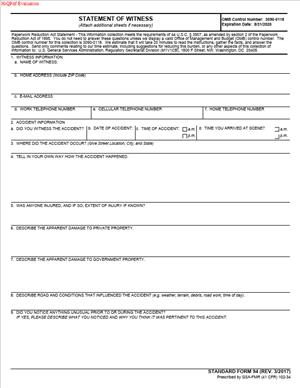
Standard Form 94 – Statement of Witness
Fill out nowJurisdiction: Country: United States | Province or State: Federal
The Standard Form 94 – Statement of Witness is a federal government document used to record what a witness saw, heard, or experienced. It captures first-hand information in a clear, written format. If you are about to complete this form, you are likely being asked to provide a formal account of an incident connected to federal operations.
This form is commonly used within federal agencies. It helps create an official record that can be reviewed later. Your statement may become part of an administrative file, an internal investigation, or another government process.
When you fill out the Standard Form 94 – Statement of Witness, you are documenting facts from your personal knowledge. The focus is on what you directly observed. The form is not meant for opinions, guesses, or second-hand stories.
Accuracy matters. Once submitted, your statement may be relied upon by supervisors, investigators, or decision-makers. Understanding what the form does and how it is used helps you complete it clearly and confidently.
What is Standard Form 94 – Statement of Witness?
Clear definition
Standard Form 94 – Statement of Witness is an official federal form used to collect a written statement from someone who witnessed an event. It creates a structured record of the witness’s account. The form is designed to capture identifying details and a narrative description of what occurred.
It is typically part of an internal federal process. The form ensures that statements are documented in a consistent format across agencies. This consistency makes it easier to review, compare, and preserve records.
The document usually includes space for your personal information, the date of the statement, and a detailed description of the incident. It ends with your signature, confirming that the information is true to the best of your knowledge.
Who typically uses this form?
This form is commonly used by federal employees, contractors, or other individuals involved in federal activities. You may be asked to complete it if you witnessed an accident, workplace incident, or other event connected to a federal agency.
Supervisors and internal investigators often request the form. It can also be used in connection with security matters, property damage, safety concerns, or conduct issues within a federal setting.
If you were present during an event that is under review, you may be asked to provide your account using this document. You do not have to be directly involved in the incident. Being a witness is enough.
Why might you need this form?
You may need this form because a federal agency is gathering facts. Written witness statements help clarify what happened. They also reduce reliance on memory over time.
In some situations, multiple people submit statements about the same event. Your form helps build a more complete picture. It may confirm, clarify, or contradict other accounts.
The form also creates a permanent record. If questions arise later, the agency can refer back to your original words. This is one reason why clear and careful completion is important.
Typical real-life scenarios
- You witness a workplace accident at a federal facility. An employee slips on a wet floor and is injured. You are asked to describe what you saw, where you were standing, and what happened immediately before and after the fall.
- You observe damage to government property. For example, a vehicle in a federal fleet is involved in a minor collision. You are asked to provide details about the time, location, and actions of those involved.
- You are present during a disagreement between coworkers that escalates into a formal complaint. Your statement may be requested to document what was said and how the situation unfolded.
- You see a security-related incident, such as unauthorized access to a restricted area. The agency may ask for your written account to support an internal review.
When would you use Standard Form 94 – Statement of Witness?
You would use this form when a federal agency needs a written record of what you personally observed. It is often part of an internal review or investigation. The form may be requested soon after the incident, while details are still fresh.
Supervisors may distribute the form following an accident or safety event. Security personnel may request it after a breach or suspicious activity. Human resources staff may use it in connection with workplace complaints.
The timing can vary. Sometimes you complete the form immediately. In other cases, you may be contacted days or weeks later if an issue surfaces during a review.
The form is typically used in administrative settings rather than in court. However, the information you provide could later be referenced in other proceedings. That is why the document focuses on factual detail and personal knowledge.
Legal characteristics of Standard Form 94 – Statement of Witness
This form is an official federal document. It is intended to create a reliable written record. For the document to be effective, it generally needs to be completed fully and signed by the witness.
Clarity and completeness are important. Missing identifying information, unclear handwriting, or vague descriptions can reduce the usefulness of the statement. In some cases, incomplete forms may be returned for clarification.
The form is usually part of an administrative process. Different federal agencies may use it within their own procedures. While the core purpose is consistent, the way it is reviewed or stored may vary across departments.
Common problems include including opinions instead of facts, speculating about motives, or repeating rumors. The form is strongest when it focuses on direct observations. Statements like “I heard from someone else” often carry less weight than “I saw” or “I heard.”
It is also important to understand what this form does not do. It does not automatically determine fault. It does not impose discipline by itself. It does not resolve disputes. It is one piece of information used in a broader process.
Is it legally binding?
Your statement is a formal declaration of what you know. By signing, you confirm that the information is true to the best of your knowledge. In that sense, the document carries legal significance.
In many federal contexts, knowingly providing false information in an official statement can have serious consequences. This is one reason the form includes a signature line. The signature connects you to the accuracy of the content.
At the same time, the form itself is not a contract. It does not create obligations between parties. It serves as evidence or documentation within an administrative framework.
How to fill out Standard Form 94 – Statement of Witness
Step 1 – Identify yourself clearly
Begin by entering your full legal name as requested. Provide your job title, position, or relationship to the agency if the form asks for it. Include contact information if there is a designated space.
Make sure all identifying details are current and accurate. This allows reviewers to follow up if clarification is needed.
Step 2 – Provide the date and location of your statement
Enter the date you are completing the form. Some versions may also request the location where the statement is being made. This helps establish the timeline of the documentation process.
Do not confuse this with the date of the incident. That information is usually included later in the narrative section.
Step 3 – Describe the incident in chronological order
Use the main narrative section to explain what happened. Start with where you were and why you were there. Then describe what you observed, step by step.
Keep your sentences direct. Focus on actions, words spoken, and physical details. If you remember specific times, include them. If you do not recall exact times, describe the sequence as clearly as possible.
Avoid guessing about intentions or causes. If you are unsure about something, state that you are unsure rather than filling in gaps.
Step 4 – Distinguish facts from assumptions
As you write, separate what you directly saw or heard from what others told you. If you include information shared by someone else, make that clear. For example, note that “I was told” rather than presenting it as something you witnessed.
This distinction helps reviewers evaluate the reliability of each part of the statement. Clear separation strengthens the overall document.
Step 5 – Review for accuracy and completeness
After writing your statement, read it carefully from start to finish. Check names, dates, and locations. Confirm that your description reflects what you truly remember.
Look for vague phrases such as “something happened” or “it was chaotic.” Replace them with specific details if possible. The goal is to make the account understandable to someone who was not present.
Step 6 – Sign and date the form
Sign your name in the space provided. Add the date of your signature if required. Your signature confirms that the statement is accurate to the best of your knowledge.
Once signed, follow the instructions provided for submission. This may involve returning it to a supervisor, investigator, or designated office within the agency.
Legal terms you might encounter in Standard Form 94 – Statement of Witness
- Affirmation: An affirmation is a formal declaration that your statement is true. Unlike an oath, it does not require a religious reference. When you complete this form, you are confirming that the information you provide is accurate to the best of your knowledge.
- Oath: An oath is a solemn promise that your statement is truthful. It may be administered by an authorized official. If your statement is made under oath, false information can lead to serious consequences.
- Perjury: Perjury means knowingly making a false statement after swearing or affirming that it is true. When you sign this document, you expose yourself to potential penalties if you intentionally include false information.
- Material Fact: A material fact is an important detail that could influence a decision in an investigation or proceeding. On this form, focus on facts that directly relate to the incident or issue being reviewed.
- Jurisdiction: Jurisdiction refers to the authority of a specific agency or body to review or act on your statement. This form is typically used within federal administrative processes, so your statement should relate to matters within that authority.
- Sworn Statement: A sworn statement is a written account of facts that you declare to be true. This form functions as a sworn or affirmed written record of what you personally observed.
- Exhibit: An exhibit is a document or item attached to support your statement. If you reference emails, photographs, or reports, you may attach them as exhibits and clearly label them.
- Chronology: Chronology means arranging events in the order they occurred. Your statement should follow a clear timeline so the reader can understand what happened step by step.
- Declarant: The declarant is the person making the statement. When you fill out this form, you are the declarant and are responsible for its content.
- Official Capacity: Official capacity refers to actions taken as part of a job or role. If you witnessed events while working in an official role, you should clarify that context in your statement.
FAQs
Do I need to have Standard Form 94 – Statement of Witness notarized?
In many situations, this document does not require notarization, but it may require you to sign under oath or affirmation before an authorized official. Check the signature block to see whether it includes language about swearing or affirming. If an official must witness your signature, do not sign it in advance. Confirm who is authorized to receive and administer your statement.
What if I do not remember the exact date or time of the event?
If you cannot recall precise details, state that clearly. Provide your best estimate and explain how you arrived at it, such as by referring to a calendar entry or work schedule. Do not guess or invent specifics. Accuracy matters more than precision.
Can I attach additional pages to this form?
Yes, you can attach extra pages if you need more space. Clearly label each additional page with your name, the date, and a page number. Reference the attachment in the main body of this form so the reviewer knows to read it as part of your statement.
What information must match my official records?
Your full legal name, job title if relevant, and contact information should match agency or employment records. If your name has changed, use your current legal name and note any prior name that may appear in related records. Consistency helps avoid delays in processing.
When is the effective date of my statement?
The effective date is generally the date you sign it. This is the date your statement becomes official. Make sure the date next to your signature is accurate and matches the day you actually sign.
Can I correct the document after I sign it?
If you notice an error before submission, correct it neatly and initial the change if required. If you discover an error after submission, you may need to provide a supplemental statement. Do not alter a signed copy without clearly documenting the revision process.
Who is allowed to submit this document?
Usually, you submit it directly to the requesting office or official. In some cases, a supervisor or investigator may collect it from you. Confirm the submission instructions so your Standard Form 94 – Statement of Witness reaches the correct recipient.
Will my statement become part of a public record?
That depends on the type of proceeding or investigation involved. Some statements remain part of internal administrative files, while others may be disclosed in formal proceedings. Ask the receiving office how this form will be stored and whether it may be shared.
Checklist: Before, During, and After Standard Form 94 – Statement of Witness
Before
- Confirm why your statement is being requested and who will review it.
- Gather any notes, emails, photos, or documents related to the incident.
- Review relevant dates using calendars, logs, or records.
- Verify the correct spelling of names and titles involved.
- Check whether you must sign in front of an authorized official.
- Set aside uninterrupted time to write clearly and thoughtfully.
- Read any instructions that accompany the form.
During
- Print or type your full legal name exactly as it appears in official records.
- State your role or relationship to the incident at the beginning.
- Present events in chronological order.
- Stick to facts you personally observed or heard.
- Clearly separate what you know from what you believe.
- Reference and label any attached exhibits.
- Write legibly if completing the form by hand.
- Review each section before moving to the next.
After
- Re-read the entire statement slowly for accuracy.
- Confirm that dates, names, and locations are consistent.
- Ensure all attachments are included and labeled.
- Sign and date the form in the correct place.
- Make a complete copy for your records.
- Submit the form using the instructed method.
- Note the date and method of submission.
- Store your copy in a secure location.
Common mistakes to avoid with Standard Form 94 – Statement of Witness
- Mistake: Including opinions instead of facts because you want to be helpful, which can weaken credibility and create confusion; do not forget to clearly distinguish between what you observed and what you assume.
- Mistake: Leaving out key dates or locations due to uncertainty, which can make the statement less useful; do not forget to provide estimated dates and explain that they are approximations.
- Mistake: Signing before meeting with an authorized official when an oath is required, which can invalidate the statement; do not forget to confirm signing instructions first.
- Mistake: Failing to attach referenced documents because you assume they are already on file, which may delay review; do not forget to label and include every exhibit you mention.
- Mistake: Using informal language or abbreviations that others may not understand, which can cause misinterpretation; do not forget to write clearly and define any necessary terms.
- Mistake: Submitting the form to the wrong office due to unclear instructions, which can slow the process; do not forget to verify the correct recipient and submission method.
- Mistake: Forgetting to keep a personal copy because you trust the process, which leaves you without proof of what you submitted; do not forget to store a complete copy securely.
- Mistake: Altering a signed version without explanation after noticing an error, which can raise authenticity concerns; do not forget to submit a clear supplemental statement if changes are needed.
What to do after filling out Standard Form 94 – Statement of Witness
Once you complete your statement, your job is not quite finished. Proper follow-up protects you and ensures the document serves its purpose.
Start by reviewing the entire document one more time. Look for small errors that are easy to miss, such as incorrect dates, inconsistent timelines, or misspelled names. Make sure every page is included and in the correct order.
- Step 1: Confirm your signature and date are present and accurate.
- Step 2: Verify that any required witness or official has signed, if applicable.
- Step 3: Assemble all attachments in the order referenced in your statement.
- Step 4: Make a complete copy of the signed form and all exhibits.
- Step 5: Submit the document using the instructed method, such as hand delivery, secure internal mail, or approved electronic submission.
- Step 6: Request confirmation of receipt if possible.
- Step 7: Record the date, time, and method of submission for your records.
- Step 8: Store your copy in a secure place, whether digital or physical.
- Step 9: Monitor for follow-up questions or requests for clarification.
- Step 10: Respond promptly and consistently if contacted about your statement.
If you are contacted for clarification, refer back to your copy before responding. This keeps your answers consistent with what you wrote. If you realize you need to add information, provide it in a separate, clearly labeled supplemental statement rather than editing the original.
Keep your copy for as long as the related matter remains open, and longer if you believe questions may arise later. Good recordkeeping prevents confusion months or years down the line.
Finally, stay professional. Your statement may be reviewed by investigators, supervisors, legal staff, or administrative officials. Clear, organized follow-through shows that you take the process seriously and strengthens the reliability of your account.
Disclaimer: This guide is provided for informational purposes only and is not intended as legal advice. You should consult a legal professional.