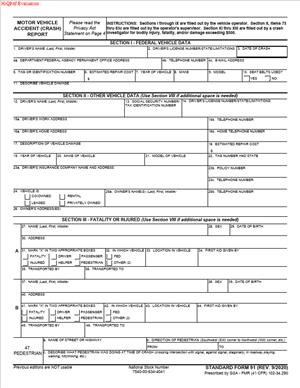
Standard Form 91 – Motor Vehicle Accident (Crash Report)
Fill out nowJurisdiction: Country: United States | Province or State: Federal
The Standard Form 91 – Motor Vehicle Accident (Crash Report) is a federal document used to record the details of a motor vehicle accident involving a government vehicle or a vehicle used for official federal business. If you are completing this form, you are likely documenting a crash that occurred during government operations.
This form creates an official record of what happened. It captures facts about the drivers, vehicles, injuries, property damage, and the circumstances of the accident. The information you provide may later be reviewed by supervisors, investigators, or claims personnel.
You may be filling out this document shortly after a crash. In that moment, clarity matters. The form is designed to collect structured, factual information rather than opinions or arguments.
Understanding what the Standard Form 91 – Motor Vehicle Accident (Crash Report) is for can help you complete it carefully and accurately. Small details can affect how the incident is reviewed later.
What is Standard Form 91 – Motor Vehicle Accident (Crash Report)?
Clear definition
Standard Form 91 – Motor Vehicle Accident (Crash Report) is a federally issued accident reporting form used by U.S. government agencies. It documents the facts surrounding a vehicle collision involving a federal employee, a government-owned vehicle, or a privately owned vehicle used for official duties.
The form collects identifying information, location details, vehicle descriptions, insurance information, witness statements, and a narrative explanation of the event. It serves as an internal government record of the crash.
This document is administrative in nature. It supports internal review, risk management, and potential claims processing.
Who typically uses this form?
Federal employees who are involved in a motor vehicle accident while driving a government vehicle often complete this form. It may also be used when an employee is driving a personal vehicle for official government business.
Supervisors or fleet managers may review or help process the form after it is submitted. In some cases, safety officers or administrative staff handle follow-up actions based on the information provided.
Contractors operating government vehicles may also be asked to complete the form, depending on agency policy and the terms of their agreement.
Why might you need this form?
You may need this form to formally report an accident that occurred during official duties. Federal agencies generally require documentation of vehicle incidents, even if the damage appears minor.
The information recorded can be used to evaluate liability, process repair requests, manage insurance matters, or assess compliance with agency driving policies.
Without this document, there may be gaps in the official record of what occurred. That can complicate internal reviews or future claims related to property damage or injuries.
Typical real-life scenarios
- You are driving a government vehicle between work sites and collide with another car at an intersection. Even if local police respond and complete their own report, your agency may still require this separate federal form.
- You are using your personal vehicle for authorized travel to attend a federal meeting. On the way, another driver rear-ends your vehicle. Because the travel was work-related, the incident may need to be documented using this form.
- You are operating a government-owned truck on federal property and accidentally strike a parked vehicle. No one is injured, but there is visible property damage. The form helps record the event for administrative purposes.
- You are involved in a multi-vehicle accident during official travel. Different insurance carriers and agencies may later review the facts. A detailed crash report helps ensure your account is preserved early.
When would you use Standard Form 91 – Motor Vehicle Accident (Crash Report)?
You would use this form after a motor vehicle accident involving a government vehicle or a vehicle driven for official federal duties. Timing often matters. The report is commonly completed as soon as practical after the crash, while details are still fresh.
The form is used whether the accident occurs on public roads, federal property, or in parking areas. It may apply to collisions involving other vehicles, fixed objects, pedestrians, or property.
Drivers are often the primary individuals completing the document. However, supervisors may assist if the driver is injured or unavailable. In some agencies, submission of the form is part of a required post-accident reporting process.
This document may also be used even if another driver appears to be at fault. It is not limited to situations where the government driver caused the accident. Its purpose is to create a complete factual record from the government’s perspective.
Legal characteristics of Standard Form 91 – Motor Vehicle Accident (Crash Report)
This form is an official federal administrative record. Its effectiveness depends on accurate, complete, and truthful information. Missing sections, unclear handwriting, or inconsistent details can create follow-up questions.
Common problems include leaving fields blank, providing estimates instead of confirmed facts, or including opinions about fault rather than describing observable events. The form generally focuses on objective information such as time, location, vehicle identification numbers, and weather conditions.
Different federal agencies may have internal procedures for reviewing or storing the completed document. While the form itself is standardized, internal handling practices can vary.
The form does not determine liability by itself. It records information. Decisions about fault, insurance coverage, discipline, or claims typically involve additional review beyond the document.
It also does not replace any police report that may be required by local or state authorities. It serves a separate administrative function within the federal system.
Is it legally binding?
The Standard Form 91 – Motor Vehicle Accident (Crash Report) is not a contract. It does not create a binding agreement between parties involved in the accident.
However, it is an official statement of facts provided by the person completing it. Because it is a formal government record, the information you provide may be relied upon in administrative reviews or related proceedings.
Statements made on the form may be compared with police reports, witness accounts, or later testimony. For that reason, accuracy and clarity are important. The form’s legal significance comes from its role as an official record, not from creating new legal obligations on its own.
How to fill out Standard Form 91 – Motor Vehicle Accident (Crash Report)
Step 1 – Identify the driver and agency information
Begin by entering your full name, contact details, and employing federal agency. Provide your job title and duty station if requested. This section establishes who was operating the vehicle and under what authority.
Step 2 – Provide vehicle details
Enter the information for the government vehicle or the vehicle used for official business. This may include the make, model, year, license plate number, and vehicle identification number. If another vehicle was involved, record its identifying details in the designated section.
Step 3 – Record the date, time, and location of the accident
State the exact date and time of the crash. Include the city, state, street names, mile markers, or other specific location markers. Precise location information helps reconstruct the event later.
Step 4 – Describe the road and weather conditions
Indicate whether the road was dry, wet, icy, or under construction. Note visibility conditions such as daylight, darkness, rain, or fog. These details provide context for how the accident occurred.
Step 5 – Identify other parties involved
List the names, addresses, and contact information of other drivers, passengers, or property owners involved in the accident. Include insurance information if requested in the form. Accuracy here helps with later communication and claims processing.
Step 6 – Document injuries and property damage
Indicate whether anyone was injured and describe the nature of the injuries as known at the time. Record visible damage to all vehicles and any other property. Stick to observable facts rather than conclusions about severity.
Step 7 – List witnesses
Provide the names and contact information of any witnesses. If law enforcement responded, record the agency name and report number if available. This connects your filing to any official investigation.
Step 8 – Provide a narrative description of the accident
Write a clear, chronological account of what happened. Start with what you were doing immediately before the crash. Describe the movements of each vehicle and the sequence of events leading to impact. Use simple, factual language and avoid speculation about fault.
Step 9 – Review and sign the form
Read through the entire document before signing. Confirm that dates, numbers, and spellings are correct. Sign and date the form where indicated to certify that the information provided reflects your knowledge of the incident.
Legal terms you might encounter in Standard Form 91 – Motor Vehicle Accident (Crash Report)
- Operator: This refers to the person driving the government vehicle at the time of the accident. On this form, the operator is typically a federal employee or authorized driver. You must clearly identify the operator because responsibility, training status, and authorization to drive may be reviewed later.
- Government Vehicle: This means a vehicle owned, leased, or rented by a federal agency. The form requires specific details such as vehicle identification number (VIN), license plate number, and agency assignment. These details tie the accident to official government property.
- Third Party: A third party is any person or entity other than the federal agency and its employee who was involved in the crash. This can include another driver, a pedestrian, or a property owner. You must list their contact and insurance information if available.
- Property Damage: This refers to physical damage to vehicles, buildings, road signs, fences, or other objects. The form asks you to describe the extent of damage and estimate costs if known. Accurate reporting affects insurance claims and internal government repair processes.
- Personal Injury: Personal injury means any physical harm suffered by drivers, passengers, or bystanders. The form requires you to note visible injuries and whether medical attention was provided. Even minor injuries should be recorded to avoid disputes later.
- Witness Statement: A witness statement is information provided by someone who saw the accident happen. The form includes space for names and contact details. Witnesses can support or clarify your narrative if questions arise.
- Narrative Description: This is your written explanation of how the accident occurred. It should include direction of travel, speed, traffic signals, and actions taken before impact. The narrative is often reviewed closely in investigations.
- Diagram of Accident: Some versions of the form include space to draw a simple diagram. This sketch shows vehicle positions, road layout, and points of impact. A clear diagram helps investigators understand what happened without relying only on text.
- Official Duty Status: This indicates whether the driver was performing authorized government work at the time of the accident. This matters because coverage, liability, and internal review depend on whether the trip was official.
- Claim: A claim is a formal request for payment due to injury or property damage. Information from this form may be used to evaluate or defend against claims. Accuracy protects both the agency and the driver.
FAQs
Do I need to complete Standard Form 91 – Motor Vehicle Accident (Crash Report) even if the accident was minor?
Yes. This document is generally required for any accident involving a government vehicle, even if the damage seems small. Minor dents or scratches can later become part of insurance claims or internal reviews. You should report the date, time, location, and all involved parties so there is a clear record from the start.
Who is authorized to sign this form?
The driver of the government vehicle typically completes and signs the form. In some cases, a supervisor or agency representative may review it before submission. Make sure the name and title of the signer match agency records to avoid delays in processing.
What information should I gather before I start filling it out?
You should have the vehicle details, your driver’s license information, agency contact information, and the other party’s insurance and registration details. You also need the exact date, time, and location of the accident. Police report numbers and witness contact information are important if available.
What if I do not know the other driver’s insurance information?
Enter as much identifying information as you can, such as the driver’s name, license plate number, and vehicle description. Note on this form that insurance details were unavailable at the scene. This shows you attempted to collect the information and prevents the form from appearing incomplete due to oversight.
Can I correct information after I submit this document?
If you discover an error, notify your supervisor or the office that processes the report as soon as possible. Corrections are usually handled through a supplemental statement or written clarification. Do not alter a submitted copy without following your agency’s procedure.
Does filing this form mean I am admitting fault?
No. Completing Standard Form 91 – Motor Vehicle Accident (Crash Report) creates an official record of the incident. Determining fault is a separate process that may involve supervisors, investigators, or insurance personnel. Your role is to provide accurate and factual information.
Should I attach photos or additional pages?
If there is not enough space for your narrative, you can attach additional sheets and clearly reference them in the main document. Photos of the scene, vehicle damage, and road conditions can be helpful if your agency accepts attachments. Make sure each attachment is labeled with the date and your name.
What happens after I submit this form?
After submission, the agency typically reviews the report for completeness and accuracy. It may be forwarded to risk management, safety officers, or claims personnel. The information you entered can affect repair decisions, training reviews, or responses to third-party claims.
Checklist: Before, During, and After Standard Form 91 – Motor Vehicle Accident (Crash Report)
Before
- Confirm that the vehicle involved is a government-owned or leased vehicle.
- Seek medical attention first if anyone is injured.
- Contact law enforcement if required by policy or if injuries or major damage occurred.
- Gather driver’s license, registration, and insurance details from all parties.
- Take clear photos of vehicle positions, damage, and road conditions.
- Write down names and phone numbers of witnesses.
- Notify your supervisor according to agency procedures.
- Obtain the police report number, if one is issued.
During
- Enter the exact date and time of the accident.
- Provide the precise location, including street names or mile markers.
- Record complete vehicle information, including VIN and license plate.
- List all individuals involved, even passengers.
- Describe weather, lighting, and road conditions accurately.
- Write a factual narrative without assigning blame.
- Draw a simple and clear diagram showing vehicle positions.
- Review each section to ensure no blanks are left unintentionally.
After
- Make a copy of the completed form for your records.
- Submit the form to the designated office or supervisor promptly.
- Provide any required attachments, such as photos or police reports.
- Respond quickly to follow-up questions from your agency.
- Keep all related documents together in one file.
- Document any medical treatment received after the accident.
- Track repair estimates and vehicle service records.
- Update internal logs or mileage records if required.
Common mistakes to avoid with Standard Form 91 – Motor Vehicle Accident (Crash Report)
- Mistake: Leaving sections blank because you think they do not apply, which often happens when you are rushed; this can delay processing or raise questions later, so do not forget to write “N/A” where appropriate.
- Mistake: Guessing about speed or distance due to stress at the scene; inaccurate estimates can affect investigations, so do not forget to state if a detail is an approximation.
- Mistake: Admitting fault in the narrative because you feel pressured, which can complicate claims review; do not forget to stick to objective facts instead of opinions.
- Mistake: Forgetting to include witness contact information, often because the scene feels chaotic; missing witnesses can weaken the record, so do not forget to collect names and phone numbers immediately.
- Mistake: Failing to attach extra pages when space runs out, which leads to incomplete explanations; do not forget to label and reference all attachments clearly.
- Mistake: Submitting the form late due to uncertainty about procedure, which can violate internal timelines; do not forget to confirm and follow your agency’s reporting deadline.
- Mistake: Recording incorrect vehicle identification numbers because you rely on memory; errors can misidentify the vehicle, so do not forget to verify details directly from the vehicle or official documents.
- Mistake: Not keeping a personal copy, assuming the agency will provide one later; this can leave you without proof of what you reported, so do not forget to save a complete copy for your records.
What to do after filling out Standard Form 91 – Motor Vehicle Accident (Crash Report)
Once you complete the form, your job is not quite finished. Proper follow-up protects you and ensures your agency can respond effectively.
Start by reviewing the entire document one more time. Check names, dates, numbers, and signatures. Small errors can create delays or confusion during claims review.
- Step 1: Make at least one clear copy of the completed form for your personal records.
- Step 2: Attach supporting documents such as photos, police reports, witness statements, and additional narrative pages.
- Step 3: Confirm the correct submission method required by your agency, whether electronic upload, email, or physical delivery.
- Step 4: Submit the form within the required internal deadline.
- Step 5: Request confirmation that your report was received and is complete.
- Step 6: Record the name and contact information of the person or office that accepted it.
- Step 7: Monitor your email or internal system for follow-up questions.
- Step 8: Provide prompt written clarification if asked for additional details.
- Step 9: Keep all medical records and repair invoices related to the accident.
- Step 10: Update any required internal vehicle logs or incident tracking systems.
You should store your copy of the report in a secure place. Keep it together with any related correspondence. If a claim arises months later, you will want quick access to what you originally reported.
If your agency conducts a safety review or interview, prepare by rereading your narrative. Make sure your verbal explanation matches what you wrote. Consistency strengthens your credibility.
Finally, track the status of vehicle repairs and any administrative actions. If the accident leads to training, policy updates, or additional documentation, complete those steps promptly. Staying organized after submission helps prevent small issues from becoming larger problems.
Disclaimer: This guide is provided for informational purposes only and is not intended as legal advice. You should consult a legal professional.