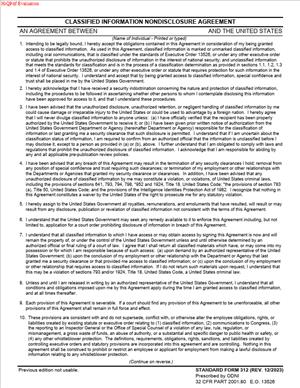
Standard Form 312 – Classified Information Nondisclosure Agreement
Fill out nowJurisdiction: Country: United States | Province or State: Federal
The Standard Form 312 – Classified Information Nondisclosure Agreement is a federal agreement you sign before gaining access to classified national security information. It is used across the United States federal government. If you are starting a position that involves sensitive information, this is often one of the first documents you complete.
This form is not a typical workplace confidentiality agreement. It deals specifically with classified information that is protected under federal law. By signing, you formally acknowledge your responsibilities and the serious consequences of unauthorized disclosure.
You may encounter this form if you are joining a federal agency, working as a government contractor, or serving in the military. It can also apply to consultants and others who need access to classified materials to perform their duties.
Understanding what you are signing is important. This agreement creates ongoing obligations that continue even after your job ends. Knowing what the document covers can help you complete it accurately and understand your responsibilities.
What is Standard Form 312 – Classified Information Nondisclosure Agreement?
Clear definition
The Standard Form 312 – Classified Information Nondisclosure Agreement is a federal document that sets out the rules for handling classified information. It is a written promise that you will protect that information and follow all security procedures.
The agreement explains what counts as classified information. It includes information marked as Confidential, Secret, or Top Secret, as well as certain unmarked information that is officially classified. The form makes clear that disclosure is limited to authorized persons with proper clearance and a need to know.
When you sign, you acknowledge that classified information is the property of the United States government. You also confirm that you understand the legal penalties for unauthorized disclosure, including possible criminal prosecution and administrative action.
The document includes statements about prepublication review. This means that certain writings or speeches related to classified matters may need to be reviewed before public release. The agreement outlines this obligation in general terms.
Who typically uses this form?
This form is used by federal civilian employees who require access to classified information. It is also used by members of the armed forces and reserve components.
Government contractors and subcontractors frequently sign this agreement. If you work for a private company that performs classified work for the federal government, you may be required to complete the form before receiving access.
Consultants, temporary employees, and detailees may also use this form. Anyone granted a security clearance and authorized access to classified material is a typical user.
In short, if your role requires access to national security information, this agreement is commonly part of the onboarding or clearance process.
Why might you need this form?
You need this form when your position requires access to classified information. Access is not automatic, even if you have a job offer. The government must formally grant you eligibility and document your agreement to protect sensitive information.
The form is part of the security clearance process. Even if your background investigation is complete, you generally cannot receive classified materials until you have signed this agreement.
It also serves as written confirmation that you understand your responsibilities. By signing, you acknowledge that you have been briefed on the rules for handling, storing, and discussing classified information.
The agreement creates a clear record. If questions arise later about unauthorized disclosure, the signed document shows that you were informed of your duties and the potential consequences.
Typical real-life scenarios
- You accept a position with a federal agency that works on national defense. During orientation, you attend a security briefing and are given this form to sign before you receive your access badge and system credentials.
- You are employed by a private company that designs equipment for a federal agency. Your role requires reviewing technical documents marked Secret. Before you can log into secure systems, you must complete this agreement.
- You are a military service member assigned to a unit that handles classified operational plans. As part of your assignment, you sign the form after receiving a security briefing from your command.
- You are a consultant brought in for a limited project involving classified research. Even though your contract is short-term, you sign the agreement because you will access protected information.
- You are transferring from one federal agency to another. Although you previously held a clearance, you may be required to execute a new agreement as part of the gaining agency’s procedures.
When would you use Standard Form 312 – Classified Information Nondisclosure Agreement?
You use this form when you are about to be granted access to classified information for the first time. It is typically completed after your eligibility for access has been determined, but before actual access is given.
It is also used when you are being read into a specific classified program. In some situations, additional briefings and acknowledgments may accompany the form, depending on the sensitivity of the program.
If you are reentering federal service after a break, you may be asked to sign a new agreement. Agencies often require current documentation before restoring access.
Contractors use the form when a contract requires classified work. If your job duties change and now involve classified materials, you may complete the agreement at that point rather than at initial hire.
You may also encounter the form during a security re-briefing. For example, if policies change or if you are granted a higher level of access, the agency may document your continued understanding through this agreement or related paperwork.
The form is not used for general confidential business information. It is specific to classified national security information under federal authority.
Legal characteristics of Standard Form 312 – Classified Information Nondisclosure Agreement
This agreement is a federal legal document. It is authorized for use across executive branch agencies. Its purpose is to create a clear, enforceable obligation to protect classified information.
For the agreement to be effective, it generally must be properly completed and signed. This includes your full legal name, signature, and date. A witness, often a security officer or authorized representative, also signs the form.
The document explains that classified information remains the property of the United States government. It states that you do not gain ownership or personal rights over that information by accessing it.
The agreement outlines possible consequences for unauthorized disclosure. These may include administrative actions, loss of clearance, termination of employment, and criminal penalties under federal law. The form does not list every possible statute, but it references the seriousness of the obligation.
Common issues arise when the form is incomplete or improperly witnessed. Missing signatures, incorrect dates, or altered language can create administrative delays. Agencies generally require the standard wording without modification.
This form does not grant you a security clearance. It documents your agreement to protect information after eligibility is determined. Clearance decisions are made through separate processes.
It also does not define the specific classification level of the materials you will access. That determination is made by the agency based on your role and need to know.
Although the agreement is federal in nature, handling procedures may vary slightly between agencies. Internal policies and briefings often provide additional detail. The core obligation to protect classified information remains consistent across the federal government.
Is it legally binding?
Yes, the Standard Form 312 – Classified Information Nondisclosure Agreement is legally binding once properly signed and executed. By signing, you enter into a formal agreement with the United States government.
The binding effect comes from your written acknowledgment and acceptance of the terms. You confirm that you understand the rules for handling classified information and agree to follow them.
The obligation continues even after your employment or contract ends. The agreement states that your duty to protect classified information is ongoing. Ending your job does not end your responsibility.
If a dispute arises, the signed document serves as evidence that you were informed of your obligations. Courts and administrative bodies may consider the agreement when evaluating alleged unauthorized disclosures.
The agreement’s enforceability generally depends on proper execution and your voluntary signature. If the document is signed as part of a lawful security clearance process, it is treated as a valid federal agreement.
How to fill out Standard Form 312 – Classified Information Nondisclosure Agreement
Step 1 – Review the entire document before signing
Start by reading the full agreement carefully. Pay attention to the definitions of classified information and the sections describing your responsibilities. Make sure you understand that the obligation continues after your access ends.
If you are given a security briefing, listen closely. The briefing often explains key terms used in the form. The document and the briefing work together to outline your duties.
Step 2 – Enter your full legal name and identifying information
Print or type your full legal name exactly as requested on the form. Use the same name associated with your security clearance records. If the form requests additional identifying details, provide them accurately.
Check for spelling errors. Inconsistent names can cause administrative delays or confusion in your security file.
Step 3 – Confirm your understanding of the obligations
Before signing, ensure you understand that classified information may only be shared with authorized persons who have a need to know. Recognize that unauthorized disclosure can lead to serious consequences.
The form includes statements about returning classified materials and submitting certain writings for review. Read these sections carefully so you are aware of these continuing responsibilities.
Step 4 – Sign and date the agreement
Sign your name in the designated signature block. Use your usual legal signature. Enter the date of signing in the required format.
Your signature indicates that you agree to the terms as written. Do not alter the language of the form unless directed through official channels.
Step 5 – Have the witness complete their section
An authorized official, often a security officer or representative, will sign as a witness. This person confirms your identity and that the agreement was properly executed.
Ensure the witness signs and dates the form where required. An incomplete witness section may delay your access to classified information.
Step 6 – Submit the completed form through the designated process
After signing, return the document as instructed. This may involve submitting it to a security office or designated administrative unit.
The completed agreement is typically placed in your security file. Once processed, and after all other clearance steps are satisfied, you may be granted access consistent with your role.
Legal terms you might encounter in Standard Form 312 – Classified Information Nondisclosure Agreement
- Classified Information: This refers to information that the U.S. government has determined requires protection for national security reasons. This document includes information marked or designated as Confidential, Secret, or Top Secret. By signing, you agree to protect all such information that you access, regardless of format.
- Security Clearance: A security clearance is an official determination that you are eligible to access classified information at a specific level. This document does not grant a clearance. Instead, it sets the rules you must follow once you are given access.
- Need-to-Know: This principle limits access to classified information to people who require it to perform their official duties. Even if you hold a clearance, you cannot access information unless you have a need-to-know. This document reinforces that limitation.
- Unauthorized Disclosure: This means sharing classified information with someone who is not authorized to receive it. That includes accidental disclosures. The agreement makes clear that you are responsible for preventing unauthorized disclosure.
- Administrative Remedies: These are non-criminal consequences for violating the agreement. They can include loss of clearance, job termination, or reassignment. The document explains that such actions may occur even if no criminal charges are filed.
- Criminal Penalties: These are legal punishments imposed by a court if you unlawfully disclose classified information. The agreement references federal laws that may apply. By signing, you acknowledge that violations can lead to prosecution.
- Lifetime Obligation: Your duty to protect classified information does not end when you leave your position. This continuing responsibility is a key part of the agreement. It applies for as long as the information remains classified.
- Prepublication Review: This is the requirement to submit certain writings or materials for review before public release if they contain or may contain classified information. The document states that you must obtain approval before disclosing such material publicly.
- Indoctrination: This is the formal briefing process where you are informed of your security responsibilities before accessing classified information. Signing the agreement typically occurs during this process. It confirms that you understand your obligations.
- Witness Certification: A designated official must witness your signature. This person confirms your identity and that you signed voluntarily. The witness also signs and dates the form to complete it.
FAQs
Do I need to complete every blank on this form?
Yes. You must complete all required fields, including your full legal name, any prior names used, and identifying information such as your Social Security number if requested. Do not leave signature or date lines blank. If a section does not apply, follow the instructions given during your security briefing rather than guessing.
When does my obligation under Standard Form 312 – Classified Information Nondisclosure Agreement actually begin?
Your obligation begins when you sign and date the document, not when you first handle classified information. The effective date is the date next to your signature. From that point forward, you are legally bound by its terms, even if your clearance activation occurs later.
What if my name on this document does not exactly match my other records?
Your name must match your official personnel and clearance records. If you have recently changed your name or use a different variation, disclose prior names where the form requests them. Consistency prevents processing delays and confusion in your security file.
Can I make changes or cross out language I do not agree with?
No. This document is a standardized federal agreement. You cannot modify its terms, add attachments to change its meaning, or cross out provisions. If you have questions about a clause, raise them with the security officer before signing, but do not alter the text.
Who is authorized to witness my signature?
The witness must be an authorized government official or designated security representative. You cannot choose a friend, coworker, or family member. The witness completes their portion of the form, including signature and date, to certify proper execution.
What happens to this form after I sign it?
After signing, this form is placed in your official security or personnel file. It becomes part of your permanent record related to access to classified information. You typically will not file it yourself; the responsible office handles submission and retention.
Do I need to renew or re-sign this document if I change jobs?
In many cases, you do not need to sign a new agreement if you remain within the same federal security system and your clearance transfers. However, some agencies may require a new execution during re-indoctrination. Always confirm during onboarding whether a new form is required.
Does signing this document change anything in the public record?
No. This document does not create a public filing. It is not recorded in public databases. It affects your legal obligations and your security file, but it does not change any public registry or corporate record.
Checklist: Before, During, and After Standard Form 312 – Classified Information Nondisclosure Agreement
Before
- Confirm that you are scheduled for a security briefing or indoctrination session.
- Review your full legal name and any prior names for accuracy.
- Bring any required identification documents.
- Read any pre-briefing materials provided to you.
- Prepare questions about obligations, especially lifetime responsibilities.
- Verify that you understand the level of clearance you are being granted.
- Ensure you are not using nicknames or shortened versions of your name.
- Set aside uninterrupted time to review the document carefully.
During
- Read each paragraph slowly before signing.
- Confirm that your personal information is accurate and complete.
- Ask the security officer to clarify unfamiliar legal references.
- Sign your name exactly as it appears in the identification section.
- Date the form on the actual day you sign it.
- Watch the witness complete their portion after you sign.
- Avoid making any handwritten edits to the printed language.
- Double-check that all required signature blocks are filled.
After
- Confirm that the security office has received the completed document.
- Request a copy for your personal records if permitted.
- Store your copy in a secure place.
- Follow all instructions given during your security briefing.
- Mark your calendar to track any future re-briefings.
- Immediately report any suspected security incidents.
- Update your contact information with the appropriate office if it changes.
- Keep records of your indoctrination date for future reference.
Common mistakes to avoid with Standard Form 312 – Classified Information Nondisclosure Agreement
- Mistake: Skimming the document because it looks standard, which happens when people assume all government forms are routine; this can lead to misunderstanding lifetime obligations and severe penalties, so do not forget to read every clause carefully.
- Mistake: Using a nickname or incomplete legal name, often due to habit; this can cause record mismatches and administrative delays, so do not forget to match your name exactly to official records.
- Mistake: Leaving blanks unfilled because you think they are optional; this can result in rejection or processing hold-ups, so do not forget to complete every required field.
- Mistake: Altering or crossing out language to reflect personal preferences, which some people attempt when they disagree with wording; this can invalidate the form, so do not forget that you cannot change standardized terms.
- Mistake: Forgetting to date the form on the actual signing day, often due to oversight; this creates confusion about the effective date, so do not forget to enter the correct date.
- Mistake: Assuming the obligation ends when employment ends, which happens when people equate it with a typical workplace policy; this can lead to improper disclosures later, so do not forget that the duty continues for life.
What to do after filling out Standard Form 312 – Classified Information Nondisclosure Agreement
Once you have signed and the witness has completed their portion, your role shifts from completing paperwork to complying with ongoing responsibilities. Do not treat this as a one-time task. It marks the start of a continuing duty.
- Step 1: Confirm the form is fully executed. Check that both you and the witness signed and dated it.
- Step 2: Ensure submission to the proper security office. In most cases, the witnessing official will handle this, but you should verify that it was transmitted to your personnel or security file.
- Step 3: Request confirmation of acceptance. Ask whether any additional documentation is required to finalize your clearance activation.
- Step 4: Obtain a copy if permitted. Some offices provide a copy for your records. If allowed, keep it in a secure location.
- Step 5: Review your security briefing notes. Reinforce your understanding of reporting obligations, handling procedures, and contact points.
- Step 6: Update your internal compliance checklist. If you maintain personal compliance records, log the date you signed and the level of access granted.
- Step 7: Implement secure handling practices immediately. This includes password protection, proper storage, and adherence to need-to-know limits.
- Step 8: Calendar future reporting or re-briefing requirements. Some roles require periodic updates or refresher training.
- Step 9: Monitor changes in your status. If you change roles, locations, or employers within the federal system, notify the appropriate security office to determine whether additional paperwork is required.
- Step 10: Maintain awareness of your lifetime obligation. Even years later, before publishing, speaking publicly, or sharing past work experiences, pause and assess whether prepublication review is required.
Your responsibility does not end when the form is filed. It continues as long as the information you accessed remains classified. Staying organized and proactive protects both you and national security interests.
Disclaimer: This guide is provided for informational purposes only and is not intended as legal advice. You should consult a legal professional.