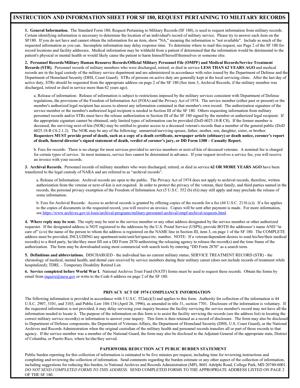
Standard Form 180 – Request Pertaining to Military Records
Fill out nowJurisdiction: Country: United States | Province or State: Federal
The Standard Form 180 – Request Pertaining to Military Records is the official federal form used to request military service records from the United States government. If you are about to complete this form, you are likely trying to obtain copies of service documents, discharge papers, or other personnel records tied to military service.
This form is used by veterans, next of kin, and in some cases authorized third parties. It helps federal record custodians identify the correct individual and locate the specific records requested. Without accurate information on this form, your request may be delayed or denied.
The Standard Form 180 – Request Pertaining to Military Records matters because military records are often required for benefits, employment, burial honors, medical care, or personal documentation. Many agencies will not accept informal requests. They expect this specific document or the same information in writing.
Before you begin filling it out, it helps to understand what the form does, what it does not do, and what information you will need to provide. Clear and complete entries reduce delays and back-and-forth communication.
What is Standard Form 180 – Request Pertaining to Military Records?
Clear definition
The Standard Form 180 – Request Pertaining to Military Records is a federal request form issued for obtaining military personnel, medical, and related service records. It is designed to collect identifying details about a service member so that the appropriate records repository can locate the correct file.
The form asks for basic personal data such as full name used during service, service number or Social Security number, branch of service, and dates of service. It also allows you to specify exactly which documents you want. This may include separation documents, medical records, or an entire personnel file.
The form is not a benefits application. It is not a claim for compensation. It is strictly a request for copies of records that already exist in government custody.
Who typically uses this form?
Veterans are the most common users of this form. They may need copies of discharge papers, often referred to as a DD Form 214, to prove military service for employment or benefits purposes.
Next of kin frequently use the form when a veteran is deceased. This can include a surviving spouse, parent, child, or sibling. They may need records for burial arrangements, memorial benefits, or family history purposes.
Attorneys, researchers, and authorized representatives may also submit the form, but they must provide proof of authorization. Without proper authorization, access to certain records may be limited due to privacy rules.
In some cases, government agencies request records to verify service. However, the individual whose records are being requested remains central to the process, and identifying details must be accurate.
Why might you need this form?
You may need this form to prove your military service for a civilian employer. Many employers request official documentation of discharge status before granting veteran preference or related benefits.
You might also need it to apply for veterans’ benefits. Agencies that administer housing assistance, education programs, or health care often require official proof of service.
Family members commonly use the form to obtain documents necessary for burial in a national cemetery or to arrange military funeral honors. In these situations, timely submission can be important.
You may also need your records for personal reasons. Some people request their full service file to review their performance evaluations, awards, or medical history.
Typical real-life scenarios
- A veteran who recently retired from the military may realize they misplaced their discharge paperwork. When applying for a new job, the employer requests official proof of honorable discharge. The veteran uses this form to request a certified copy.
- A surviving spouse may need to confirm the deceased veteran’s eligibility for burial honors. The cemetery requests official documentation of service. The spouse completes the form to obtain the required record.
- An individual applying for a home loan program available to veterans may be asked to provide evidence of service dates and character of discharge. If those documents are not readily available, the form provides a structured way to obtain them.
- A former service member seeking medical care related to past service may need copies of in-service medical records. These records can support discussions with medical providers or agencies administering veteran programs.
- A family researching genealogy may request older service records of a deceased relative. Depending on the age of the records, access rules may differ, but the same form is typically used to start the request process.
When would you use Standard Form 180 – Request Pertaining to Military Records?
You would use this form any time you need official copies of military personnel or medical records held by a federal records repository. It applies to records from various branches of the armed forces.
Timing often matters. You might complete the form when preparing for retirement from military service, when transitioning to civilian employment, or when applying for a benefit that requires documented proof of service.
The form is also commonly used after a veteran’s death. Funeral directors, family members, and estate representatives may need prompt access to discharge documents to move forward with burial arrangements.
If you discover errors in your records, you may first request copies using this form before pursuing any correction process. Having the full file allows you to review what is on record before taking further steps.
This form may also be used years after service has ended. There is no general expiration period for requesting your own records. However, the location of records may vary depending on how long ago the service occurred.
Legal characteristics of Standard Form 180 – Request Pertaining to Military Records
This form functions as a formal written request to a federal records custodian. For it to be effective, it must clearly identify the service member and specify the records requested. Incomplete identifying information is a common cause of delays.
A valid submission usually requires a signature. The signature confirms your identity or your authority to request the records. Unsigned forms are frequently rejected or returned.
Privacy laws protect military records. Access to recent records is generally restricted to the veteran or authorized individuals. For older records, public access rules may apply differently. These differences depend on the age of the record and the status of the service member.
Requests may also be limited by missing information. If you provide incorrect service dates or an inaccurate service number, the records custodian may not be able to locate the file. Careful review before submission reduces this risk.
This form does not change your military status. It does not correct errors in your record. It does not create new entitlements. It only requests existing documents.
Processing times can vary depending on the type of record and the volume of requests. Urgent requests, such as those related to funerals, are often handled differently from routine requests, but you must clearly indicate the reason for urgency on the form.
Is it legally binding?
The Standard Form 180 – Request Pertaining to Military Records is not a contract between you and the government. It does not create obligations beyond the processing of your request under applicable federal rules.
However, your signature carries legal significance. By signing, you confirm that the information provided is accurate to the best of your knowledge. Providing false information can lead to denial of the request and other consequences under federal law.
If you are signing as a next of kin or authorized representative, your signature represents that you have the authority to access the requested records. Misrepresenting your relationship or authority can result in refusal of access.
In practical terms, the form becomes effective when it is properly completed, signed, and submitted to the correct records location. At that point, it serves as a formal record of your request.
How to fill out Standard Form 180 – Request Pertaining to Military Records
Step 1 – Identify the service member
Start by entering the full name used during military service. Include any middle names or initials that appeared in official records. If the service member used a different name at the time of service, include that version to avoid confusion.
Provide the Social Security number and, if applicable, the service number. Accuracy here is critical. Even a single incorrect digit can delay the search process.
Step 2 – Provide service details
Enter the branch of service, such as Army, Navy, Air Force, Marine Corps, or Coast Guard. Include the approximate dates of entry and separation. If you do not remember exact dates, provide the best estimate you can.
Indicate the place of entry into service and the last unit of assignment if known. These details help narrow the search, especially for older records.
Step 3 – Specify the records requested
Clearly state which documents you are requesting. You may request a copy of the separation document, medical records, or the entire personnel file. Be as specific as possible to avoid unnecessary delays.
If you need certified copies, indicate that on the form. If the request is urgent, such as for burial purposes, note the reason and the date by which the records are needed.
Step 4 – Indicate the purpose of the request
The form includes a section asking for the purpose of your request. Provide a short, clear explanation, such as employment, veterans’ benefits, medical treatment, or burial arrangements. This information can affect processing priority.
You do not need to provide detailed personal information beyond what is requested. A concise explanation is usually sufficient.
Step 5 – Provide requester information
If you are the veteran, enter your current contact information, including mailing address and telephone number. This allows the records office to reach you if clarification is needed.
If you are not the veteran, state your relationship to the service member. Include any required proof of death if requesting records of a deceased veteran, when applicable.
Step 6 – Sign and date the form
Review the entire form before signing. Confirm that names, numbers, and dates are accurate. Ensure all required fields are complete.
Sign your full legal name and enter the date of signing. An unsigned form is typically not processed. After signing, follow the submission instructions provided with the form to send it to the correct records location.
Legal terms you might encounter in Standard Form 180 – Request Pertaining to Military Records
- Official Military Personnel File (OMPF): This is the master record of a service member’s military career. It may include enlistment contracts, duty assignments, awards, evaluations, and discharge documents. When you request a “complete file,” you are usually asking for the OMPF or key parts of it.
- DD Form 214: This is the Certificate of Release or Discharge from Active Duty. It shows dates of service, character of discharge, and other critical details. Many people use this form to prove veteran status for employment, benefits, or membership purposes.
- Next of Kin: This refers to the closest living relative of a deceased service member. The form uses this term to determine who has the right to request records if the veteran is no longer alive. You must identify your relationship clearly if you are applying as next of kin.
- Archival Records: These are older military records that are considered permanent historical documents. Access rules may differ depending on how old the records are. The form helps determine whether the file is archival or non-archival.
- Non-Archival Records: These are more recent records that are still protected by privacy laws. Access is generally limited to the veteran or authorized individuals. If you are not the veteran, you may need proof of death or written authorization.
- Authorization: This is written permission from the veteran allowing someone else to request records. It usually requires a signature and date. Without proper authorization, your request may be delayed or denied.
- Proof of Death: This can include a death certificate, obituary, or funeral program. It may be required if you are requesting records as a relative of a deceased veteran. The document confirms that privacy restrictions have changed.
- Service Number: This is an identification number assigned to service members, used especially before Social Security numbers became standard. Including it helps the records center locate the correct file faster. If you do not know it, provide as much identifying information as possible.
- Character of Service: This refers to how the military categorized a service member’s discharge, such as honorable or general. It often appears on the DD Form 214. This classification can affect eligibility for certain benefits.
- Separation Date: This is the official date the service member left active duty. The form asks for entry and separation dates to narrow the search. Even an approximate date can help if exact details are unavailable.
FAQs
Do I need to use Standard Form 180 – Request Pertaining to Military Records to get a DD Form 214?
You are not always required to use this document, but it is the standard way to request a DD Form 214 by mail or fax. If you want a paper copy sent to you and you are not using an online system, this form ensures you provide all required identification details.
What information must match exactly for my request to be accepted?
The service member’s full name used during service, date of birth, branch, and approximate dates of service should match official records as closely as possible. If the name changed after service, list both the service name and the current name. Small errors can delay processing because staff must manually verify identity.
Can I request records for someone else using this form?
Yes, but you must show your authority. If the veteran is living, you need written authorization signed and dated by that person. If the veteran is deceased, you may need to show proof of death and confirm your relationship as next of kin.
Where do I send this document once it is completed?
The mailing address depends on the branch of service and the dates of service. The instructions on the form include a chart to help you choose the correct address. Sending it to the wrong location can add weeks to processing time.
How do I know if the records are considered archival?
Records generally become archival after a set number of years from the service member’s separation. The instructions explain how age affects access. If the file is archival, more information may be available to the public, but you still need to provide enough details to locate it.
What happens if I do not know the exact service dates?
Provide your best estimate and explain that the dates are approximate. Include additional identifiers such as place of birth, service number, or last duty station. The more details you give, the easier it is to find the correct file.
Does this form change anything in the veteran’s official record?
No. This document only requests copies of existing records. It does not update discharge status, correct errors, or add new information to the file.
How long does it take to receive the requested documents?
Processing time varies depending on the volume of requests and the type of record you want. Requests for basic separation documents are often faster than full personnel files. Incomplete forms or missing signatures are a common cause of delay.
Checklist: Before, During, and After Standard Form 180 – Request Pertaining to Military Records
Before
- Gather the veteran’s full name used during service.
- Confirm Social Security number or service number if available.
- Identify branch of service and approximate service dates.
- Determine whether the veteran is living or deceased.
- Collect proof of death if you are applying as next of kin.
- Review what specific documents you need, such as DD Form 214 or full personnel file.
- Check whether you need written authorization.
- Prepare your mailing address and contact information.
During
- Print clearly or type to avoid misreading.
- Complete all identification fields as fully as possible.
- Specify exactly which documents you are requesting.
- Indicate the purpose of the request if the form asks for it.
- Sign and date the form where required.
- Double-check that names and dates are consistent.
- Attach authorization or proof of death if needed.
- Review the address chart for the correct submission location.
After
- Make a copy of the completed form for your records.
- Make copies of all attachments.
- Send the form using a method that provides delivery confirmation if possible.
- Note the date you mailed or faxed the request.
- Monitor your mail for follow-up letters.
- Respond promptly if additional information is requested.
- Store received records in a safe place.
- Provide copies to agencies or employers only as needed.
Common mistakes to avoid with Standard Form 180 – Request Pertaining to Military Records
- Mistake: Leaving required identification fields blank because you do not know the answer, which happens when applicants assume partial information is enough, causing delays or rejection; do not forget to provide estimates and add extra identifying details instead of skipping sections.
- Mistake: Forgetting to sign and date the form, often because people focus on the record details and overlook the certification section, which leads to automatic return of the request; do not forget to check for a signature before mailing.
- Mistake: Sending the form to the wrong address due to not carefully reading the branch and date chart, resulting in long forwarding delays; do not forget to match the service branch and separation period to the correct destination.
- Mistake: Failing to include proof of death when requesting records for a deceased veteran, which happens when applicants assume their relationship is enough, leading to privacy-based denial; do not forget to attach acceptable documentation.
- Mistake: Requesting “all records” without clarity, which can slow processing because staff must interpret your needs, potentially causing incomplete responses; do not forget to list specific documents if you know what you require.
- Mistake: Using a nickname or married name without listing the service name, which occurs when the veteran’s name changed after service, causing difficulty locating the file; do not forget to include the exact name used during military service.
- Mistake: Providing inconsistent dates across sections, which often happens when estimates are not double-checked, creating confusion during record searches; do not forget to review every date entry before submission.
- Mistake: Not keeping a copy of what you sent, which happens when people assume the agency will track everything, making it harder to follow up; do not forget to retain a complete copy for your records.
What to do after filling out Standard Form 180 – Request Pertaining to Military Records
Once you complete the form, slow down before you send it. A careful final review prevents weeks of delay.
- Step 1: Review every field for accuracy, especially names, dates, and identification numbers.
- Step 2: Confirm you signed and dated the certification section.
- Step 3: Attach any required documents, such as authorization or proof of death.
- Step 4: Make a complete copy of the signed form and all attachments for your records.
- Step 5: Verify the correct mailing address based on branch and service dates.
- Step 6: Send the request using a method that provides tracking or delivery confirmation if available.
- Step 7: Record the date you sent the request and keep any tracking number.
- Step 8: Watch for written confirmation or returned mail in case corrections are needed.
- Step 9: Respond promptly if you receive a notice asking for clarification or additional documents.
- Step 10: Once you receive the records, review them for completeness and legibility.
- Step 11: Store the documents securely, such as in a fire-resistant folder or safe location.
- Step 12: Update your personal files and provide copies only when necessary for benefits, employment, or official purposes.
If you discover errors in the records you receive, remember that this request process only provides copies. Correcting military records usually requires a separate application to the appropriate review board. Keep your copies organized so you can refer to them easily if you decide to pursue corrections or submit future benefit claims.
Disclaimer: This guide is provided for informational purposes only and is not intended as legal advice. You should consult a legal professional.