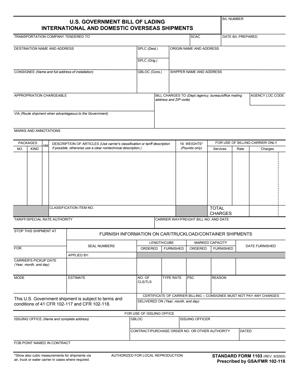
Standard Form 1103 – U.S. Government Bill of Lading International and Domestic Overseas Shipments
Fill out nowJurisdiction: Country: United States | Province or State: Federal
Standard Form 1103 – U.S. Government Bill of Lading International and Domestic Overseas Shipments is a federal transportation document used to move government property. If you are handling a shipment for a federal agency, this form acts as the official record of that movement. It sets out who is shipping, what is being shipped, where it is going, and how it will be paid for.
This document matters because it creates a clear agreement between the U.S. Government and a transportation carrier. It confirms that the carrier has received the goods and agrees to deliver them under specific terms. It also supports payment and audit review.
You may encounter this form if you work in logistics, procurement, property management, or contracting for a federal agency. Carriers and freight forwarders who handle overseas or international shipments for the government also see it regularly.
If you are about to fill it out, you need to understand that this is not just a shipping label. It is both a receipt and a contract. Accuracy affects payment, tracking, accountability, and potential claims.
What is Standard Form 1103 – U.S. Government Bill of Lading International and Domestic Overseas Shipments?
Clear definition
Standard Form 1103 – U.S. Government Bill of Lading International and Domestic Overseas Shipments is an official federal form used to document the transportation of government property when the shipment is international or moves to or from overseas locations. It serves as a government bill of lading.
A bill of lading is a transportation document that does three main things. It acknowledges receipt of goods. It outlines the terms of shipment. It acts as evidence of the contract between the shipper and the carrier. In this case, the shipper is the U.S. Government.
This form is typically issued by a federal agency or an authorized representative. It includes details about the origin, destination, description of goods, weight, special handling requirements, and charges.
Because it is a standardized federal document, it promotes uniformity across agencies. That consistency helps carriers, auditors, and government personnel rely on a predictable structure and set of terms.
Who typically uses this form?
Federal civilian agencies use this form when arranging international or overseas shipments of government property. This may include equipment, supplies, vehicles, or household goods connected to official assignments.
Military-related shipments may use other specialized forms, but certain federal activities outside the continental United States rely on this specific document. Overseas posts, installations, and offices often use it when moving materials to or from the United States.
Transportation officers, contracting officers, logistics specialists, and property custodians may prepare or review the form. On the carrier side, freight companies, shipping agents, and international transport providers receive and sign it.
If you are a contractor acting on behalf of a federal agency, you may be asked to complete portions of the form under agency supervision. The government remains the named shipper.
Why might you need this form?
You might need this form when government property must be shipped across national borders or to overseas territories. The form documents that the transportation is authorized and funded by the federal government.
It may also be required to ensure that the shipment qualifies for specific government transportation rates. Without the correct bill of lading, a carrier may not process the shipment under federal terms.
The document supports internal accountability. Agencies must track government property and transportation costs. This form provides a paper trail for audits and financial review.
If damage or loss occurs during shipment, the completed form becomes key evidence. It shows the condition, quantity, and terms agreed upon at the time of pickup.
Typical real-life scenarios
- A federal agency sends specialized equipment from a warehouse in the United States to an overseas office. The agency prepares this form to authorize the international shipment and outline the delivery terms.
- An employee is reassigned to an overseas post. The agency arranges shipment of official household goods connected to the assignment. The form documents the carrier’s responsibility and delivery details.
- An overseas federal facility returns surplus equipment to the continental United States. The shipment moves by sea freight. The form records the transfer and confirms receipt by the carrier.
- Emergency supplies are transported to an overseas disaster response site. The form establishes the shipping terms and provides documentation for rapid payment processing and later audit review.
When would you use Standard Form 1103 – U.S. Government Bill of Lading International and Domestic Overseas Shipments?
You would use this form when the U.S. Government is the shipper, and the transportation involves international or overseas movement. It is typically used before the carrier takes possession of the goods.
The form is prepared at the time transportation arrangements are finalized. This often occurs after a carrier has been selected under a contract or rate agreement. The document then formalizes the specific shipment.
Transportation personnel may use it when scheduling freight pickup. It travels with the shipment and is signed or acknowledged by the carrier to confirm receipt.
It is also used when shipment charges will be billed to the government under established terms. The completed form supports invoicing and payment review.
If goods are moving between the United States and a foreign country, or between U.S. territories and foreign locations, this form may apply. The exact circumstances can vary depending on agency procedures and transportation agreements.
Legal characteristics of Standard Form 1103 – U.S. Government Bill of Lading International and Domestic Overseas Shipments
This form has legal significance because it documents a transportation contract. When properly completed and accepted by the carrier, it outlines the obligations of both parties.
The form typically includes standard government transportation terms. These may address liability for loss or damage, routing, freight classification, and payment terms. The specific language on the form governs the shipment unless modified by applicable contracts or regulations.
For the document to function properly, it must be accurate and complete. Common problems include incorrect destination information, incomplete descriptions of goods, missing weights, or unsigned sections. Errors can delay payment or create disputes about responsibility.
Because it is a federal form, it operates within the framework of federal procurement and transportation rules. International shipments may also be affected by customs laws and international carriage conventions. Those external rules may influence how liability or claims are handled.
The form does not transfer ownership of the goods. It documents transportation, not sale. It also does not replace separate procurement contracts or service agreements between the agency and the carrier. It works alongside them.
Is it legally binding?
When properly issued and accepted, this form generally serves as a binding transportation agreement between the U.S. Government and the carrier. The binding effect arises from the combination of the written terms and the carrier’s acceptance of the goods for shipment.
The carrier’s signature or other acknowledgment typically confirms receipt and agreement to transport under the stated conditions. Once goods are in transit, both parties are expected to follow the documented terms.
However, the form’s binding nature depends on proper authority and completion. If it is signed by someone without authorization, or if key terms are missing, disputes may arise about enforceability. The surrounding transportation contract and federal rules may also affect how disagreements are resolved.
How to fill out Standard Form 1103 – U.S. Government Bill of Lading International and Domestic Overseas Shipments
Step 1 – Identify the issuing agency
Enter the full name and address of the federal agency responsible for the shipment. This establishes the government entity acting as the shipper. Ensure the information matches official agency records to avoid confusion during billing or audit review.
Step 2 – Enter the bill of lading number
Provide the unique control number assigned to this shipment. This number is used for tracking, payment processing, and recordkeeping. Double-check that it matches internal transportation logs.
Step 3 – Provide shipper and origin details
List the specific office or facility releasing the goods. Include the complete pickup address. Accurate origin information helps the carrier plan routing and supports verification if questions arise later.
Step 4 – Provide consignee and destination details
Enter the name and address of the receiving location. This may be an overseas post office, warehouse, or other federal site. Include contact information if space allows, so delivery can be coordinated efficiently.
Step 5 – Describe the property being shipped
Clearly describe each item or category of goods. Include quantity, weight, dimensions if required, and any identifying numbers. Avoid vague terms. Precise descriptions reduce the risk of disputes about what was shipped.
Step 6 – Record weight and classification information
Insert the gross weight and any applicable freight classification. If the weight is estimated, indicate that clearly where the form allows. Weight accuracy affects transportation charges and carrier responsibility.
Step 7 – Specify routing and mode of transportation
Indicate whether the shipment will move by air, sea, or a combination of modes. Include routing instructions if applicable. This ensures the carrier understands the approved transportation method.
Step 8 – Include special handling instructions
Note any requirements such as hazardous materials handling, temperature control, security measures, or priority delivery. Clear instructions protect the goods and clarify expectations.
Step 9 – Confirm payment terms and charges
Identify how charges will be billed and paid. This may reference an existing government contract or rate agreement. Ensure the billing information is consistent with agency financial procedures.
Step 10 – Review certifications and signatures
Check all entries for completeness and accuracy. The authorized government representative signs to certify the shipment details. The carrier signs or acknowledges receipt of the goods. Once both parties complete this step, the document serves as the official record of the shipment agreement.
Legal terms you might encounter in Standard Form 1103 – U.S. Government Bill of Lading International and Domestic Overseas Shipments
- Consignor (Shipper): This is the federal agency or authorized office that releases the property for shipment. On this form, the consignor’s name and address must match official agency records. You need to ensure the office listed has authority to initiate the shipment.
- Consignee: The consignee is the party receiving the shipment at the destination. This may be another federal installation, an overseas facility, or a designated agent. The name and address must be precise to avoid delivery delays or storage fees.
- Carrier: The carrier is the transportation provider moving the goods. The form identifies the carrier responsible for each leg of the shipment. This information determines who is liable for loss or damage during transit.
- Freight Charges: These are the transportation costs associated with the shipment. The form specifies how charges are calculated and who is responsible for payment. You must confirm whether charges are prepaid, collect, or billed under government transportation terms.
- Accessorial Services: These are additional services beyond basic transportation. Examples include packing, storage, special handling, or expedited delivery. If you request them, they must be clearly listed so billing and responsibility are accurate.
- Declared Value: This is the stated value of the property being shipped. It can affect liability limits and claims if goods are lost or damaged. Make sure the declared value reflects accurate replacement or accounting value.
- Routing: Routing refers to the transportation path and mode used to move the shipment. It may include truck, air, sea, or a combination. Clear routing instructions help prevent misdelivery or unauthorized transport changes.
- Transportation Control Number (TCN): This is a unique tracking identifier assigned to the shipment. It links the shipment to internal logistics and accounting systems. You must ensure it matches agency records to avoid payment or tracking issues.
- Certificate of Release: This section confirms the property was released to the carrier in stated condition. It is typically signed by an authorized representative. This signature creates a record of transfer of custody.
- Inspection and Acceptance: This refers to the process at delivery where the receiving party confirms condition and quantity. Noting discrepancies at this stage is critical for damage claims. Failure to document issues can limit recovery options.
FAQs
Do I need special authority to sign this document?
Yes. The person signing must have delegated authority from the issuing agency. Before signing, confirm that your name or position is listed in internal authorization records. If you are unsure, check with your supervisor or contracting office so the signature is valid and accepted for payment and tracking purposes.
What date should I enter as the shipment date?
You should enter the actual date the carrier takes possession of the goods. This is not the date you prepared the paperwork unless both occur on the same day. The shipment date affects tracking, billing cycles, and any timelines tied to delivery performance.
What if the shipping and receiving names do not exactly match agency records?
Names should match official records exactly, including abbreviations and unit codes. If they do not, shipments can be delayed or misrouted. Before finalizing Standard Form 1103 – U.S. Government Bill of Lading International and Domestic Overseas Shipments, verify spelling and formatting against your agency directory or logistics system.
Can I correct errors after the carrier has picked up the shipment?
You can make corrections, but they must be clearly documented and communicated to the carrier and receiving location. Do not erase or obscure original entries. Use a formal correction process so there is a clear audit trail and no confusion about responsibility or charges.
What attachments should go with this form?
You may need packing lists, weight certificates, hazardous material documentation, or special handling instructions. Confirm that each attachment is referenced on this document. Missing attachments can cause rejection by receiving personnel or payment delays.
How do I confirm the shipment was officially accepted?
A signed delivery receipt or electronic confirmation from the consignee usually confirms acceptance. Check that the date, condition notes, and quantity received are recorded. Keep a copy of that confirmation with your completed Standard Form 1103 – U.S. Government Bill of Lading International and Domestic Overseas Shipments for your records.
What happens if there is visible damage at delivery?
The receiving party should note the damage on the delivery record before signing. Photographs and detailed descriptions help support a claim. Without written notation at the time of inspection, it may be harder to establish when the damage occurred.
Does this form change ownership of the property?
No. This document records transportation and custody transfer, not ownership transfer. It shows who is responsible for moving and safeguarding the property during transit. Ownership typically remains with the issuing agency unless separate documentation states otherwise.
Checklist: Before, During, and After Standard Form 1103 – U.S. Government Bill of Lading International and Domestic Overseas Shipments
Before
- Confirm you have authority to initiate and sign the shipment.
- Verify shipper and consignee names against official agency records.
- Gather accurate weight, dimensions, and property descriptions.
- Assign or confirm the Transportation Control Number.
- Determine routing and approved carrier arrangements.
- Identify any hazardous or special handling requirements.
- Prepare supporting documents such as packing lists or certificates.
- Review funding codes or billing information for accuracy.
During
- Enter all shipment details clearly and legibly.
- Double-check quantities, weights, and declared values.
- Confirm routing and carrier information before release.
- Ensure accessorial services are listed if requested.
- Have the carrier acknowledge receipt of goods.
- Sign and date the release section with proper authority.
- Provide copies to the carrier as required.
- Keep a working copy for internal tracking.
After
- Confirm delivery through signed receipt or electronic notice.
- Compare delivered quantities to shipped quantities.
- Document and report any damage or shortages immediately.
- Reconcile freight charges with agreed terms.
- File the completed form with attachments in agency records.
- Update internal tracking or inventory systems.
- Monitor payment processing if applicable.
- Retain records according to agency retention schedules.
Common mistakes to avoid with Standard Form 1103 – U.S. Government Bill of Lading International and Domestic Overseas Shipments
- Mistake: Listing incomplete consignee information because you assume the carrier “knows the location,” which can cause delivery delays or storage fees; do not forget to include full address details and unit identifiers.
- Mistake: Understating shipment weight due to rough estimates, which often leads to billing adjustments and audit issues; do not forget to verify weight with certified measurements when required.
- Mistake: Forgetting to attach hazardous material documentation because the items seem routine, which can result in regulatory violations or shipment refusal; do not forget to confirm compliance for any controlled materials.
- Mistake: Allowing an unauthorized employee to sign the release section, which can invalidate the document for payment or accountability purposes; do not forget to verify delegated authority before signing.
- Mistake: Failing to note visible damage at delivery because you are in a hurry, which weakens any later claim; do not forget to document condition before accepting the shipment.
- Mistake: Using outdated routing instructions copied from a prior shipment, which can misdirect goods or increase costs; do not forget to confirm current routing guidance for each new shipment.
- Mistake: Omitting accessorial services from the form because they were discussed verbally, which leads to billing disputes; do not forget to record every agreed service in writing.
- Mistake: Misplacing the signed delivery confirmation, which complicates audits and payment verification; do not forget to store copies in the designated record system.
What to do after filling out Standard Form 1103 – U.S. Government Bill of Lading International and Domestic Overseas Shipments
Once you complete the form, your focus shifts to control and documentation. You want a clear record from release through delivery. Every step should support accountability, tracking, and payment accuracy.
Start by reviewing the entire document one more time. Look for missing signatures, unchecked boxes, or incomplete routing details. Small omissions can delay shipment or payment processing.
- Step 1: Make at least two copies of the completed form, including all attachments.
- Step 2: Provide the required copy to the carrier at pickup.
- Step 3: Distribute internal copies to your logistics or finance office as required.
- Step 4: Enter shipment details into your agency’s tracking or property system.
- Step 5: Monitor transit status using the assigned control number.
- Step 6: Confirm delivery with the consignee and obtain written or electronic proof.
- Step 7: Compare delivery confirmation with the original quantities and condition notes.
- Step 8: Report discrepancies or damage immediately through your internal claims process.
- Step 9: Reconcile any freight invoices with the charges listed on the form.
- Step 10: File the final, signed version with all confirmations in your records system.
Keep your documents organized. Store electronic scans if permitted. Make sure the Transportation Control Number, shipment date, and carrier name are easy to search later.
If your agency conducts periodic audits, you may need to show how the shipment was authorized, released, transported, delivered, and paid. A complete file helps you answer those questions quickly.
Finally, update any related internal documents. This may include inventory logs, property transfer records, or financial tracking sheets. Accurate updates ensure that property location and accountability remain current long after the shipment is complete.
Disclaimer: This guide is provided for informational purposes only and is not intended as legal advice. You should consult a legal professional.