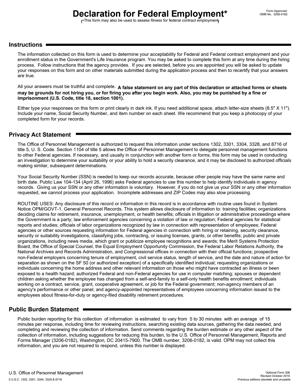
OF-306 – Declaration for Federal Employment
Fill out nowJurisdiction: Country: United States | Province or State: Federal
The OF-306 – Declaration for Federal Employment is a standard form used in the federal hiring process in the United States. You complete it when you are applying for or being considered for a federal job. It gathers background information that federal agencies use to decide whether you are suitable for employment.
If you are about to fill out the OF-306 – Declaration for Federal Employment, you are likely in the middle of a job application or have received a conditional job offer. The form asks detailed questions about your work history, criminal history, military service, and prior federal employment.
This document matters because your answers are part of your official employment record. Agencies rely on this information when evaluating your eligibility and trustworthiness. Inaccurate or incomplete responses can delay the hiring process.
The form is not just another application page. It is a formal declaration. When you sign it, you confirm that the information you provided is true and complete to the best of your knowledge.
What is OF-306 – Declaration for Federal Employment?
Clear definition
The OF-306 – Declaration for Federal Employment is a federal government form used to collect personal and background information from job applicants. It is part of the pre-employment screening process for many federal positions.
The form focuses on issues that may affect your eligibility for federal service. These often include prior federal employment, selective service registration, criminal charges or convictions, and past misconduct. The information supports decisions about hiring, security clearances, and suitability determinations.
It is not a résumé or general job application. Instead, it is a declaration that supplements other hiring documents. Agencies may review it alongside your application, background check results, and interview records.
Who typically uses this form?
You use this form if you are applying for a position with a federal agency. This can include civilian roles in departments such as defense, health, transportation, homeland security, or administrative offices.
Both first-time applicants and former federal employees may complete it. If you previously worked for the federal government and are returning, you may still need to provide updated information.
Contractors generally do not complete this form unless they are applying for a direct federal position. The form is tied to federal employment, not private employment.
Students, interns, seasonal workers, and full-time professionals may all be asked to complete it. The requirement depends on the position and agency, not your career stage.
Why might you need this form?
You need this form because federal employers must evaluate suitability before hiring. Suitability refers to whether your background meets the standards for federal service.
Federal agencies operate under rules that require consistency and fairness in hiring. The form helps standardize the type of information collected from every applicant.
It also supports background investigations. In some cases, the answers you provide will be compared with fingerprint results, security checks, or other records.
If you receive a tentative or conditional offer, the agency may require this form before finalizing employment. Completing it accurately helps move your hiring process forward.
Typical real-life scenarios
- You apply for an entry-level administrative role with a federal agency. After your interview, you receive an email asking you to complete additional onboarding documents, including this declaration. The agency reviews your answers before confirming your start date.
- You are a former member of the military applying for a civilian federal position. As part of the hiring process, you are asked to disclose prior service details and any discharge information on this form.
- You worked for a federal agency years ago and left voluntarily. Now you are reapplying to a different agency. The form asks about your prior federal employment and whether you were ever fired or resigned after being told you would be removed.
- You are applying for a position that requires a background investigation. The hiring office collects your OF-306 early in the process to identify any issues that may need clarification before a full investigation begins.
When would you use OF-306 – Declaration for Federal Employment?
You typically use this form during the hiring stage, either when you apply or after you receive a conditional offer. Some agencies request it upfront. Others wait until they are seriously considering you.
It is commonly used for permanent, temporary, and term federal positions. Roles may include administrative assistants, analysts, law enforcement officers, engineers, medical professionals, and many others. The requirement is broad across federal agencies.
If a position involves access to sensitive information or facilities, the form may be reviewed carefully as part of a larger suitability assessment. Even for positions that do not require a high-level security clearance, agencies still review the declaration.
You may also complete the form again if you are transferring between agencies. Each agency may need its own record of your declarations.
The timing can vary. In some cases, you submit it electronically through a hiring portal. In others, you may receive a fillable document to complete and return to a human resources office.
Legal characteristics of OF-306 – Declaration for Federal Employment
This form is a formal declaration made to the federal government. Its effectiveness depends on complete and truthful responses. You are attesting that the information is correct to the best of your knowledge.
A common issue that causes delays is incomplete disclosure. Leaving out required details, such as dates or explanations, may result in follow-up questions. Inconsistent answers compared to other records can also create problems.
Another frequent concern is misunderstanding the scope of a question. Some questions ask about your entire lifetime. Others focus on a specific time period. Reading each question carefully helps ensure your answers match what is being asked.
Federal agencies may interpret answers based on internal policies and suitability standards. While the form is used nationwide, individual agencies may handle follow-up steps differently. The underlying federal rules are consistent, but the review process can vary.
The form does not replace a background investigation. It is one part of a broader review. It also does not guarantee employment once submitted. Agencies still evaluate qualifications, references, and other factors.
Is it legally binding?
When you sign the form, you are making a formal declaration to the federal government. This carries legal significance. Providing false or misleading information can lead to serious consequences, including withdrawal of a job offer or removal from federal service.
The form includes a certification statement near the end. By signing, you confirm that your answers are true and complete. This certification is what gives the document its binding nature.
If errors are discovered later, agencies may review whether the mistake was intentional or accidental. Intentional falsification is treated more seriously than a minor, unintentional omission.
The legal effect comes from your signed declaration. Unsigned drafts or incomplete submissions do not carry the same weight because they are not finalized representations.
How to fill out OF-306 – Declaration for Federal Employment
Step 1 – Review the entire form before starting
Begin by reading through the full document from start to finish. This gives you a clear sense of the type of information requested. Pay attention to time frames, definitions, and any instructions about attachments or explanations.
Understanding the structure in advance helps you gather necessary details, such as dates of employment, military service information, or court records, before you begin entering answers.
Step 2 – Provide your personal identifying information
Enter your full legal name, contact details, and other identifying information exactly as requested. Use consistent information that matches your other application materials.
If the form asks for previous names or aliases, include them as required. Consistency across documents helps prevent delays in processing.
Step 3 – Answer questions about federal civilian or military service
Carefully respond to questions about prior federal employment. This may include whether you were ever fired, resigned after being told you would be fired, or left by mutual agreement following notice of removal.
If you have prior military service, provide the requested details about your service and discharge. If explanations are required, write clearly and focus on factual information.
Step 4 – Respond to questions about criminal history
Read each question about charges, convictions, probation, or parole closely. Note whether the question refers to convictions only or also includes charges.
If the form requires additional explanation, provide a concise description of what occurred, including dates and outcomes. Avoid leaving required fields blank.
Step 5 – Address selective service registration, if applicable
If you are asked about selective service registration, answer based on your situation. Provide any requested details if you were required to register.
If an explanation is needed, use the space provided or attach additional pages as instructed. Keep your response focused on the facts requested.
Step 6 – Review your answers for completeness and accuracy
Before signing, read every response again. Confirm that dates are accurate and that explanations are clear.
Check that you answered every required question. Missing information can delay processing or lead to follow-up inquiries from the hiring office.
Step 7 – Sign and date the declaration
Complete the certification section by signing and dating the form as instructed. Your signature confirms that your responses are true and complete to the best of your knowledge.
If submitting electronically, follow the instructions for digital signatures or electronic certification. Once signed, your declaration becomes part of your official employment record.
Legal terms you might encounter in OF-306 – Declaration for Federal Employment
- Appointing Authority: This is the federal agency or official who has the legal power to hire you into a federal position. On this document, your answers are reviewed by the appointing authority to determine if you meet suitability requirements. They rely on your disclosures to decide whether to move forward with your appointment.
- Suitability Determination: This refers to the government’s decision about whether you are appropriate for federal employment based on character and conduct. Your responses about criminal history, prior federal employment, and other background factors directly affect this determination. It is not just about qualifications. It is about trust and reliability.
- False Statement: A false statement is any knowingly incorrect, incomplete, or misleading information you provide. The certification section of this document makes clear that false statements can lead to serious consequences. These can include removal from federal service or criminal penalties.
- Selective Service Registration: Certain male applicants must confirm they registered with the Selective Service System. The form asks about your registration status. Your answer helps the agency confirm eligibility for federal employment under applicable rules.
- Military Service: This term refers to prior service in the U.S. Armed Forces. The form may ask whether you were discharged and under what conditions. The characterization of your discharge can affect your eligibility for certain roles or benefits.
- Criminal Offense: A criminal offense includes felonies and certain misdemeanors. The form requires you to disclose specific convictions, pending charges, or probation status. You must read the wording carefully to understand what must be reported and what is excluded.
- Probation: Probation is a court-ordered period of supervision instead of, or following, incarceration. If you are currently on probation or have been on probation within a specified time frame, you may need to disclose it. The form’s instructions will guide you on timing and scope.
- Certification: Certification is your formal statement that the information you provided is true, complete, and accurate to the best of your knowledge. You make this certification by signing and dating the form. It gives the document legal weight.
- Official Personnel Folder (OPF): This is your permanent federal employment record if you are hired. Information from this form may be placed in your personnel file. That means your answers can remain part of your employment history.
FAQs
Do I need to complete this document if I already submitted a résumé and background information?
Yes. Your résumé shows your experience and qualifications. This document serves a different purpose. It collects specific declarations about your background that are required before appointment. Even if you provided similar information elsewhere, you must answer the questions here as written and sign the certification.
What effective date should I use when signing?
You should enter the actual date you sign the form. Do not predate or postdate it. The date confirms when you made your certification. Make sure the date format matches the instructions on the document and is clearly legible.
What if my legal name is different from the name on my application?
Use your current legal name where requested. If the form asks for other names used, list prior names exactly as they appeared. Consistency matters. The agency will compare this document with your application, identification, and background investigation records, so make sure everything matches or is clearly explained.
Do I need to attach court documents or explanations?
Follow the instructions provided by the hiring agency. If you answer “yes” to certain questions, you may be asked to provide additional details. When explaining, include dates, locations, and outcomes. Keep your explanation factual and complete so the reviewer does not have to request clarification.
Who is authorized to sign this form?
You must sign it yourself. This is a personal declaration. No one else can sign on your behalf unless specific legal authority exists, and that would need to be clearly documented. Your signature confirms that you personally reviewed every answer.
What happens after I submit OF-306 – Declaration for Federal Employment?
The hiring office reviews your responses as part of the suitability process. They may compare your answers with information from background checks or security forms. If questions arise, they will usually contact you for clarification before making a decision.
Can I update my answers after submitting this document?
Yes. If you realize you made an error or your situation changes before your appointment, notify the hiring contact promptly. Provide the corrected information in writing. Do not wait for the agency to discover the discrepancy.
Will this form become part of my permanent employment record?
If you are hired, this document may be placed in your Official Personnel Folder. That means it can remain part of your federal employment record. Accuracy is important because it may be reviewed later in connection with promotions, transfers, or investigations.
Checklist: Before, During, and After OF-306 – Declaration for Federal Employment
Before
- Read all instructions carefully, including any agency-specific guidance.
- Gather details about prior federal employment, if any.
- Collect information about military service, including discharge status.
- Review your criminal history records to ensure accurate dates and outcomes.
- Confirm your Selective Service registration status, if applicable.
- Check that your legal name matches your identification documents.
- Set aside uninterrupted time to complete the form carefully.
During
- Answer every question exactly as written without skipping sections.
- Use clear, legible handwriting if completing a paper version.
- Provide full explanations when a “yes” answer requires details.
- Double-check dates for accuracy and consistency.
- Ensure names of courts, agencies, or employers are spelled correctly.
- Review each page before moving to the next.
- Sign and date the certification only after reviewing all responses.
After
- Make a complete copy for your personal records.
- Confirm submission instructions from the hiring office.
- Submit the form using the required method (upload, email, or physical delivery).
- Watch for confirmation that your document was received.
- Respond promptly to any follow-up questions.
- Store your copy in a secure place with other employment documents.
- Update your personal records if you provided corrected or clarified information later.
Common mistakes to avoid with OF-306 – Declaration for Federal Employment
- Mistake: Leaving questions blank because you think they do not apply, which often happens when instructions are skimmed, can delay processing or make the form appear incomplete; do not forget to follow any directions about marking “no” where required.
- Mistake: Guessing dates for arrests or employment because you do not have records in front of you, which can lead to inconsistencies during background review; do not forget to verify dates before you submit.
- Mistake: Failing to disclose required criminal history due to embarrassment or confusion about what counts, which can result in a finding of falsification; do not forget that honesty is weighed heavily in suitability decisions.
- Mistake: Using a nickname or shortened name instead of your full legal name, which happens out of habit and can cause record mismatches; do not forget to match your identification documents exactly.
- Mistake: Signing before reviewing every page, which is common when you are rushing to meet a deadline and can lock in errors under certification; do not forget that your signature confirms accuracy.
- Mistake: Ignoring instructions about additional explanations after answering “yes,” which may cause the agency to pause your application for clarification; do not forget to include complete details when required.
- Mistake: Submitting the wrong version of the form because you downloaded an outdated copy, which can lead to rejection and resubmission; do not forget to confirm you are using the current version provided by the hiring office.
- Mistake: Failing to update the agency if something changes before appointment, which may be seen as withholding information; do not forget to report new developments promptly in writing.
What to do after filling out OF-306 – Declaration for Federal Employment
Once you complete the form, slow down before you send it. A careful final review can prevent delays. Read each answer out loud to yourself. This helps you catch missing words, incorrect dates, or unclear explanations.
- Step 1: Review the entire document from beginning to end for completeness and accuracy.
- Step 2: Confirm that your name, date of birth, and other identifying details match your application and identification exactly.
- Step 3: Ensure every required signature and date field is properly completed.
- Step 4: Make a clear copy or save a secure digital version for your records.
- Step 5: Prepare any required attachments or written explanations referenced in your answers.
- Step 6: Submit the document using the method specified by the hiring office.
- Step 7: Look for confirmation of receipt, whether by email acknowledgment or portal update.
- Step 8: Keep all correspondence related to this form in one organized folder.
- Step 9: Monitor your email and phone for follow-up questions from the agency.
- Step 10: Promptly provide any additional information requested to avoid delays in your hiring process.
After submission, stay organized. Keep your copy with other federal employment paperwork. If you are hired, the information may become part of your personnel record. If you are not selected, retaining a copy helps you answer similar questions accurately in future applications.
If you discover an error after submission, act quickly. Contact your hiring representative. Provide a clear written correction. Being proactive shows good faith and can prevent misunderstandings.
Treat this document as part of your professional record. Accuracy, completeness, and honesty support a smoother review process and help establish trust from the beginning of your federal employment journey.
Disclaimer: This guide is provided for informational purposes only and is not intended as legal advice. You should consult a legal professional.