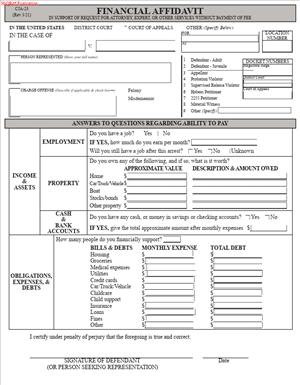
CJA 23 – Financial Affidavit
Fill out nowJurisdiction: Country: United States | Province or State: Federal
The CJA 23 – Financial Affidavit is a court form used to describe your financial situation in a clear, structured way. It focuses on income, assets, expenses, and debts at a specific point in time. Courts use this information to make decisions about eligibility for certain court-related services.
If you are about to fill out the CJA 23 – Financial Affidavit, you are likely interacting directly with the federal court system. This form is commonly completed by people who do not have a lawyer or who are asking the court to consider their financial limits. Accuracy and clarity matter because the form is reviewed closely.
The CJA 23 – Financial Affidavit matters because it creates a written record of your finances under oath. What you write becomes part of the court file. The court relies on this document rather than informal explanations or estimates given outside the form.
This form is not about telling your story or explaining your case. It is about numbers, sources, and regular obligations. The court uses standardized forms like this to compare situations consistently across cases.
Before you begin, it helps to understand what the form asks for and how each section fits together. That understanding can reduce mistakes, delays, or requests for clarification later in the process.
What is CJA 23 – Financial Affidavit?
Clear definition
The CJA 23 – Financial Affidavit is a sworn financial disclosure form used in federal court proceedings. It collects detailed information about your income, assets, expenses, and debts. The form presents this information in a standardized format so the court can review it efficiently.
This document functions as a snapshot of your financial condition. It reflects your situation at the time you complete and sign it. The court does not treat it as a budget plan or a prediction of future earnings.
The affidavit format means you confirm that the information is true and complete to the best of your knowledge. The court relies on that confirmation when making procedural decisions related to your case.
Who typically uses this form/document?
People involved in federal criminal cases commonly use this form. It is often completed by defendants who are interacting with the court without retained counsel. The form helps the court assess financial eligibility for certain court-related determinations.
This document may also be used by individuals who already have counsel but need to formally disclose financial information. In some situations, a judge or court staff may request the completed form before a hearing or review.
Self-represented individuals frequently encounter the CJA 23 – Financial Affidavit early in a case. For many, it is one of the first detailed forms they complete in federal court.
Why you might need this form/document
You might need this form when the court requires a clear record of your finances. The court cannot rely on verbal statements alone for financial assessments. A written affidavit allows the court to document and review the information consistently.
The form may be required before the court considers requests tied to financial capacity. Completing it allows the court to evaluate those requests using standardized criteria rather than assumptions.
The CJA 23 – Financial Affidavit can also be required to update or confirm financial information already provided. Courts often rely on the most recent sworn statement available.
Typical real-life scenarios
A person appears for an initial court appearance and is asked to provide financial information. The court provides the CJA 23 – Financial Affidavit to capture income, expenses, and assets in writing. The form becomes part of the case file for review.
Someone’s financial situation changes during a pending case. The court asks for updated information to reflect current circumstances. The affidavit provides a structured way to present that change.
An individual does not have immediate access to funds to cover certain case-related costs. The court uses the completed form to understand available resources and regular obligations.
A defendant is unsure how much detail the court expects when discussing finances. The standardized questions in the form guide the level of detail required.
When would you use CJA 23 – Financial Affidavit?
You would use the CJA 23 – Financial Affidavit when the federal court asks for a sworn statement of your finances. This often happens early in a case, but it can also occur later if circumstances change. The timing depends on what the court needs to evaluate.
The form is commonly used during proceedings where financial capacity is relevant. Judges, clerks, or court staff may request it to ensure the court has complete information before moving forward.
In many cases, the request to complete this form comes with other procedural steps. You may be asked to submit it before or after a hearing, conference, or review. The form supports those proceedings by providing a financial context.
People interacting with probation services or pretrial services may also encounter this form. It allows financial information to be shared in a standardized way within the court system.
Legal characteristics of CJA 23 – Financial Affidavit
The CJA 23 – Financial Affidavit is effective when it is complete, signed, and submitted as required by the court. Completeness means every applicable section is addressed, even if the answer is zero or none. Leaving sections blank often creates delays or follow-up questions.
Accuracy is critical. The form relies on your representations under oath. Inconsistent numbers, unexplained gaps, or estimates without explanation can raise concerns during review.
Common problems include missing signatures, unclear income sources, and expenses that do not align with stated earnings. Another frequent issue is failing to include jointly held assets or shared household expenses.
Federal courts use similar financial principles, but minor procedural differences may exist between districts. These differences usually relate to how the form is submitted or reviewed, not the substance of the questions.
This form does not decide the outcome of your case. It does not determine guilt, innocence, or liability. It is used only for financial assessment purposes within the court process.
Is it legally binding?
The CJA 23 – Financial Affidavit is legally binding in the sense that it is a sworn statement. When you sign it, you affirm that the information is true and complete based on your knowledge. The court relies on that affirmation.
Because it is sworn, inaccuracies can have consequences within the court process. The binding nature comes from the oath, not from creating a contract or agreement between parties.
The form does not bind the court to a particular decision. It provides information the court considers alongside other factors. The court retains discretion in how it uses the information provided.
How to fill out CJA 23 – Financial Affidavit
Step 1 – Review the entire form before writing
Start by reading the full CJA 23 – Financial Affidavit from beginning to end. This gives you a sense of what information is required and how sections relate to each other. Early review helps you avoid entering inconsistent information later.
Step 2 – Gather financial records
Collect documents that reflect your current financial situation. This may include pay information, benefit statements, bank balances, and regular bills. Having records nearby makes it easier to provide accurate figures.
Step 3 – Provide identifying information
Complete the sections that ask for your name, case information, and basic identifiers. Enter the information exactly as it appears on court paperwork. Consistency helps the court match the form to your case.
Step 4 – Disclose income sources
List all sources of income requested on the form. This includes wages, benefits, and any other regular payments. Use current amounts and timeframes that match the form’s instructions.
Step 5 – Describe assets
Identify assets such as cash, bank accounts, vehicles, and property. Include items even if they are jointly owned. The goal is to show what resources exist, not to explain how they are used.
Step 6 – List monthly expenses
Enter regular living expenses as requested. Use typical monthly amounts rather than occasional or unusual figures. This section helps the court understand ongoing financial obligations.
Step 7 – Report debts and obligations
Provide information about outstanding debts, loans, and other financial obligations. Include the type of debt and the amount owed if the form asks for it. This completes the picture of your financial condition.
Step 8 – Review for accuracy and completeness
Read through the entire form after filling it out. Check that numbers are consistent and sections are not left blank where a response is required. Make sure the information reflects your current situation.
Step 9 – Sign and date the affidavit
Sign and date the CJA 23 – Financial Affidavit where indicated. Your signature confirms that the information is true and complete to the best of your knowledge. The form is not considered finished without this step.
Legal terms you might encounter in CJA 23 – Financial Affidavit
- Affidavit: An affidavit is a written statement you swear is true. On this form, your signature confirms that the financial details you provided are accurate to the best of your knowledge. The court treats it as a sworn statement, not a casual summary.
- Gross Income: Gross income means the money you receive before taxes or other deductions. When this term appears on the form, you should list full amounts, not take‑home pay. Using net figures here can make your income look lower than it actually is.
- Net Income: Net income is what remains after required deductions. Some sections distinguish between gross and net amounts, so read carefully. Mixing the two can create confusion when the court compares income to expenses.
- Assets: Assets are things you own or have a legal interest in. On this form, assets include cash, bank accounts, vehicles, and property. Even items with low value or shared ownership usually belong in this section.
- Liabilities: Liabilities are debts or financial obligations you owe. This can include loans, credit balances, and unpaid bills. Listing liabilities helps the court understand how much of your income is already committed.
- Monthly Expenses: Monthly expenses are regular, ongoing costs. The form expects typical amounts, not one‑time or unusual expenses. Courts look at this section to understand your baseline financial obligations.
- Joint Ownership: Joint ownership means you share ownership of an asset or responsibility for a bill with someone else. When this appears on the form, you still list the item, but note that it is shared. Do not leave it out just because someone else is also responsible.
- Dependents: Dependents are people who rely on you financially. The form may ask for the number of dependents and related costs. This information helps explain why certain expenses exist.
- Perjury: Perjury refers to knowingly making false statements under oath. Because this form is sworn, incorrect information can have consequences. This term explains why accuracy matters more than speed.
FAQs
Do I list income that is irregular or changes month to month?
Yes. You should still list it. Use a reasonable average based on recent months and enter the amount in the section that matches the income type. If the form gives space for explanation, note that the amount varies so the court understands why it may not match a single paycheck.
What date does this form apply to?
This document reflects your finances as of the day you sign it. You are not reporting past years unless the form specifically asks for them. Make sure the numbers match your current situation on the signing date.
Should I include money I could access but do not use?
Yes. If you can legally access the money, it belongs on this form. That includes bank accounts you rarely touch or assets you plan to sell later. The court decides how much weight to give each item.
What if my name is slightly different on bank statements?
Use the name that appears on your court case paperwork. The court matches this form to the case file, not to your bank records. Consistency helps avoid delays or questions.
Do I need to attach documents or proof?
Only attach documents if the form or the court specifically asks for them. Most of the time, you just enter the numbers. Keep your records available in case the court asks later.
Can someone help me fill it out if I sign it?
Someone can help you gather information or read questions, but you must review everything yourself. Your signature confirms that you personally agree the information is true. The responsibility stays with you.
What happens if my finances change after I submit it?
The court relies on the information as submitted. If there is a major change, you may be asked to complete an updated version. Keep track of changes so you can respond accurately if requested.
Is the CJA 23 – Financial Affidavit public?
This form becomes part of the court record, but access can be limited depending on the case. You should assume the court and related personnel can see it. Enter only what the form asks for and no extra commentary.
Checklist: Before, During, and After CJA 23 – Financial Affidavit
Before
- Read the entire form once without writing anything.
- Gather recent pay information and benefit statements.
- Check balances for bank accounts and cash on hand.
- List regular monthly bills and typical amounts.
- Identify debts and approximate balances.
- Confirm how your name appears on court documents.
- Set aside enough time to complete the form carefully.
During
- Follow the order of the form instead of skipping sections.
- Use current amounts that match the time period requested.
- Enter zero or none when a section does not apply.
- Keep numbers consistent across income and expense sections.
- Note shared assets or expenses when asked.
- Review each page before moving to the next.
- Ask for clarification if a question is unclear.
After
- Recheck totals and math for obvious errors.
- Confirm all required sections are completed.
- Sign and date the form where indicated.
- Make a copy for your own records.
- Submit the form using the method provided by the court.
- Note the submission date for future reference.
- Store your supporting documents securely.
Common mistakes to avoid with CJA 23 – Financial Affidavit
- Mistake: Leaving sections blank because they seem irrelevant, which happens when people rush, leads to court follow‑up, and you should remember to write zero or none instead.
- Mistake: Reporting take‑home pay instead of gross income, which happens due to confusion, causes income to appear inaccurate, and you should remember to check the label carefully.
- Mistake: Omitting jointly owned assets, which happens when people think shared items do not count, results in incomplete disclosure, and you should remember to list them with notes.
- Mistake: Guessing amounts without checking records, which happens when documents are not gathered, creates inconsistencies, and you should remember to verify key numbers.
- Mistake: Forgetting to sign and date the form, which happens at the end of long paperwork, makes the submission invalid, and you should remember to check the final page.
- Mistake: Including explanations instead of numbers, which happens when people try to tell their story, distracts from the required data, and you should remember the form is about figures.
What to do after filling out CJA 23 – Financial Affidavit
Once the form is complete, slow down before submitting it. This document becomes part of your court file, so the steps you take after filling it out matter. A few extra minutes now can prevent delays later.
Make sure you know how the court expects to receive the form. Some courts accept electronic submission, while others require a physical copy. Follow the instructions you were given with the form or by court staff.
- Step 1: Make at least one complete copy for yourself, including the signature page.
- Step 2: Check that every page is clear and readable if you are submitting copies.
- Step 3: Submit the form using the required method and within the stated timeframe.
- Step 4: Ask for confirmation of receipt if the submission is in person or electronic.
- Step 5: Write down when and how you submitted it for your records.
- Step 6: Keep the copy with your other court documents in one place.
- Step 7: Update your own notes if your financial situation changes.
- Step 8: Be prepared to answer questions about the information if the court asks.
- Step 9: Bring your copy and any supporting records to future court appearances if relevant.
Staying organized after submission helps you stay consistent. If the court later requests updated information, you will already know what you reported and when. That consistency builds credibility and reduces stress as your case continues.
Disclaimer: This guide is provided for informational purposes only and is not intended as legal advice. You should consult a legal professional.