AO 442 – Arrest Warrant
Fill out nowJurisdiction: Country: United States | Province or State: Federal
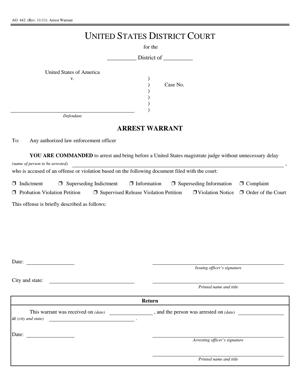
The AO 442 – Arrest Warrant is a federal court document used to authorize law enforcement to arrest a specific person. It is issued by a United States District Court judge or magistrate judge. This form is part of the official paperwork used in federal criminal cases.
You will not usually fill out this document as a private individual. It is prepared within the federal court system, often by a clerk, based on a judge’s order. Still, understanding it matters if you are reviewing court records, working in a legal support role, or trying to understand what has been issued in a federal criminal case.
The form confirms that a judicial officer has found probable cause. That finding allows federal law enforcement officers to take someone into custody. Without this authorization, an arrest in many situations may not be legally supported.
If you are looking at this document, you are likely trying to understand what it means, how it works, and what information it contains. This guide explains the structure, purpose, and legal effect of the AO 442 – Arrest Warrant in clear, practical terms.
What is AO 442 – Arrest Warrant?
Clear definition
AO 442 – Arrest Warrant is an official federal court form that orders the arrest of a named individual. It is issued after a judge or magistrate judge determines there is probable cause to believe the person committed a federal offense.
The document identifies the defendant, describes the charges or refers to the charging document, and directs law enforcement officers to bring the person before the court. It serves as formal written authority for federal officers to carry out the arrest.
This form is standardized across United States District Courts. While case details vary, the structure and required information remain consistent because it is part of the federal judiciary’s official forms.
Who typically uses this form?
The form is used by the United States Federal District Court. A federal judge or magistrate judge authorizes it. A clerk of court typically prepares and signs it on behalf of the court after the judge orders its issuance.
Federal prosecutors are often involved in requesting that a warrant be issued. They present a complaint, indictment, or other charging document to the court. If the judge finds probable cause, the arrest warrant is issued.
Federal law enforcement officers, such as agents or other authorized officers, rely on this document to carry out the arrest. They execute the warrant and later return it to the court with information about how and when it was served.
Defendants and their attorneys may review this form as part of the case file. It helps them understand the basis and authority for the arrest.
Why might you need this form?
You may need to understand this form if you are reviewing your federal criminal case file. It shows when the court authorized your arrest and under what authority.
You may also encounter it if you work in a legal support role. Paralegals, court staff, and law enforcement personnel often handle or process this document as part of routine case management.
In some situations, journalists or researchers reviewing federal court records may look at the arrest warrant to confirm when a case formally began with an arrest order.
The document can also be relevant in procedural questions. For example, the timing of arrest, execution of the warrant, and return of service may appear in court records and affect how the case proceeds.
Typical real-life scenarios
- A federal prosecutor files a criminal complaint alleging that a person committed a federal fraud offense. The prosecutor submits a sworn affidavit describing the evidence. A magistrate judge reviews the materials and finds probable cause. The court issues an arrest warrant using this form.
- A federal grand jury returns an indictment charging someone with drug trafficking. Once the indictment is filed, the court issues an arrest warrant so law enforcement can locate and arrest the defendant.
- A person has been charged but not yet arrested. The judge authorizes the warrant so officers can take the person into custody and bring them before the court for an initial appearance.
- In some cases, a defendant fails to appear in court as required. The court may issue an arrest warrant to ensure the person is brought back before the judge. Although other warrant forms may also be used in certain circumstances, the structure and purpose are similar.
When would you use AO 442 – Arrest Warrant?
This form is used when the federal court has determined that an arrest is legally justified. The most common situation is after a complaint or indictment has been filed and probable cause has been established.
A magistrate judge may issue the warrant based on a sworn complaint supported by an affidavit. In other cases, a district judge may issue it following an indictment by a grand jury.
The form is not used for state charges. It applies to federal criminal proceedings in United States District Courts. Federal crimes typically involve violations of federal statutes, interstate conduct, or offenses investigated by federal agencies.
The document is part of the early stage of a criminal case. It connects the charging process to the physical act of arrest. Once the warrant is executed, the defendant is brought before the court for an initial appearance, where rights are explained, and conditions of release may be addressed.
Clerks, prosecutors, and law enforcement officers interact with this form as part of their official roles. It becomes part of the permanent court record once issued and returned.
Legal characteristics of AO 442 – Arrest Warrant
This form is effective because it reflects a judicial finding of probable cause. A neutral judicial officer must review the facts and determine that there is a reasonable basis to believe a crime was committed and that the named person committed it.
For the warrant to be valid, it must clearly identify the defendant. It typically includes the person’s name and may include other identifying details. It must also refer to the offense charged and bear the signature of a judge or magistrate judge, along with the date of issuance.
Common problems arise when the information is incomplete or incorrect. If the name is misspelled or the wrong person is identified, enforcement issues may follow. Clerical errors can create confusion, especially if multiple individuals have similar names.
The warrant must be properly executed. That means an authorized officer carries out the arrest and later completes the return section, stating when and how the arrest occurred. Failure to complete the return may cause administrative issues in the case record.
High-level procedural details can vary slightly across federal districts. Local practices may affect how quickly warrants are processed or how returns are handled. However, the core legal requirements stem from federal law and rules of criminal procedure, which apply nationwide.
This document does not determine guilt. It does not impose a sentence. It does not replace the need for a trial or plea. It only authorizes arrest based on probable cause.
Is it legally binding?
Yes, the arrest warrant is legally binding once issued by a federal judge or magistrate judge. It gives lawful authority to federal law enforcement officers to arrest the named individual.
The binding effect comes from the court’s judicial power. When a judge signs the order, it becomes an enforceable directive. Officers acting under the warrant are carrying out a court order.
The legal force of the warrant depends on proper issuance. If a judge did not actually make a probable cause finding, or if required procedures were not followed, legal challenges may arise. Courts generally examine whether constitutional and procedural standards were met.
The warrant remains in effect until it is executed or withdrawn by the court. Once the person is arrested and brought before the court, the focus shifts to the next stages of the criminal process.
How to fill out AO 442 – Arrest Warrant
Step 1 – Enter the Court Information
At the top of the form, the name of the United States District Court is listed. This includes the specific district, such as a particular federal district within a state. The case number is also included, which connects the warrant to the correct criminal case file.
This information ensures the document is properly tied to an active federal case. Accuracy here prevents confusion between cases with similar party names.
Step 2 – Identify the Defendant
The full legal name of the defendant is entered in the space provided. The name must match the charging document, such as the complaint or indictment. In some situations, additional identifiers may be included to reduce the risk of mistaken identity.
Clear identification is essential. The warrant authorizes the arrest of a specific person, not anyone generally suspected of wrongdoing.
Step 3 – Reference the Charges
The form states that a complaint, indictment, or information has been filed. It may reference the specific federal offense or cite the charging document. This connects the warrant directly to the alleged criminal conduct.
The language confirms that a judicial officer has reviewed the supporting materials and found probable cause. That statement is a key legal element of the document.
Step 4 – Judicial Authorization
A judge or magistrate judge signs the warrant. The signature confirms that the court has authorized the arrest. The date of issuance is also included.
Without the judicial signature, the document has no legal effect. The signature is what transforms the form into a binding court order.
Step 5 – Command to Arrest
The body of the document directs authorized law enforcement officers to arrest the defendant and bring them before the court. This command is clear and direct.
It typically instructs that the defendant be brought before a magistrate judge without unnecessary delay. This reflects constitutional requirements related to prompt court appearances after arrest.
Step 6 – Clerk’s Attestation and Seal
The clerk of court may sign or attest to the issuance of the warrant. The court seal may also appear on the document. This confirms that the form is an official court record.
Administrative completion by the clerk ensures that the warrant is properly entered into the court system and can be tracked through execution and return.
Step 7 – Execution and Return Section
After the arrest, the officer completes the return portion of the form. This section states when and where the arrest took place. It may also include information about how the defendant was brought before the court.
The officer signs this section to confirm that the warrant was executed. The completed form is then returned to the court and filed in the case record.
This final step closes the loop between judicial authorization and law enforcement action. It documents that the court’s order was carried out and provides a clear record for the ongoing federal criminal proceeding.
Legal terms you might encounter in AO 442 – Arrest Warrant
- Probable Cause: This is the legal standard that must exist before a judge issues the warrant. It means there is a reasonable basis to believe a crime was committed and the named person committed it. The warrant is based on a sworn statement that explains these facts.
- Affidavit: A written statement made under oath. In this context, it supports the request for the warrant and lays out the facts establishing probable cause. The judge relies on this document when deciding whether to authorize the arrest.
- Complaint: A formal charging document that outlines the alleged offense. It identifies the defendant and describes the criminal conduct. The warrant references this complaint as the legal basis for the arrest.
- Defendant: The person accused of committing the crime. The warrant must clearly state the defendant’s full legal name and any known aliases to avoid confusion during execution.
- Magistrate Judge: A federal judicial officer who reviews the complaint and affidavit. If probable cause exists, this judge signs the warrant. The signature is what makes the document enforceable.
- Issuance Date: The date the judge signs and authorizes the warrant. This date marks when the arrest authority begins. It appears clearly on the face of the document.
- Command to Arrest: The section where the court directs law enforcement to take the defendant into custody. It is written as a formal order. Officers rely on this language to carry out the arrest.
- Return: The portion completed after the arrest. It records when and where the defendant was arrested and by whom. This section is filed with the court to confirm that the warrant was executed.
- Seal of the Court: An official mark placed by the clerk to authenticate the document. The seal confirms that the warrant comes from a federal court and is valid.
- Custody: The legal control of a person by law enforcement. Once the warrant is executed, the defendant is taken into custody and must be brought before a judicial officer without unnecessary delay.
FAQs
What information must match exactly on this form?
The defendant’s full legal name must match the name listed in the complaint. Check spelling, middle names, suffixes, and any known aliases. The court name, case number, and offense description must also align with the charging documents to avoid confusion or rejection.
Who is allowed to sign the AO 442 – Arrest Warrant?
Only a federal judge or magistrate judge may sign this document. The signature confirms that probable cause exists. Without a judicial signature and date, the warrant is not valid and cannot be executed.
When does this warrant become active?
It becomes active on the date the judge signs it. The issuance date appears near the judge’s signature. Before that date, law enforcement has no authority under this document to arrest the named person.
What happens if the defendant’s name is slightly misspelled?
Even small errors can create serious problems. A misspelling may lead to the wrong person being detained or delay the arrest. Always compare the name to the complaint and any identification records before submission.
Do I need to attach the complaint or affidavit to this form?
The warrant is usually supported by a complaint and affidavit that establishes probable cause. Those documents are part of the court record. Make sure they are properly filed and referenced so the judge can review them before signing.
What does the “return” section record?
The return section documents how the warrant was executed. It includes the date and location of the arrest and the name of the officer who carried it out. This section confirms to the court that the order was completed.
Does this document become part of the public record?
Once issued and filed, this form typically becomes part of the court’s official record. Depending on court procedures, it may be publicly accessible unless sealed. What is visible usually includes the defendant’s name, charges, and issuance details.
What should I verify before presenting the AO 442 – Arrest Warrant for signature?
Confirm that the case number, court name, defendant’s identity, and charge description all match the complaint. Ensure the probable cause statement is complete and sworn. Check that all required fields are filled so the judge can review and sign without delay.
Checklist: Before, During, and After AO 442 – Arrest Warrant
Before
- Confirm the complaint has been properly prepared and filed.
- Verify the defendant’s full legal name and any aliases.
- Double-check the federal district court name and division.
- Ensure the case number matches all related documents.
- Review the probable cause affidavit for completeness and accuracy.
- Confirm that all dates are correct and consistent.
- Make sure the document is free of spelling and formatting errors.
- Prepare any supporting documents for judicial review.
During
- Present the complaint and affidavit together with the warrant.
- Ensure the judge reviews the probable cause statement.
- Confirm the judge signs and dates the warrant.
- Check that the clerk applies the court seal if required.
- Verify that no required fields are left blank.
- Make sure the defendant’s identifying details are clear.
- Observe that the issuance date is entered correctly.
- Confirm instructions for returning the executed warrant.
After
- Distribute the signed warrant to the appropriate law enforcement agency.
- Retain a filed copy for court records.
- Track whether and when the arrest occurs.
- Ensure the return section is completed after execution.
- File the executed warrant with the court promptly.
- Update internal case records to reflect the arrest.
- Monitor the scheduling of the initial appearance.
- Confirm all related documents are organized in the case file.
Common mistakes to avoid with AO 442 – Arrest Warrant
- Mistake: Listing the wrong defendant or misspelling the name because of rushed preparation, which can lead to wrongful detention or delays, so do not forget to verify identity details against the complaint and records.
- Mistake: Using an incorrect case number due to copying from another file, which can cause filing confusion or rejection, so do not forget to cross-check every number before submission.
- Mistake: Leaving required sections blank because you assume the clerk will fill them in, which may delay judicial review, so do not forget to complete all applicable fields yourself.
- Mistake: Submitting the warrant without a properly sworn affidavit, which prevents a finding of probable cause, so do not forget that the judge must review a complete factual statement.
- Mistake: Failing to obtain the judge’s signature and date, which makes the document unenforceable, so do not forget that it has no legal effect until signed.
- Mistake: Overlooking the return section after arrest because you think the process is finished, which can leave the court record incomplete, so do not forget to ensure execution details are filed.
- Mistake: Forgetting to apply the court seal when required due to a misunderstanding of clerk procedures, which may raise authenticity questions, so do not forget to confirm sealing requirements.
- Mistake: Not keeping a copy for your records because you rely only on electronic tracking, which can create record gaps, so do not forget to maintain organized copies of all signed documents.
What to do after filling out AO 442 – Arrest Warrant
Once the warrant is fully completed and signed, your focus shifts to proper handling and follow-through. Accuracy and documentation matter at every stage. Small oversights can create delays or procedural problems later.
Start by confirming that the judge’s signature and issuance date are clearly visible. Without both, the document has no force. Check that the court seal is present if required by the clerk’s office.
- Step 1: Make at least two complete copies of the signed warrant, including all pages and attachments.
- Step 2: Provide the original signed warrant to the authorized law enforcement agency responsible for execution.
- Step 3: Retain one copy in the official court file or case record.
- Step 4: Store an additional copy in your working file for tracking and reference.
- Step 5: Confirm with the receiving agency that they have accepted the document and understand the defendant’s identifying information.
- Step 6: Monitor the status of execution and note any updates in your internal case log.
- Step 7: After arrest, verify that the officer completes the return section accurately.
- Step 8: Ensure the executed warrant, including the return, is promptly filed with the court.
- Step 9: Update the case record to reflect the date of arrest and custody status.
- Step 10: Prepare for the defendant’s initial appearance by organizing all related documents.
Keep your records organized. Maintain a clear timeline that shows when the warrant was issued, delivered, executed, and returned. This helps you answer procedural questions quickly.
If any corrections are needed after issuance, do not alter the signed document yourself. Instead, follow court procedures for addressing errors or requesting a corrected document. Unauthorized changes can invalidate the warrant.
Finally, confirm that all related documents, including the complaint and affidavit, are properly linked in the court record. A complete and organized file ensures the case can move forward without unnecessary delay.
Disclaimer: This guide is provided for informational purposes only and is not intended as legal advice. You should consult a legal professional.