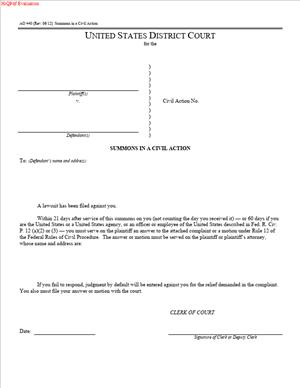
AO 440 – Summons in a Civil Action
Fill out nowJurisdiction: Country: United States | Province or State: Federal
The AO 440 – Summons in a Civil Action is an official federal court document used at the very start of a lawsuit. It formally notifies a defendant that a civil case has been filed against them in a United States District Court. If you are filing a lawsuit in federal court, this form is part of the first set of documents you prepare.
This form works together with your complaint. The complaint explains your claims. The summons tells the defendant they must respond and gives them a deadline to do so. Without a properly issued summons, your case cannot move forward.
You may encounter this document if you are representing yourself in federal court. Many self-represented plaintiffs are surprised to learn that filing a complaint alone is not enough. The summons must be completed, issued by the clerk, and formally delivered to each defendant.
Understanding how this form works helps you avoid delays. Small mistakes can cause service problems. That can slow down your case or require you to start the service process again. Knowing what each section means gives you more control over your filing.
The AO 440 – Summons in a Civil Action is not complicated, but it is precise. Each blank space has a purpose. When you understand why the information is required, the form becomes much easier to complete correctly.
What is AO 440 – Summons in a Civil Action?
Clear definition
The AO 440 – Summons in a Civil Action is a standardized federal court form used to notify a defendant that a civil lawsuit has been filed against them. It is issued by a United States District Court after a complaint is filed.
A summons is an official court notice. It identifies the court, the parties, and the case number. It also states how long the defendant has to respond to the complaint. The time to respond typically depends on how and where the defendant is served.
The form itself is not a description of your claims. It does not explain the facts of your case. Instead, it directs the defendant to review the complaint and file a response with the court within the required time.
Once completed and signed by the clerk of court, the summons becomes an official court document. It must then be served on each defendant according to federal rules.
Who typically uses this form?
This form is usually prepared by the plaintiff. The plaintiff is the person or business starting the lawsuit. If you are filing your own civil case in federal district court, you will likely complete this form as part of your initial filing.
Attorneys also use this form when filing on behalf of clients. Even when represented by counsel, the same standard form is used in federal courts across the country.
Each defendant named in your complaint generally requires a separate summons. If you sue three defendants, you typically prepare three summons forms. Each one lists the same case information but is directed to a different person or entity.
Court clerks review the form for completeness. Once approved, the clerk signs and seals it. Only then is it ready to be served.
Why might you need this form?
You need this form when you start a civil lawsuit in a United States District Court. Filing a complaint alone does not officially notify the defendant. The summons is what triggers the formal notice process.
Without a valid summons, you cannot properly serve the defendant. If service is not completed correctly, the court may not have authority over that defendant. This can prevent your case from moving forward.
The summons also establishes a clear response deadline. The defendant must answer or otherwise respond within the time stated in the document. If they do not respond within that period, other procedural steps may become available in the case.
Using the correct form helps ensure uniformity. Federal courts across all states use this same template. That consistency helps avoid confusion about what information is required.
Typical real-life scenarios
- You file a civil rights lawsuit in federal court against a government official. After submitting your complaint, you prepare a summons for that official. The clerk issues the form, and it is served along with the complaint. The official then has a defined period to respond.
- You bring a breach of contract claim in federal court based on diversity jurisdiction. The defendant is a company located in another state. You complete a summons addressed to the company’s registered agent. The document informs the company that it must respond within the required time after service.
- You sue multiple defendants after a car accident involving commercial vehicles. Each driver and company is named in your complaint. You prepare a separate summons for each defendant so that each one receives formal notice of the lawsuit.
- You file an employment discrimination case in federal court. After filing your complaint, you complete the summons and arrange for service on your former employer. The summons gives the employer clear notice that the case has been filed and outlines the timeline for responding.
- In each of these situations, the summons serves the same purpose. It provides official notice of the lawsuit and establishes the defendant’s obligation to respond.
When would you use AO 440 – Summons in a Civil Action?
You use this form at the beginning of a federal civil case. It is part of the initial filing process. After you prepare and file your complaint, you complete the summons so it can be issued by the court.
The summons is used before any hearings or motions take place. It is not something you file later in the case. Its role is to start the formal notice process.
If you amend your complaint to add a new defendant, you may need to complete and issue a new summons for that additional party. The summons is tied to each defendant individually, not just to the case as a whole.
You also use this form when a defendant has not yet been served. Service is a formal step. It is usually carried out by a process server, marshal, or other authorized person. The summons must accompany the complaint during service.
The plaintiff is typically responsible for ensuring that the summons is issued and served. The clerk of court signs and seals the form, but the plaintiff arranges for service according to federal procedural rules.
If a defendant waives service under certain procedures, the summons may still be prepared as part of the record. However, the waiver process follows its own specific steps.
In short, you use this form whenever you need to formally notify a defendant of a new federal civil lawsuit and establish their response deadline.
Legal characteristics of AO 440 – Summons in a Civil Action
This form becomes effective only after it is issued by the court. That usually means it is signed by the clerk and bears the court’s seal. A draft that you fill out yourself is not yet an official summons until the court issues it.
For the summons to be valid, it must correctly identify the court, the parties, and the case number. The defendant’s name must match the name listed in the complaint. Errors in spelling or legal entity names can cause service problems.
The document must also state the time within which the defendant must respond. That time is typically based on federal procedural rules. The response period can vary depending on factors such as whether the defendant is in the United States or abroad, or whether the United States is a party.
Service must be completed according to federal rules. If the summons is not served properly, the court may not have personal jurisdiction over the defendant. This can lead to delays or dismissal of claims against that defendant.
Common issues include using the wrong address, failing to prepare a separate summons for each defendant, or serving the document outside the allowed time frame. Another frequent problem is attempting to serve the summons without first having it issued by the clerk.
While the form is standardized nationwide, some local federal courts may have specific administrative procedures. For example, electronic filing systems may require you to upload a proposed summons for review before issuance. The core content of the form remains the same, but the submission process can differ slightly from court to court.
The summons does not prove your claims. It does not establish liability. It does not guarantee that the court agrees with your allegations. Its purpose is limited to notice and procedure.
It also does not replace the complaint. The summons must be served together with a copy of the complaint. The defendant reads the complaint to understand the claims and the factual basis for the lawsuit.
Is it legally binding?
Yes, once properly issued and served, the summons has legal effect. It creates a formal obligation for the defendant to respond within the time stated.
The binding effect comes from the court’s authority. When the clerk signs and seals the summons, it becomes an official command of the court. The defendant is legally required to respond by filing an answer or other permitted response.
If the defendant ignores a properly served summons and complaint, the case may proceed without their participation. In many situations, failure to respond can lead to a default process. That process follows its own steps and is handled by the court.
However, the summons is only binding if service is completed correctly. If the service is defective, the defendant may challenge it. In that case, the court may require service to be redone.
The summons binds the defendant to respond. It does not bind the court to rule in your favor. It simply ensures that the case moves forward in an orderly way under federal procedural rules.
How to fill out AO 440 – Summons in a Civil Action
Step 1 – Enter the court name
At the top of the form, fill in the name of the United States District Court where you filed your complaint. Include the specific district, such as the Northern, Southern, Eastern, or Western District of the relevant state. Use the same court name that appears on your complaint.
Step 2 – List the parties
In the section labeled for the plaintiff and defendant, enter your name as the plaintiff exactly as it appears in your complaint. Then enter the defendant’s full legal name. If there are multiple defendants, each summons form should list the same plaintiff but only one defendant in the space provided for the party being served.
Step 3 – Insert the case number
Write the civil action number assigned by the court. This number is usually provided after you file your complaint. It must match the case number on the complaint and other filings. An incorrect number can cause confusion or delays in processing.
Step 4 – Complete the “To” section
In the space that begins with “To,” enter the name and address of the defendant being served. For an individual, use their full legal name and a complete service address. For a corporation or other entity, use the correct legal name and the appropriate address for service, such as the address of a registered agent if applicable.
Step 5 – Review the response time language
The form includes standard language explaining how many days the defendant has to serve an answer or motion. This section is generally pre-printed. Review it carefully to ensure it has not been altered and that it matches the standard language on the form. You typically do not change this section yourself.
Step 6 – Leave the clerk’s signature area blank
Do not sign the section reserved for the clerk of court. This area is completed by the clerk when the summons is issued. It usually includes the clerk’s signature, the date of issuance, and the court’s seal. Submitting the form without altering this section helps ensure proper issuance.
Step 7 – Provide your contact information if required
Some versions of the form include space for the plaintiff’s or attorney’s name and address. Enter your full name, mailing address, and contact information as it appears on your complaint. Make sure the information is current and legible.
Step 8 – Prepare separate forms for each defendant
If your case names more than one defendant, repeat the process for each one. Each defendant must receive a summons directed specifically to them. Check that each form lists the correct defendant in both the caption and the “To” section.
Step 9 – Submit the completed form to the court for issuance
File or upload the completed summons form according to the court’s filing procedures. The clerk will review the document. If everything is complete and matches the complaint, the clerk will sign, date, and seal the summons. Once issued, the summons is ready to be served along with a copy of the complaint on the named defendant.
Legal terms you might encounter in AO 440 – Summons in a Civil Action
- Plaintiff: The person or entity who filed the lawsuit. On this form, the plaintiff’s name must match exactly what appears on the complaint. If there are multiple plaintiffs, they are listed together as shown in the case caption.
- Defendant: The person or entity being sued. Each defendant must be named precisely as in the complaint. You typically prepare a separate summons for each defendant so that service can be completed individually.
- Case Caption: The heading on the first page that lists the court, parties, and case number. The caption on this form must mirror the caption on the complaint word for word. Even small differences can delay issuance.
- Civil Action Number: The unique number assigned to your case by the court clerk. You insert this number once it has been assigned. It links the summons to your specific lawsuit in the court’s records.
- Clerk of Court: The court official who issues the summons. The clerk signs, dates, and stamps the form to make it official. Until the clerk issues it, the summons is not valid for service.
- Seal of the Court: The official court stamp placed on the summons when it is issued. The seal shows that the document is authentic. A summons without the seal is usually not accepted for service.
- Service of Process: The formal delivery of the summons and complaint to the defendant. This step gives the defendant legal notice of the lawsuit. The summons explains how long the defendant has to respond after being served.
- Proof of Service: Written confirmation that the summons and complaint were delivered. After service, the person who served the documents completes a separate proof or affidavit. You file that proof with the court to show proper service.
- Responsive Pleading: The defendant’s formal written response to the complaint. The summons states the deadline for filing this response. Missing that deadline can lead to serious consequences for the defendant.
- Default Judgment: A court order entered if a defendant fails to respond on time. The summons warns that failing to answer may result in default. This means the plaintiff could win without a trial.
FAQs
What information must match exactly between the complaint and this form?
The court expects the case caption to be identical. That includes the full court name, all party names, and the civil action number. If anything differs from the complaint, the clerk may reject the summons for correction.
Do I fill in the response deadline myself?
No. The language about how long the defendant has to respond is already printed on the form. You should not change that wording. Your job is to confirm it appears complete and readable before submission.
Can I sign AO 440 – Summons in a Civil Action myself?
You do not sign as the issuing authority. The clerk of the court signs and dates the document to issue it. You may need to provide your contact information if you are self-represented, but you do not complete the clerk’s signature area.
What happens if the defendant’s name is slightly wrong on this document?
Even small errors can create problems. Service may be challenged if the wrong legal name appears. Always double-check spelling, business designations, and formatting against the complaint before submitting the form.
How many copies of this form do I need?
You usually need one original for the court to issue, and at least one copy for each defendant you plan to serve. You may also want a copy for your records. Confirm that each copy includes the clerk’s signature and seal after issuance.
What changes in the public record once the summons is issued?
When the clerk issues this form, it becomes part of the official case docket. The docket will show that a summons was issued for each named defendant. This creates a record that the court authorized formal notice to be served.
What if the clerk rejects my AO 440 – Summons in a Civil Action?
The clerk may return it if information is missing or does not match the complaint. Review the caption, party names, and case number carefully. Correct the errors and resubmit so the document can be properly issued.
Do I attach the complaint to this document before service?
Yes. The summons is served together with a copy of the complaint. The defendant must receive both documents at the same time so they understand the claims and the deadline to respond.
Checklist: Before, During, and After AO 440 – Summons in a Civil Action
Before
- Confirm the complaint has been filed and accepted by the court.
- Obtain the assigned civil action number.
- Verify the exact spelling and format of each defendant’s legal name.
- Check the full official name of the federal district court.
- Prepare a separate summons for each defendant.
- Review the complaint caption for exact matching language.
- Decide how you plan to complete service of process.
- Make draft copies for review before submitting to the clerk.
During
- Enter the court name exactly as shown on your complaint.
- Copy the case caption word for word.
- Insert the correct civil action number.
- Complete the “To” section with the full legal name of one defendant.
- Leave the clerk’s signature and seal area blank.
- Review the printed response time language for completeness.
- Ensure your contact information is accurate if included.
- Double-check that each defendant has a separate form.
After
- Submit the forms to the clerk for issuance.
- Confirm each issued summons includes the clerk’s signature and court seal.
- Make service copies of the issued summons and complaint.
- Arrange for proper service according to court rules.
- Obtain completed proof of service from the person who served the documents.
- File proof of service with the court promptly.
- Calendar the defendant’s response deadline.
- Store stamped copies in your case file for reference.
Common mistakes to avoid with AO 440 – Summons in a Civil Action
- Mistake: Listing a defendant’s nickname or trade name instead of the full legal name, which often happens when copying informal records, leading to service challenges or delays, so do not forget to confirm the exact registered name.
- Mistake: Changing or editing the preprinted response deadline language because it seems confusing, which can result in rejection by the clerk, so do not forget that only the court issues the official wording.
- Mistake: Submitting one summons for multiple defendants, which happens when trying to save time, causing improper service, so do not forget that each defendant requires a separate issued form.
- Mistake: Signing in the clerk’s signature area, which occurs when self-represented parties assume they must complete every blank, resulting in rejection, so do not forget to leave issuance sections for the clerk.
- Mistake: Serving an unsigned or unsealed copy, which can happen if you copy the draft instead of the issued version, making service invalid, so do not forget to check for the clerk’s signature and seal.
- Mistake: Failing to file proof of service after delivery, which often happens when focusing only on mailing documents, risking dismissal for lack of service, so do not forget to file the completed proof with the court.
- Mistake: Entering the wrong civil action number due to copying errors, which confuses the court record and delays processing, so do not forget to verify the number directly from the docket.
- Mistake: Waiting too long to serve the defendant after issuance, which can violate service deadlines, so do not forget to track timing requirements from the date the complaint was filed.
What to do after filling out AO 440 – Summons in a Civil Action
Once you complete the form, your next focus is issuance and service. The summons is not active until the clerk signs, dates, and seals it. That step turns your prepared document into an official court directive.
- Step 1: Review each completed summons for accuracy, matching it carefully to the complaint and the assigned civil action number.
- Step 2: Make at least one copy of each completed summons before submitting it, keeping a draft copy for your records.
- Step 3: Submit the original summons forms to the clerk of the federal district court where your case is filed, using the court’s accepted filing method.
- Step 4: Wait for confirmation that the clerk has issued the summons by signing, dating, and applying the court seal.
- Step 5: Obtain issued copies for service. Confirm each one includes the clerk’s signature and seal.
- Step 6: Prepare service packets that include the issued summons and a complete copy of the complaint for each defendant.
- Step 7: Arrange for proper service by an authorized person who is not a party to the case and meets court requirements.
- Step 8: Ensure the person who serves the documents completes a proof of service or affidavit detailing when and how service was made.
- Step 9: File the proof of service with the court promptly so the docket reflects that each defendant has been properly served.
- Step 10: Calculate and calendar the response deadline listed in the summons so you can track whether the defendant files a response.
- Step 11: Organize all issued summonses, proofs of service, and related correspondence in a dedicated case file for easy reference.
- Step 12: Monitor the court docket for any updates, including responses, motions, or notices related to service.
Staying organized at this stage helps you avoid delays. Proper issuance and service set the foundation for everything that follows in your federal civil case.
Disclaimer: This guide is provided for informational purposes only and is not intended as legal advice. You should consult a legal professional.