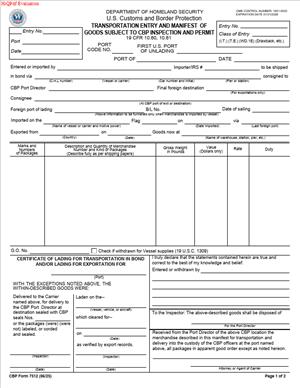
CBP Form 7512 – Transportation Entry and Manifest of Goods Subject to CBP Inspection and Permit
Fill out nowJurisdiction: Country: United States | Province or State: Federal
CBP Form 7512 – Transportation Entry and Manifest of Goods Subject to CBP Inspection and Permit is a federal customs document used when goods move within the United States under customs control. You use it when imported merchandise has not yet been fully entered or released and needs to be transported from one location to another.
This form allows the shipment to move legally between ports, bonded warehouses, or other approved facilities without paying duties at the first point of arrival. It acts as both a transportation entry and a manifest.
If you are handling imported cargo, operating as a carrier, working as a customs broker, or managing a bonded warehouse, this document may be part of your workflow. It connects the shipment to U.S. Customs and Border Protection tracking systems and identifies who is responsible for the goods during transit.
Understanding this form helps you avoid delays, holds, and penalties. Even small errors can lead to shipment interruptions or additional scrutiny. When you are about to complete it, you need to know exactly what each section represents and why it matters.
What is CBP Form 7512 – Transportation Entry and Manifest of Goods Subject to CBP Inspection and Permit?
Clear definition
CBP Form 7512 – Transportation Entry and Manifest of Goods Subject to CBP Inspection and Permit is a federal customs document used to move imported goods under bond from one U.S. customs location to another. It serves as an official notice to U.S. Customs and Border Protection that the merchandise is being transported without immediate duty payment.
The form identifies the shipment, the parties responsible for it, the origin and destination, and the bond under which it travels. It creates a traceable record of custody while the goods remain subject to customs supervision.
This document is commonly associated with what is called “in-bond” transportation. That means the goods are not yet cleared for entry into U.S. commerce and are still under federal control.
Who typically uses this form?
Importers may use this form when their goods arrive at one port but will be formally entered at another. For example, cargo might arrive at a coastal port but be destined for customs processing inland.
Customs brokers often prepare and submit the form on behalf of importers. They handle the details of classification, shipment identification, and bond coverage.
Carriers, including trucking companies, rail operators, and other transport providers, rely on the information in the form to move the cargo legally. The carrier listed on the document becomes part of the chain of responsibility.
Bonded warehouse operators and foreign trade zone operators may also be involved. If goods are moving into or between secured facilities, this form helps document that movement under customs supervision.
Why might you need this form?
You may need this form if your shipment is not being cleared at the first U.S. port of arrival. Instead of paying duties and completing entry immediately, you move the goods to another authorized location.
This can reduce storage congestion at busy ports. It may also allow you to complete customs processing closer to your business operations.
You might also use this document when goods are moving for export after arriving in the United States. In some cases, merchandise enters the country only temporarily and then leaves without entering domestic commerce.
The form is also relevant when goods are transferred between bonded facilities. Customs authorities must be able to track that movement and confirm the shipment reaches its approved destination.
Typical real-life scenarios
- A shipment of electronics arrives at a seaport on the West Coast. The importer is based in the Midwest and prefers to complete customs entry closer to its distribution center. The goods move in bond by rail using this document.
- A container of apparel arrives at one port but is immediately scheduled for export to another country. The merchandise moves under customs supervision to a different port for outbound shipment.
- Industrial machinery enters through a Gulf Coast port but must be transported to an inland bonded warehouse for inspection and further processing. The form documents the authorized movement.
- Perishable goods arrive at an airport but need to be transferred to a cold storage bonded facility nearby. The document allows the shipment to move without immediate duty payment while still under federal oversight.
When would you use CBP Form 7512 – Transportation Entry and Manifest of Goods Subject to CBP Inspection and Permit?
You would use this form whenever imported goods need to move within the United States before formal customs entry is completed. This typically occurs when the port of arrival is not the final destination for customs processing.
If you are coordinating logistics for international shipments, you may encounter this document during in-bond transfers. It often appears when transportation involves multiple carriers or different modes of transport, such as ocean to rail or air to truck.
You may also see it when goods are moving from a port to a bonded warehouse. Until duties are paid and the goods are officially entered, they remain under customs control. The form helps track that status.
In some cases, the document is used when goods are refused entry or require examination at a different location. Moving the shipment under bond allows customs authorities to maintain supervision while relocating the cargo.
If you are listed as the importer of record, carrier, or bonded facility operator, your name and identifying numbers may appear on the document. Each role carries responsibility for accurate reporting and proper handling of the shipment during transit.
Legal characteristics of CBP Form 7512 – Transportation Entry and Manifest of Goods Subject to CBP Inspection and Permit
This form functions as an official customs record. It documents that goods are moving under bond and have not yet entered U.S. commerce. The accuracy of the information affects whether the shipment is accepted for transport.
For the document to be effective, it must clearly identify the merchandise, quantities, marks and numbers, transportation details, and bond information. Missing or inconsistent data can result in rejection or delays.
Common problems include incorrect port codes, mismatched container numbers, inaccurate descriptions of goods, or listing the wrong bonded carrier. Even small typographical errors can cause processing issues because customs systems rely on precise data.
The bond referenced in the form is central to its validity. An active and sufficient bond generally must be in place to cover potential duties, taxes, and penalties. If the bond information is incomplete or invalid, the shipment may not be allowed to move.
Although the form is federal, operational procedures may vary depending on the port of entry and the method of filing. Some ports rely heavily on electronic systems, while others may have additional documentation practices. These differences typically relate to process, not to the legal authority behind the form.
This document does not replace a formal customs entry. It does not calculate duties or finalize the import process. It only authorizes and records transportation under customs supervision. Separate filings are required to complete entry or export.
Is it legally binding?
Yes, in practical terms, this form carries legal significance. When submitted and accepted, it becomes part of the official customs record for that shipment. The information provided can be relied upon by federal authorities.
The parties identified on the document, such as the bonded carrier or principal on the bond, may be held responsible if the goods do not arrive at the declared destination. Failure to properly complete the transportation can result in claims against the bond.
By filing or authorizing the filing of this document, the responsible party represents that the information is accurate to the best of their knowledge. Inaccurate or misleading details may lead to penalties or enforcement actions.
At the same time, the form does not create a private contract between buyer and seller. Its binding effect relates to customs compliance and regulatory obligations, not to the commercial terms of the shipment.
How to fill out CBP Form 7512 – Transportation Entry and Manifest of Goods Subject to CBP Inspection and Permit
Step 1 – Identify the type of in-bond movement
Start by indicating the specific in-bond category that applies to your shipment. This may involve transportation to another port, exportation, or movement to a bonded warehouse. The category determines how customs will track the shipment.
Step 2 – Enter the port of origin and destination
Provide the correct federal port codes and names for both the starting location and the intended destination. Accuracy here is critical because customs systems use these codes to monitor the shipment’s route and completion.
Step 3 – Provide importer and consignee information
List the full legal name and identifying number of the importer or consignee. This often includes an importer number or similar federal identification reference. Ensure the details match existing customs records.
Step 4 – Identify the bonded carrier
Enter the name and bond identification information for the carrier responsible for transporting the goods. The carrier must be authorized to move in-bond shipments. The bond number or related reference ties the shipment to financial responsibility.
Step 5 – Describe the merchandise
Provide a clear and specific description of the goods. Include quantities, weights, marks, and container numbers where required. Avoid vague terms. The description must allow customs officials to identify the shipment without confusion.
Step 6 – Include transportation details
Record the mode of transport, such as truck, rail, air, or vessel. Add identifying information like trailer numbers, container numbers, or conveyance names. These details help track the physical movement of the goods.
Step 7 – Reference the bond information
Enter the bond type and bond number that covers the shipment. Confirm that the bond is active and sufficient for the value and risk associated with the goods. This connection supports approval of the movement.
Step 8 – Review for accuracy and consistency
Before submission, compare all entries against shipping documents such as bills of lading and arrival notices. Check spelling, numbers, and port codes carefully. Consistency across documents reduces the risk of delays.
Step 9 – Submit through the appropriate channel
File the completed form using the accepted customs filing method for your situation, which may involve an electronic system or other approved process. Once accepted, maintain a copy as part of your shipment records and monitor the movement until arrival is confirmed.
Legal terms you might encounter in CBP Form 7512 – Transportation Entry and Manifest of Goods Subject to CBP Inspection and Permit
- In-Bond Movement: This refers to the transportation of imported goods within the United States without immediate payment of duties. On this document, you specify the type of in-bond movement, such as immediate transportation, transportation and exportation, or immediate exportation. The selected type determines where the goods are going and when duties may become due.
- Bonded Carrier: A bonded carrier is a transportation company authorized to move goods under customs bond. On this form, you must list the carrier’s identifying information because that carrier is financially responsible for delivering the goods as declared. If the shipment is not properly delivered, the carrier’s bond may be at risk.
- Surety Bond: A surety bond is a financial guarantee that duties, taxes, and penalties will be paid if required. This document references a bond number that backs the in-bond movement. Without valid bond coverage, the shipment cannot legally move under bond.
- Port of Entry: The port of entry is the location where goods first arrive in the United States or where they are formally presented to customs. You must accurately identify this port because it establishes where the customs authority first attaches to the shipment.
- Port of Destination: This is the port where the in-bond movement will end. It may be a different port within the United States or an export location. The information you enter here controls where the goods must be delivered and examined, if required.
- Importer of Record: The importer of record is the party responsible for ensuring that imported goods comply with customs laws and that duties are paid. Even if goods move in bond, this party’s information may appear on the document. Accuracy matters because customs systems track compliance by importer identification.
- Consignee: The consignee is the person or company receiving the goods. On this form, you identify the consignee to show the intended recipient at the destination. Incorrect consignee details can cause delays or holds.
- Harmonized Tariff Schedule (HTS) Number: The HTS number classifies the merchandise for duty and statistical purposes. While in-bond shipments may defer duty payment, the classification still affects compliance review. An incorrect number can trigger additional inspection or penalties.
- Manifest: A manifest is a detailed listing of cargo on a particular shipment. This document functions as both a transportation entry and a manifest. It summarizes what is being moved, in what quantity, and under what authority.
- Customs Custody: Customs custody means the goods remain under government control until they are properly entered, exported, or released. When you use this form, the goods are still considered under customs supervision. You cannot divert or deliver them outside the approved route without authorization.
FAQs
Do I need to sign CBP Form 7512 – Transportation Entry and Manifest of Goods Subject to CBP Inspection and Permit myself?
You must confirm who is authorized to sign before submitting this document. The signer is typically the bonded carrier or an authorized agent acting on behalf of the responsible party. Check that the name and title match the authority granted under the bond or power of attorney, because mismatched signatures can lead to rejection.
What effective date should I enter for the in-bond movement?
You should use the actual date the shipment begins its bonded movement. This date must match transportation records, such as the bill of lading or carrier dispatch documents. If the dates do not align, customs systems may flag the shipment for review.
What attachments should I have ready when filing this document?
You should gather the commercial invoice, bill of lading or airway bill, bond information, and any prior entry or export documentation. Make sure the quantities and descriptions on those records match what you enter. Inconsistencies between attachments and this form can delay acceptance.
How do I confirm that my filing was accepted?
After submission, check for an electronic acknowledgment or confirmation number in the system used to file. Review the status to ensure the movement is authorized and not rejected or placed on hold. If you receive a rejection message, correct the listed errors before the shipment departs.
What happens if the consignee’s name on this form does not exactly match the shipping documents?
You should correct the discrepancy before submission. Customs systems compare names across documents, and even small differences can trigger manual review. Make sure the legal name, address, and identification numbers are consistent on all paperwork.
Can I change the destination port after I file CBP Form 7512 – Transportation Entry and Manifest of Goods Subject to CBP Inspection and Permit?
Changes to the destination are not automatic. You must request authorization to divert or update the movement before the goods arrive at the original destination. Unauthorized changes can result in penalties and bond claims.
What information becomes part of the official customs record when I file this document?
The shipment details, carrier information, bond reference, ports, and merchandise description become part of the official movement record. Customs uses this data to track compliance and confirm proper delivery. Errors remain traceable, so accuracy at filing is important.
What should I double-check right before submitting this form?
Confirm the bond number, port codes, container numbers, and total quantity. Make sure the transportation mode and carrier identifiers are correct. Verify that all fields required for the specific type of in-bond movement are complete so the filing is not rejected.
Checklist: Before, During, and After CBP Form 7512 – Transportation Entry and Manifest of Goods Subject to CBP Inspection and Permit
Before
- Confirm the shipment qualifies for in-bond movement.
- Verify that a valid surety bond is active and sufficient.
- Gather the commercial invoice and transportation documents.
- Confirm the correct HTS classification for the goods.
- Identify the correct port codes for origin and destination.
- Check the legal names and identification numbers of all parties.
- Ensure the bonded carrier is authorized for the route.
- Review internal shipping instructions for accuracy.
During
- Select the correct in-bond movement type.
- Enter accurate port of entry and destination codes.
- Input complete importer and consignee information.
- Record the bond number exactly as issued.
- Describe the merchandise clearly and consistently.
- Enter the correct container, seal, and conveyance details.
- Verify quantities and weights against invoices.
- Review all fields before final submission.
After
- Obtain and save the electronic acceptance confirmation.
- Provide confirmation details to the carrier.
- Monitor the shipments’ in-bond status until arrival.
- Confirm delivery at the destination port.
- Retain copies of the filed document and attachments.
- Update internal tracking systems with movement details.
- Address any notices or holds promptly.
- Archive records according to retention policies.
Common mistakes to avoid with CBP Form 7512 – Transportation Entry and Manifest of Goods Subject to CBP Inspection and Permit
- Mistake: Entering the wrong bond number because you copied it from an outdated file, which can cause immediate rejection and delay the shipment; do not forget to confirm the active bond tied to this specific carrier and movement.
- Mistake: Selecting the incorrect in-bond type due to a misunderstanding of shipment intent, which may result in improper routing and penalties; do not forget to match the type to the actual transportation plan.
- Mistake: Listing inconsistent quantities compared to the commercial invoice, often caused by last-minute packing changes, leading to inspection or holds; do not forget to reconcile final packing details before filing.
- Mistake: Misspelling the consignee’s legal name because of informal abbreviations, which can trigger manual review and delays; do not forget to use the exact registered business name.
- Mistake: Using outdated port codes from old templates, which may cause system rejection or misrouting; do not forget to verify current port identifiers before submission.
- Mistake: Failing to monitor the shipment after filing, assuming approval guarantees completion, which can expose the bond to claims if delivery is not confirmed; do not forget to track arrival and closure of the in-bond movement.
- Mistake: Changing the destination without formal authorization due to logistical convenience, which can result in penalties and bond liability; do not forget to request and receive approval before any diversion.
- Mistake: Omitting container or seal numbers because they seem minor, which can raise security concerns and delay clearance; do not forget to include complete conveyance details.
What to do after filling out CBP Form 7512 – Transportation Entry and Manifest of Goods Subject to CBP Inspection and Permit
Once you complete the document, pause before you move the shipment. Accuracy at this stage prevents enforcement issues later. Review every critical data point against your source documents.
- Step 1: Confirm you received an electronic acceptance or authorization message.
- Step 2: Save a digital copy of the filed form exactly as submitted.
- Step 3: Save copies of supporting documents in the same file.
- Step 4: Send movement authorization details to the bonded carrier.
- Step 5: Instruct the carrier not to deviate from the approved route.
- Step 6: Monitor shipment tracking to confirm departure and arrival.
- Step 7: Check customs systems for proof of arrival at the destination port.
- Step 8: Verify that the in-bond movement is properly closed in the system.
- Step 9: Update your internal shipment log with confirmation numbers.
- Step 10: Retain all records in accordance with your document retention policy.
Keep your records organized. Customs authorities may review past in-bond transactions during audits or compliance checks. You should be able to quickly produce the filed form, proof of acceptance, and delivery confirmation.
If you discover an error after submission, act quickly. Determine whether the error affects routing, bond coverage, or shipment identity. Then follow the appropriate correction or amendment process before the goods reach the destination.
Finally, confirm that the next step in the supply chain is ready. If the goods will be formally entered for consumption or exported, coordinate that filing in advance. Proper sequencing avoids storage fees, delays, and compliance risks.
Disclaimer: This guide is provided for informational purposes only and is not intended as legal advice. You should consult a legal professional.