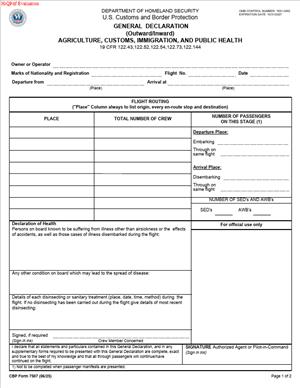
CBP Form 7507 – General Declaration (Outward/Inward) – Agriculture, Customs, Immigration and Public Health
Fill out nowJurisdiction: Country: United States | Province or State: Federal
If you are involved in international air travel, you may encounter CBP Form 7507 – General Declaration Agriculture, Customs, Immigration, and Public Health. This document is used when aircraft arrive in or depart from the United States. It plays a key role in how federal authorities review flights and passengers.
CBP Form 7507 – General Declaration Agriculture, Customs, Immigration, and Public Health collects essential details about the aircraft, crew, passengers, cargo, and onboard conditions. It supports multiple inspection areas at once, including customs, agriculture, immigration, and public health.
You will most often see this form in connection with private, charter, cargo, or other non-scheduled international flights. It helps U.S. Customs and Border Protection receive standardized information before or upon arrival.
If you are preparing to complete this document, you need to understand what information it asks for and how it is used. The accuracy of this filing can affect how smoothly a flight clears inspection and proceeds through federal review.
What is CBP Form 7507 – General Declaration (Outward/Inward) – Agriculture, Customs, Immigration, and Public Health?
Clear definition
CBP Form 7507 – General Declaration Agriculture, Customs, Immigration, and Public Health is a federal government form used to declare details about an aircraft entering or leaving the United States. It serves as a consolidated declaration covering customs, agriculture, immigration, and public health concerns.
The form captures identifying information about the aircraft, including registration number and flight details. It also records crew member information, passenger counts, and certain cargo or supply declarations. In many cases, it supplements electronic filings submitted through approved aviation systems.
This document acts as a formal statement to federal authorities. By signing it, the responsible party confirms that the information provided is accurate to the best of their knowledge at the time of submission.
Who typically uses this form?
Pilots in command frequently complete or sign this form for private or charter international flights. In corporate aviation, a flight department representative may prepare it for the pilot’s review and signature.
Air carriers operating certain international flights may also use it as part of their arrival documentation package. Cargo operators sometimes rely on it when transporting goods across U.S. borders.
In some cases, a handling agent or operations coordinator gathers the required data. However, the pilot in command or another authorized representative typically signs the declaration.
If you are part of a flight crew, an aircraft operator, or an aviation support team, you may be responsible for preparing or reviewing this filing before arrival.
Why might you need this form?
You may need this form when an aircraft arrives in the United States from a foreign location. Federal authorities require advance information to assess security, customs compliance, immigration status, and potential agricultural risks.
The form helps officials identify who is onboard and what is being transported. It allows them to evaluate potential duties, prohibited items, health concerns, or regulatory violations before the aircraft is cleared.
In some operational contexts, this document supports inspection procedures at designated ports of entry. It provides a clear, written declaration that complements other required submissions.
Without accurate and complete information, arrival processing may be delayed. The form is part of a broader compliance framework designed to protect borders, public health, and agricultural resources.
Typical real-life scenarios
- A private jet returning to the United States after an international trip may use this form as part of its arrival documentation. The pilot provides aircraft details, lists crew members, and confirms passenger totals before landing at a designated airport.
- A charter operator flying clients from another country into a U.S. airport may complete the form to declare onboard information. This ensures customs and immigration officials have a clear summary of who and what is arriving.
- A cargo aircraft transporting goods across the border may rely on the form to declare flight and crew details, while separate cargo manifests address specific shipments. The general declaration supports overall compliance.
- A corporate flight department managing multiple international trips may prepare the form in advance using scheduled flight information. The pilot then reviews and signs it before submission to federal authorities.
- A medical transport flight arriving from another country may use the form to declare crew members and any relevant public health information. This helps authorities assess potential health-related concerns.
- An aircraft repositioning without passengers may still need to complete the declaration. Even without paying customers on board, crew and aircraft information must be accurately reported.
When would you use CBP Form 7507 – General Declaration (Outward/Inward) – Agriculture, Customs, Immigration, and Public Health?
You typically use this form when an aircraft enters the United States from a foreign country. It is most commonly associated with international arrivals at designated airports of entry.
The form may also be used when departing the United States for a foreign destination, depending on operational procedures and regulatory requirements in place at the time. Operators often coordinate submission timing with arrival or departure notifications.
Pilots in command are frequently responsible for ensuring the form is completed and signed. In larger operations, compliance staff or dispatch teams prepare the document in advance.
You may also encounter this form during unscheduled landings that involve international travel. If a flight diverts from a foreign origin into the United States, authorities may require a completed declaration as part of the inspection process.
The timing of submission can vary. In some situations, information is transmitted in advance through approved systems, and the signed document is provided upon arrival. In other cases, the form is presented directly to an officer during inspection.
This document is generally part of a package of required arrival materials. It works alongside passenger manifests, cargo documents, and other filings required for border processing.
Legal characteristics of CBP Form 7507 – General Declaration (Outward/Inward) – Agriculture, Customs, Immigration, and Public Health
This form functions as an official declaration to a federal agency. It is not a private agreement between parties. It is a statement made to the United States government regarding facts about a flight.
For the form to be effective, it must be complete, legible, and signed by an authorized individual. Required fields typically include aircraft identification, flight origin, crew details, and relevant declarations concerning onboard conditions.
Common issues arise when information does not match other submitted records. For example, discrepancies between passenger counts on this form and electronic manifests can trigger additional review. Inconsistent aircraft registration numbers or missing signatures can also cause delays.
Incomplete forms may result in follow-up questions from officers. Inaccurate data can lead to inspection delays and, in some situations, penalties under federal law. The form relies on truthful reporting.
Because this document operates at the federal level, it applies uniformly across all U.S. states and territories. While airport procedures may vary slightly in practice, the underlying authority and purpose remain consistent nationwide.
It is important to understand what this form does not do. It does not replace required visas, travel authorizations, or customs entries for goods. It does not serve as a cargo manifest or immigration status document. Instead, it provides a summary declaration that supports multiple inspection categories at once.
The form also does not grant permission to enter the United States by itself. Final admission decisions are made by authorized officers after review and inspection.
Is it legally binding?
CBP Form 7507 – General Declaration Agriculture, Customs, Immigration, and Public Health is legally significant because it is a signed declaration made to a federal authority. When you sign it, you are affirming that the information provided is true and correct to the best of your knowledge.
While it is not a contract between private parties, it carries legal weight. False statements on federal forms can have serious consequences. The signature confirms responsibility for the accuracy of the content.
The binding nature of the form relates to the truthfulness of the statements made. By signing, the responsible party acknowledges accountability for the declared information. This can include aircraft details, crew identities, and other reported facts.
If errors are discovered, authorities may review the circumstances. Unintentional mistakes are generally treated differently from knowingly false statements, but both can lead to additional scrutiny.
In practice, the legal effect centers on compliance with federal reporting requirements. The form becomes part of the official record of the flight’s entry or departure.
How to fill out CBP Form 7507 – General Declaration (Outward/Inward) – Agriculture, Customs, Immigration, and Public Health
Step 1 – Review the form layout and instructions
Start by reading the entire form before entering any information. Identify each section, including aircraft details, flight routing, crew information, and declarations related to customs, agriculture, immigration, and public health.
Pay attention to required fields and signature lines. Make sure you understand who is authorized to sign. This initial review reduces the chance of omissions.
Step 2 – Enter aircraft identification details
Provide the aircraft registration number exactly as it appears on official records. Include the aircraft type or model if requested.
Enter the flight number if one is assigned. For private flights without a commercial flight number, follow the format indicated on the form.
Accuracy in this section is critical because it links the declaration to a specific aircraft movement.
Step 3 – Record departure and arrival information
List the foreign airport of departure and the intended U.S. airport of arrival. Use the appropriate airport identifiers if required.
Include the date of arrival and any other timing information requested. Ensure that these details match other filed notices or electronic submissions.
Consistent routing information helps officers verify that the flight aligns with prior notifications.
Step 4 – Provide crew member information
Enter the full names of all crew members onboard. Include additional identifying details if the form requests them, such as nationality or passport information.
Ensure that the crew list matches any separate crew manifests or electronic filings. Discrepancies between documents can result in questions during inspection.
Double-check spelling and identification numbers. Small errors can cause delays in processing.
Step 5 – Confirm passenger totals or status
If the form requests the number of passengers, enter the total accurately. In some cases, individual passenger details are submitted through separate systems, but the declaration still requires confirmation of counts.
If there are no passengers onboard, indicate that clearly. Do not leave the field blank if a zero entry is appropriate.
Accurate passenger reporting supports immigration and customs review.
Step 6 – Address customs and cargo declarations
Review any section related to goods, cargo, or onboard stores. Declare items as required by the form.
If cargo details are provided on separate manifests, ensure that the summary information on this document aligns with those records.
Avoid general or vague descriptions if specific information is requested. Clear, consistent entries reduce follow-up inquiries.
Step 7 – Complete agriculture declarations
Read the agriculture section carefully. It may address food, plants, animals, or other items that could affect U.S. agriculture.
Indicate the presence or absence of relevant items as instructed. If the form requires additional explanation, provide concise and accurate details.
Agricultural declarations are taken seriously due to potential risks to crops and livestock.
Step 8 – Review public health information
Check whether the form asks about illnesses onboard or other health-related matters. Provide truthful responses based on current knowledge.
If there are no health concerns, confirm that clearly where indicated. If there are relevant conditions, ensure the information is consistent with other required notifications.
Public health reporting supports safe border processing.
Step 9 – Verify all entries for consistency
Before signing, compare the completed form with flight logs, manifests, and other submissions. Confirm that dates, names, aircraft numbers, and counts match exactly.
Look for missing fields, unclear handwriting if completed manually, or incomplete sections. Correct any errors before submission.
A final review helps prevent avoidable inspection delays.
Step 10 – Sign and date the declaration
The authorized individual, often the pilot in command, signs the form in the designated area. Include the date and any additional required identification details.
By signing, you confirm that the information is accurate to the best of your knowledge. Make sure the signature is legible.
Once signed, provide the form as required for inspection or retain it according to operational procedures.
Legal terms you might encounter in CBP Form 7507 – General Declaration (Outward/Inward) – Agriculture, Customs, Immigration and Public Health
- General Declaration: This is the primary statement made by the aircraft operator or pilot in command. It summarizes key details about the flight, crew, passengers, and cargo. In this document, the general declaration confirms that all listed information is complete and accurate at the time of arrival or departure.
- Pilot in Command: This is the person legally responsible for the operation and safety of the aircraft during the flight. On this form, the pilot in command typically signs the certification section. That signature confirms the truth of the information provided to customs, immigration, agriculture, and public health authorities.
- Crew List: This refers to the official list of crew members on board the aircraft. The form requires full names and may require additional identifying details. The crew list must match the actual individuals performing duties on the flight.
- Passenger Manifest: A passenger manifest is a record of all passengers on board. While this document may not list each passenger individually in all cases, it confirms the total number of passengers. The numbers must align with other submitted travel records.
- Port of Arrival: This is the specific U.S. airport where the aircraft lands and reports to authorities. You must identify the correct port because that determines which CBP officers review your declaration. Listing the wrong port can delay clearance.
- Agricultural Articles: These are items such as food, plants, animal products, or soil that may pose a risk to U.S. agriculture. The form includes declarations about whether such items are on board. You must disclose them even if they seem minor.
- Dutiable Goods: Dutiable goods are items that may be subject to customs duties or taxes upon entry into the United States. If cargo or certain onboard items fall into this category, you must declare them accurately. Failure to declare can lead to penalties or seizure.
- Public Health Declaration: This section addresses health-related information, such as illness on board. You are required to report certain communicable disease symptoms. This allows public health authorities to take appropriate action upon arrival.
- Arrival Report: An arrival report is the formal notice to customs that the aircraft has entered U.S. territory and landed. This form serves as part of that report. It documents the official entry of the aircraft into the country.
- Certification Statement: This is the final statement near the signature line. By signing, the responsible party affirms that the information is true and correct. Providing false information can result in fines or other enforcement action.
FAQs
Who is authorized to sign CBP Form 7507 – General Declaration (Outward/Inward) – Agriculture, Customs, Immigration, and Public Health?
The pilot in command usually signs this document because that person is legally responsible for the flight. In some operations, an authorized agent may prepare the form, but the certification still ties back to the person with operational control. Before signing, confirm that the name printed matches the signature and that the signer has authority for that specific flight.
Do I need to list every passenger by name on this form?
This form typically requires the total number of passengers rather than a full name-by-name manifest. However, the passenger count must match the actual number on board and any separate passenger information already transmitted to authorities. Double-check your headcount before submission so your totals are consistent across all records.
What happens if the arrival time changes after I complete this document?
If your actual arrival time differs from what you originally entered, update the information before presenting it to officers. The form is meant to reflect the real arrival details, not an estimate. Make sure the time listed matches the aircraft’s actual landing and reporting time.
How do I correct a mistake on the form after it has been signed?
If you notice an error before submission, correct it clearly and ensure the final version is accurate and legible. If it has already been submitted, notify the appropriate officer as soon as possible and follow instructions for providing an amended declaration. Do not ignore discrepancies, especially in crew names, passenger totals, or declarations about goods.
Do I need to attach other documents to this form?
You may need supporting documents such as crew identification, passenger information, or cargo paperwork, depending on the flight. This document acts as a summary declaration, so supporting records must be consistent with it. Always confirm that names, aircraft registration numbers, and ports match across all paperwork.
What information must match exactly with other filings?
Aircraft registration, flight origin, port of arrival, crew names, and passenger totals must align with other submitted travel data. Even small differences in spelling or numbers can cause delays. Before presenting the document, compare it carefully with your flight plan and transmitted data.
Is this form part of the public record?
This document is submitted to federal authorities as part of an official entry or clearance process. It is not typically published for public viewing, but it becomes part of the government’s official records. That means accuracy matters because it can be reviewed later if questions arise about the flight.
Does filing this document mean the aircraft is automatically cleared?
No. Submitting this form is one step in the clearance process. Officers may review the information, ask questions, inspect the aircraft, or verify declarations before granting entry clearance.
Checklist: Before, During, and After CBP Form 7507 – General Declaration (Outward/Inward) – Agriculture, Customs, Immigration, and Public Health
Before
- Confirm the correct aircraft registration number and call sign.
- Verify the exact port of arrival in the United States.
- Confirm the total number of crew and passengers on board.
- Review cargo details and identify any dutiable goods.
- Check for any agricultural items on board, including food and plant products.
- Confirm whether any passengers or crew are ill or showing symptoms.
- Gather supporting documents such as crew IDs and cargo paperwork.
- Make sure you have the most current version of the form.
During
- Print or type all names clearly and exactly as shown on the identification.
- Enter departure and arrival locations accurately.
- Record actual dates and times, not estimates if already known.
- Double-check passenger and crew totals before finalizing.
- Carefully answer the agriculture and customs declaration questions.
- Review every section for blanks or incomplete fields.
- Ensure the signer reviews the completed form before signing.
- Sign and date in the correct certification area.
After
- Provide the completed form to the appropriate officer at arrival.
- Keep a copy for your records.
- Confirm that passenger and crew numbers match any separate submissions.
- Be prepared to answer follow-up questions about declarations.
- Document the date and time of submission for internal records.
- Update internal flight logs to reflect the declared arrival.
- Correct any discrepancies immediately if identified by officers.
Common mistakes to avoid with CBP Form 7507 – General Declaration (Outward/Inward) – Agriculture, Customs, Immigration, and Public Health
- Mistake: Entering an incorrect aircraft registration number because of copying from memory, which can trigger delays or inspection issues; do not forget to verify it directly from the aircraft documents.
- Mistake: Reporting an estimated passenger count without physically confirming, which can lead to inconsistencies with other records; do not forget to conduct a final headcount.
- Mistake: Leaving agriculture questions blank due to uncertainty, which may be treated as incomplete or misleading; do not forget to answer every declaration clearly.
- Mistake: Signing before reviewing the entire document, which increases the risk of certifying incorrect information; do not forget to perform a full line-by-line review first.
- Mistake: Misspelling crew names because of rushed data entry, which can cause identity verification delays; do not forget to match spellings exactly to official identification.
- Mistake: Forgetting to update the arrival time after schedule changes, which creates discrepancies in official records; do not forget to confirm the actual landing time before submission.
- Mistake: Failing to declare small food items on board because they seem insignificant, which can result in penalties; do not forget that all agricultural items must be disclosed.
- Mistake: Assuming submission alone equals clearance, which may cause operational misunderstandings; do not forget to wait for official confirmation from authorities.
What to do after filling out CBP Form 7507 – General Declaration (Outward/Inward) – Agriculture, Customs, Immigration, and Public Health
Once you complete the form, your focus shifts to proper submission and documentation. Accuracy is only part of the process. You also need to manage records and confirmations carefully.
- Step 1: Review the entire form one final time for accuracy and legibility.
- Step 2: Confirm that the signature and date are present in the certification section.
- Step 3: Make at least one clear copy for your records before submission.
- Step 4: Present or transmit the form according to the arrival procedures at your port of entry.
- Step 5: Be available to answer questions from customs, immigration, agriculture, or public health officers.
- Step 6: Document the name or badge number of the officer who accepts the form, if applicable.
- Step 7: Note the date and time clearance is granted.
- Step 8: Store your copy with the flight’s operational records.
- Step 9: Update your internal compliance logs to reflect that the declaration was filed.
- Step 10: If any corrections are required, submit them promptly and keep a record of the update.
Keep your copy of the completed form with related flight documentation. If questions arise later about cargo, passengers, or health declarations, you will need to show exactly what was reported at the time of arrival.
If you operate multiple flights, create a simple tracking system. Record each flight date, port of arrival, and confirmation of submission. This helps you demonstrate consistent compliance.
Finally, review your internal process after each filing. If you notice repeated errors or confusion, adjust your checklist. Small improvements in how you prepare and verify information can prevent delays and enforcement issues on future arrivals.
Disclaimer: This guide is provided for informational purposes only and is not intended as legal advice. You should consult a legal professional.