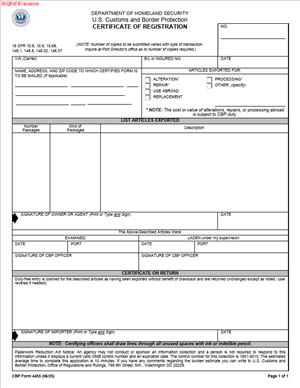
CBP Form 4455 – Certificate of Registration
Fill out nowJurisdiction: Country: United States | Province or State: Federal
CBP Form 4455 – Certificate of Registration is a document used to register personal items with U.S. Customs and Border Protection before you leave the United States. It helps prove that certain goods were in your possession before traveling abroad. This can matter when you bring those items back into the country.
If you travel internationally with valuable property, this form may help avoid questions about whether you bought those items overseas. It creates a record that the goods were previously in the United States. That record can reduce delays at reentry.
You complete the form before departure and present the items to a customs officer for verification. The officer reviews the goods and validates the document. Once approved, the form serves as evidence of prior possession.
Many travelers overlook this step until they face questions at the border. Understanding how CBP Form 4455 – Certificate of Registration works can save time and reduce uncertainty when returning home.
What is CBP Form 4455 – Certificate of Registration?
Clear definition
CBP Form 4455 – Certificate of Registration is an official federal form issued by U.S. Customs and Border Protection. It records specific items that you already own and plan to take outside the United States. The form confirms that these goods were not purchased abroad.
The document typically includes details such as item descriptions, serial numbers, and identifying features. A customs officer examines the property and certifies the information. Once signed and stamped, the form becomes an official registration record.
This filing does not transfer ownership or change your legal rights to the property. It simply documents that the items were in your possession before international travel.
Who typically uses this form?
International travelers often use this form when carrying valuable or easily resold items. This may include professional equipment, high-end electronics, cameras, musical instruments, or specialized tools.
Business travelers frequently register company-owned equipment. Photographers, engineers, and consultants who travel with technical gear may rely on this document to avoid confusion at reentry.
Students studying abroad sometimes register laptops or other electronics. Performers touring internationally may register instruments or sound equipment.
Military personnel, contractors, and researchers traveling overseas with personal items may also use the form when appropriate.
Why might you need this form?
When you return to the United States, customs officers may ask about items you are bringing back. If an item appears new or high in value, officers may question whether you purchased it abroad.
If you cannot show proof that the property was yours before departure, you may face delays. In some situations, travelers may be asked to provide evidence of prior ownership.
This form helps reduce uncertainty. It provides official confirmation that the listed goods left the country with you.
Typical real-life scenarios
- You are a freelance photographer traveling overseas for an assignment. You plan to carry two camera bodies and several lenses. Before departure, you register each item with serial numbers. When you return, you present the certified document to show that the equipment was not purchased abroad.
- You are a consultant traveling with specialized diagnostic tools. The tools are compact but valuable. Registering them helps demonstrate they were part of your work kit before you left the country.
- You are a musician touring internationally with a custom instrument. The instrument is unique and expensive. Registering it creates a record tied to its identifying features, which can be helpful upon reentry.
- You are a student studying abroad for a semester and taking a high-end laptop and tablet. Although these are common items, registering them may help if they appear new or high in value.
When would you use CBP Form 4455 – Certificate of Registration?
You use this form before leaving the United States with items you intend to bring back. The timing matters. The form is generally completed and certified prior to departure, not after you return.
The form is most relevant when you are temporarily exporting personal property. This includes travel for work, study, vacation, or temporary relocation. The key factor is that the goods are expected to re-enter the country with you.
Business owners may use the form when employees travel internationally with company equipment. In these situations, the employee carries the certified document and presents it upon return.
Independent contractors and self-employed professionals may also use the form for tools of their trade. The document helps distinguish between previously owned property and newly acquired foreign purchases.
If you plan to permanently export items, this form does not serve that purpose. It is designed for temporary travel where you expect to return with the same goods.
Legal characteristics of CBP Form 4455 – Certificate of Registration
This form becomes effective once a U.S. Customs and Border Protection officer verifies the items and certifies the document. The officer’s validation confirms that the listed goods were presented and inspected.
Accuracy is critical. Item descriptions must match the actual property. Serial numbers, model numbers, and distinguishing features are commonly required. Incomplete or unclear information may reduce the document’s usefulness.
The form is tied to the specific items listed. It does not cover unlisted goods. If you travel with additional property that is not recorded, the form does not apply to those items.
Problems often arise from vague descriptions. For example, listing “laptop” without a serial number may not provide enough detail to identify the device. The stronger the identifying information, the more effective the registration tends to be.
Federal procedures govern this document. Because it is a federal customs form, its use applies across all states. Practices at ports of entry may vary slightly in process, but the form itself is federal in scope.
The document does not replace purchase receipts, warranties, or insurance records. It does not protect against loss, theft, or damage. It only serves as proof of prior possession for customs purposes.
Is it legally binding?
The certified form is an official government record. Once signed and validated by a customs officer, it carries evidentiary weight in customs inspections.
It does not create a contract between you and the government. Instead, it documents a factual condition at the time of inspection. Its binding nature relates to the accuracy of the recorded information.
If the information is false or misleading, that may create separate legal issues. The document’s authority depends on truthful and accurate reporting.
How to fill out CBP Form 4455 – Certificate of Registration
Step 1 – Gather the items you plan to register
Before completing the form, collect all items you intend to take abroad and bring back. Ensure each item is physically available for inspection. Customs officers generally need to see the actual goods to verify identifying details.
Step 2 – Record your personal information
Enter your full name and contact details as requested on the form. Use consistent information that matches your travel documents. Clear identification connects you to the registered property.
Step 3 – Describe each item in detail
List every item separately. Provide specific descriptions, including brand, model, and serial number when available. Add distinguishing features such as color, size, or custom markings to make identification easier.
Step 4 – Review for completeness and accuracy
Check that each listed item matches the physical property. Confirm that serial numbers and descriptions are correct. Errors at this stage can create confusion later.
Step 5 – Present the form and items to a customs officer
Take the completed form and the items to a U.S. Customs and Border Protection office or port of departure. The officer will examine the goods and verify the information you provided.
Step 6 – Obtain official certification
After inspection, the officer will sign and validate the document if everything matches. Ensure the form includes the necessary official markings or stamps. Keep the certified copy in a safe place during your travels.
Step 7 – Retain the certified form for reentry
Carry the validated document with you when you return to the United States. Present it to customs officers if questions arise about the listed items. The form serves as proof that the property was registered before departure.
Legal terms you might encounter in CBP Form 4455 – Certificate of Registration
- Certificate of Registration: This is the official title of the document once it has been completed and certified by a customs officer. It confirms that specific items were in your possession in the United States before you traveled abroad. On this form, the certificate becomes valid only after a customs officer signs and stamps it.
- Port of Entry: This refers to the official location where you enter or leave the United States and where customs processing occurs. On this form, you will present your items and the completed document to an officer at a port of entry or another authorized customs location. The port information may be reflected in the officer’s certification.
- Customs Officer: This is the federal official authorized to inspect your items and certify the form. The officer verifies that the items match the descriptions you provided. The form is not valid unless it is signed and stamped by this officer.
- Personal Effects: These are items you personally own and use, such as cameras, laptops, jewelry, or musical instruments. In this document, you list personal effects that you are temporarily taking out of the country and plan to bring back. The form does not apply to items intended for sale or commercial distribution.
- Serial Number: A unique identification number assigned by a manufacturer to a specific item. This is one of the most important details you can include when describing electronics or other high-value goods. Accurate serial numbers help prove that the item you bring back is the same one you registered.
- Detailed Description: This refers to the written information you provide about each item. You may include brand, model, color, distinguishing marks, and any other features that make the item identifiable. Vague descriptions can weaken the effectiveness of the form.
- Certification: The official act of a customs officer confirming the information on the form. Certification usually includes a signature, date, and an official stamp or seal. Without certification, the document does not serve its intended purpose.
- Reentry: This is your return to the United States after traveling abroad. You present the certified document during reentry to show that the listed items were previously taken out of the country by you. This helps avoid questions about whether duties apply.
- Dutiable Goods: These are items that may be subject to customs duties when brought into the United States. The purpose of this form is to help demonstrate that certain items are not newly acquired abroad and therefore should not be treated as dutiable upon return.
- Proof of Prior Possession: This concept refers to evidence that you owned and had the item in the United States before leaving. The certified document serves as this proof. It reduces the risk of being asked to pay duty on your own belongings when you return.
- FAQs
Do I need to list every item I am taking with me?
You only need to list items that could raise questions when you return, typically high-value or easily resold goods such as electronics, professional equipment, or expensive jewelry. Everyday clothing and common personal items usually do not need to be recorded. Focus on items that might look new or recently purchased abroad.
What information must match exactly in this document?
Your name should match your travel identification. Item descriptions should match the actual items you present, including serial numbers and distinguishing features. If the information on this form does not align with what the officer sees, certification may be delayed or refused.
Can I complete CBP Form 4455 – Certificate of Registration after I leave the United States?
No. You must complete and have this form certified before you leave the country. The purpose is to prove the items were in your possession in the United States before departure. Once you are already abroad, you cannot retroactively create proof of prior possession through this document.
Do I need receipts to support the items I list?
Receipts are not always required, but they can be helpful if there is any doubt about ownership or value. The most important requirement is that you physically present the items to a customs officer for verification. Supporting documentation simply adds clarity if questions arise.
What happens if I lose the certified copy of this form?
If you lose the certified copy, you lose the proof it provides. You may face additional questions at reentry and may need to provide other evidence that the items were previously owned. Keeping copies and storing the original safely is essential because the CBP Form 4455 – Certificate of Registration is only useful if you can present it when needed.
Does this document expire?
There is no standard expiration date printed on the form, but it is tied to the items and the specific details recorded at the time of certification. If the item changes in a significant way, such as a replacement or alteration, the original certification may no longer accurately reflect the item. In that case, a new form should be completed before future travel.
Can someone else present the items for certification on my behalf?
In general, you should be present with your items when seeking certification. The officer needs to confirm that the items belong to the person named on the form. If someone else presents them, it may create doubt about ownership and delay certification.
What does certification by a customs officer actually confirm?
Certification confirms that the officer inspected the listed items and verified their existence and identifying details before your departure. It does not guarantee duty-free treatment in every situation, but it provides strong evidence that the goods were not acquired abroad. The certified CBP Form 4455 – Certificate of Registration becomes your proof of prior possession when you return.
Checklist: Before, During, and After CBP Form 4455 – Certificate of Registration
Before
- Identify high-value or unique items you plan to take abroad and bring back.
- Locate serial numbers and distinguishing marks on each item.
- Write down detailed descriptions for each item.
- Confirm your name matches your passport or travel ID.
- Set aside enough time at the port of entry for inspection.
- Gather any supporting purchase records if available.
- Review the form fields so you understand what information is required.
During
- Complete all personal identification fields clearly and legibly.
- List each item separately with a detailed description.
- Double-check serial numbers for accuracy.
- Present the actual items to the customs officer.
- Answer questions clearly and honestly.
- Watch as the officer reviews and compares items to the form.
- Ensure the officer signs and stamps the document.
- Confirm that the date of certification is clearly written.
After
- Make a physical copy of the certified document.
- Store the original in a secure place with travel documents.
- Keep a digital scan for backup.
- Bring the certified form with you when you travel.
- Present the document during reentry if questions arise.
- Retain the form for future trips with the same items.
- Update the form if you replace or significantly alter an item.
Common mistakes to avoid with CBP Form 4455 – Certificate of Registration
- Mistake: Providing vague item descriptions because you assume details are unnecessary, which can lead to questions or rejection; do not forget to include serial numbers and distinguishing features.
- Mistake: Waiting until the last minute at departure, which happens due to tight travel schedules and may prevent certification; do not forget to allow extra time for inspection.
- Mistake: Failing to present the actual items to the officer, often because they are packed in checked luggage, which can delay or prevent certification; do not forget to keep items accessible.
- Mistake: Listing items intended for sale or business inventory, which occurs from misunderstanding the form’s purpose and may cause complications; do not forget this document is for personal effects.
- Mistake: Losing the certified original, which happens due to poor recordkeeping and leaves you without proof at reentry; do not forget to store both physical and digital copies.
- Mistake: Using outdated or incorrect personal information, which may occur after a name change and can create identity mismatches; do not forget to ensure your name matches your travel documents.
What to do after filling out CBP Form 4455 – Certificate of Registration
Once your form is completed and certified, your job is not finished. You need to manage it properly so it serves its purpose when you return to the United States.
Start by reviewing the certified document carefully. Confirm that every listed item is included and that the officer’s signature, date, and stamp are clearly visible. If anything is missing or unclear, address it immediately while you are still at the customs location.
- Step 1: Verify that all item descriptions and serial numbers are accurate and readable.
- Step 2: Confirm the customs officer has signed and officially stamped the form.
- Step 3: Make at least one paper copy of the certified document.
- Step 4: Create a digital scan or photo and store it securely.
- Step 5: Place the original with your passport or travel folder.
- Step 6: Keep the form accessible during your return trip.
- Step 7: Present the form proactively if an officer questions your items at reentry.
- Step 8: Retain the document for future trips if you travel again with the same items.
- Step 9: Complete a new form if you replace, upgrade, or significantly modify any listed item.
- Step 10: Organize your travel records so you can quickly locate the form in the future.
When you reenter the country, have the certified document ready. If an officer asks about expensive or professional equipment, present the form calmly and clearly. This helps streamline inspection and reduces uncertainty.
Keep the form for as long as you own and travel with the listed items. There is no automatic expiration, but accuracy matters. If the information no longer reflects the item’s condition or identifying features, complete a new form before your next trip.
Treat this document as part of your travel compliance records. Good organization protects you from delays, confusion, and unexpected duty assessments. A few minutes of careful handling now can save you significant time and stress later.
Disclaimer: This guide is provided for informational purposes only and is not intended as legal advice. You should consult a legal professional.