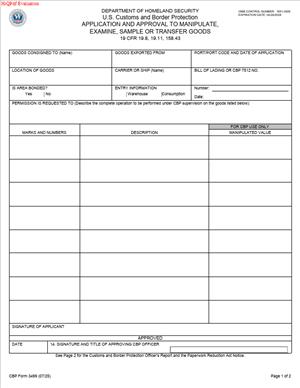
CBP Form 3499 – Application and Approval to Manipulate, Examine, Sample, or Transfer Goods
Fill out nowJurisdiction: Country: United States | Province or State: Federal
CBP Form 3499 – Application and Approval to Manipulate, Examine, Sample, or Transfer Goods is a federal customs document used when imported goods need to be handled in a specific way before they are officially released. It allows certain actions to take place while the goods remain under U.S. Customs and Border Protection control.
You use this form when you want to examine, sample, manipulate, or transfer imported merchandise that has not yet been fully cleared. These actions cannot happen freely once goods arrive in the United States. They require prior approval.
This document matters because imported goods are legally in “customs custody” until they are properly entered and released. Any change to the goods, including repackaging or testing, may affect classification, value, or admissibility.
If you are an importer, customs broker, warehouse operator, or carrier, you may encounter this form during the entry process. Understanding how it works helps you avoid delays, storage costs, and compliance issues.
What is CBP Form 3499 – Application and Approval to Manipulate, Examine, Sample, or Transfer Goods?
Clear definition
CBP Form 3499 – Application and Approval to Manipulate, Examine, Sample, or Transfer Goods is a written request submitted to U.S. Customs and Border Protection asking for permission to handle imported merchandise in a specific way while it remains under customs supervision.
The form identifies the shipment, explains what action you want to take, and states where and how the goods will be handled. A customs officer reviews the request and either approves or denies it.
Without approval, you generally cannot alter, inspect internally, take samples from, or move goods that are still in bonded status. This document creates a formal record of the requested action and the government’s authorization.
Who typically uses this form?
Importers of record often use this form when they need to inspect goods before finalizing their customs entry. This may happen if the importer needs to confirm quality, quantity, or product specifications.
Licensed customs brokers frequently prepare and submit the document on behalf of importers. They coordinate with bonded warehouse operators or carriers to ensure the requested action takes place lawfully.
Warehouse operators use it when goods stored in a bonded facility need to be manipulated, such as repacked or labeled, before release. Carriers and freight forwarders may also be involved when the request includes transferring goods to another bonded location.
Manufacturers who import components for assembly sometimes use this filing to handle goods before duties are finalized. Laboratories may be involved when samples are needed for testing.
Why might you need this form?
You might need this form if you cannot determine the correct tariff classification without physically examining the goods. Inspection may clarify material composition or product function.
You may also need it if goods arrived damaged and you want to document the condition before entry. Taking photographs or samples often requires authorization.
In some cases, you may need to repackage goods to comply with labeling requirements. If the merchandise arrived without required markings, limited manipulation in a bonded warehouse may be allowed with approval.
Another common reason is quality testing. If you import chemicals, food products, textiles, or machinery parts, laboratory sampling may be necessary before the goods can move forward in the supply chain.
Typical real-life scenarios
- An importer brings in a shipment of electronics but is unsure whether the products match the purchase order. Before filing the final entry, the importer requests permission to open cartons and inspect the contents inside a bonded warehouse.
- A clothing distributor receives garments that may not meet country-of-origin marking rules. The distributor applies for approval to relabel the items while they remain under customs control.
- A food importer needs to send samples to a laboratory for safety testing. The company submits the request so that small quantities can be removed legally from the shipment.
- A machinery company imports equipment in partially assembled form. The company asks for permission to perform limited assembly or testing to confirm the correct classification before duties are calculated.
- An importer discovers that goods were shipped to the wrong bonded facility. The form is used to request a transfer to another approved location under customs supervision.
When would you use CBP Form 3499 – Application and Approval to Manipulate, Examine, Sample, or Transfer Goods?
You use this form after goods arrive in the United States but before they are released from customs custody. At this stage, the merchandise is typically in a bonded warehouse, container freight station, or other approved location.
Timing is important. The request is generally made during the entry process, often before duties are finalized. If the goods are already released, this form usually no longer applies because customs control has ended.
Importers commonly use it when classification or valuation questions cannot be resolved from paperwork alone. Physical inspection may be necessary to confirm product details.
Warehouse operators may initiate the process when an importer asks to manipulate goods stored in bond. For example, repacking bulk goods into retail packaging may require approval.
Customs brokers often coordinate the submission when clients need to take samples or correct labeling. They ensure the request matches the shipment’s entry documentation.
If goods are being moved between bonded facilities, such as from a port warehouse to an inland bonded warehouse, this form may be part of the approval process. The transfer must remain under customs supervision.
In practice, you use this document whenever the goods need to be handled in a way that goes beyond simple storage while they are still legally under federal customs control.
Legal characteristics of CBP Form 3499 – Application and Approval to Manipulate, Examine, Sample, or Transfer Goods
This form functions as a formal application and written authorization. It is not simply a notice. Customs officers review the details and decide whether the requested action is permitted under federal customs law and regulations.
For the document to be effective, it generally must clearly identify the shipment. This includes entry numbers, bill of lading or airway bill information, and the bonded location where the goods are stored. Incomplete shipment data is a common cause of delay.
The requested action must be described precisely. Vague language, such as “inspect goods,” may not be sufficient. Customs typically expects details about how the goods will be handled, how much will be sampled, and whether any physical changes will occur.
The location matters. Manipulation or sampling usually must occur at an approved bonded facility under supervision. If the proposed location is not authorized, the request may be denied.
Errors in entry numbers, mismatched quantities, or inconsistencies between the form and entry documents often create problems. If the description of goods on the form does not match the customs entry, review may be delayed.
This filing does not eliminate duties or guarantee admissibility. It does not replace the formal entry process. It only authorizes specific handling of the goods while they remain in customs custody.
Because this is a federal customs form, the rules apply uniformly across the United States. Procedures may vary slightly by port in practice, but the underlying authority is federal. The approval comes from U.S. Customs and Border Protection, not from state or local agencies.
Is it legally binding?
Once approved, the authorization is legally effective within the scope described in the document. That means you are permitted to perform only the actions listed, and only under the conditions stated.
If you manipulate or transfer goods beyond what was approved, you may be outside the terms of the authorization. This can create compliance issues, especially if the goods’ condition changes in a way that affects duties or admissibility.
The approval does not create a contract between you and Customs. Instead, it is an administrative authorization under federal customs law. It binds you to follow the stated conditions.
If the request is denied, you are not authorized to take the proposed action. The goods must remain in their existing status until another approved step is taken in the entry process.
How to fill out CBP Form 3499 – Application and Approval to Manipulate, Examine, Sample, or Transfer Goods
Step 1 – Identify the shipment
Enter the entry number and shipment details exactly as they appear in your customs entry documents. This typically includes the bill of lading or airway bill number and identifying marks. Accuracy here connects the request to the correct goods.
Step 2 – Provide importer and applicant information
List the importer of record and, if different, the applicant submitting the form. This may be a customs broker acting on the importer’s behalf. Ensure names and identification numbers match the entry filing.
Step 3 – State the current location of the goods
Identify the bonded warehouse, container freight station, or other approved facility where the merchandise is stored. Include enough detail so customs can confirm the goods are under proper supervision.
Step 4 – Describe the merchandise
Provide a clear description of the goods covered by the request. Use wording consistent with the entry documents. Include quantities, packaging type, and any identifying characteristics needed to avoid confusion.
Step 5 – Explain the requested action
Describe exactly what you want to do. State whether you plan to examine, sample, manipulate, or transfer the goods. Include details such as how many units will be opened, how samples will be removed, or how the goods will be repacked.
Step 6 – Specify the purpose
Explain why the action is needed. For example, you may need to verify classification, conduct laboratory testing, correct labeling, or move goods to another bonded facility. A clear purpose helps customs evaluate the request.
Step 7 – Identify the proposed location for the action
If the goods will be moved or handled at a different bonded site, provide that location’s details. Confirm that the facility is authorized to receive or handle bonded merchandise.
Step 8 – Sign and date the application
The applicant signs the form to confirm that the information is accurate and complete. The signature indicates responsibility for complying with the terms of any approval.
Step 9 – Submit for customs review and await approval
After submission, a customs officer reviews the request. Do not perform the requested action until approval is granted. Once approved, follow the authorization exactly as written when handling the goods.
Legal terms you might encounter in CBP Form 3499 – Application and Approval to Manipulate, Examine, Sample, or Transfer Goods
- Port Director: The Port Director is the customs official who has authority over the port where your goods are located. On this form, approval is granted by or under the authority of the Port Director. Your request is not valid until the appropriate customs official signs off.
- Bonded Warehouse: A bonded warehouse is a secured facility where imported goods can be stored without paying duties immediately. If your goods are in one, you must identify the warehouse and bond information. The requested manipulation or transfer must comply with warehouse bond conditions.
- Customs Bond: A customs bond is a financial guarantee that you will follow customs laws and pay any duties, taxes, or penalties owed. This form may require you to confirm that your bond covers the requested action. If your bond does not cover the activity, your request may be denied.
- Importer of Record: This is the person or business legally responsible for the imported goods. The name and identification number of the importer of record must match customs records. Any mismatch can delay approval.
- Entry Number: The entry number is the unique identifier assigned to your shipment when it was filed with customs. You must list it correctly so officers can locate the exact shipment. An incorrect entry number can cause confusion or rejection.
- Manipulation: In this context, manipulation means changing the condition of the goods under customs supervision. This can include repacking, sorting, labeling, or assembling. You must clearly describe what type of manipulation you plan to perform.
- Sampling: Sampling refers to removing a portion of the goods for testing, inspection, or quality control. The form requires you to explain how much will be taken and for what purpose. Customs wants to ensure the sampling does not affect duty assessment or compliance.
- Transfer: Transfer means moving goods from one approved customs location to another. This might involve moving goods from a port facility to a bonded warehouse. You must specify both the current and proposed locations.
- Examination: Examination is a physical inspection of goods by customs officers. Sometimes you request an examination to verify classification, value, or condition. The form documents your request and any approval to open or handle the goods.
- Supervision: Supervision refers to customs oversight during the requested activity. Customs may require an officer to be present. You may be responsible for arranging and covering any associated costs.
FAQs
Do I need approval before I open or repackage my imported goods?
Yes. If your goods are still under customs control, you must receive written approval before opening, repacking, sampling, or moving them. This document serves as your formal request. Do not begin any activity until you see that the request has been approved and signed by the appropriate official.
What information do I need to match exactly with customs records?
You must ensure the importer name, importer number, entry number, and shipment details match what was filed at entry. Check your entry summary and related paperwork line by line. Even small differences in spelling or numbers can delay processing because customs systems rely on exact matches.
Who is allowed to sign this form?
The signer must have authority to act for the importer or the bonded warehouse. That could be the importer of record, an authorized employee, or a licensed customs broker acting within their authority. Make sure the name and title of the signer are clearly printed and that internal authorization records support the signature.
What should I attach to support my request?
Attach any documents that explain why you need the action, such as test requests, invoices, packing lists, or warehouse records. If you are requesting a sample, include details about the quantity and purpose. If you are requesting a transfer, include the full address and identification of the receiving facility.
How do I know if CBP Form 3499 – Application and Approval to Manipulate, Examine, Sample, or Transfer Goods has been approved?
You will receive confirmation showing that the request was reviewed and authorized by customs. This may include a signed and dated approval section or an electronic confirmation, depending on how it was submitted. Do not rely on verbal statements alone; look for documented approval.
What happens if my request is denied?
If your request is denied, customs may explain the reason or request additional information. Review the explanation carefully and correct any errors before resubmitting. Do not proceed with the manipulation, examination, sampling, or transfer until you receive proper approval.
Can I change the location or scope of the activity after I submit this form?
If your plans change, you generally need to submit a revised request. The approval applies only to the specific action and location described in this document. Making changes without updated approval can lead to compliance issues.
Does this form change the ownership or duty status of my goods?
No. This document only authorizes certain actions while the goods are under customs control. It does not transfer ownership, finalize classification, or eliminate duty obligations. Those matters are handled through your entry and related filings.
Checklist: Before, During, and After CBP Form 3499 – Application and Approval to Manipulate, Examine, Sample, or Transfer Goods
Before
- Confirm that the goods are still under customs control and require approval for the planned action.
- Locate the correct entry number and verify it against your entry summary.
- Confirm the importer of record name and identification number exactly as filed.
- Check that your customs bond covers the requested activity.
- Gather supporting documents such as invoices, packing lists, and warehouse records.
- Verify the exact address and identification of the current and proposed locations.
- Ensure the person signing has documented authority to act.
During
- Complete all required fields clearly and legibly.
- Describe the merchandise in enough detail to match customs records.
- Provide a specific explanation of the requested manipulation, sampling, examination, or transfer.
- State the purpose of the request in practical terms.
- Identify any supervision requirements and coordinate with the facility.
- Review the form for spelling and number accuracy before submission.
- Submit the form using the accepted method for the port handling your shipment.
After
- Wait for documented approval before taking any action.
- Retain a copy of the approved form with your entry records.
- Provide a copy to the warehouse or facility performing the action.
- Follow the approved scope exactly as written.
- Keep records of what was done, including dates and quantities.
- Update your internal inventory and compliance records.
- Monitor for any follow-up questions or inspections from customs.
Common mistakes to avoid with CBP Form 3499 – Application and Approval to Manipulate, Examine, Sample, or Transfer Goods
- Mistake: Starting manipulation or sampling before written approval because you assume it will be granted, which can lead to penalties or seizure; do not forget to wait for documented authorization.
- Mistake: Listing an incorrect entry number due to copying errors, which causes delays or misidentification of goods; do not forget to verify the number against official entry documents.
- Mistake: Providing a vague description of the requested action because you think “repacking” is enough, which may result in denial; do not forget to explain exactly what will be done and where.
- Mistake: Using a signer without proper authority because it is convenient, which can invalidate the request; do not forget to confirm and document signing authority.
- Mistake: Failing to match importer details exactly as filed, often due to name variations, which can trigger system errors; do not forget to copy the legal name precisely.
- Mistake: Overlooking bond coverage requirements because you assume all activities are covered, which can lead to rejection; do not forget to confirm that your bond permits the specific action.
- Mistake: Changing the location of the goods without updating the request, which creates compliance issues; do not forget to submit a revised request if plans change.
- Mistake: Not keeping a copy of the approved form, which weakens your records during audits; do not forget to store the approval with your entry file.
What to do after filling out CBP Form 3499 – Application and Approval to Manipulate, Examine, Sample, or Transfer Goods
Once you complete the form, pause and review every field. Accuracy matters more than speed. Small errors can cause delays that affect storage costs and delivery timelines.
- Step 1: Make a clean copy of the completed form for your records before submitting it.
- Step 2: Confirm the correct submission method for the port where your goods are located, whether electronic or paper.
- Step 3: Submit the form to the appropriate customs office or through the accepted filing system.
- Step 4: Track the submission date and keep proof that it was sent or uploaded.
- Step 5: Monitor for acknowledgment or requests for additional information from customs.
- Step 6: Do not begin the requested action until you receive documented approval.
- Step 7: Once approved, provide a copy of the authorization to the warehouse, carrier, or facility involved.
- Step 8: Carry out only the approved activities and stay within the described scope.
- Step 9: Record the date, time, and details of the completed manipulation, sampling, examination, or transfer.
- Step 10: Update your inventory systems, entry files, and compliance records to reflect what was done.
After everything is complete, organize your paperwork. Keep the approved form with your entry summary, bond information, invoices, and warehouse documents. Good recordkeeping helps if customs later review the transaction.
If customs follows up with questions, respond promptly and provide copies of the approved request and related records. Staying organized shows that you handled the goods under proper authorization and within the limits granted.
Disclaimer: This guide is provided for informational purposes only and is not intended as legal advice. You should consult a legal professional.