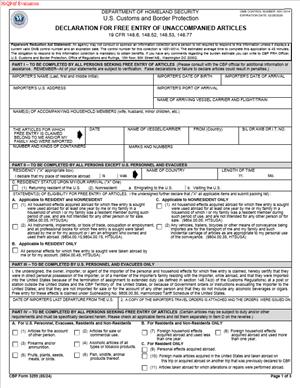
CBP Form 3299 – Declaration of Free Entry of Unaccompanied Articles
Fill out nowJurisdiction: Country: United States | Province or State: Federal
The CBP Form 3299 – Declaration of Free Entry of Unaccompanied Articles is a federal customs document used when your personal belongings enter the United States separately from you. It tells U.S. Customs and Border Protection what items are arriving and why they may qualify for duty-free entry.
If you are moving to the United States, returning after living abroad, or sending household goods ahead of you, this form often becomes part of the import process. It connects your shipment to your personal status.
The CBP Form 3299 – Declaration of Free Entry of Unaccompanied Articles matters because it helps determine whether you must pay duties or taxes on your belongings. It also supports customs review and inspection.
When you are about to complete this document, you need to understand what counts as “unaccompanied articles,” what information customs expects, and how your answers affect clearance. Small details can affect timing and cost.
This form is not a general shipping document. It is a declaration made to a federal agency. Your statements are part of an official customs record.
What is CBP Form 3299 – Declaration of Free Entry of Unaccompanied Articles?
Clear definition
The CBP Form 3299 – Declaration of Free Entry of Unaccompanied Articles is a written declaration submitted to U.S. Customs and Border Protection for personal property entering the country without you physically carrying it at the time of entry.
“Unaccompanied articles” usually mean household goods, personal effects, or other items shipped by freight, air cargo, or mail that arrive before or after you. The form identifies you as the owner and describes the shipment.
It is used to request duty-free treatment under customs rules that apply to certain personal belongings. You provide details about your residency status, your time abroad, and the nature of the goods.
The form becomes part of your customs entry file. Customs officers review it to decide whether the shipment qualifies for free entry or requires duties.
Who typically uses this form?
People relocating to the United States often use this form. This includes U.S. citizens returning after living abroad and foreign nationals moving for work, study, or permanent residence.
Members of the armed forces and government employees returning from overseas assignments commonly complete this document. Their household goods are often shipped separately.
International students and temporary workers may also use it when bringing personal items for the duration of their stay. In some cases, diplomats and other official personnel use related processes that involve similar declarations.
Family members who follow up with separate shipments may file this form for those goods. The key factor is that the items are personal and not commercial merchandise.
Why might you need this form?
You need this form when your belongings enter the United States as cargo rather than in your luggage. Without it, customs may treat the goods as regular imports subject to duties and additional documentation.
The form allows you to claim that the items are used personal effects or household goods that qualify for duty-free treatment under federal rules. It supports your statement that the goods are not intended for resale.
It also provides customs with a summary of what is inside the shipment. This helps officers assess risk and determine whether an inspection is necessary.
If your shipment is delayed or held, this document often becomes central to resolving the issue. Clear and accurate information can reduce back-and-forth with customs authorities.
Typical real-life scenarios
- You accept a job in the United States and ship your furniture and clothing from another country. The shipment arrives by sea two weeks after you land. You complete the form to declare those goods as your personal household items.
- You are a U.S. citizen who has lived abroad for several years. You decide to return permanently and send your books, electronics, and home goods ahead of you. When they arrive at a U.S. port, this form supports your claim for duty-free entry.
- You are an international student moving into campus housing. Your parents send boxes of personal belongings after you start school. The form connects those packages to your temporary stay in the country.
- You are a military service member returning from an overseas assignment. Your household goods are shipped under government arrangements. The declaration helps document that the items are used personal property tied to your service.
When would you use CBP Form 3299 – Declaration of Free Entry of Unaccompanied Articles?
You use this form when your personal goods enter the United States separately from you, and you want them considered for duty-free treatment as personal effects or household goods.
This often happens during international relocations. Employees transferring to U.S. offices, professors accepting academic positions, and researchers joining institutions may ship their belongings in advance.
You may also use it when returning to the United States after extended travel or residence abroad. If you purchased items for personal use and they are part of your household goods, they may be included in the declaration.
The form is typically submitted as part of the customs clearance process. A customs broker or carrier may prepare the entry package, but the declaration reflects your information and statements.
If you receive multiple shipments over time, you may complete separate declarations for each arrival. Each shipment is reviewed based on its own details and timing.
Legal characteristics of CBP Form 3299 – Declaration of Free Entry of Unaccompanied Articles
This document is a federal customs declaration. It becomes effective when you sign it, and it is submitted to U.S. Customs and Border Protection in connection with an entry.
Its validity depends on accurate and complete information. Missing signatures, incomplete descriptions of goods, or inconsistent dates can delay clearance. Discrepancies between the form and shipping documents may trigger additional review.
The form relies on your stated residency status and the nature of the goods. If the items appear new, in commercial quantities, or intended for resale, customs may question eligibility for free entry.
Although customs rules are federal, practical handling can vary by port of entry. Processing times and documentation preferences may differ. However, the core legal framework remains the same across the United States.
This document does not replace immigration paperwork. It does not grant entry into the country, extend a visa, or change your legal status. It addresses only the customs treatment of your unaccompanied personal property.
It also does not insure your goods or confirm delivery. Shipping contracts and insurance arrangements are separate from this declaration.
Is it legally binding?
Yes. When you sign the form, you are making statements to a federal agency. Your declaration is part of an official customs filing.
You confirm that the information is true and correct to the best of your knowledge. Providing false or misleading information can lead to penalties, delays, or seizure of goods under federal customs laws.
The form binds you to the accuracy of what you declare. If customs later determines that items were mischaracterized or omitted, you may be responsible for duties or other consequences.
At the same time, the form itself does not create a private contract between you and another party. Its binding effect relates to your representations to the government in the customs process.
How to fill out CBP Form 3299 – Declaration of Free Entry of Unaccompanied Articles
Step 1 – Provide your personal identification information
Enter your full legal name, date of birth, and other identifying details requested on the form. This information must match your passport or other entry documents. Customs uses it to link the shipment to your identity and status.
Step 2 – State your residency and immigration status
Indicate whether you are a U.S. citizen, returning resident, nonresident, or another applicable category. The form asks about your length of stay abroad and your intended stay in the United States. These details affect eligibility for duty-free entry.
Step 3 – Describe the unaccompanied articles
Provide a general description of the goods in the shipment. This usually includes household goods, personal effects, books, clothing, and similar items. The description does not need to list every spoon or shirt, but it must reasonably reflect what is included.
If the form asks for shipment details, include information such as the carrier, arrival date, and tracking or bill numbers. This helps customs identify the correct cargo.
Step 4 – Disclose items that may require special attention
Answer any questions about alcohol, tobacco, firearms, or other regulated goods. If such items are included, they may be subject to different rules or duties. Clear disclosure reduces the risk of delays.
The form may also ask whether any items were purchased abroad and how long they were used before import. Provide accurate timeframes based on your records or best knowledge.
Step 5 – Review declarations and certifications
Read the certification section carefully. It summarizes your statements about ownership, use, and intent. Confirm that the goods are for personal use and not for sale, if that reflects your situation.
Check that all dates, addresses, and shipment details are consistent. Small errors can lead to requests for clarification.
Step 6 – Sign and date the form
Sign and date the declaration where indicated. Your signature confirms that the information is true and complete to the best of your knowledge. If someone prepares the form on your behalf, ensure your authorization is properly reflected as required on the document.
After signing, the form is submitted as part of the customs entry process for your shipment.
Legal terms you might encounter in CBP Form 3299 – Declaration of Free Entry of Unaccompanied Articles
- Unaccompanied Articles: These are personal or household goods that arrive in the United States separately from you. They may be shipped by air, sea, or land. On this form, you declare these items so they can be considered for duty-free entry under customs rules.
- Free Entry: This means your goods can enter the country without paying customs duties. The form allows you to claim this benefit if you qualify. You must meet specific eligibility requirements, such as prior ownership and personal use.
- Importer of Record: This is the person legally responsible for the imported goods. On this form, you are usually the importer of record if the items are yours. Your name must match your identification and shipping documents.
- Household Effects: These are items used in your home, such as furniture, clothing, books, and kitchenware. The form asks you to confirm that these goods were used abroad and are not intended for resale.
- Personal Effects: These include items for your personal use, such as clothing, jewelry, and personal electronics. You declare that these items were owned and used by you before your move.
- Nonresident: This refers to a person who does not live permanently in the United States. The form distinguishes between returning residents and nonresidents because different rules apply to each group.
- Returning Resident: A U.S. citizen or lawful permanent resident who lived abroad and is now returning. If you fall into this category, you must state how long you were outside the country and confirm that the goods were used abroad.
- Immigrant: A person moving to the United States to live permanently. If you are immigrating, the form asks for details about your immigration status and arrival date.
- Customs Bond: A financial guarantee that duties and fees will be paid if required. In some cases, if documentation is incomplete, a bond may be required before your goods are released.
- Declaration Under Penalty of Perjury: This is your sworn statement that the information you provide is true and complete. When you sign, you accept legal responsibility for accuracy.
FAQs
Do I need to be physically present in the United States to submit this form?
You generally complete this document in connection with your arrival or shortly after. Customs officials or your shipping agent will tell you when it must be submitted. The important point is that the information reflects your actual arrival date and status at that time.
What date should I list as my arrival date?
Enter the date you physically entered the United States to begin your stay as a resident or returning resident. This date should match your passport entry stamp, travel record, or immigration paperwork. Do not use the shipping date of your goods.
What happens if my name on the shipment paperwork is slightly different from my passport?
The name on this form should match your identification. If your shipping documents show a variation, you may need to explain the difference or provide supporting identification. Consistency avoids delays in releasing your goods.
Do I need to attach an inventory list of everything I shipped?
Yes, you typically need a detailed inventory. This list should describe the items clearly and match the shipment records. The inventory supports your claim for duty-free treatment under CBP Form 3299 – Declaration of Free Entry of Unaccompanied Articles.
Can someone else sign this document on my behalf?
Only if they have proper authority, such as a valid power of attorney. If an agent signs, their authority must be documented. The signature section must clearly show who is signing and in what capacity.
What if I realize I made a mistake after submitting the form?
You should contact the customs office or your broker as soon as possible. Corrections may require a written explanation or updated paperwork. Do not ignore the error, especially if it affects your eligibility for free entry.
Will this document become part of a public record?
This form is used for customs processing and becomes part of your import file. It is not typically published publicly, but it is maintained by customs authorities. The details you provide are used to verify your eligibility and shipment contents.
What does signing the certification section actually confirm?
When you sign CBP Form 3299 – Declaration of Free Entry of Unaccompanied Articles, you confirm that the goods were owned and used as required and are not intended for sale. You also confirm that all statements are true and complete. False statements can lead to penalties or seizure of goods.
Checklist: Before, During, and After CBP Form 3299 – Declaration of Free Entry of Unaccompanied Articles
Before
- Confirm your immigration or residency status and arrival date.
- Gather your passport, visa, or residency documents.
- Obtain a complete inventory list from your mover or prepare one yourself.
- Verify that the shipment is addressed in your legal name.
- Check that your goods were owned and used before shipping.
- Identify any restricted or regulated items in your shipment.
- Confirm whether a customs broker is assisting you.
- Review prior customs declarations if you are a returning resident.
During
- Enter your full legal name exactly as shown on your passport.
- Provide your current U.S. address accurately.
- State your status (immigrant, returning resident, nonresident) clearly.
- List all unaccompanied shipments covered by the form.
- Attach the detailed inventory and ensure it matches the shipment.
- Answer all yes/no questions truthfully and completely.
- Review each page for missing fields or blank sections.
- Sign and date the certification in the correct place.
After
- Keep a signed copy of the completed form for your records.
- Confirm that customs or your broker received the document.
- Respond quickly to any requests for additional information.
- Monitor the status of your shipment release.
- Store all shipping and customs documents together.
- Update your personal records to reflect your new U.S. address.
- Retain the paperwork in case of future customs questions.
- Verify that all goods were delivered as listed.
Common mistakes to avoid with CBP Form 3299 – Declaration of Free Entry of Unaccompanied Articles
- Mistake: Listing new or recently purchased items as used household goods, which happens when people assume everything qualifies; this can lead to duties being charged or penalties, so do not forget to separate newly bought items from previously used ones.
- Mistake: Using a nickname or a different spelling of your name than on your passport, which often occurs due to shipping labels; this may delay clearance, so do not forget to match your legal identification exactly.
- Mistake: Forgetting to attach a complete inventory, often because the mover keeps the list; this can result in shipment holds, so do not forget to obtain and submit a full copy.
- Mistake: Leaving yes/no questions blank because they seem irrelevant; this creates processing delays, so do not forget to answer every question clearly.
- Mistake: Signing without reviewing the certification, which happens when you are in a hurry; this exposes you to legal responsibility for errors, so do not forget to read the declaration carefully.
- Mistake: Failing to disclose restricted items such as certain food or agricultural products, which can cause seizure or fines, so do not forget to review your shipment contents thoroughly.
- Mistake: Providing the wrong arrival date based on shipment timing instead of personal entry, which can affect eligibility, so do not forget to confirm the correct date from your travel documents.
- Mistake: Assuming your customs broker will complete everything without review, which may lead to unnoticed errors, so do not forget to personally verify all information before submission.
What to do after filling out CBP Form 3299 – Declaration of Free Entry of Unaccompanied Articles
Once you complete the form, your focus shifts to submission and follow-up. Timing matters. Your goods cannot be released until customs processing is complete.
- Step 1: Make at least two copies of the signed form for your records.
- Step 2: Confirm who will submit the form—either you or your authorized agent.
- Step 3: Provide the signed document and attachments to the appropriate customs office or your broker handling the shipment.
- Step 4: Verify that your inventory list is attached and matches the shipment tracking details.
- Step 5: Request confirmation that the form has been received and is complete.
- Step 6: Monitor communication from customs for any follow-up questions or document requests.
- Step 7: Respond promptly if customs asks for clarification about specific items.
- Step 8: Keep all related documents—passport copy, visa, bill of lading, inventory—in one secure file.
- Step 9: After your goods are released, compare the delivered items with your inventory list.
- Step 10: Store the finalized paperwork with your immigration and relocation records for future reference.
Stay organized. Customs records may be relevant later, especially if you import additional goods or if questions arise about duty-free claims. Keeping complete and accurate records protects you.
Disclaimer: This guide is provided for informational purposes only and is not intended as legal advice. You should consult a legal professional.