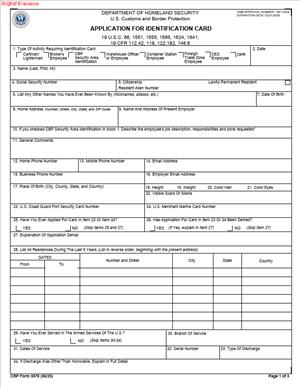
CBP Form 3078 – Application for Identification Card
Fill out nowJurisdiction: Country: United States | Province or State: Federal
CBP Form 3078 – Application for Identification Card is a federal form used by U.S. Customs and Border Protection. It is completed by individuals who need official identification to access CBP-controlled facilities, areas, or systems. If you are about to fill it out, you are likely seeking authorization to enter a secure port, airport, border facility, or similar location.
This form collects personal, employment, and background information. It allows CBP to evaluate whether you qualify for an identification card. The card is often required for contractors, transportation workers, brokers, and others who work in or around secure customs areas.
The completion of this document is not a routine paperwork exercise. It can affect your ability to work in certain federal facilities. Incomplete or inaccurate information may delay or prevent approval.
If you are reviewing the form before starting, it helps to understand what it is designed to do. That clarity makes it easier to gather the right documents and provide consistent information.
What is CBP Form 3078 – Application for Identification Card?
Clear definition
CBP Form 3078 – Application for Identification Card is an official application used by U.S. Customs and Border Protection to issue identification credentials. These credentials grant approved individuals access to designated CBP-secured areas.
The form functions as a screening tool. It collects identifying details, employment information, and background disclosures. CBP uses this information to assess eligibility and security risk before issuing an identification card.
This document is not the identification card itself. It is the application that begins the review and approval process.
Who typically uses this form?
You will usually see this form used by people who need regular access to federal inspection areas. This may include customs brokers, freight forwarders, bonded warehouse employees, and transportation workers.
Contractors who perform maintenance, security, cleaning, or technology services in CBP-controlled spaces may also complete the form. Some airport or seaport employees require this identification to perform their duties near international cargo or passengers.
In some situations, company representatives who interact directly with CBP officers in restricted zones must apply for a card. The need for the form is tied to access, not job title alone.
Why might you need this form?
You may need this form if your work requires physical entry into a CBP facility. Without the identification card, access is often restricted or denied.
Your employer or contracting entity may require you to obtain the card before you can start certain assignments. In other cases, you may already be working in a related field but are expanding your duties to include secure areas.
The form is also used when renewing or replacing a CBP identification card in certain circumstances. If your previous card expired, was lost, or was revoked, a new application may be necessary.
Typical real-life scenarios
- You work for a logistics company that handles international shipments at a major port. Your role requires you to enter a bonded warehouse space supervised by CBP. To move cargo legally within that area, you must apply for and receive a CBP identification card.
- You are a customs broker who regularly meets clients and CBP officers inside a federal inspection station. To conduct daily business inside that facility, you complete the application and undergo the required screening.
- You are a contractor hired to upgrade surveillance systems inside a secure airport customs area. Your work takes place behind restricted access doors. Before you can begin the project, you are asked to submit the form for approval.
- You previously held a CBP identification card, but it expired after you changed employers. Your new position again requires access to secure areas. You complete a new application to restore your authorized access.
When would you use CBP Form 3078 – Application for Identification Card?
You use this form when access to a CBP-controlled space is necessary for your job or business activities. This usually occurs in environments connected to international travel or trade.
For example, seaports and airports that process international cargo or passengers often contain secure federal inspection areas. Rail yards, land border crossings, and certain inland facilities may also have restricted zones.
The form is typically required before access is granted, not after. That means you complete it during onboarding, contract approval, or when your role changes. If you are moving into a position that increases your level of access, a new or updated submission may be requested.
Some individuals submit the form as part of a broader credentialing process. This may include fingerprinting, identity verification, or background review. The application is one component of that overall screening framework.
Legal characteristics of CBP Form 3078 – Application for Identification Card
CBP Form 3078 – Application for Identification Card is an official federal document. It is used within an administrative process governed by federal authority. The information you provide is subject to review and verification.
For the form to be considered valid, it must be complete and accurate. Missing fields, inconsistent answers, or unsigned sections commonly result in delays. Providing false or misleading information can lead to denial and may carry additional consequences under federal law.
The form becomes effective as part of an approval process. Submission alone does not grant access. Approval is typically confirmed only after CBP completes its review and issues an identification card.
Requirements and procedures may vary slightly by facility. While the form itself is federal, local port directors or facility administrators often manage day-to-day processing. Timelines and appointment procedures can differ between locations.
This document does not guarantee employment. It does not create a contract between you and CBP. It also does not replace other credentials that may be required by airport authorities, port operators, or transportation security programs.
Is it legally binding?
CBP Form 3078 – Application for Identification Card is legally significant because it involves sworn statements and personal disclosures. When you sign the form, you are affirming that the information provided is true and complete to the best of your knowledge.
The binding nature of the document relates to the accuracy of your statements. False information may be treated as a violation of federal rules. The form itself does not bind CBP to approve your application.
Approval, if granted, creates authorization to access certain secure areas under specific conditions. That authorization can typically be limited, suspended, or revoked if rules are violated.
In practical terms, the form carries legal weight because it is part of a federal screening process. It establishes your representations about identity, background, and eligibility.
How to fill out CBP Form 3078 – Application for Identification Card
Step 1 – Review the entire form before writing
Start by reading the full document from beginning to end. This helps you understand what information is required and which sections apply to you. Pay attention to any instructions about attachments, identification documents, or background disclosures.
Step 2 – Provide your full legal name and personal details
Enter your full legal name exactly as it appears on your government-issued identification. Include any middle names, suffixes, or prior names if requested. Provide your date of birth, place of birth, citizenship information, and current residential address as instructed.
Make sure the information matches your identification documents. Inconsistencies can slow the review process.
Step 3 – Enter contact information
Fill in your current phone number and email address, if requested. Use contact details you regularly monitor. CBP or facility administrators may use this information to schedule appointments or request clarification.
Accurate contact information helps avoid unnecessary delays.
Step 4 – Provide employment and business information
List your current employer, job title, and work address. If you are self-employed or acting as an independent contractor, provide the business name and relevant details as required on the form.
Describe your role in a way that reflects why you need access to secure areas. The explanation should align with your employer’s records.
Step 5 – Answer background and eligibility questions
Carefully read each background question. These may address prior convictions, pending charges, or previous issues involving federal credentials. Respond truthfully and completely.
If the form provides space for explanations, use it to give clear and concise details. Incomplete responses may result in follow-up inquiries.
Step 6 – Review for completeness and accuracy
Before signing, go back through every section. Confirm that all required fields are filled in. Check dates, spelling of names, and identification numbers for accuracy.
Look for any missing signatures or unchecked boxes. Even small omissions can delay processing.
Step 7 – Sign and date the application
Sign the form in the designated area using your legal signature. Enter the date of signing. Your signature confirms that the information provided is true and complete.
Some facilities may require the signature to be witnessed or submitted in person. Follow the specific submission process given to you.
Step 8 – Submit the form and supporting documents
Provide the completed application and any required identification or supporting materials as directed. Submission may occur in person at a CBP office or through an authorized facility contact, depending on local procedures.
After submission, the form enters the review process. Approval is typically confirmed separately once screening is complete and an identification card is issued.
Legal terms you might encounter in CBP Form 3078 – Application for Identification Card
- Port Director: This is the CBP official who oversees operations at a specific port of entry. On this form, the Port Director is the approving authority for your identification card. Your application is reviewed and approved or denied at the port level, not by a general national office.
- Applicant: You are the applicant if you are requesting a CBP identification card. The form collects detailed personal and employment information about you. Everything you enter is evaluated to determine whether you qualify for unescorted access to secure CBP areas.
- Employer Sponsorship: Many applicants must be sponsored by a company that does business with CBP. Your employer confirms that you need access to customs areas for work. The employer’s certification on the form supports your eligibility and connects your access to a legitimate business purpose.
- Background Investigation: This refers to the review of your criminal history and other records. By signing the form, you consent to this review. The results help CBP decide whether granting you access poses any security risk.
- Customs Security Area: These are restricted areas at ports of entry, airports, seaports, or border facilities. Access is limited to authorized individuals with valid identification. The form is your request to enter these controlled zones without constant escort.
- Bonded Carrier: A bonded carrier is a transportation company authorized to move goods under a customs bond. If you work for such a carrier, you may need identification to access cargo areas. The form may require you to identify your company’s bonded status.
- Disqualifying Offense: This is a criminal conviction or conduct that may prevent approval. The form asks you to disclose arrests or convictions. Failing to disclose something that qualifies as disqualifying can lead to denial or revocation.
- Revocation: Revocation means your identification card is canceled after it has been issued. This can happen if you violate security rules or if new information affects your eligibility. The form warns that approval is conditional and can be withdrawn.
- Certification: Certification is the signed statement confirming that your answers are true and complete. When you sign, you are declaring under penalty that the information is accurate. False statements can result in denial, penalties, or loss of access.
- Privacy Act Statement: This section explains how your information will be used and stored. It tells you the authority under which the information is collected. It also explains routine uses and what may happen if you choose not to provide certain information.
FAQs
What information do I need to gather before starting CBP Form 3078 – Application for Identification Card?
You should have your full legal name exactly as it appears on your government-issued identification, your date and place of birth, your Social Security number if requested, and your current residential address. You will also need your employer’s legal business name, address, and contact information. If you have prior arrests or convictions, gather dates, locations, and case outcomes so you can answer accurately and consistently.
Do I have to disclose arrests that did not lead to a conviction?
This document may ask about both arrests and convictions. Read each question carefully and answer only what is requested. If the question includes arrests, you must disclose them even if charges were dropped, and you should provide the final disposition so the reviewer understands the outcome.
What happens if my name on this form does not exactly match my government ID?
Your name must match your identification documents. If there is a difference due to marriage, divorce, or a legal name change, you may need to provide documentation supporting the change. Inconsistent names can delay processing because the agency must confirm your identity before approving access.
Does my employer need to complete part of this document?
Yes, in most cases, your employer must complete and sign a section confirming your job duties require access to secure areas. This certification supports your business needs. If the employer section is incomplete or unsigned, the application is typically not accepted for processing.
How long is the identification card valid once approved?
Validity periods can vary by port and policy. The approval notice or the identification card itself will usually state an expiration date. You are responsible for tracking that date and renewing before it expires if you still need access.
What should I do if I made a mistake after submitting this form?
Contact the port where you submitted the application as soon as you notice the error. Minor clerical mistakes may be corrected with written clarification, while more significant errors might require a new CBP Form 3078 – Application for Identification Card. Do not ignore the mistake, because inconsistencies discovered during review can delay or jeopardize approval.
Will I receive confirmation that my application was accepted?
Most ports provide some form of acknowledgment, such as a receipt, appointment notice, or pickup instructions. Acceptance for processing is not the same as approval. You should confirm whether additional steps like fingerprinting or an interview are required.
Can my identification card be taken away after it is issued?
Yes. Approval is conditional on continued compliance with security rules and truthful information. If new disqualifying information arises, or if you violate facility rules, your access can be suspended or revoked, and you may be required to return the card immediately.
Checklist: Before, During, and After CBP Form 3078 – Application for Identification Card
Before
- Confirm that your job duties require unescorted access to a CBP secure area.
- Verify your full legal name matches your government-issued photo ID.
- Gather your personal history details, including prior addresses if needed.
- Collect accurate employer information and supervisor contact details.
- Review any past arrests or convictions and note dates and outcomes.
- Ask your employer who is authorized to sign the certification section.
- Check whether your port requires an appointment before submission.
- Prepare any supporting documents related to name changes or legal status.
During
- Read each question fully before writing your answer.
- Print clearly or type if the form allows electronic completion.
- Answer every required question; do not leave blanks.
- Use “N/A” only when a question truly does not apply to you.
- Double-check dates for accuracy and consistency.
- Ensure your employer completes and signs their section.
- Review the Privacy Act Statement so you understand how your data is used.
- Sign and date the certification in ink if submitting a paper form.
After
- Make a complete copy of the signed form for your records.
- Submit the application using the method required by your port.
- Confirm whether fingerprinting or a photo appointment is required.
- Track any reference or receipt number provided.
- Respond promptly to requests for additional information.
- Mark your calendar with the card’s expiration date once issued.
- Store your identification card securely when not in use.
- Notify CBP if your employment ends or your role changes.
Common mistakes to avoid with CBP Form 3078 – Application for Identification Card
- Mistake: Leaving questions blank because you think they do not apply, which happens when you rush, can result in rejection for incomplete information, so do not forget to use “N/A” where appropriate.
- Mistake: Providing a nickname or shortened name instead of your full legal name, often out of habit, can delay identity verification and approval, so do not forget to match your government ID exactly.
- Mistake: Failing to disclose an arrest because you believe it was minor, which happens due to misunderstanding the question, can lead to denial for lack of candor, so do not forget to read each disclosure question carefully.
- Mistake: Submitting the form without the employer’s signature, often because of internal miscommunication, can cause immediate rejection, so do not forget to confirm the certification section is complete.
- Mistake: Entering incorrect dates for employment or criminal history due to guessing can create inconsistencies during background checks, so do not forget to verify dates before signing.
- Mistake: Forgetting to sign and date the form yourself, which happens when focusing on attachments, can make the application invalid, so do not forget the final certification step.
- Mistake: Ignoring follow-up requests from the port office, often because emails are overlooked, can stall or close your application, so do not forget to monitor your messages after submission.
- Mistake: Failing to report job changes after approval, which happens when roles shift internally, can result in revocation, so do not forget that your access is tied to your specific employment need.
What to do after filling out CBP Form 3078 – Application for Identification Card
Once you complete the form, pause before submitting it. Review every page slowly. Check spelling, dates, and signatures. Make sure all required fields are filled.
- Step 1: Make a full copy of the completed and signed form for your records.
- Step 2: Attach any required supporting documents, such as name change documentation or employer letters.
- Step 3: Confirm the correct submission location for your specific port of entry.
- Step 4: Submit the application using the accepted method, whether in person or as otherwise directed by the port.
- Step 5: Ask for confirmation that your application was received and is being processed.
- Step 6: Complete any additional requirements, such as fingerprinting, photographing, or attending an in-person appointment.
- Step 7: Monitor your phone and email for follow-up questions or status updates.
- Step 8: Respond quickly if CBP requests clarification or additional documentation.
- Step 9: Once approved, review the identification card for accuracy, including your name and expiration date.
- Step 10: Store the card securely and follow all facility rules regarding display and use.
Keep your copy of the application and any approval correspondence in a safe place. If you change employers, job duties, or legal name, check whether you must update your information. Staying organized protects your access and prevents interruptions to your work.
Disclaimer: This guide is provided for informational purposes only and is not intended as legal advice. You should consult a legal professional.