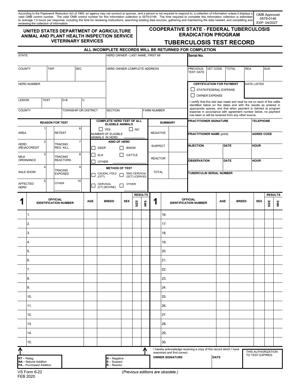
VS Form 6-22 – Cooperative State – Federal Tuberculosis Eradication Program Tuberculosis Test Record
Fill out nowJurisdiction: Country: United States | Province or State: Federal
The VS Form 6-22 – Cooperative State – Federal Tuberculosis Eradication Program Tuberculosis Test Record is an official federal document used to record tuberculosis testing in animals under a national disease control program. It plays a key role in tracking, verifying, and documenting test results as part of the United States tuberculosis eradication effort.
If you are about to complete this form, you are likely involved in livestock management, veterinary services, animal movement, or regulatory compliance. This document creates a formal record of tuberculosis testing performed on specific animals at a specific time and location.
The information you provide becomes part of an official disease control record. It may be reviewed by federal or state animal health authorities. Accuracy and completeness matter because this record can affect animal movement, herd status, and compliance with program requirements.
Understanding what the form does, what it includes, and how it is used will help you complete it correctly and avoid delays or questions later.
What is VS Form 6-22 – Cooperative State – Federal Tuberculosis Eradication Program Tuberculosis Test Record?
Clear definition
The VS Form 6-22 – Cooperative State – Federal Tuberculosis Eradication Program Tuberculosis Test Record is a standardized federal record used to document the administration and results of tuberculosis tests in animals. It is part of a cooperative disease control program between federal and state animal health authorities.
The form captures identifying details about the animals tested, the type of test performed, the date of testing, and the official results. It also identifies the accredited veterinarian or authorized individual who conducted the testing.
This document serves as an official record within the broader tuberculosis eradication framework. It helps ensure consistent documentation across states and supports traceability and disease monitoring efforts.
Who typically uses this form?
This form is typically used by accredited veterinarians who are authorized to perform tuberculosis testing under federal and state programs. These professionals complete and sign the record after conducting the test.
Livestock owners, herd managers, and animal producers may not complete the form themselves, but they often provide key information that appears on it. This can include owner details, premises information, and animal identification numbers.
State and federal animal health officials may review the completed document. They use it to verify compliance with testing requirements and to maintain accurate records within disease control systems.
In some cases, market operators, transporters, or buyers may rely on the information recorded in the document to confirm that animals meet testing requirements for movement or sale.
Why might you need this form?
You may need this form when animals are required to undergo tuberculosis testing as part of routine herd surveillance. This can occur in areas participating in the eradication program or where testing is tied to herd status.
The form may also be necessary before animals can be moved across state lines. Many interstate movements require documentation showing that tuberculosis testing was performed and that results were negative or otherwise classified under program rules.
If a herd has been identified as exposed or at risk, additional testing may be required. In that situation, this document records follow-up testing and helps track the herd’s progress toward a specific status.
The form also supports official certification programs. Herds seeking or maintaining certain health classifications may need properly completed tuberculosis test records on file.
Typical real-life scenarios
- A cattle producer plans to sell breeding stock to a buyer in another state. Before shipment, the animals must undergo tuberculosis testing. An accredited veterinarian performs the test and completes the form to document the results. The completed record supports the animals’ eligibility for movement.
- A dairy herd participates in a surveillance program designed to monitor tuberculosis risk in a particular region. Periodic testing is required. Each round of testing is recorded on a separate form, creating a clear testing history for the herd.
- A herd has been identified as potentially exposed to tuberculosis due to contact with another affected group of animals. Regulatory authorities require whole-herd testing. The veterinarian records each animal tested and the outcome on the official test record.
- An animal market requires proof of recent tuberculosis testing for certain classes of cattle. Sellers provide documentation based on the completed test record, allowing the market to confirm compliance before accepting the animals.
When would you use VS Form 6-22 – Cooperative State – Federal Tuberculosis Eradication Program Tuberculosis Test Record?
You would use this form at the time tuberculosis testing is performed under the cooperative federal-state eradication program. The document is completed as part of the official testing event, not afterward as an informal summary.
Accredited veterinarians use the form immediately following administration of the approved tuberculosis test. The record reflects the specific test method used, the date it was administered, and the date results were read, if applicable.
The form is also used when testing is required for interstate movement. In that context, the record supports other movement documents and confirms that animals meet federal testing standards.
In herds under investigation or quarantine, the form may be used multiple times. Each testing event generates its own record, which builds a documented timeline of compliance and results.
Regulatory officials may also require the use of this form when validating herd status changes. If a herd is moving from a restricted status toward a more favorable classification, documented negative test results on this form may be part of the review process.
Legal characteristics of VS Form 6-22 – Cooperative State – Federal Tuberculosis Eradication Program Tuberculosis Test Record
This form is an official government record within a federal disease control program. Its effectiveness depends on accurate completion, proper authorization of the individual conducting the test, and compliance with program procedures.
For the record to be valid, it typically must include complete animal identification, correct premises information, accurate test details, and the signature of the accredited veterinarian. Missing signatures, incomplete identification numbers, or unclear test results are common reasons for rejection or follow-up questions.
Because the program operates cooperatively between federal and state authorities, there may be administrative differences in how records are processed or stored. However, the core purpose and structure of the form remain consistent across jurisdictions within the United States.
The document does not grant movement permission by itself. It records test results. Other documents, such as health certificates or movement permits, may rely on the information in this form but are separate records.
The form also does not establish herd status on its own. Herd classification decisions are generally made by animal health authorities based on a broader review of testing history and compliance with program standards.
Is it legally binding?
The VS Form 6-22 – Cooperative State – Federal Tuberculosis Eradication Program Tuberculosis Test Record functions as an official government record once it is completed and signed by an authorized individual. In that sense, it carries legal significance as documentation within a federal program.
When an accredited veterinarian signs the form, they are certifying that the information is accurate to the best of their knowledge and that the test was performed according to program requirements. Providing false or misleading information on such a record may have serious consequences under general federal and state laws governing official records.
For livestock owners, the form serves as documented evidence that testing occurred and records the outcome. It may be relied upon by regulators or other parties when evaluating compliance with tuberculosis testing requirements.
However, the form itself is not a contract between private parties. It does not create an agreement for sale, transfer ownership, or establish liability terms. Its legal effect is tied to its role as an official disease control record.
How to fill out VS Form 6-22 – Cooperative State – Federal Tuberculosis Eradication Program Tuberculosis Test Record
Step 1 – Review the form header and program details
Start by carefully reading the top section of the form. Confirm that you are using the correct version of the document for the tuberculosis eradication program. The header usually identifies the program and the agency overseeing it. Make sure the form is legible and complete before entering any information.
Step 2 – Enter owner and premises information
Provide the full legal name of the animal owner and the address associated with the herd or premises. Include any required identification numbers linked to the location, such as a premises identification number if requested. Double-check spelling and numeric entries for accuracy.
Step 3 – Identify the animals tested
Record each animal’s official identification as required by the program. This may include ear tag numbers, registration numbers, or other approved identification methods. Ensure that each number is written clearly and matches the physical identification on the animal. Incomplete or incorrect identification can undermine the usefulness of the record.
Step 4 – Specify the type of tuberculosis test performed
Indicate the exact test method used, such as the appropriate intradermal test or other approved method under the program. Enter the date the test was administered. If the test requires a separate reading date, include that as well. Accurate dates are important for determining compliance with movement or program timelines.
Step 5 – Record the test results for each animal
For every animal listed, enter the official test result as determined under program guidelines. This may include negative, suspect, or reactor classifications, depending on the outcome. Make sure the result for each animal clearly corresponds to its identification number.
Step 6 – Complete any additional herd or epidemiological information
Some versions of the form request additional details about the herd status, reason for testing, or related investigation numbers. Fill in these fields as applicable. Provide concise, factual information that reflects the testing event.
Step 7 – Review all entries for accuracy and completeness
Before signing, read through the entire document. Confirm that names, identification numbers, dates, and results are consistent and legible. Correct any errors according to accepted procedures rather than leaving unclear markings.
Step 8 – Sign and date the form as the accredited veterinarian
The authorized individual who performed the test must sign the form. Include any required accreditation or license number. Add the date of signature. The signature certifies that the testing was conducted in accordance with program requirements and that the information recorded is accurate to the best of your knowledge.
Step 9 – Distribute and retain copies as required
After completion and signature, provide copies to the appropriate parties as required by program procedures. This may include the animal owner and relevant animal health authorities. Retain any required copies for your records in accordance with program guidelines.
Legal terms you might encounter in VS Form 6-22 – Cooperative State – Federal Tuberculosis Eradication Program Tuberculosis Test Record
- Accredited Veterinarian: This is a veterinarian approved by the federal government to perform specific regulatory duties, including tuberculosis testing under the eradication program. On this form, the accredited veterinarian is the person who performs the test, records the results, and signs the certification. Your signature as an accredited veterinarian confirms that the information is accurate and that the testing followed official protocols.
- Herd Identification Number: This is a unique number assigned to a herd or premises. It links the animals tested to a specific location in official records. You must enter this correctly so that test results are associated with the right herd in state and federal databases.
- Official Identification: This refers to government-approved animal ID methods, such as ear tags or other traceable markers. Each animal listed on the form must have its official ID recorded. This allows regulators to trace individual animals if there is a positive or suspect result.
- Caudal Fold Test (CFT): This is a common screening test for bovine tuberculosis. The form may require you to specify that this test was used and to record the date of injection and the date of reading. Accurate timing is critical because results must be read within a specific window.
- Comparative Cervical Test (CCT): This is a follow-up test often used when an initial screening test is inconclusive or suspect. If this test is performed, the form must clearly reflect that it was a comparative test and include detailed results. It may trigger additional regulatory steps.
- Reactor: A reactor is an animal that tests positive for tuberculosis based on official criteria. If you mark an animal as a reactor, that designation carries regulatory consequences. It can lead to quarantine, movement restrictions, or further testing.
- Suspect: A suspect animal shows a reaction that is not clearly negative but does not meet the criteria for a confirmed positive. The form may require you to classify animals carefully. Mislabeling a suspect as negative can delay necessary follow-up action.
- Quarantine: Quarantine is a legal restriction on animal movement to prevent disease spread. While this form itself does not impose quarantine, positive or suspect results recorded on it can trigger quarantine orders. The document becomes part of the official record supporting that action.
- Premises Identification Number (PIN): This is a unique number assigned to a physical location where animals are kept. It helps authorities track disease investigations geographically. You must ensure the PIN matches the correct farm or facility.
- Official Use Only: Some sections of the form may be marked for official use. These areas are reserved for state or federal personnel. Do not complete those sections unless you are authorized to do so.
FAQs
What dates do I need to enter, and why do they matter?
You must enter the date the test was administered and the date the test was read. These dates confirm that the reading occurred within the required time frame for that specific test. If the reading date falls outside the acceptable window, the result may not be valid and may have to be repeated.
Who is authorized to sign this document?
Only an accredited veterinarian who performed or directly supervised the testing can sign. The signature certifies that the procedures followed official standards. If someone without proper accreditation signs, the record may be rejected by authorities.
What identification details are required for each animal?
You must record each animal’s official identification number exactly as it appears on the ear tag or other approved device. Do not rely on farm nicknames or internal numbering systems. If the ID does not match official records, the test result may not be traceable.
Do I need to attach additional paperwork?
In some cases, yes. If there are suspect or reactor animals, you may need to attach supplemental reports or laboratory documents. Check whether your state or supervising authority requires extra documentation to accompany this form.
What happens if I make a mistake while completing VS Form 6-22 – Cooperative State – Federal Tuberculosis Eradication Program Tuberculosis Test Record?
If you discover an error before submission, correct it clearly according to accepted recordkeeping practices, and initial the correction if required. Do not use correction fluid or obscure the original entry. If the document has already been submitted, contact the receiving office to ask how to file an amended record.
How do I know if the form has been accepted?
Acceptance usually occurs when the state or federal office processes and records the information without requesting corrections. You may receive confirmation through an official copy, electronic acknowledgment, or direct communication. If you do not receive confirmation and the results are time-sensitive, follow up to verify receipt.
What if the owner’s name on this form does not exactly match other records?
Use the legal name associated with the herd or premises as it appears in official registration records. Minor spelling differences can cause confusion in databases. Confirm the correct spelling before finalizing the document to avoid processing delays.
Does completing VS Form 6-22 – Cooperative State – Federal Tuberculosis Eradication Program Tuberculosis Test Record automatically change an animal’s status in public records?
The document itself records the test results, but the official status update occurs when the appropriate authority enters the data into its system. Once processed, the animal’s disease status may change in regulatory databases. This can affect movement eligibility and herd classification.
Checklist: Before, During, and After VS Form 6-22 – Cooperative State – Federal Tuberculosis Eradication Program Tuberculosis Test Record
Before
- Confirm your accreditation status is current and valid.
- Verify the herd identification number and premises identification number.
- Gather official ID information for all animals to be tested.
- Confirm the correct type of tuberculosis test required.
- Review timing requirements for test administration and reading.
- Bring the correct version of the form and any required supplemental documents.
- Check that you understand state-specific submission procedures.
During
- Record each animal’s official identification exactly as displayed.
- Write legibly and use consistent formatting for dates.
- Enter the test administration date at the time of injection.
- Record the reading date within the approved time window.
- Carefully classify each result as negative, suspect, or reactor.
- Double-check herd and owner information before moving to the next page.
- Complete all required fields and avoid leaving blanks.
After
- Review the entire document for accuracy and completeness.
- Sign and date the certification section as the accredited veterinarian.
- Make copies for your records and for the animal owner.
- Submit the form to the appropriate state or federal office as required.
- Confirm receipt if the results affect animal movement.
- File your copy in a secure and organized recordkeeping system.
- Update any internal herd health logs to reflect the test results.
Common mistakes to avoid with VS Form 6-22 – Cooperative State – Federal Tuberculosis Eradication Program Tuberculosis Test Record
- Mistake: Recording farm nicknames instead of official animal identification numbers, which happens when relying on internal herd logs, can make animals untraceable in official systems; do not forget to copy the exact ID from the approved tag or device.
- Mistake: Entering the wrong test reading date because of scheduling confusion, which can invalidate the test window and require retesting; do not forget to verify the correct reading timeframe before writing the date.
- Mistake: Leaving required fields blank due to oversight, which can cause rejection or delays in processing; do not forget to review every section before signing.
- Mistake: Failing to sign as the accredited veterinarian, often because of rushed paperwork, which makes the document incomplete and not legally valid; do not forget to complete the certification section.
- Mistake: Misclassifying a suspect animal as negative to simplify records, which can delay disease control actions and create regulatory issues; do not forget to apply official interpretation standards.
- Mistake: Submitting the form to the wrong office due to unclear procedures, which can delay herd status updates; do not forget to confirm the correct submission destination in advance.
- Mistake: Using outdated herd or premises information copied from old records, which can mismatch current databases and complicate traceability; do not forget to verify current registration details before completing the form.
- Mistake: Making corrections with correction fluid or illegible cross-outs, which can raise concerns about record integrity; do not forget to follow accepted correction practices and initial changes if required.
What to do after filling out VS Form 6-22 – Cooperative State – Federal Tuberculosis Eradication Program Tuberculosis Test Record
Once you complete the form, your job is not quite finished. What you do next affects whether the test results are recognized and properly recorded.
- Step 1: Review every entry one more time. Confirm animal IDs, dates, and result classifications match your field notes.
- Step 2: Sign and date the certification section if you have not already done so. Your signature confirms compliance with official testing procedures.
- Step 3: Make clear copies. Provide one copy to the animal owner or herd manager and keep one for your professional records.
- Step 4: Submit the original or required copy to the designated state or federal office. Follow the required submission method, whether paper delivery or approved electronic transmission.
- Step 5: Document the date and method of submission in your own records. This helps if there is ever a question about timing.
- Step 6: Monitor for confirmation or feedback. If you receive notice of missing information or corrections needed, respond promptly.
- Step 7: Update your internal logs or practice management system to reflect that the test has been completed and reported.
- Step 8: If any animals were classified as suspect or reactor, prepare for follow-up steps. This may include additional testing, movement restrictions, or coordination with regulatory officials.
- Step 9: Keep your copy of the completed form in a secure file for the retention period required by your accreditation standards.
- Step 10: Communicate clearly with the herd owner about what the recorded results mean for movement, sales, or herd status.
Careful follow-through protects you, the herd owner, and the broader livestock industry. Accurate records support disease control and help avoid unnecessary delays in animal movement or herd certification.
Disclaimer: This guide is provided for informational purposes only and is not intended as legal advice. You should consult a legal professional.