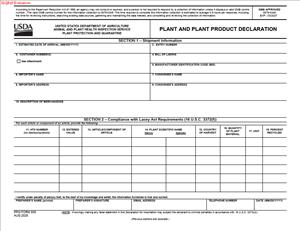
PPQ Form 505 – Plant and Plant Production Declaration
Fill out nowJurisdiction: Country: United States | Province or State: Federal
The PPQ Form 505 – Plant and Plant Production Declaration is a federal document used to declare specific details about plants or plant products entering the United States. You complete it when you are importing certain plants, plant parts, or plant-based materials that are subject to inspection and regulation.
If you are about to fill out this form, you are likely involved in importing, shipping, or receiving plant materials from another country. This could be for commercial sale, research, manufacturing, or personal use. The form helps federal authorities understand exactly what is being brought into the country.
This document matters because plant materials can carry pests, diseases, or invasive species. The information you provide supports inspection and risk assessment. Incomplete or inaccurate information can delay shipments or lead to enforcement actions.
You are not signing a contract with another private party. You are making a declaration to a federal agency. That means accuracy and clarity are central to the completion of this form.
What is PPQ Form 505 – Plant and Plant Production Declaration?
Clear definition
PPQ Form 505 – Plant and Plant Production Declaration is a federal declaration form used to report detailed information about imported plants and plant products. It identifies what the items are, where they come from, and how they will be used.
The form is part of a broader inspection and regulatory system for plant health. When you submit it, you are formally stating facts about the shipment. This includes scientific names, quantities, country of origin, and intended use.
It functions as a disclosure document. Authorities rely on your statements to determine whether the shipment meets plant health requirements and whether additional inspection or restrictions apply.
Who typically uses this form?
Importers commonly use this form when bringing regulated plant materials into the United States. An importer may be an individual, a business, a customs broker, or another authorized representative acting on behalf of a company.
Nurseries and plant distributors use it when importing live plants, cuttings, or seeds for resale. Manufacturers may use it when importing plant-based materials used in production, such as wood packaging components or botanical ingredients.
Research institutions sometimes complete the form when importing plant specimens for study. Even private individuals may encounter it if they are importing plant materials that fall under federal regulation.
Why might you need this form?
You may need this form because certain plants and plant products are subject to declaration requirements at the time of entry into the country. The form helps authorities evaluate potential plant health risks.
Customs processing often requires accurate plant identification. Without this declaration, a shipment may be held until proper documentation is provided. That can result in delays, storage costs, or refusal of entry.
The document also creates a record of what was imported. If questions arise later about compliance, inspections, or distribution, the declaration becomes part of the official file.
Typical real-life scenarios
- You are a small nursery importing ornamental plants from another country. Before the plants are released into commerce, you must declare their species and origin. The form becomes part of the entry documentation for the shipment.
- You operate a furniture business and import wooden components made from specific tree species. Even though the wood is processed, it still qualifies as a plant product. The declaration identifies the species and country of harvest.
- You are a researcher importing dried plant samples for laboratory testing. The form clarifies that the materials are for research use and not for planting or resale. That information affects how the shipment is handled.
- You ordered specialty seeds from an overseas supplier for cultivation. The declaration provides the scientific name and quantity of seeds. This allows inspectors to determine whether additional permits or inspections apply.
When would you use PPQ Form 505 – Plant and Plant Production Declaration?
You use PPQ Form 505 – Plant and Plant Production Declaration at the time of importation or entry of regulated plant materials into the United States. It is typically part of the documentation package submitted during customs processing.
The timing often coincides with shipment arrival. In many cases, the form is prepared in advance so it can be submitted promptly when the goods reach the port of entry. This helps avoid unnecessary delays.
Importers of record frequently coordinate the completion of the form. A customs broker may prepare it based on information provided by the importer. However, the importer remains responsible for the accuracy of the information supplied.
The form is also used when there is a change in the type of plant materials being imported. If your business begins importing a new species or product category, a new declaration reflecting those details may be required.
You may encounter this form if authorities request additional documentation during an inspection. For example, if inspectors need more detailed information about plant species or origin, the declaration can clarify those details.
Legal characteristics of PPQ Form 505 – Plant and Plant Production Declaration
PPQ Form 505 – Plant and Plant Production Declaration is a regulatory declaration. Its effectiveness depends on accurate, complete, and truthful information. The form becomes part of a federal compliance record once submitted.
For the document to be accepted, required fields must be completed clearly. Missing scientific names, unclear country of origin information, or inconsistent quantities can lead to processing delays. In some cases, incomplete forms are rejected and must be corrected and resubmitted.
Accuracy is central. Providing incorrect information, even unintentionally, can create complications. For example, listing a common name instead of a scientific name may cause confusion during inspection. Discrepancies between the declaration and the physical shipment can trigger additional scrutiny.
The form operates within a federal regulatory framework. While plant health rules apply nationwide, inspection practices and processing timelines may vary depending on the port of entry. The core declaration requirement remains federal in nature.
This document does not replace other required permits or certificates. Depending on the type of plant material, additional documentation may be necessary. The declaration complements, but does not substitute for, other regulatory filings.
It also does not guarantee that a shipment will be admitted. Submission of the form allows authorities to review and assess the shipment. Admission depends on compliance with applicable plant health standards and inspection results.
Is it legally binding?
When you sign and submit this form, you are making an official statement to a federal authority. In that sense, it is legally significant. Your signature confirms that the information provided is true and correct to the best of your knowledge.
The form is not a contract between private parties. It does not create negotiated obligations like a sales agreement. Instead, it serves as a sworn or certified declaration within a regulatory process.
Because it is a formal declaration, false or misleading statements can have consequences. Enforcement actions may arise if information is intentionally misrepresented. Even unintentional errors can lead to shipment delays or additional review.
Its binding effect relates to the truthfulness of your statements and your compliance with federal plant health regulations. It documents what you declared at the time of import and can be referenced in future compliance reviews.
How to fill out PPQ Form 505 – Plant and Plant Production Declaration
Step 1 – Review the shipment details
Start by gathering complete information about the plant materials in your shipment. Confirm the scientific names, quantities, country of harvest, and intended use. Compare commercial invoices and shipping documents to ensure consistency before entering any data.
Step 2 – Identify the importer and contact information
Enter the full legal name of the importer of record. Provide accurate mailing address and contact details. This information links the declaration to the responsible party for the shipment.
Step 3 – Describe the plant or plant product accurately
List each plant species using its scientific name. Avoid relying only on common names. Include the type of material, such as live plants, seeds, wood, or dried plant parts, along with the quantity and unit of measure.
Step 4 – State the country of origin
Indicate the country where the plant was grown or harvested. If multiple countries are involved, ensure that each product is matched to its correct origin. Consistency with shipping and customs documents is essential.
Step 5 – Specify the intended use
Provide the intended purpose of the plant material. This may include planting, resale, manufacturing, research, or personal use. The stated use can influence inspection procedures and regulatory requirements.
Step 6 – Review for completeness and consistency
Before signing, read through every entry. Confirm that names, quantities, and origin details match the accompanying paperwork. Check for blank fields that require responses and correct any typographical errors.
Step 7 – Sign and date the declaration
Sign the form where indicated, using the name of the authorized individual completing the submission. Date the document accurately. Your signature confirms that the information provided is true and complete to the best of your knowledge.
Step 8 – Submit with the required entry documentation
Provide the completed form as part of the shipment’s entry package. Ensure it is included with any other required documents so that inspectors can review the information together during processing.
Legal terms you might encounter in PPQ Form 505 – Plant and Plant Production Declaration
- Importer of Record: This is the person or business legally responsible for the imported goods. On this form, you must list the exact legal name and contact details of the importer of record. This party is accountable for the accuracy of the declaration and for complying with plant health and trade requirements.
- Consignee: The consignee is the person or company that will receive the shipment. Sometimes the consignee and the importer of record are the same. If they are different, you must clearly identify both so officials know who is taking possession of the plant products.
- Country of Harvest: This refers to the country where the plant was grown and harvested, not necessarily where it was shipped from. On this form, you must state the country of harvest accurately. This detail affects admissibility and inspection requirements.
- Scientific Name: Many plant products must be identified by their botanical (Latin) name. This avoids confusion caused by common names that vary by region. If you provide only a trade name, your shipment may be delayed.
- Harmonized Tariff Schedule (HTS) Code: This is a numerical code used to classify traded products. While primarily a customs classification, it helps match your declaration to the correct product category. Entering the wrong code can create inconsistencies between this form and other entry documents.
- Intended Use: This describes how the plant product will be used after import. Examples include consumption, manufacturing, planting, or research. The intended use can determine whether additional permits or inspections are required.
- Authorized Signatory: This is the person who has the authority to sign on behalf of the importer or company. By signing, the authorized signatory certifies that the information provided is true and complete. Signing without proper authority can create internal and legal issues.
- Declaration Statement: This is the certification language near the signature block. When you sign, you confirm under penalty that the information is accurate. You should read this section carefully before signing.
- Shipment Identifier: This can include invoice numbers, bill of lading numbers, or container numbers. It links this document to a specific shipment. If the identifier does not match other entry paperwork, the filing may be flagged for review.
- Entry Documentation: These are the other forms and records submitted alongside this declaration. They may include invoices, packing lists, and customs entry forms. The information in this document must align with those records exactly.
FAQs
Do I need to complete PPQ Form 505 – Plant and Plant Production Declaration for every plant shipment I import?
You generally complete this form when your shipment includes plant or plant products that require a declaration at entry. Check your entry instructions and confirm whether your product category triggers this requirement. Do not assume that similar past shipments follow the same rule without verifying current requirements.
What name should I enter if my business operates under a trade name?
Enter the full legal name of the importer of record as it appears on your official registration and customs filings. If you also use a trade name, you can include it where appropriate, but the legal name must match your other entry documents exactly. Inconsistent naming can delay processing.
How specific does the plant description need to be?
Be as precise as possible. Include the scientific name if available, the common name, and the type of product (for example, dried leaves, raw logs, seeds for planting). Avoid general descriptions like “plant material.” Officials use your description to determine admissibility and inspection needs.
What happens if I do not know the exact country of harvest?
You should confirm this information with your supplier before submitting this document. The country of harvest is not optional. If you guess or leave it blank, your shipment may be held until you provide corrected information.
Who is allowed to sign this document?
The signer must have authority to act on behalf of the importer of record. This could be an owner, officer, or a properly authorized employee. Before signing, confirm that your company’s internal policies allow you to certify regulatory documents.
Can I correct an error after I submit the PPQ Form 505 – Plant and Plant Production Declaration?
If you discover an error, act quickly. Contact the appropriate processing office or broker handling your entry and explain the issue. You may need to submit a corrected version of PPQ Form 505 – Plant and Plant Production Declaration and ensure all related documents reflect the same correction.
Does this form become part of the public record?
Information provided in import filings can be shared among government agencies and may be subject to disclosure rules. The details you enter become part of your shipment’s official record. That is why accuracy and consistency are essential.
What should I double-check before signing?
Review the product description, country of harvest, shipment identifiers, and importer name. Make sure these match your invoice and other entry paperwork exactly. Also, read the declaration statement carefully so you understand what you are certifying.
Checklist: Before, During, and After PPQ Form 505 – Plant and Plant Production Declaration
Before
- Confirm that your shipment requires a plant declaration.
- Gather commercial invoices, packing lists, and shipping documents.
- Verify the scientific names of all plant materials.
- Confirm the country of harvest with your supplier in writing.
- Check that your importer of record information is current.
- Identify who has the authority to sign the document.
- Match shipment identifiers across all entry documents.
During
- Enter the importer of record’s full legal name exactly as registered.
- Provide complete contact information for responsible parties.
- Describe each plant product clearly and specifically.
- List the correct country of harvest for each product.
- Ensure quantities and units match your invoice.
- Review all codes and identifiers for consistency.
- Read the declaration statement before signing.
- Sign and date the form in the correct location.
After
- Make a complete copy of the signed document for your records.
- Submit the form with the required entry documentation.
- Confirm receipt if your filing method provides confirmation.
- Monitor the status of your shipment for inspection notices.
- Respond promptly to any requests for clarification.
- Retain the form with your import records.
- Update internal tracking systems to reflect submission.
Common mistakes to avoid with PPQ Form 505 – Plant and Plant Production Declaration
- Mistake: Using a vague product description because it seems easier, which often happens when relying on invoice shorthand; this can trigger inspection delays or document rejection, so do not forget to include scientific names and clear product details.
- Mistake: Listing the shipping country instead of the country of harvest, usually due to confusion between origin and export location; this can result in compliance issues, so do not forget to verify where the plant was actually grown.
- Mistake: Entering a trade name instead of the full legal name of the importer of record, which happens when copying marketing materials; this can cause mismatched records, so do not forget to match the legal name exactly to customs filings.
- Mistake: Leaving required fields blank because the information seems minor, often due to rushing; incomplete forms may be rejected, so do not forget to review every section before submission.
- Mistake: Allowing someone without proper authority to sign, which can occur in busy shipping departments; this may invalidate the certification internally, so do not forget to confirm signer authority.
- Mistake: Failing to align quantities and shipment identifiers with other documents, often because documents are prepared separately; inconsistencies can delay clearance, so do not forget to cross-check against invoices and bills of lading.
- Mistake: Submitting the form but not keeping a copy, which happens when relying on third parties; this can create recordkeeping gaps, so do not forget to store a complete signed version in your files.
- Mistake: Ignoring follow-up requests from processing officials, often due to missed emails; this can result in shipment holds, so do not forget to monitor communications until the entry is finalized.
What to do after filling out PPQ Form 505 – Plant and Plant Production Declaration
Once you complete the form, your focus shifts to proper submission and tracking. Accuracy alone is not enough. You must ensure the document reaches the correct destination and is connected to the right shipment.
- Step 1: Make a clear, legible copy of the signed form for your internal records.
- Step 2: Attach the form to the rest of your entry documentation, including invoices and shipping papers.
- Step 3: Submit the full entry package through your usual filing channel, whether directly or through a customs representative.
- Step 4: Confirm that the submission was received, using any tracking or confirmation system available to you.
- Step 5: Record the submission date and shipment reference number in your internal tracking system.
- Step 6: Monitor the status of the shipment for inspection notices or document review requests.
- Step 7: Respond promptly if officials request clarification or corrections.
- Step 8: If a correction is required, revise the form carefully and ensure all related documents reflect the same updated information.
- Step 9: Keep the final, accepted version of the form with your import compliance records.
- Step 10: Review the process internally to identify any improvements for future shipments.
You should store the completed form in the same file as the rest of the shipment’s compliance documents. Organize records by shipment identifier so you can quickly retrieve them during audits or internal reviews.
If you work with a team, inform relevant staff that the declaration has been submitted. This helps avoid duplicate filings or conflicting updates. Clear communication reduces the risk of inconsistent records.
Finally, treat each completed declaration as part of your long-term compliance history. Consistent, accurate filings build a reliable record. Over time, that consistency supports smoother processing and fewer delays.
Disclaimer: This guide is provided for informational purposes only and is not intended as legal advice. You should consult a legal professional.