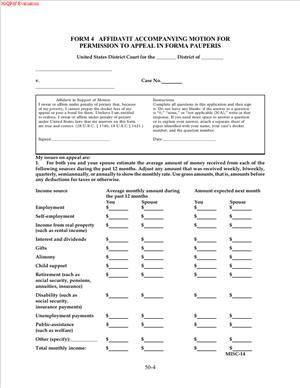
Form 4 – Affidavit Accompanying Motion for Permission to Appeal In Forma Pauperis
Fill out nowJurisdiction: Country: United States | Province or State: Federal
Form 4 – Affidavit Accompanying Motion for Permission to Appeal In Forma Pauperis is a financial disclosure document used in federal court when you want to appeal a decision but cannot afford the filing fees. It allows you to ask the court for permission to move forward without prepaying those costs.
When you file an appeal, courts usually require payment of a filing fee. If you do not have the financial ability to pay, this form gives you a structured way to explain your income, expenses, assets, and debts under oath.
This document is not about arguing why you should win your appeal. It focuses on your financial situation. The court uses it to decide whether you qualify to proceed “in forma pauperis,” which means without paying fees upfront.
If you are representing yourself, this form can feel detailed and personal. You are asked to disclose specific financial information. Knowing what the court is looking for helps you complete it clearly and accurately.
Because this filing is made under oath, accuracy matters. The court relies on the information you provide when deciding whether to waive the fees for your appeal.
What is Form 4 – Affidavit Accompanying Motion for Permission to Appeal In Forma Pauperis?
Clear definition
Form 4 – Affidavit Accompanying Motion for Permission to Appeal In Forma Pauperis is a sworn financial statement filed with a federal appellate court. It supports a motion asking for permission to appeal without paying court fees in advance.
An affidavit is a written statement made under penalty of perjury. By signing this form, you confirm that the financial details you provide are true to the best of your knowledge.
The form typically requires information about your employment, wages, other income, bank accounts, property, dependents, monthly expenses, and debts. The court reviews this information to determine whether paying the appeal fee would create a serious financial hardship for you.
This document does not replace your notice of appeal. It accompanies a motion requesting in forma pauperis status for your appeal.
Who typically uses this form?
People who file appeals in federal court and cannot afford the filing fee often use this form. Many are self-represented litigants, but individuals with attorneys may also complete it if they lack financial resources.
You might use this form if you lost a case in a federal trial court and want to challenge that decision at the appellate level. If you cannot pay the required appellate filing fees, this form becomes part of your request for fee relief.
In some situations, individuals who were granted in forma pauperis status in the trial court may still need to provide updated financial information for the appeal. The court may review whether your financial condition has changed.
Prisoners and non-prisoners both use this form, although additional requirements may apply in certain cases. The core purpose remains the same: to provide a clear picture of your financial situation.
Why might you need this form?
Appealing a federal court decision usually involves a filing fee. For many people, this cost is high. If paying it would prevent you from meeting basic living expenses, this form gives you a way to explain that to the court.
Without this affidavit, the court may not consider your request to proceed without prepayment of fees. The form provides the factual basis for your motion.
The court does not automatically assume financial hardship. It needs detailed information. This form creates a standardized format so that judges can review requests consistently.
Submitting a complete and accurate affidavit can prevent delays. Incomplete financial disclosures may lead to requests for more information or denial of your motion.
Typical real-life scenarios
- You filed a civil rights lawsuit in federal district court, and the judge dismissed your case. You believe the decision was incorrect and want to appeal. However, you are unemployed and do not have funds to cover the appellate filing fee. You use this form to show your financial condition.
- You receive disability benefits as your primary income. After losing a federal case, you decide to appeal. Because your monthly income barely covers rent and utilities, you complete the form to request permission to proceed without paying the fee upfront.
- You are incarcerated and wish to appeal a federal court ruling. You have limited funds in your inmate account. You file the affidavit to explain your financial status and request in forma pauperis status for your appeal.
- You were employed during your original case but recently lost your job. You now want to appeal the judgment. Since your financial circumstances changed, you must complete the affidavit to reflect your current income, assets, and expenses.
When would you use Form 4 – Affidavit Accompanying Motion for Permission to Appeal In Forma Pauperis?
You use this form at the time you are seeking to appeal a decision in a federal case and want to avoid prepaying the appellate filing fees. It is filed together with, or shortly after, your notice of appeal and motion requesting in forma pauperis status.
The key situation is financial inability to pay. If you can afford the filing fee without hardship, this form is not necessary. It is specifically for those who claim they cannot pay due to limited income or assets.
You may also use it if your financial situation has changed since the lower court proceedings. For example, if you were employed during the trial but are now unemployed, the court may require updated information for the appeal stage.
In cases where you were previously granted in forma pauperis status in the district court, the appellate court may still review your financial eligibility. This form provides the court with current and detailed information to make that decision.
Self-represented appellants often rely on this document to communicate their financial limitations clearly. Attorneys may assist with preparation, but the financial details come from you and are sworn under oath.
Legal characteristics of Form 4 – Affidavit Accompanying Motion for Permission to Appeal In Forma Pauperis
This form is a sworn affidavit. That means it is signed under penalty of perjury. The legal effect comes from your sworn declaration that the information is true and complete.
For the filing to be effective, it generally must be complete, signed, and submitted in the proper court handling your appeal. Missing information about income, assets, or expenses can lead to delays or denial.
Accuracy is critical. Courts may compare your statements with other filings in your case. Inconsistent or incomplete disclosures can raise concerns about credibility.
The form does not guarantee that your fees will be waived. It only provides the information the court uses to decide whether to grant in forma pauperis status. The final decision rests with the court.
Federal courts follow similar standards for reviewing these affidavits, but procedures may vary slightly between circuits. The general requirement remains a detailed and truthful disclosure of financial circumstances.
This document does not argue the merits of your appeal. It does not explain why the lower court was wrong. It strictly addresses your ability to pay court fees.
Providing false information can have serious consequences. Because the affidavit is sworn, knowingly incorrect statements may result in penalties, including dismissal of the appeal or other sanctions.
Is it legally binding?
Yes, in the sense that it is a sworn statement. When you sign the affidavit, you are legally affirming that the information is true. This affirmation has legal significance because it is made under penalty of perjury.
The court relies on your sworn financial disclosures to make a decision. If the court grants in forma pauperis status based on your affidavit, that decision is directly connected to the accuracy of what you reported.
However, the form itself is not a contract between you and another party. It does not create obligations like an agreement would. Its binding effect relates to the truthfulness of your statements and the court’s reliance on them.
If your financial circumstances change after filing, courts may have procedures to address updated information. The affidavit reflects your situation at the time you sign it.
How to fill out Form 4 – Affidavit Accompanying Motion for Permission to Appeal In Forma Pauperis
Step 1 – Review the entire form before writing anything
Start by reading the full document from beginning to end. This gives you a clear picture of what information is required. Pay attention to sections asking about employment, income, assets, expenses, and dependents. Understanding the structure helps you gather accurate details before completing the form.
Step 2 – Enter your case information
At the top of the form, provide the case caption exactly as it appears in your federal case. This usually includes the names of the parties and the case number. Make sure the appellate court information matches the court handling your appeal. Accurate case identification prevents processing delays.
Step 3 – Provide your employment details
The form typically asks whether you are currently employed. If you are, list your employer’s name, your position, and your gross monthly wages. If you are not employed, indicate that clearly and provide the date of your last employment and your last monthly pay. Be factual and precise.
Step 4 – Disclose all sources of income
Report every source of income you receive. This may include wages, self-employment income, government benefits, pensions, unemployment benefits, child support, or financial support from others. Include approximate monthly amounts. Even irregular income should be disclosed if it contributes to your support.
Step 5 – List your assets
Identify cash on hand, bank account balances, and other financial accounts. The form may also ask about vehicles, real estate, or other valuable property. Provide estimated values when requested. The goal is to present a realistic snapshot of what you own.
Step 6 – Describe your monthly expenses
Detail your regular monthly expenses. This often includes rent or mortgage payments, utilities, food, transportation, medical costs, insurance, and loan payments. Use average monthly amounts. Clear, organized figures help the court understand your financial obligations.
Step 7 – Identify your dependents
If you support other people, such as children or family members, list the number of dependents and your relationship to them. Include how much you contribute to their support each month. This information helps the court assess your overall financial responsibilities.
Step 8 – Disclose debts and financial obligations
List significant debts, such as credit cards, loans, medical bills, or other financial obligations. Provide approximate amounts owed. This section gives context to your financial position beyond income and expenses.
Step 9 – Review for completeness and accuracy
Before signing, read through every answer carefully. Confirm that you did not skip any sections. Make sure the numbers are consistent and reflect your current financial situation. Corrections are easier to make before submission than after filing.
Step 10 – Sign under penalty of perjury
Sign and date the affidavit where indicated. By signing, you affirm that the information is true and correct. Ensure your signature matches the name listed on the form. Once signed, the document is ready to be submitted with your motion requesting permission to appeal in forma pauperis.
Legal terms you might encounter in Form 4 – Affidavit Accompanying Motion for Permission to Appeal In Forma Pauperis
- Affidavit: An affidavit is a written statement you swear or affirm is true. In this document, you confirm your financial information under penalty of perjury. The court relies on this sworn statement to decide whether you qualify to proceed without paying filing fees.
- In Forma Pauperis: This Latin phrase means “in the manner of a poor person.” It refers to your request to move forward with an appeal without paying court fees because you cannot afford them. This form supports that request with detailed financial information.
- Motion: A motion is a formal request asking the court to take a specific action. Here, you are asking for permission to appeal without prepaying fees. The affidavit provides the facts the court uses to rule on your motion.
- Perjury: Perjury means knowingly making a false statement under oath. When you sign this form, you declare that everything is true and correct. False information can lead to serious consequences, including dismissal of your appeal or penalties.
- Assets: Assets are things you own that have value. This includes bank accounts, real estate, vehicles, investments, and other property. You must disclose them so the court can assess your overall financial situation.
- Liabilities: Liabilities are debts or financial obligations you owe to others. Examples include credit card balances, loans, medical bills, and child support. Listing liabilities shows the court your financial responsibilities.
- Dependents: Dependents are people who rely on you financially. This may include children, a spouse, or others you support. The number and needs of your dependents affect how the court evaluates your ability to pay fees.
- Monthly Expenses: Monthly expenses are your regular costs, such as rent, utilities, food, transportation, and insurance. You report these to show how much of your income is already committed.
- Filing Fee: The filing fee is the amount the court normally charges to process an appeal. If your request is granted, you may not have to prepay this fee. If it is denied, you will likely need to pay it to continue.
- Good Faith: In the appeal context, good faith generally means your appeal is not frivolous and has a legitimate legal basis. Some courts consider whether your appeal is taken in good faith when reviewing your request to proceed without paying fees.
FAQs
Do I have to fill out every financial section even if I have no income?
Yes. If a section does not apply to you, you should indicate that clearly rather than leaving it blank. For example, write “none” or “$0” where appropriate. Blank spaces can cause delays because the court may think you forgot to provide information.
What date should I use when signing this document?
Use the actual date you sign the affidavit. Do not backdate or leave the date blank. The signing date shows when you swore that the financial information was accurate, which matters if your situation changes later.
Does the name on this form have to match my appeal paperwork exactly?
Yes. Your name should match the name used in your notice of appeal and other court filings. Even small differences can create confusion in the court record and slow down processing.
Do I need to attach proof of my income or expenses?
The court may not always require attachments at the time you file, but you should be prepared to provide documentation if asked. Keep pay stubs, benefit letters, bank statements, and bills organized. If you reference specific amounts in this document, make sure you can support them if the court requests verification.
What happens after I file Form 4 – Affidavit Accompanying Motion for Permission to Appeal In Forma Pauperis?
The court reviews your financial disclosures and decides whether you qualify to proceed without prepaying fees. You may receive an order granting or denying your request. Read that order carefully because it explains what you must do next.
Can someone else sign this form for me?
In most cases, you must sign it yourself because you are the one swearing to the truth of the information. If someone has legal authority to act for you, that authority must be clear in the court record. The signer must have the right to make sworn financial statements on your behalf.
What if my financial situation changes after I submit this document?
You should promptly inform the court if your income, assets, or expenses change significantly. The court’s decision is based on the information you provide. If that information becomes outdated, you may need to file updated details.
Will the information in this form become part of the public record?
Generally, documents filed with the court become part of the case record. That means the financial details you disclose may be accessible as part of the file. Make sure the information is accurate and complete because it becomes part of your official case history.
Checklist: Before, During, and After Form 4 – Affidavit Accompanying Motion to Appeal In Forma Pauperis
Before
- Confirm that you have filed or are filing a notice of appeal.
- Gather recent pay stubs, benefit statements, and bank records.
- Make a list of all monthly expenses and debts.
- Identify all assets, including vehicles and property.
- Count the number of dependents you financially support.
- Review the filing fee amount for your appeal.
- Check that your name and case number are correct on all documents.
During
- Write clearly and legibly or type if allowed.
- Fill in every section, even if the answer is “none” or “$0.”
- Double-check all dollar amounts for accuracy.
- Make sure your income and expenses are consistent.
- Use full legal names when listing employers or dependents.
- Do not exaggerate or minimize your financial situation.
- Read the perjury statement carefully before signing.
- Sign and date the form on the same day you complete it.
After
- Make at least one copy for your records.
- Attach the affidavit to your motion if required.
- File the documents using the court’s accepted method.
- Note the date of filing for your records.
- Watch for a court order responding to your request.
- Be ready to provide additional documents if asked.
- Update your address with the court if it changes.
- Keep all correspondence related to your appeal in one folder.
Common mistakes to avoid with Form 4 – Affidavit Accompanying Motion to Appeal In Forma Pauperis
- Mistake: Leaving sections blank because you think they do not apply, which happens when you are unsure what to write, can delay review or lead to denial; do not forget to write “none” or “$0” where appropriate.
- Mistake: Underreporting income because you only count wages and forget benefits or side work, which can appear misleading and harm your credibility; do not forget to include all sources of money.
- Mistake: Forgetting to list assets like vehicles or savings accounts because you think they are minor, which can affect the court’s assessment; do not forget that even small assets must be disclosed.
- Mistake: Providing inconsistent numbers for income and expenses because you estimate quickly, which can raise questions; do not forget to review your math before signing.
- Mistake: Signing without reading the perjury statement, which happens when you rush, can expose you to serious consequences; do not forget that you are swearing the information is true.
- Mistake: Failing to update the court after a financial change, which can create problems later in the appeal; do not forget to inform the court if your situation improves or worsens significantly.
- Mistake: Using a different name format than on your notice of appeal because of habit, which can confuse the record; do not forget to match your name exactly across all filings.
- Mistake: Not keeping a copy of what you filed because you assume the court will provide one, which can leave you without proof of your disclosures; do not forget to store a complete copy for your records.
What to do after filling out Form 4 – Affidavit Accompanying Motion to Appeal In Forma Pauperis
Once you complete the affidavit, pause before filing. Read every page slowly. Make sure your answers are complete, and your numbers make sense together. Check that your signature and date are included.
- Step 1: Make a complete copy of the signed form for your records.
- Step 2: Attach the affidavit to your motion for permission to appeal without prepaying fees, if they are separate documents.
- Step 3: Confirm the correct case number appears on every page.
- Step 4: File the documents using the court’s approved filing method, such as electronic filing or paper submission.
- Step 5: Obtain confirmation that your filing was received, such as a timestamp or receipt.
- Step 6: Calendar a reminder to check for a court order regarding your request.
- Step 7: Review any order carefully as soon as you receive it to see whether your request was granted or denied.
- Step 8: If granted, follow any additional instructions about service or next steps in your appeal.
- Step 9: If denied, review the order to determine whether you must pay the filing fee by a specific deadline.
- Step 10: Keep all related documents together in a dedicated appeal folder.
- Step 11: Update your financial information internally so you can quickly respond if the court asks for clarification.
- Step 12: Continue monitoring your case status to ensure your appeal proceeds without interruption.
Staying organized after filing is just as important as completing the form correctly. Track deadlines. Keep copies. Respond promptly to any court communication. That way, your appeal can move forward smoothly.
Disclaimer: This guide is provided for informational purposes only and is not intended as legal advice. You should consult a legal professional.