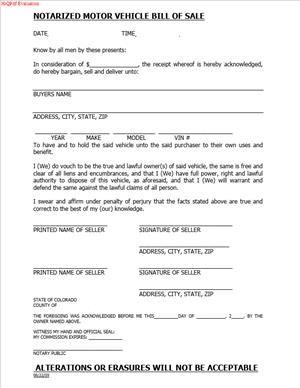
Notarized Motor Vehicle Bill of Sale (Colorado)
Fill out nowJurisdiction: Country: United States | Province or State: Colorado
A Notarized Motor Vehicle Bill of Sale is a written record of a vehicle transfer that is signed in front of a notary public. It documents the details of the sale and confirms the identities of the people involved. In Colorado, it is commonly used when ownership of a car, truck, motorcycle, or other motor vehicle changes hands.
If you are about to fill out this form, you are likely buying or selling a vehicle and want clear proof of the transaction. This document creates a reliable paper trail. It shows what was sold, for how much, and when the transfer happened.
The notarization step adds an extra layer of verification. A notary checks identification and witnesses the signatures. That process helps reduce disputes about whether the agreement was actually signed by the named parties.
This form is often connected to title transfer and registration with the Colorado Department of Revenue – Division of Motor Vehicles. While it does not replace a certificate of title, it supports the ownership record and can help clarify the terms of the sale.
Understanding how the form works before you start writing will help you avoid delays, rejected filings, or confusion later.
What is a Notarized Motor Vehicle Bill of Sale?
Clear definition
A Notarized Motor Vehicle Bill of Sale is a formal document that records the sale of a motor vehicle and includes a notary’s acknowledgment of the signatures. It identifies the buyer, the seller, and the vehicle. It also states the purchase price and the date of the transaction.
Unlike a simple handwritten receipt, this document is signed in the presence of a notary public. The notary confirms the identity of each signer and applies an official seal or stamp. That seal shows that the signatures were verified on a specific date.
In practical terms, it is both a sales agreement and a sworn confirmation that the signatures are genuine.
Who typically uses this form?
Private sellers often use this form when selling a vehicle directly to another individual. This is common in person-to-person transactions rather than dealership sales.
Buyers use it to show proof of purchase. It can help demonstrate the agreed price and the condition of the transfer if questions arise later.
In some situations, family members transferring a vehicle between relatives may also complete this document. Even when money is not exchanged, the form can record the change in ownership.
Lenders, insurers, or government offices may request a notarized bill of sale as supporting documentation during title or registration processes.
Why might you need this form?
You may need this form to support a title transfer. When ownership changes, the state requires accurate records of the transaction. A notarized bill of sale helps confirm that the transfer was voluntary and properly documented.
It can also help establish the purchase price. This information may be used for tax or registration purposes. Having it clearly written reduces misunderstandings.
If a dispute arises about payment, date of sale, or vehicle condition at the time of transfer, the document provides written evidence. Because it is notarized, it carries more weight than an unsigned or informal note.
In situations where the title is incomplete, lost, or delayed, a notarized bill of sale may serve as temporary proof that a sale occurred.
Typical real-life scenarios
- You sell your used car to a neighbor. You both agree on a price and meet to complete the paperwork. You fill out the form together and sign it in front of a notary to confirm the sale.
- You buy a motorcycle from someone you found through a local listing. The seller wants formal proof that you accepted the vehicle in its current condition. The notarized document records the terms and protects both sides.
- You transfer a vehicle to a family member as a gift. Even though no payment is made, the document shows the date of transfer and identifies the vehicle clearly.
- You purchase a vehicle from someone who still owes money on it. The notarized record shows when you took possession and the amount agreed upon, helping clarify the timeline of events.
When would you use a Notarized Motor Vehicle Bill of Sale?
You would use a Notarized Motor Vehicle Bill of Sale at the time of a private vehicle transaction. It is typically completed on or near the date the buyer pays for and receives the vehicle.
The form is useful when both parties want clear documentation beyond the signed title. While the certificate of title transfers legal ownership, the bill of sale explains the financial and factual details of the transaction.
It is often used when the buyer plans to register the vehicle shortly after purchase. The document can accompany other paperwork submitted during the registration process.
Sellers may use it to show that they no longer own or control the vehicle after a specific date. This can be important if traffic violations or other issues arise after the sale.
In situations involving older vehicles, rebuilt vehicles, or vehicles with unusual histories, a notarized bill of sale may help clarify the circumstances of the transfer.
Legal Characteristics of Notarized Motor Vehicle Bill of Sale
A Notarized Motor Vehicle Bill of Sale is generally considered a written contract between the buyer and seller. It contains essential terms such as the identity of the parties, a description of the vehicle, and the purchase price.
For the document to function properly, the information must be accurate and complete. Missing details, incorrect vehicle identification numbers, or unsigned sections commonly cause problems. If signatures are not properly notarized, the document may be rejected for certain administrative purposes.
The notarization confirms that the individuals signing appeared before the notary and presented identification. It does not confirm that the statements in the document are true. It also does not guarantee that the vehicle is free from liens or defects.
Requirements can vary by state. In some states, notarization is optional. In others, it is required for certain types of vehicle transfers. In Colorado, notarization is commonly used to strengthen the reliability of the document, especially in private sales.
This document does not replace the vehicle title. The title is the primary legal proof of ownership. The bill of sale supports the transaction but does not, by itself, transfer title unless accepted as part of a broader legal process.
It also does not provide warranties unless they are clearly written in the text. If the vehicle is sold “as is,” that language typically needs to be stated in the document to reflect the parties’ understanding.
Is it legally binding?
In general, a Notarized Motor Vehicle Bill of Sale is legally binding if it meets basic contract requirements. These include mutual agreement, consideration such as payment, and clear identification of the subject matter.
Once both parties sign in front of a notary, the document becomes strong evidence that an agreement was made. The notarization supports the authenticity of the signatures, which can be important if the agreement is later challenged.
However, the document is only binding to the extent of what it actually says. If certain terms are not included, they are not automatically implied. For example, if no warranty is written, the document may not create one.
If the form contains false information, was signed under pressure, or includes major errors, its enforceability could be questioned. Accuracy and voluntary signing are key factors in whether it will be upheld as valid.
How to fill out a Notarized Motor Vehicle Bill of Sale
Step 1 – Identify the seller and buyer
Start by writing the full legal name of the seller. Include the current residential address as requested on the form. Then enter the full legal name and address of the buyer.
Make sure the names match the identification that will be presented to the notary. Small spelling differences can cause confusion later.
Step 2 – Describe the vehicle in detail
Enter the vehicle’s year, make, and model. Provide the vehicle identification number exactly as it appears on the title or on the vehicle itself.
Include additional details requested on the form, such as body type or color if required. Double-check the VIN carefully. Even one incorrect character can create registration problems.
Step 3 – State the purchase price and date of sale
Write the total amount paid for the vehicle. Record the payment in U.S. dollars unless the form specifies otherwise.
Enter the exact date when the sale takes place. This date should reflect when ownership and possession are transferred. Clear dating helps establish responsibility for the vehicle going forward.
Step 4 – Note any special terms or conditions
If the vehicle is being sold “as is,” include that language in the space provided. If there are specific promises about the vehicle’s condition, those details should be written clearly.
If the sale involves a gift or partial payment, describe that arrangement accurately. The goal is to ensure the written terms match what both parties agreed to verbally.
Step 5 – Review the entire form for accuracy
Before signing, read through every section carefully. Confirm that names, numbers, and vehicle details are correct.
Check that no required fields are left blank. Incomplete forms are a common reason for delays in processing related paperwork.
Step 6 – Sign in front of a notary public
Do not sign the document in advance unless instructed by the notary. Both parties typically need to appear before the notary with valid identification.
Sign the form exactly as your name is printed. The notary will complete the acknowledgment section and apply an official seal or stamp.
Step 7 – Make copies and distribute them
After notarization, make clear copies of the completed document. The buyer and seller should each keep a copy for their records.
Store your copy in a safe place with other vehicle documents. Having it readily available can help if questions arise about the transaction in the future.
Legal terms you might encounter in a Notarized Motor Vehicle Bill of Sale
- Grantor: This is the person transferring ownership of the vehicle. In this document, the grantor is the seller. You will see this term used to identify who is giving up legal rights to the vehicle.
- Grantee: This is the person receiving ownership of the vehicle. In a vehicle sale, the grantee is the buyer. The grantee’s full legal name and address must match their identification.
- Consideration: This means the value exchanged for the vehicle. Usually, it is the purchase price in dollars. The form may use this word to describe the payment the buyer gives to the seller.
- Odometer Disclosure: This is a statement of the vehicle’s mileage at the time of sale. You must enter the exact odometer reading. Providing a false number can create serious legal and financial problems.
- Vehicle Identification Number (VIN): This is the unique 17-character code assigned to the vehicle. The VIN must be copied exactly as it appears on the vehicle and title. Even one wrong character can delay title transfer.
- Lienholder: A lienholder is a lender or other party that has a legal claim against the vehicle, usually because of an unpaid loan. If a lien exists, it must be addressed before clear ownership can transfer.
- Notarial Acknowledgment: This is the section completed by the notary public. It confirms that the people signing the document proved their identities and signed willingly. Without this section properly completed, the document may not be accepted.
- Affiant: An affiant is a person who makes a sworn statement. If the form includes sworn statements about ownership or vehicle condition, the signer making that statement is the affiant.
- Assignment of Title: This refers to the act of transferring ownership from seller to buyer. While the official title document handles the primary transfer, this document supports and confirms that assignment.
FAQs
Does this document replace the vehicle title?
No. This document does not replace the official certificate of title. The title is the primary proof of ownership. This form supports the transaction by documenting the sale terms, purchase price, and notarized signatures. You still need to complete the title assignment to transfer ownership.
What information must match exactly between this form and the title?
The seller’s and buyer’s full legal names must match their identification and the names used on the title. The VIN must be identical on both documents. The purchase date should also be consistent. If details do not align, the transfer may be delayed.
Do both the buyer and seller have to sign in front of the notary?
Yes, both parties typically need to sign in the presence of the notary. The notary verifies identity and confirms that each person signs voluntarily. If one party signs earlier without the notary present, the document may not be accepted.
What date should I enter as the effective date of the sale?
Use the actual date when ownership changes hands and payment is made or agreed upon. This date should reflect when the buyer takes possession. Make sure this date matches the date used on the title assignment and any related paperwork.
What happens if I make a mistake while completing the Notarized Motor Vehicle Bill of Sale?
If you make a mistake before signing, start over with a clean copy. Do not use correction fluid or cross out information, especially in key fields like the VIN or purchase price. If the error is discovered after notarization, you will likely need to complete and notarize a new document.
Do I need to attach anything to this document?
You may need to provide identification to the notary, but that is not attached to this document. In some cases, you might attach a separate odometer disclosure or lien release if not included directly in this form. Make sure any supporting documents use consistent vehicle and party information.
What if the vehicle is a gift and no money is exchanged?
You should clearly state that the vehicle is a gift and list the consideration as zero dollars if required. Be accurate and truthful about the transaction. The document must still include all required vehicle details and be properly notarized.
Will this document become part of the public record?
Information from this document may be used by motor vehicle authorities to process the title transfer. The key details, such as ownership change and vehicle information, can become part of official records. Keep a copy for your files so you know exactly what was reported.
Checklist: Before, During, and After Notarized Motor Vehicle Bill of Sale
Before
- Confirm the vehicle’s VIN by checking the dashboard plate and title.
- Verify that the seller’s name matches the name on the title.
- Make sure any liens are satisfied or have written releases.
- Gather valid government-issued photo identification for both parties.
- Agree in writing on the purchase price and payment method.
- Review the vehicle’s current odometer reading.
- Obtain a blank copy of the correct form.
- Schedule time with a notary public.
During
- Enter the full legal names and addresses of both buyer and seller.
- Carefully write the complete VIN without skipping characters.
- Record the exact odometer reading at the time of sale.
- State the full purchase price or clearly indicate if it is a gift.
- Double-check all numbers for accuracy before signing.
- Sign only in the presence of the notary.
- Ensure the notary completes and stamps the notarial acknowledgment.
- Confirm the date of notarization matches the signing date.
After
- Make at least two copies of the signed and notarized document.
- Provide the buyer with the original if required for title transfer.
- Keep a copy in a secure location with other vehicle records.
- Complete and sign the certificate of title assignment.
- Submit the required documents to the appropriate motor vehicle office.
- Monitor for confirmation that the title transfer is processed.
- Remove license plates if required before handing over the vehicle.
- Notify your insurance company about the sale or purchase.
Common mistakes to avoid with Notarized Motor Vehicle Bill of Sale
- Mistake: Writing the VIN from memory, which happens when parties rush the process; this can lead to rejection of the transfer, so do not forget to copy the VIN directly from the vehicle and title.
- Mistake: Using nicknames instead of full legal names, often because the parties know each other; this can cause record mismatches, so do not forget to use names exactly as shown on official ID.
- Mistake: Signing before meeting the notary, which people do for convenience; this can invalidate the notarization, so do not forget to wait and sign in the notary’s presence.
- Mistake: Leaving the purchase price blank, sometimes to “decide later”; this creates confusion and processing delays, so do not forget to clearly state the agreed amount.
- Mistake: Failing to address an existing lien, often because the seller assumes it is understood; this can block title transfer, so do not forget to obtain written lien releases.
- Mistake: Making handwritten corrections after notarization, usually to fix small errors; this can cause the document to be rejected, so do not forget to complete a new form if changes are needed.
What to do after filling out the Notarized Motor Vehicle Bill of Sale
Once the document is fully completed and notarized, your job is not finished. You still need to make sure the ownership transfer is properly recorded and your personal records are protected.
- Step 1: Make clear, legible copies of the signed and notarized document for both buyer and seller.
- Step 2: Complete the assignment section on the vehicle’s certificate of title so it matches the sale details.
- Step 3: Give the buyer the documents required to apply for a new title, including the signed title and this notarized record.
- Step 4: If you are the buyer, submit the required paperwork to the appropriate motor vehicle office as soon as possible.
- Step 5: Pay any applicable fees and taxes at the time of submission to avoid delays.
- Step 6: Request and keep proof that your application was received and accepted for processing.
- Step 7: If you are the seller, remove your license plates if required and cancel or transfer your registration.
- Step 8: Notify your insurance company immediately if you sold the vehicle, or activate coverage if you purchased it.
- Step 9: Store your copy of the document with other important records, such as tax documents and prior titles.
- Step 10: Check your mail or online account for confirmation that the title transfer has been completed.
If you are the seller, your main goal is to make sure you are no longer legally tied to the vehicle. Keep proof of the sale date and the buyer’s information. This helps protect you if parking tickets, toll charges, or other issues arise after the transfer.
If you are the buyer, your priority is to secure legal ownership in your name. Submit documents promptly. Delays can create complications with registration, insurance, or financing.
Take the time to confirm that all records now reflect the correct owner. A properly completed and notarized document supports a smooth and defensible transfer of ownership.
Disclaimer: This guide is provided for informational purposes only and is not intended as legal advice. You should consult a legal professional.