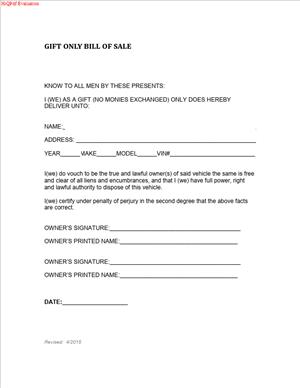
Gift Only Bill of Sale
Fill out nowJurisdiction: Country: United States | Province or State: Colorado
A Gift Only Bill of Sale is a written record showing that you are transferring ownership of property as a gift, not as a sale. No money changes hands. The document confirms that the item is being given voluntarily and accepted without payment.
If you are about to fill out a Gift-Only Bill of Sale, you likely want clarity. You want to know what information belongs on the form and why it matters. You also want to avoid mistakes that could delay registration or cause confusion later.
In Colorado, this form is commonly used for motor vehicles. It helps document that a car, truck, motorcycle, or similar vehicle is being transferred as a gift. The form becomes part of the ownership record.
This document protects both sides. It shows the giver did not receive payment, and the recipient did not buy the property. That distinction can affect taxes, registration fees, and official records.
Understanding each section before you start will make the completion process smoother. The details you include can determine whether the transfer is processed without issue.
What is a Gift Only Bill of Sale?
Clear definition
A Gift Only Bill of Sale is a written statement confirming that ownership of specific property is being transferred as a gift. It identifies the parties involved, describes the item, and states clearly that no payment was made or expected.
Unlike a standard bill of sale, this document does not list a purchase price. Instead, it confirms that the transfer is voluntary and without consideration. “Consideration” is a legal term for something of value exchanged between parties.
The form typically includes names, addresses, signatures, and a detailed description of the item. For vehicles, this often includes the make, model, year, and vehicle identification number. Accuracy in these details is essential because they tie the document to a specific asset.
Who typically uses this form?
Individuals most often use this form when giving a vehicle to a family member or close friend. Parents transferring a car to a child is a common example. Siblings or other relatives may also use it.
It may also be used when someone gives away a vehicle they no longer need. For example, a person may gift an older car instead of selling it.
In many cases, the recipient needs written proof of the gift when applying for title transfer or registration. The Gift Only Bill of Sale becomes part of that paperwork.
Why might you need this form?
You may need this form to document that no sale occurred. This distinction can affect how a government office processes the transfer.
Without written proof, a transfer could appear to be a sale. That may trigger questions about purchase price or required documentation that does not apply to a gift.
The form also creates a clear record between you and the other party. It helps prevent misunderstandings about whether money was expected or promised.
If the property is a motor vehicle, the form often supports the title transfer process. It connects the giver, the recipient, and the vehicle in a single written record.
Typical real-life scenarios
- A parent gives a used car to a teenager who has just received a driver’s license. The parent signs over the title and completes a Gift Only Bill of Sale to confirm the transfer was a gift. The child then uses that paperwork to complete the registration process.
- A grandparent no longer drives and decides to give a vehicle to a grandchild. The document helps show that the transfer was not a sale and that no purchase price applies.
- After moving to a new city, someone gives an extra vehicle to a sibling instead of selling it. The form provides a clear record of when ownership changed and who accepted the gift.
- A person donates a vehicle to an individual rather than an organization. The Gift Only Bill of Sale clarifies that the transfer was voluntary and without payment.
- In each of these situations, the document serves as written proof. It supports official filings and reduces the risk of later disputes.
When would you use a Gift Only Bill of Sale?
You use this form at the time ownership is transferred as a gift. It is completed when the giver and recipient agree that no money will be exchanged and the item will change hands.
For motor vehicles in Colorado, this often happens alongside the title endorsement. The title shows the legal transfer of ownership, while the Gift Only Bill of Sale explains the nature of the transfer.
The giver fills out the relevant information and signs the document. The recipient also signs to confirm acceptance. Both parties typically keep a copy for their records.
You may use this form when preparing other paperwork required for registration. It can accompany a title application and other required documents during submission to the appropriate office.
Timing matters. The form is usually completed at or near the date the vehicle is delivered to the recipient. This helps align the written record with the actual transfer.
The document can also be useful if questions arise later about when ownership changed. The date on the form can help establish a clear timeline.
Legal characteristics of Gift Only Bill of Sale
A Gift Only Bill of Sale is generally effective when it clearly identifies the parties, describes the property in detail, and states that the transfer is a gift. Signatures and dates strengthen the document by showing agreement and timing.
Clarity is critical. Incomplete names, incorrect vehicle identification numbers, or missing signatures can create problems. Errors may delay processing or require correction before the transfer is accepted.
The description of the vehicle must match other official documents. If the make, model, or VIN differs from the title, the discrepancy can raise concerns. Consistency across documents supports smoother completion of the process.
In some situations, additional formalities may apply. For example, certain forms may require notarization. Requirements can vary depending on the type of property and the agency handling the filing.
This document does not replace a certificate of title. For vehicles, the title remains the primary proof of ownership. The Gift Only Bill of Sale supports the transfer but does not, by itself, establish legal ownership without proper title endorsement.
It also does not guarantee that the vehicle is free of liens or other claims. If a lender has an interest in the vehicle, that issue must be addressed separately. The form simply records the nature of the transfer between the named parties.
The document does not set warranties or promises about the condition unless specific language is added. In most cases, a gifted vehicle is transferred in its current condition, without additional guarantees.
Is it legally binding?
In general, a Gift Only Bill of Sale can be legally binding when it reflects a clear intention to give, acceptance by the recipient, and delivery of the property. The written and signed document serves as evidence of that intent.
A gift typically requires three elements: intent to give, delivery of the item, and acceptance by the recipient. The form supports these elements by recording them in writing.
If both parties sign and the vehicle is delivered, the document can serve as proof of the completed gift. Courts and agencies often rely on written, signed records when determining what occurred.
However, the document’s enforceability may depend on accurate information and compliance with any applicable procedural requirements. Missing details or improper execution can weaken its usefulness.
The form confirms the transfer between the parties. It does not resolve unrelated disputes or override separate legal obligations tied to the vehicle.
How to fill out Gift Only Bill of Sale
Step 1 – Title of the Document
At the top of the form, confirm that the document is labeled as a Gift Only Bill of Sale. The title signals that the transfer is a gift, not a sale. Make sure you are using the correct form associated with motor vehicle transfers.
Step 2 – Date of Transfer
Enter the exact date when the gift is made. This is usually the date the vehicle is delivered, or ownership changes hands. Use a clear format with month, day, and year to avoid confusion.
Step 3 – Giver’s Full Legal Name and Address
Write the full legal name of the person giving the vehicle. Include the current residential address. The name should match the name shown on the vehicle title to avoid discrepancies.
Step 4 – Recipient’s Full Legal Name and Address
Enter the full legal name of the person receiving the gift. Provide the complete residential address. This information links the vehicle to the new owner for registration and title purposes.
Step 5 – Vehicle Description
Provide a detailed description of the vehicle. Include the year, make, model, body type, and color if requested. Most importantly, enter the complete vehicle identification number exactly as it appears on the title and the vehicle itself.
Step 6 – Odometer Reading if Required
If the form includes a section for odometer disclosure, record the current mileage accurately. Write the number as it appears on the odometer at the time of transfer. Do not round or estimate.
Step 7 – Statement of Gift
Review the section stating that the vehicle is being transferred as a gift with no payment or consideration. Ensure the wording clearly reflects that no money is exchanged. Confirm that both parties understand this statement before signing.
Step 8 – Signatures of the Parties
The giver signs and dates the form in the designated space. The recipient also signs and dates to confirm acceptance of the gift. Use consistent signatures that match other official documents.
Step 9 – Notarization if Applicable
If the form includes a notary section, do not sign until you are in the presence of a notary. The notary will verify identity and complete the acknowledgment. Ensure all required fields are filled before presenting the form for notarization.
Legal terms you might encounter in Gift Only Bill of Sale
- Donor: The donor is the person giving the vehicle as a gift. This is the current legal owner listed on the title. On this document, the donor’s full legal name and address must match the title to avoid delays when the recipient registers the vehicle.
- Donee: The donee is the person receiving the vehicle. This individual becomes the new owner once the transfer is completed. Their full legal name and residential address must be written clearly so the motor vehicle department can issue a new title in their name.
- Consideration: Consideration usually means something of value exchanged in a contract. In a gift transfer, the consideration is stated as zero dollars. This document makes it clear that no money or other payment is involved.
- Vehicle Identification Number (VIN): The VIN is a unique 17-character number assigned to the vehicle. You must copy it exactly as it appears on the title and on the vehicle itself. Even one incorrect character can cause registration problems.
- Odometer Disclosure: This is a written statement of the vehicle’s mileage at the time of transfer. For certain vehicles, you must record the exact mileage shown on the dashboard. Inaccurate mileage can create legal issues and delay title processing.
- Title Transfer: Title transfer is the legal process of changing ownership from the donor to the donee. This document supports that process by documenting the gift. It does not replace the certificate of title but works alongside it.
- Affidavit: An affidavit is a written statement confirmed as true by signing it. When you sign this document, you are declaring that the vehicle is truly a gift and that the information provided is accurate.
- Lien: A lien is a legal claim against the vehicle, usually by a lender. If there is an active lien, the donor cannot freely transfer ownership. The lien must be satisfied or properly addressed before the transfer can be completed.
- Notarization: Notarization means a notary public verifies the identity of the signer and witnesses the signature. Some transfers require notarized signatures. If notarization is needed and missing, the motor vehicle department may reject the paperwork.
FAQs
Does this document replace the vehicle title?
No. This document supports the transfer, but it does not replace the certificate of title. You still need the properly assigned title signed by the current owner. The motor vehicle department uses both documents together to update ownership records.
What date should I list as the date of transfer?
You should list the actual date when ownership changes hands. This is usually the day you sign and deliver the vehicle and title. Make sure the date on this document matches the date written on the title to avoid questions during processing.
Do both parties have to sign the Gift Only Bill of Sale?
In most cases, the donor must sign because they are transferring ownership. It is also wise for the recipient to sign to confirm acceptance of the gift and the details listed. Check the signature lines carefully and do not leave any required signature blank.
What if the name on this form does not exactly match the name on the title?
The names should match exactly, including middle initials or suffixes. If they do not match, the motor vehicle department may refuse to process the transfer. Review the title before completing this document and copy the name precisely as shown.
Do I need to include the odometer reading?
If the vehicle qualifies for mileage disclosure, you must record the exact mileage at the time of transfer. Write the number exactly as shown on the dashboard. Do not estimate or round up, because incorrect mileage can cause rejection or future disputes.
Can I use this form if there is still a loan on the vehicle?
You generally cannot complete a valid transfer if there is an active lien. The lender has a legal interest in the vehicle. Make sure the lien is released and documented before using this form to transfer ownership.
What happens after I submit the Gift Only Bill of Sale?
The motor vehicle department reviews the paperwork along with the signed title and any required applications. If everything is complete and accurate, they issue a new title in the recipient’s name. If something is missing or inconsistent, they may return the documents for correction.
Will this document affect taxes or fees?
Even though the transfer is a gift, certain fees may still apply when the new owner registers the vehicle. The document shows that no purchase price was paid. This helps the agency determine how to process the transaction under its rules.
Checklist: Before, During, and After Gift Only Bill of Sale
Before
- Confirm you are the legal owner listed on the certificate of title.
- Check whether there is any active lien on the vehicle.
- Locate the vehicle’s VIN on both the title and the vehicle itself.
- Review the title for the exact spelling of all names.
- Verify whether an odometer disclosure is required.
- Confirm whether notarization will be needed.
- Gather the recipient’s full legal name and current address.
- Make sure the vehicle description matches the title exactly.
During
- Write the full legal names of both donor and donee clearly.
- Enter the complete and accurate vehicle description.
- Copy the VIN carefully, character by character.
- Record the exact odometer reading if required.
- State clearly that the transfer is a gift with no payment.
- Double-check the date of transfer for accuracy.
- Review the document for blanks before signing.
- Sign in the correct place and in ink.
- Have signatures notarized if required.
After
- Make at least two copies of the signed document.
- Provide the original to the recipient if they are registering the vehicle.
- Complete the assignment section on the certificate of title.
- Submit the required documents to the motor vehicle department.
- Pay any applicable registration or title fees.
- Confirm that the new title is issued in the recipient’s name.
- Keep a copy with your personal records.
- Remove or transfer license plates if required.
- Update your insurance to reflect that you no longer own the vehicle.
Common mistakes to avoid with Gift Only Bill of Sale
- Mistake: Misspelling names or using nicknames because you are in a hurry, which leads to rejection by the motor vehicle department and delays in title transfer, so do not forget to copy names exactly as they appear on the title.
- Mistake: Writing an incorrect VIN due to a simple typing error, which can invalidate the document and prevent registration, so do not forget to double-check every character against the title and the vehicle.
- Mistake: Leaving the odometer section blank when it is required, which can cause processing delays or legal concerns about mileage accuracy, so do not forget to confirm whether disclosure applies to your vehicle.
- Mistake: Failing to address an existing lien because you assumed a gift avoids loan issues, which can block the transfer entirely, so do not forget to obtain a proper lien release first.
- Mistake: Using different transfer dates on the title and this document because you signed them on different days, which creates confusion about when ownership changed, so do not forget to align all dates.
- Mistake: Forgetting to make copies before submitting paperwork, which leaves you without proof of the transaction if questions arise, so do not forget to keep a signed copy for your records.
- Mistake: Skipping notarization when it is required because you did not check the instructions, which can result in rejected paperwork, so do not forget to verify signature requirements in advance.
- Mistake: Assuming no fees apply because it is a gift, which can cause surprise costs and delays at registration, so do not forget to prepare for standard title and registration fees.
What to do after filling out the Gift Only Bill of Sale
Once you complete the document, your next steps focus on making the transfer official and protecting yourself from future issues.
Start by reviewing everything one more time. Look at names, VIN, dates, and signatures. Small errors can cause big delays.
- Step 1: Make at least two clear copies of the signed document.
- Step 2: Complete the assignment section on the back of the certificate of title.
- Step 3: Ensure any required odometer disclosure is properly recorded on the title or attached document.
- Step 4: Confirm that any lien has been officially released in writing.
- Step 5: Provide the recipient with the signed title and the original bill of sale.
- Step 6: Submit the required paperwork to the motor vehicle department if you are responsible for filing.
- Step 7: Pay any title transfer and registration fees that apply.
- Step 8: Wait for confirmation that the new title has been issued in the recipient’s name.
- Step 9: Remove your license plates if they are not staying with the vehicle.
- Step 10: Notify your insurance company that you no longer own the vehicle.
Keep your copy of the document in a safe place. Store it with other important records related to the vehicle. If questions come up later about when ownership changed, you will have written proof.
You should also check your personal records. If you listed the vehicle in any financial documents or internal inventories, update them. If the vehicle was insured under your policy, confirm that coverage has ended or been transferred appropriately.
If you receive any notices about the vehicle after the transfer date, respond promptly and keep a record of your communication. Your copy of the completed document will help show that you no longer own the vehicle as of the date listed.
Disclaimer: This guide is provided for informational purposes only and is not intended as legal advice. You should consult a legal professional.