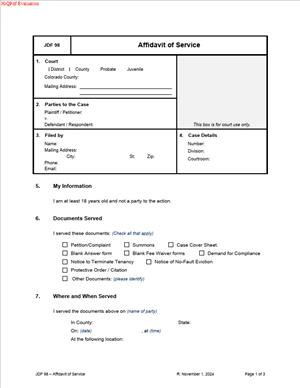
JDF 98 – Affidavit of Service
Fill out nowJurisdiction: Country: United States | Province or State: Colorado
JDF 98 – Affidavit of Service is a court form used to prove that legal documents were properly delivered to another party. When you file papers in a case, the court usually requires proof that the other side received them. This form creates that proof.
If you are representing yourself, this document can feel technical. In reality, it serves a simple purpose. It tells the court who was served, how they were served, when service happened, and who completed the service.
You do not use this form to argue your case. You use it to document a step in the process. Without proper service, a judge may not consider your filing.
Understanding how this form works helps you avoid delays. When completed clearly and accurately, it supports the progress of your case.
What is JDF 98 – Affidavit of Service?
Clear definition
JDF 98 – Affidavit of Service is a sworn written statement confirming that court documents were delivered to another party in a case. It is filed with the court as proof that service occurred.
An affidavit is a statement made under oath. By signing this form, the person completing it confirms that the information is true to the best of their knowledge. This adds legal weight to the document.
The form does not replace the original papers you served. Instead, it verifies that those papers were properly provided to the correct person using an accepted method.
In short, this document connects the act of service to the official court record.
Who typically uses this form?
This form is commonly used by individuals involved in civil, family, or other court proceedings. That includes people filing for divorce, custody changes, protection orders, eviction matters, or civil claims.
Often, the person who actually delivers the documents completes the form. That may be a private individual, a professional process server, or another qualified adult.
If you are representing yourself, you may encounter this form more than once during your case. Each time you are required to serve documents, the court may require a completed affidavit of service.
Court clerks and judges rely on this form to confirm that both sides have notice of the proceedings.
Why might you need this form?
Courts generally require proof that all parties received notice of filings and hearings. This ensures fairness. Everyone must have an opportunity to respond.
You may need this form when you start a case. For example, after filing a petition or complaint, the other party usually must be formally served.
You may also need it later in the case. Motions, amended pleadings, or other important filings often require service.
Without this document in the court file, your case could be delayed. In some situations, a hearing may be rescheduled if proof of service is missing.
Typical real-life scenarios
- You file a petition to modify child support. After filing, you arrange for the other parent to receive copies of the documents. The person who delivers them completes this form to confirm delivery.
- You submit a motion asking the court to change a prior order. You send a copy to the opposing party by mail. The person who mailed the documents signs the affidavit stating the date and address used.
- You are involved in a small claims dispute. After filing your claim, you arrange personal service on the defendant. The individual who served the papers signs the form to confirm where and when service occurred.
- You are part of a civil lawsuit involving property damage. During the case, you file additional documents that must be served. Each time, the person completing service documents the details using this form.
- In each of these situations, the form does not argue the facts of the dispute. It simply records that the required notice was given.
When would you use JDF 98 – Affidavit of Service?
You use this form any time the court requires proof that documents were delivered to another party. This commonly occurs at the beginning of a case, when the first set of papers must be formally served.
It may also be used after motions are filed. If you request a hearing or ask the court for a new order, the other party typically must receive copies. The affidavit documents that step.
The timing of service often matters. Some filings must be served a certain number of days before a hearing. The date written on the form can affect whether the court considers your request timely.
Different roles may be involved in service. The filer prepares the documents. A separate adult may deliver them. That person completes the affidavit. In some situations, professionals handle service regularly. In others, a qualified private individual may do so.
You generally do not use this form if the court automatically sends notice itself. In cases where the clerk handles service, a separate affidavit may not be required. The need for the form depends on the type of document and the stage of the case.
Whenever proof of service is required, this document becomes part of the official court record.
Legal characteristics of JDF 98 – Affidavit of Service
This form is effective because it is a sworn statement. The person signing it confirms under oath that service occurred as described. Courts rely on sworn statements when making procedural decisions.
For the form to be accepted, it typically must include accurate names, correct case information, and complete service details. Missing dates, incorrect addresses, or unsigned affidavits often cause problems.
Clarity matters. The method of service must be clearly stated. If the service was by personal delivery, the form should reflect that. If it were by mail, the mailing details must be clear. Ambiguity can raise questions about whether proper notice was given.
The person completing the form usually cannot be a party to the case when personal service is required. Service rules commonly require a neutral adult. If the wrong person performs the service, the court may not recognize it.
This form does not prove that the recipient read the documents. It only proves that the documents were delivered using an accepted method. Refusal to accept papers may still count as service, depending on the circumstances.
High-level differences may exist between types of cases. Some matters require personal service. Others may allow service by mail or other approved methods. The affidavit reflects whichever method was used.
The form does not create rights or obligations by itself. It does not decide your case. It simply confirms that a procedural requirement was completed.
Is it legally binding?
The affidavit is legally significant because it is sworn under oath. By signing it, the person affirms that the statements are true. False information can carry serious consequences.
However, the form does not bind the parties to any agreement. It does not function like a contract. Its purpose is evidentiary, not transactional.
If the court accepts the affidavit, it generally treats service as complete. This can trigger deadlines for the other party to respond. In that sense, the form can affect the timeline of a case.
If the affidavit is incomplete or inaccurate, the court may find that service was not properly accomplished. That can delay proceedings or require service to be repeated.
The legal effect depends on whether the information is accurate and whether the service followed applicable procedural rules. When properly completed and filed, it supports the validity of the service step in your case.
How to fill out JDF 98 – Affidavit of Service
Step 1 – Identify the court and case information
At the top of the form, enter the court name, county, and case number exactly as they appear on your other court documents. Include the names of the parties in the correct order. This connects the affidavit to the correct case file.
Step 2 – Identify the person served
Provide the full name of the person who received the documents. Use the same name listed in the case caption. Accuracy is important to avoid confusion about who was served.
Step 3 – Describe the documents served
List the specific documents that were delivered. Use the exact titles of the filings, such as petition, motion, or notice of hearing. This shows the court precisely what was provided.
Step 4 – State the method of service
Indicate how the documents were delivered. This may include personal delivery, mail, or another approved method. Be clear and consistent with what actually occurred.
Step 5 – Provide the date and location of service
Enter the exact date the service took place. If required, include the address or location where delivery occurred. These details help confirm that the service met timing requirements.
Step 6 – Identify the person who completed the service
Write the full name of the individual who delivered or mailed the documents. Include any additional identifying information requested on the form, such as an address or contact details.
Step 7 – Sign the affidavit under oath
The person who completed the service signs the form, affirming that the information is true. Follow any instructions on the form regarding notarization or declaration language. The signature finalizes the sworn statement.
Step 8 – File the completed form with the court
Once signed, submit the completed affidavit to the court clerk for filing in the case. Ensure it is attached or associated with the correct case number. After filing, it becomes part of the official court record.
Legal terms you might encounter in JDF 98 – Affidavit of Service
- Affidavit: A written statement made under oath. When you sign this document, you are swearing that the information about how the service was completed is true. Giving false information in an affidavit can lead to serious consequences because it is treated as sworn testimony.
- Service of Process: The formal delivery of court papers to another party. This document records how that delivery happened. The court relies on this proof to confirm that the other side received proper notice.
- Personal Service: A method of service where the documents are handed directly to the person being served. On this form, you must state if the papers were delivered directly and identify who received them. Personal service often requires specific details about the time and place.
- Substituted Service: A method where the documents are left with someone else at the recipient’s home or workplace, if allowed. This form may require you to describe who accepted the documents and their relationship to the intended recipient. Clear details help the court decide if the service meets legal standards.
- Certified Mail: A mailing method that provides proof of mailing and delivery. If the service was completed by certified mail, you may need to include tracking information or attach a receipt. This document records that the mailing was completed and when.
- Return of Service: Another name sometimes used for proof that service was completed. This form serves as the official return of service in many cases. Once filed, it becomes part of the court record.
- Case Caption: The section at the top of the document listing the court, the parties, and the case number. You must copy this information exactly as it appears on your other court papers. Any mismatch can delay processing.
- Declarant: The person who signs the affidavit. This is usually the person who actually delivered or mailed the documents. The declarant must have firsthand knowledge of how the service was completed.
- Notary Public: An official who verifies the identity of the person signing the affidavit. If notarization is required, you must sign in front of the notary. The notary adds a seal or stamp confirming that you swore to the truth of the statement.
- Proof of Service Date: The date the documents were actually delivered or mailed. This date is critical because court deadlines are often calculated from it. You must record it accurately and consistently throughout the form.
FAQs
Who is allowed to complete and sign this form?
The person who actually served the documents must complete and sign this document. That person cannot usually be a party to the case. The signer must have firsthand knowledge of when, where, and how the papers were delivered and must be able to swear that the information is true.
Do I need to file JDF 98 – Affidavit of Service right away after service?
You should file it as soon as possible after service is completed. The court often will not move your case forward until proof of service is in the file. Check that the service date listed on the document matches your records before submitting it.
What information about the person served do I need to include?
You must include the full legal name exactly as it appears in the case caption. If you served someone at a home or workplace, include the full address where the service occurred. Make sure the name and address on this document match the summons or motion you served.
What if the person refused to take the papers?
If the server personally identified the person and clearly informed them of the nature of the documents, refusal to physically accept them may still count as service. The server should describe what happened in clear detail. This form should explain that the papers were offered and refused, along with the date, time, and location.
Do I need to attach receipts or proof of mailing?
If the service was done by certified or registered mail, attach any tracking confirmation or signed receipt you received. Make sure the tracking number and delivery date match what you wrote on this document. Incomplete attachments can lead to rejection or delay.
What happens after I file this form with the court?
Once filed, this document becomes part of the official court record. The judge may review it to confirm that proper notice was given. Court deadlines for the other party often begin running from the service date you listed.
Can I correct a mistake after I sign and file it?
If you notice an error, you may need to complete a corrected affidavit. Do not simply cross out information after filing. A corrected version should clearly state accurate details and may need to be refiled and, in some cases, re-notarized.
Will the court notify the other party after I file JDF 98 – Affidavit of Service?
No. This form only proves that you already delivered the documents. Filing it does not replace service, and the court does not send additional notice based solely on this filing.
Checklist: Before, During, and After JDF 98 – Affidavit of Service
Before
- Confirm that the service has actually been completed according to the required method.
- Verify the full legal names of all parties from the case caption.
- Double-check the correct case number and court location.
- Gather mailing receipts, tracking confirmations, or notes from the server.
- Confirm that the person who will sign is not a party to the case.
- Review any deadlines that depend on the service date.
- Make sure you have a blank, current version of the form.
During
- Enter the court name and case number exactly as shown on your other filings.
- Clearly identify the person who was served.
- Write the full address where the service took place.
- State the exact date and, if required, time of service.
- Select and complete the correct method of service.
- Attach any required proof of mailing or delivery.
- Ensure the declarant reviews all information for accuracy.
- Sign in front of a notary if notarization is required.
After
- Make at least one copy of the completed form for your records.
- File the original with the court clerk using the accepted method.
- Confirm the filing was accepted and date-stamped.
- Check the case docket to ensure the document appears in the record.
- Calendar any response deadlines triggered by the service.
- Store receipts and attachments with your case file.
- Bring a copy to your next court appearance if applicable.
Common mistakes to avoid with JDF 98 – Affidavit of Service
- Mistake: Letting a party to the case complete service because it seems easier, which happens when people try to save time, but this can invalidate service and delay your case; do not forget that the server must generally be a non-party adult.
- Mistake: Entering the wrong case number or misspelling a party’s name, which often happens when copying from memory, and this can cause filing rejection or confusion in the record; do not forget to copy the caption exactly.
- Mistake: Listing the date you filled out the form instead of the actual service date, which happens when completing paperwork later, and this can affect deadlines and court calculations; do not forget to record the true delivery or mailing date.
- Mistake: Failing to attach certified mail receipts or proof of delivery, which occurs when paperwork is separated, and this may lead the court to question whether service was completed; do not forget to staple or upload all supporting documents.
- Mistake: Signing without notarization when notarization is required, which happens when you overlook signature instructions, and this can cause rejection by the clerk; do not forget to sign in front of the proper official if required.
- Mistake: Providing vague details like “served at home” without a full address, which happens when rushing, and this may make the proof insufficient; do not forget to include the complete street address and location details.
- Mistake: Altering the form after signing, which happens when you notice a typo, and this can undermine credibility or require refilling; do not forget to complete a clean, corrected version if changes are needed.
- Mistake: Waiting too long to file after service, which happens when focusing on other steps, and this can delay court action; do not forget to submit the affidavit promptly.
What to do after filling out JDF 98 – Affidavit of Service
After you complete and sign the form, slow down and review every entry. Make sure the service date, address, and method match your notes and any receipts. Small inconsistencies can create unnecessary questions from the court.
Next, organize your paperwork. Attach all supporting documents, such as mailing confirmations or signed receipts. Arrange them in a logical order so the clerk or judge can easily follow what happened.
- Step 1: Make at least two copies of the completed and signed form, including attachments.
- Step 2: Keep one complete copy in your personal case file.
- Step 3: File the original with the court using the approved filing method.
- Step 4: If filing in person, ask the clerk to stamp your copy as “filed” for proof.
- Step 5: If filing electronically, download and save the confirmation notice.
- Step 6: Check the court docket within a few days to confirm it appears in the case record.
- Step 7: Mark your calendar with any response deadlines that start from the service date.
- Step 8: Prepare for the next stage of your case, such as waiting for a response or requesting a hearing.
- Step 9: Bring a filed copy with you to any scheduled court appearance.
- Step 10: Update your internal notes so your timeline clearly shows when and how the service was completed.
Keep your documents organized in one place. Courts often ask when the service occurred and how it was completed. Having your affidavit and attachments readily available makes it easier to answer questions confidently.
If the court rejects the filing for a technical reason, correct the issue immediately. Review the reason carefully. Submit a corrected version with complete and accurate details. Acting quickly prevents unnecessary delay in moving your case forward.
Disclaimer: This guide is provided for informational purposes only and is not intended as legal advice. You should consult a legal professional.