JDF 70 – Certificate of Service
Fill out nowJurisdiction: Country: United States | Province or State: Colorado
The JDF 70 – Certificate of Service is a court form used in Colorado to confirm that you delivered legal documents to the other party in your case. When you file something with the court, you are usually required to provide proof that the other side received a copy. This form creates that proof in writing.
If you are representing yourself, this form becomes especially important. Courts expect both sides to know what documents are being filed. The JDF 70 – Certificate of Service shows the court that you followed the basic rule of fairness.
You use this form after you have served documents, not before. It does not deliver the papers for you. Instead, it records when, how, and to whom you sent them.
Without this form, your filing may be delayed or rejected. Judges and clerks rely on it to confirm that proper notice was given. That is why understanding how it works can help your case move forward smoothly.
What is JDF 70 – Certificate of Service?
Clear definition
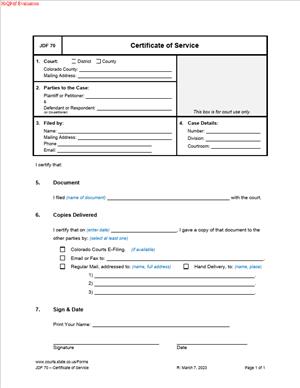
JDF 70 – Certificate of Service is a written statement filed with the Colorado court system confirming that you served copies of your legal documents on the other party or their attorney. It identifies the document you sent, the date you sent it, and the method you used to send it.
This form is not the main motion, response, or request in your case. It is a supporting document. Its purpose is to create a record showing that notice was provided.
When you sign the form, you are stating that the information is true. The court relies on your signature as confirmation that service occurred as described.
Who typically uses this form?
Self-represented individuals frequently use this form when filing motions, responses, or other papers in civil, family, or other court matters. If you do not have an attorney, you are usually responsible for completing and filing your own certificate of service.
Attorneys also use certificates of service. In many cases, the requirement applies to both sides equally. Anyone who files a document that must be shared with another party may need to complete this form.
It may be used in cases involving divorce, custody, child support, eviction, small claims, probate matters, and other court proceedings where documents must be exchanged between parties.
Why might you need this form?
Courts require that each party receive notice of filings that could affect their rights. The JDF 70 – Certificate of Service helps demonstrate that you met that requirement.
If you file a motion asking the court to take action, the other side must usually be informed. The certificate provides written proof that you sent them a copy.
Clerks may look for this form before accepting or processing your filing. If it is missing, your document may not move forward in the way you expect.
The form also protects you. If someone later claims they did not receive your document, the certificate creates a record of the date and method of delivery.
Typical real-life scenarios
- You file a motion to modify child support. After filing, you mail a copy of the motion to the other parent. You complete the certificate to confirm the mailing and file it with the court.
- You respond to a motion filed by the other party. You email or mail your response to their attorney. You then submit the certificate stating the date and method of service.
- You submit updated financial documents in a divorce case. Because these documents may affect court decisions, you provide copies to the other side and document that service using the form.
- You file a written request for a hearing. The court needs proof that the other party knows about your request. The certificate records how and when you gave notice.
When would you use JDF 70 – Certificate of Service?
You generally use this form after you have served documents that are required to be shared with another party. This often happens each time you file a motion, response, notice, or supporting document during an active case.
In many cases, service requirements begin after the initial complaint or petition has been properly served. Later filings between parties are typically handled by mail, electronic service, or other permitted methods. The certificate records those later exchanges.
If the other party has an attorney, service is often made on the attorney rather than directly on the party. The form allows you to state who received the documents and how they were delivered.
You may also use the form when sending documents to multiple parties. For example, if more than one person is involved in the case, you can indicate that each person or attorney received a copy.
If the court sets deadlines for responses, proof of service can affect those deadlines. The date listed on your certificate may become part of the court’s timeline for the case.
Legal characteristics of JDF 70 – Certificate of Service
The JDF 70 – Certificate of Service is effective when it clearly identifies the document served, the date of service, the method used, and the person served. Your signature confirms that the statement is accurate.
Clarity and completeness matter. Missing dates, incorrect names, or unclear methods of service can cause confusion. In some situations, the court may require correction before proceeding.
The form does not replace proper service itself. If the underlying method of service does not meet court rules, the certificate alone does not fix that problem. It only reports what was done.
Different types of cases may have different service rules. For example, the initial service of a case often requires more formal methods than later filings. The certificate is commonly used for subsequent filings, not the first service of a summons and complaint.
The form does not argue your position or request relief from the court. It does not contain evidence about the facts of your case. Its sole function is to document the delivery of documents.
Is it legally binding?
The JDF 70 – Certificate of Service becomes part of the official court record once filed. By signing it, you are making a formal statement to the court. Courts treat signed statements seriously.
It does not create a contract between you and the other party. Instead, it serves as a sworn or affirmed representation that service occurred as described. Providing false information can lead to consequences within the court process.
Its legal effect is procedural. It supports the validity of your filing by showing that notice requirements were met. Without proper service, a court may decline to consider a motion or may delay action.
How to fill out JDF 70 – Certificate of Service
Step 1 – Enter the court information
At the top of the form, fill in the name of the court where your case is filed. Include the county and any identifying court location information shown on your other case documents. This ensures the certificate is connected to the correct court.
Step 2 – Add the case details
Write the full names of the parties exactly as they appear in your case caption. Include the case number assigned by the court. Accuracy here is important because the certificate must match the underlying filing.
Step 3 – Identify the document you served
Clearly state the name of the document or documents you delivered. Use the same title that appears on the filing itself. If you served more than one document at the same time, list each one so the record is complete.
Step 4 – State the date of service
Enter the exact date on which you mailed, delivered, or electronically transmitted the documents. This date establishes the timeline for notice and any related response deadlines.
Step 5 – Describe the method of service
Indicate how the documents were sent. This may include mail, hand delivery, electronic service, or another permitted method. Be specific so the court understands how the service was completed.
Step 6 – Provide the recipient’s information
List the name of each person or attorney who received the documents. Include their address or contact information as required by the form. If there are multiple recipients, make sure each is identified clearly.
Step 7 – Sign and date the form
Sign your name in the space provided and enter the date you are signing. Your signature confirms that the information in the certificate is true and correct to the best of your knowledge.
Step 8 – File the certificate with the court
Submit the completed form along with or after your main filing, depending on how your documents are being processed. Once filed, it becomes part of the official case record and serves as proof that service occurred.
Legal terms you might encounter in JDF 70 – Certificate of Service
- Service of Process: This refers to delivering court documents to another party in a case. On this form, you confirm that you served a specific document and explain how you delivered it. It creates a written record that the other side received notice.
- Certificate of Service: This is the written statement you complete to prove you served documents. JDF 70 – Certificate of Service is that statement. It tells the court who was served, when, and how.
- Party: A party is a person or entity directly involved in the case, such as a petitioner, respondent, plaintiff, or defendant. In this document, you list the party or parties who received the papers. You must use the exact names shown in the case caption.
- Attorney of Record: This is the lawyer officially representing a party in the case. If a party has an attorney of record, you typically serve the attorney instead of the party. You must use the attorney’s correct name and address as it appears in court filings.
- Method of Service: This describes how you delivered the document. Common methods include hand delivery, mail, or electronic service if allowed. You must clearly check or state the method you used because different methods may have different timing rules.
- Date of Service: This is the exact date you delivered or sent the document. It may affect deadlines in this case. The court relies on this date to determine when response periods begin.
- Electronic Service (E-Service): This means sending documents electronically through an approved system or by email, if permitted. If you use this method, you must confirm it complies with court rules. You then state that method clearly on the form.
- Proof of Service: This is the evidence that service occurred. The completed and signed certificate acts as proof of service. Without it, the court may not recognize that notice was properly given.
- Case Caption: The caption appears at the top of court documents and includes the court name, case number, and party names. You must copy this information exactly onto the certificate. Any mismatch can cause confusion or rejection.
- Signature Under Penalty of Perjury: When you sign, you declare that the information is true. This carries legal weight. Providing false information can lead to serious consequences.
FAQs
Do I need to file JDF 70 – Certificate of Service every time I send something to the other side?
Yes, in most situations, you should complete and file this form each time you serve a court document. The court needs written confirmation that the other party received notice. If you do not file it, the judge may assume service did not happen. That can delay your case or prevent the court from acting on your request.
What exact date should I write as the date of service?
Write the actual calendar date when you mailed, hand-delivered, or electronically sent the document. If you mailed it, use the date you placed it in the mail, not the date it was received. If you delivered it in person, use the day you handed it over. This date may affect the other party’s deadline to respond, so double-check it before signing.
Do I serve the party directly or their lawyer?
Look at the most recent filings in your case. If the other side has an attorney of record, you usually serve the attorney, not the party. Use the attorney’s name and address exactly as shown in the case file. If there is no attorney listed, then you serve the party at their last known address.
What happens if I use the wrong address on this document?
If you list the wrong address, the service may be considered invalid. That means the other party could argue they never received proper notice. The court may require you to serve the documents again and file a new certificate. Always confirm the address from the most recent court filing before completing this form.
Can I sign this form if someone else mailed the documents for me?
You should only sign if you have personal knowledge of how and when the documents were served. If someone else handled the service, that person may need to complete and sign the certificate. The signature confirms that the information is accurate. Do not sign unless you are certain the details are correct.
Do I attach proof like a mail receipt or email confirmation?
In most cases, you are not required to attach receipts to this document. Your signed statement acts as proof of service. However, you should keep any receipts, tracking confirmations, or email records for your own files in case the court asks for additional proof later.
What if I realize I made a mistake after filing the certificate?
If you notice an error, act quickly. You may need to complete a corrected certificate with accurate information and file it with the court. Make sure the corrected version clearly reflects the true date, method, and recipient. Do not ignore the mistake, because inaccurate service information can affect court deadlines.
Does this form change anything in the public record of my case?
This document does not change your claims, defenses, or requests. It simply updates the case record to show that notice was provided. Once filed, it becomes part of the court file. Anyone reviewing the file will see when and how the service was completed.
Checklist: Before, During, and After JDF 70 – Certificate of Service
Before
- Confirm the full and correct title of the document you are serving.
- Verify the case caption matches the court’s records exactly.
- Check whether the other party has an attorney of record.
- Confirm the correct mailing or email address for service.
- Review court rules to ensure your chosen method of service is allowed.
- Make copies of the document you plan to serve.
- Decide how you will document the date and method of service for your records.
During
- Complete the court name, case number, and party names exactly as shown on prior filings.
- Clearly identify the specific document you are serving.
- Write the exact calendar date you mailed, delivered, or sent the document.
- Select or state the correct method of service.
- List each person served, including full name and address.
- Review the form for spelling and number errors.
- Sign and date the certificate only after the service has actually occurred.
After
- Make at least one copy of the signed certificate for your records.
- File the original certificate with the court clerk or through the approved filing system.
- Confirm that the filing was accepted by checking for a stamp or electronic confirmation.
- Keep any mailing receipts, tracking numbers, or email confirmations.
- Note the service date on your calendar for tracking response deadlines.
- Organize the filed certificate in your case file in chronological order.
- Monitor the case docket to ensure the certificate appears in the record.
Common mistakes to avoid with JDF 70 – Certificate of Service
- Mistake: Writing the wrong date of service because you confuse the mailing date with the document’s signing date, which can shift response deadlines and cause disputes, so do not forget to use the actual date you sent or delivered the papers.
- Mistake: Serving the party instead of their attorney because you overlooked a recent notice of appearance, which can invalidate service and delay your case, so do not forget to check the latest filings for attorney information.
- Mistake: Leaving out the case number or misspelling a party’s name because you copied from memory, which may lead to filing rejection or confusion in the record, so do not forget to copy the caption exactly as it appears.
- Mistake: Checking the wrong method of service because you are unsure which option applies, which can create questions about compliance with court rules, so do not forget to match the method listed to what you actually did.
- Mistake: Signing the certificate before you actually complete service because you prepared paperwork in advance, which makes the statement inaccurate under penalty of perjury, so do not forget to sign only after service is finished.
- Mistake: Failing to file the certificate with the court because you assume mailing the documents is enough, which leaves no official proof in the case file, so do not forget that service and filing the certificate are separate steps.
What to do after filling out JDF 70 – Certificate of Service
Once you complete the form, focus on accuracy and documentation. This certificate becomes part of your official court record. Treat it with the same care as any motion or pleading.
- Step 1: Review every entry for accuracy. Check names, addresses, the case number, and the date of service. Small errors can create delays.
- Step 2: Confirm that the service has actually occurred. If you indicated mail, make sure the envelope was sent. If you indicated hand delivery, confirm it was completed.
- Step 3: Sign and date the form only after verifying the information is correct. Your signature confirms the truth of what you wrote.
- Step 4: Make copies of the signed certificate. Keep at least one copy in your personal case file.
- Step 5: File the original certificate with the court. Use the same method you use for filing other documents in your case, whether in person or through an approved filing system.
- Step 6: Obtain proof that the court accepted the filing. This may be a stamped copy or an electronic confirmation. Save that confirmation.
- Step 7: Organize your records. Place the filed certificate behind the document it relates to. This keeps your timeline clear.
- Step 8: Mark important deadlines on your calendar. The date of service often starts the clock for the other party’s response time.
- Step 9: Monitor the case docket. Confirm that the certificate appears in the official record. If it does not, follow up promptly.
- Step 10: Keep all related documentation together. Retain mailing receipts, tracking confirmations, or electronic transmission records until the case is fully resolved.
By staying organized and attentive, you reduce the risk of disputes about whether proper notice was given. A properly completed and filed certificate helps your case move forward without unnecessary delay.
Disclaimer: This guide is provided for informational purposes only and is not intended as legal advice. You should consult a legal professional.