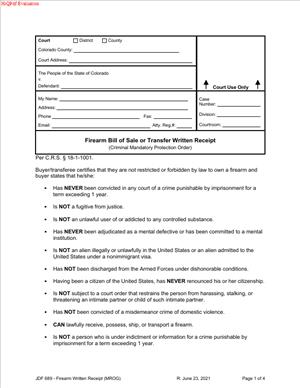
JDF 689 – Firearm Bill of Sale or Transfer Written Receipt (Criminal Mandatory Protection Order)
Fill out nowJurisdiction: Country: United States | Province or State: Colorado
If you are filling out JDF 689 – Firearm Bill of Sale or Transfer Written Receipt (Criminal Mandatory Protection Order), you are likely dealing with a court order that restricts firearm possession. This form creates a written record that a firearm was sold or transferred in response to that order.
This document is used when a criminal mandatory protection order requires someone to give up firearms. It serves as proof that the transfer or sale actually happened. The form helps document who received the firearm and when.
You may be completing this form as the person named in the protection order. You might also be the buyer or lawful recipient of the firearm. In either case, the form acts as a receipt tied to a court process.
Accuracy matters. Courts rely on written records to confirm compliance with orders. This document helps show that firearms were removed from your possession in a clear, traceable way.
What is JDF 689 – Firearm Bill of Sale or Transfer Written Receipt (Criminal Mandatory Protection Order)?
Clear definition
JDF 689 – Firearm Bill of Sale or Transfer Written Receipt (Criminal Mandatory Protection Order) is a court form used in Colorado criminal cases involving a mandatory protection order. It records the sale or transfer of a firearm by a person who is prohibited from possessing it under that order.
The form functions as a written receipt. It identifies the firearm, the person transferring it, and the person receiving it. It also documents the date of the transaction.
This document connects the firearm transfer to a specific court case. It typically includes the case number and court information so the transaction can be matched to the protection order.
Who typically uses this form?
The person named as the restrained or protected individual in a criminal case often uses this form when required to give up firearms. That person may be selling the firearm or transferring it to someone legally allowed to possess it.
A private buyer or third-party recipient may also sign the form. Their signature confirms receipt of the firearm and acknowledges the details listed.
Court staff may receive the completed form as part of a filing. In some cases, law enforcement or another authorized party may review it to verify compliance.
Why might you need this form?
You may need this form because a criminal mandatory protection order prohibits you from possessing firearms. The order may require you to sell or transfer any firearms you own within a set time.
The court may require written proof that the transfer occurred. This form provides that proof in a structured format.
Without documentation, it may be difficult to demonstrate compliance. A written receipt creates a clear record tied to your case.
Typical real-life scenarios
- You are charged with a criminal offense, and the court issues a mandatory protection order at your first appearance. The order states that you cannot possess firearms. You arrange to sell your firearm to a lawful buyer and use this form to record the transaction.
- You decide to transfer your firearm to a family member who can legally possess it. You complete the form together, documenting the details and signing it as evidence of the transfer.
- You previously owned several firearms. After receiving the order, you sell each one in separate transactions. You complete a separate written receipt for each firearm to ensure clear records.
- You are unsure how to prove you no longer have the firearm. The form provides a structured way to show the court that the firearm was sold or transferred in response to the order.
When would you use JDF 689 – Firearm Bill of Sale or Transfer Written Receipt (Criminal Mandatory Protection Order)?
You would use this form after a criminal court issues a mandatory protection order that restricts firearm possession. These orders are often entered early in a criminal case and may apply automatically in certain types of charges.
The form is used when you choose to sell or transfer the firearm to another lawful party, rather than surrendering it to law enforcement. It documents a private transaction connected to a court requirement.
Timing is important. The order may set a deadline for relinquishing firearms. The form is typically completed at the time of sale or transfer and may then be filed with the court to show compliance.
If you are the recipient of the firearm, you may be asked to sign the form to confirm you received it. Your role is to verify the transaction details, not to interpret the protection order.
This form is generally used during the active period of the protection order. If the order is modified or terminated later, the document remains a record of what occurred at the time of transfer.
Legal characteristics of JDF 689 – Firearm Bill of Sale or Transfer Written Receipt (Criminal Mandatory Protection Order)
This form is tied to a court order. Its effectiveness depends on accurate information and proper completion. It usually includes identifying details such as the case number, names of the parties, and a description of the firearm.
Clear identification of the firearm is important. Make, model, caliber, and serial number are commonly listed. Missing or incorrect information can create confusion or raise questions about whether the correct firearm was transferred.
Signatures are a key element. The person transferring the firearm and the person receiving it generally sign the document. Unsigned forms may not serve as reliable proof of transfer.
Errors in case information, dates, or firearm details can cause problems. Courts may question incomplete forms or forms that do not match the protection order.
In Colorado, this form is designed for use in criminal cases with mandatory protection orders. Other states may use different documents or procedures. Even within Colorado, processes may vary slightly by court location, but the core purpose remains the same.
This document does not change the protection order. It does not remove restrictions or restore firearm rights. It only records a transaction made in response to an existing order.
Is it legally binding?
The form can be legally significant because it creates a written record of a firearm transfer. When properly completed and signed, it serves as evidence that a transaction occurred.
Its binding effect comes from the underlying transaction and the court context. The bill of sale or receipt reflects an agreement between the parties and documents compliance with a court order.
However, the form itself does not authorize the transfer if other legal requirements are not met. It does not replace any background check, licensing, or other legal process that may apply to firearm transfers.
If the information is false or incomplete, the document may not serve its intended purpose. Accurate and truthful completion is essential for it to function as reliable proof.
How to fill out JDF 689 – Firearm Bill of Sale or Transfer Written Receipt (Criminal Mandatory Protection Order)
Step 1 – Enter the court information
Fill in the name of the court listed on your criminal case paperwork. Include the county and the court address if the form requests it. Make sure this matches the information on your protection order.
Step 2 – Provide the case details
Write the case number exactly as it appears on your court documents. Include the names of the parties as listed in the criminal case caption. Double-check spelling and numbers to avoid mismatches.
Step 3 – Identify the person transferring the firearm
Enter the full legal name of the person who is giving up the firearm. This is typically the person named in the protection order. Use the same name format that appears in the court record.
Step 4 – Identify the person receiving the firearm
Provide the full legal name of the buyer or recipient. Include any additional identifying information requested on the form, such as address or contact details. Ensure the information is legible and complete.
Step 5 – Describe the firearm
List the make, model, caliber or gauge, and serial number of the firearm. Write the information carefully and verify it directly from the firearm. Accurate identification helps avoid disputes about which firearm was transferred.
Step 6 – State the date of sale or transfer
Enter the exact date when the firearm changed hands. This date should reflect when possession was actually transferred, not when the form is later filed.
Step 7 – Include the sale price or note the nature of the transfer
If the firearm was sold, record the sale amount in the space provided. If it was transferred without payment, indicate that it was a transfer and not a sale. Use clear language consistent with the form’s structure.
Step 8 – Review all information for accuracy
Read through the entire document before signing. Confirm that the case number, names, firearm details, and dates are correct. Correct errors before adding signatures.
Step 9 – Sign and date the form
The person transferring the firearm signs and dates the form where indicated. The recipient also signs and dates in the designated space. Signatures confirm that both parties agree that the information is accurate.
Step 10 – File or submit the form as required
If the court requires submission, provide the completed form to the appropriate court location connected to your case. Keep a copy for your records so you can show proof of the transfer if questions arise.
Legal terms you might encounter in JDF 689 – Firearm Bill of Sale or Transfer Written Receipt (Criminal Mandatory Protection Order)
- Mandatory Protection Order (MPO): A court order automatically issued in certain criminal cases. It can prohibit you from possessing or controlling firearms while the case is active. This form documents that you complied with that restriction by transferring or selling your firearms.
- Defendant/Protected Person: The defendant is the person charged in the criminal case and typically the one subject to the firearm restriction. The protected person is the individual the order is designed to protect. On this form, you are usually identifying the defendant who is transferring the firearm.
- Case Number: The unique number assigned to your criminal case by the court. You must enter it exactly as it appears on your court paperwork. This connects the receipt to the correct case file.
- Transfer: The act of giving possession or control of a firearm to another person. A transfer may be a sale, a gift, or another lawful change of possession. This document records the details of that transfer.
- Bill of Sale: A written record showing that a firearm was sold for a specific amount. If the firearm was sold, this section confirms the price and identifies the buyer. It serves as proof that ownership changed hands.
- Written Receipt: A signed acknowledgment that a firearm was received by another person. Even if no money changes hands, the receipt confirms the date and details of the transfer.
- Make, Model, and Serial Number: Specific identifying details of a firearm. “Make” refers to the manufacturer, “model” identifies the product line, and “serial number” is the unique number stamped on the firearm. You must list these accurately so the firearm can be clearly identified.
- Affirmation or Declaration: A statement that the information you provide is true to the best of your knowledge. By signing, you confirm that the transfer actually occurred as described. False information can have serious consequences.
- Filing: Delivering the completed document to the court so it becomes part of the official case record. Filing may require you to submit the form to the clerk’s office. Once filed, the court can review it as proof of compliance.
- Compliance: Following the terms of the protection order. In this context, compliance means you no longer possess or control the firearms listed. This form helps show that you met that obligation.
FAQs
Do I need to file JDF 689 – Firearm Bill of Sale or Transfer Written Receipt (Criminal Mandatory Protection Order) with the court, or is keeping a copy enough?
In most situations, this document must be submitted to the court so it becomes part of your criminal case file. Keeping a copy for yourself is important, but it does not replace filing it. Check your protection order or court instructions to confirm where and how to deliver it, and make sure the clerk accepts it for the correct case number.
What date should I list as the transfer date?
You should enter the actual calendar date when the firearm physically changed hands. Do not use the date you filled out the paperwork unless that is also the date of transfer. The court looks at this date to determine whether you complied within the required timeframe.
What if I do not know the full serial number of the firearm?
You should locate the firearm and read the serial number directly from it before completing the form. If the number is partially unreadable, write it exactly as it appears and avoid guessing. Incomplete or incorrect serial numbers can raise questions about whether the specific firearm was transferred.
Can I transfer the firearm to a family member?
The form records who received the firearm, but it does not decide whether that transfer is legally allowed. You must ensure the recipient is legally permitted to receive and possess firearms. Enter the recipient’s full legal name and accurate contact information so the court record clearly reflects who now has possession.
Do both the seller and the buyer need to sign this document?
The person transferring the firearm must sign to confirm the information is true. It is also common for the receiving person to sign to acknowledge receipt. Signatures help show the transfer was real and voluntary, and they support the document’s credibility in court.
What happens if I regain the right to possess firearms later?
This document remains part of the court record as proof that you transferred the firearms while the order was in effect. It does not automatically return firearms to you. If rights are restored later, you would need to follow separate legal steps to lawfully obtain or possess firearms again.
What if I made a mistake on the form after submitting it?
If you notice an error, act quickly. You may need to complete a corrected version and submit it to the court with the same case number. Make sure all identifying details match the original case so the updated document is placed in the correct file.
Will filing this form change my public record?
Once filed, this document becomes part of the court case file. It shows that you transferred specific firearms on a certain date. It does not erase the criminal case, but it can demonstrate that you complied with the firearm restriction in the protection order.
Checklist: Before, During, and After JDF 689 – Firearm Bill of Sale or Transfer Written Receipt (Criminal Mandatory Protection Order)
Before
- Read your mandatory protection order carefully to confirm firearm restrictions.
- Locate all firearms in your possession or control.
- Record the make, model, and serial number directly from each firearm.
- Decide whether you are selling or otherwise transferring each firearm.
- Confirm the recipient is legally allowed to receive firearms.
- Gather your court paperwork to copy the correct case number and court name.
- Check any deadlines for completing the transfer.
- Prepare a valid photo ID if needed for identification purposes.
During
- Write the court name and case number exactly as shown on your paperwork.
- Enter your full legal name as it appears in the criminal case.
- Clearly identify the recipient with full legal name and address.
- List each firearm separately with accurate make, model, and serial number.
- Enter the exact date the firearm was transferred.
- State the sale price if it was sold, or note that it was a transfer without payment.
- Review every line for spelling errors and missing information.
- Sign and date the form where indicated.
- Have the recipient sign, if applicable.
After
- Make at least two copies of the completed and signed document.
- Submit the original to the court clerk as required.
- Confirm that the clerk accepted the filing for your case number.
- Keep a stamped or confirmed copy for your records.
- Provide a copy to your attorney, if you have one.
- Store your copy in a safe place with your court documents.
- Calendar any follow-up court dates related to your criminal case.
- Monitor your case status to ensure no additional firearm documentation is required.
Common mistakes to avoid with JDF 689 – Firearm Bill of Sale or Transfer Written Receipt (Criminal Mandatory Protection Order)
- Mistake: Listing the wrong case number because you copied it from memory instead of your court papers, which can cause the document to be filed in the wrong case and delay proof of compliance, so always verify the exact number before submitting.
- Mistake: Guessing the serial number without checking the firearm directly, which may create doubts about whether the specific firearm was transferred and could lead to court questions, so carefully read and copy the number as stamped.
- Mistake: Forgetting to include the transfer date, often due to rushing, which makes it unclear whether you met the deadline in your protection order, so double-check that the date is clearly written.
- Mistake: Leaving out the recipient’s full legal name or address because you assume the court does not need it, which weakens the record of who now has possession, so provide complete identifying information.
- Mistake: Failing to sign the document, which can make it incomplete and unacceptable for filing, so confirm your signature and date are present before turning it in.
- Mistake: Not keeping a copy for yourself, which can leave you without proof of what you submitted if questions arise later, so always make and store copies safely.
- Mistake: Waiting too long to complete the transfer due to confusion about deadlines, which can put you out of compliance with the protection order, so check timelines immediately after the order is issued.
- Mistake: Assuming filing the form restores your firearm rights, which it does not, and misunderstanding this can lead to further violations, so remember the document only shows transfer, not reinstatement of rights.
What to do after filling out JDF 689 – Firearm Bill of Sale or Transfer Written Receipt (Criminal Mandatory Protection Order)
Once you complete the form, your next focus is proper submission and recordkeeping. The document only serves its purpose if it is accurate and placed in the correct court file.
Start by reviewing every entry one more time. Make sure names match your criminal case exactly. Confirm the case number is correct. Check that each firearm listed includes a complete serial number and transfer date.
- Step 1: Sign and date the form in all required places.
- Step 2: Make at least two clear copies of the signed document.
- Step 3: Submit the original to the appropriate court clerk handling your criminal case.
- Step 4: Ask the clerk to confirm it has been filed under your correct case number.
- Step 5: Request a stamped or file-marked copy showing the date of filing, if available.
- Step 6: Keep one copy in a secure folder with your protection order and other case documents.
- Step 7: Provide a copy to your attorney, if you are represented.
- Step 8: Review your protection order again to ensure no additional steps are required.
- Step 9: Mark any upcoming court dates on your calendar.
- Step 10: Monitor your mail or court notifications in case the court requests clarification or additional documentation.
You should also think about long-term recordkeeping. Keep your copy of the filed form even after your case ends. It serves as proof that you complied with the firearm restriction during the period it was in effect.
If your circumstances change, such as the dismissal of charges or modification of the protection order, do not assume this document alone changes your legal status. Separate court actions may be required before you can legally possess firearms again.
Taking these steps helps protect you. Clear documentation reduces misunderstandings and shows that you acted responsibly under the court’s order.
Disclaimer: This guide is provided for informational purposes only and is not intended as legal advice. You should consult a legal professional.