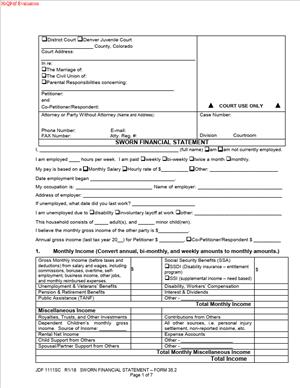
JDF 1111SC – Sworn Financial Statement – Form 35.2
Fill out nowJurisdiction: Country: United States | Province or State: Colorado
JDF 1111SC – Sworn Financial Statement – Form 35.2 is a detailed financial disclosure document used in Colorado courts. It lays out your income, expenses, assets, and debts in one sworn statement. The court relies on it to understand your financial situation.
You complete this form when a court needs clear financial information to make decisions. Most often, it appears in family law cases. It can affect support orders, maintenance, and other financial outcomes.
This is not a casual worksheet. You sign it under oath. That means you are confirming the information is true and complete to the best of your knowledge.
If you are about to fill it out, you need to know what the court is looking for. The form is designed to create a full financial snapshot. Small details can matter.
Understanding the structure before you start can save time. It also reduces the chance of corrections or delays in your case.
What is JDF 1111SC – Sworn Financial Statement – Form 35.2?
Clear definition
JDF 1111SC – Sworn Financial Statement – Form 35.2 is a court-required financial disclosure form used in Colorado domestic relations cases. It organizes your financial information into specific categories. These include employment income, other income, monthly living expenses, property, and debts.
The form functions as a sworn declaration. By signing it, you confirm that everything listed is accurate and complete. Courts treat it as formal testimony in written form.
It is not a budgeting tool for personal use. It is a legal document that becomes part of your court file. Judges may refer to it during hearings and when issuing orders.
Who typically uses this form?
This form is most often used by people involved in divorce, legal separation, allocation of parental responsibilities, or child support cases. Both parties are commonly required to complete and exchange it.
You may be required to file it if you are asking for child support or spousal maintenance. You may also need to complete it if the other party is making financial requests.
Self-represented individuals often use this form. Attorneys also prepare it for their clients. Regardless of who prepares it, the person signing it is responsible for its accuracy.
In some situations, both spouses complete separate forms. This allows the court to compare each person’s financial circumstances side by side.
Why might you need this form?
The court uses this form to calculate financial obligations. This may include child support, maintenance, or division of certain expenses. Clear financial data helps the court apply guidelines and make balanced decisions.
You might need it if there is disagreement about income. For example, one party may claim the other earns more than stated. The form provides a structured way to present numbers.
It may also be required early in the case. Many courts set deadlines for financial disclosures so both parties have the same information before negotiations or hearings.
Without this form, the court may not have enough detail to decide financial issues. Incomplete disclosures can delay progress in your case.
Typical real-life scenarios
- You are filing for divorce and need to address child support. The court requires each parent to disclose monthly income and expenses. You complete the form to show what you earn and what you pay each month.
- You are responding to a motion for temporary maintenance. The judge wants to understand both parties’ financial situations before issuing a temporary order. You provide your full financial picture through this document.
- You and the other parent disagree about how much income each of you has. The sworn statement creates a written record of what each person claims, supported by documents.
- You are modifying an existing child support order. The court needs updated financial information to determine whether a change is appropriate. You complete a new financial statement to reflect your current circumstances.
- You are requesting attorney fees in a family case. The court may look at both parties’ financial resources before deciding whether to shift fees. Your financial disclosure helps inform that decision.
When would you use JDF 1111SC – Sworn Financial Statement – Form 35.2?
You would use JDF 1111SC – Sworn Financial Statement – Form 35.2 when the court requires a sworn financial disclosure in a Colorado family law case. This commonly happens early in a divorce or allocation of parental responsibilities case.
If temporary orders are being considered, the court often needs financial information quickly. In that setting, both parties may be required to submit the form before a hearing. The judge may review it in advance.
You may also use the form when requesting a modification of child support or maintenance. Updated income and expense information allows the court to compare past and current circumstances.
In contested cases, financial disclosures are typically exchanged between parties. This helps each side understand the other’s claimed income and obligations. It can shape settlement discussions.
Even in cases that may settle without trial, the form plays an important role. Many agreements are based on the numbers disclosed in these sworn statements.
The form may also be relevant if enforcement is at issue. If someone claims inability to pay, the court may examine the financial statement to assess that claim.
Legal characteristics of JDF 1111SC – Sworn Financial Statement – Form 35.2
This document is sworn under oath. That means you affirm that the information is true and complete. False or incomplete statements can have serious consequences in court proceedings.
For the form to be effective, it must be filled out fully and accurately. Missing sections, blank income lines, or unexplained gaps can raise concerns. Courts expect a complete financial picture, not partial information.
Supporting documents are often required along with the form. These may include pay stubs, tax returns, or bank statements. While the form itself summarizes your finances, the attachments support your entries.
Common problems include underreporting income, failing to list assets, or estimating expenses without a reasonable basis. Inconsistent numbers between sections can also create issues. For example, reported income that does not reasonably cover listed expenses may prompt questions.
Procedural requirements can vary slightly depending on the county or the type of case. Deadlines, formatting, and filing methods may differ. The core purpose of the form, however, remains the same: full financial disclosure.
This form does not, by itself, create a court order. It does not automatically change support or divide property. It provides information that the court may use when making decisions.
Is it legally binding?
JDF 1111SC – Sworn Financial Statement – Form 35.2 is legally significant because it is signed under oath. When you sign it, you are making a formal declaration to the court. That declaration carries legal weight.
The form itself does not bind you to pay a specific amount. Instead, it binds you to the truthfulness of your statements. The court may rely on your disclosures when issuing orders.
If the information is later shown to be false or misleading, the court may address that issue. This could affect credibility and, in some cases, financial rulings.
Once filed, the form becomes part of the case record. Judges and, in some circumstances, opposing parties may refer back to it during hearings. That is why accuracy at the time of completion is important.
How to fill out JDF 1111SC – Sworn Financial Statement – Form 35.2
Step 1 – Case caption and identifying information
At the top of the form, enter the court name, county, and case number exactly as they appear on other court documents. Fill in the names of the parties in the correct order. Provide your full legal name and contact information where requested.
Make sure the case number matches your existing paperwork. This connects your financial statement to the correct file.
Step 2 – Employment information
List your current employer, job title, and how long you have worked there. If you are self-employed, describe your business and the nature of your work.
If you have more than one job, include each source of employment. The goal is to present a complete picture of your work situation.
If you are unemployed, indicate that clearly and provide details about your last job and when it ended, if the form requests it.
Step 3 – Gross monthly income
Enter your gross income, which is income before taxes and deductions. This typically includes wages, salary, overtime, bonuses, and commissions.
Convert income to a monthly figure if you are paid weekly or biweekly. Use consistent math. If your income fluctuates, you may calculate an average based on recent pay periods.
Include all sources of income listed on the form. This may include rental income, self-employment income, retirement benefits, disability payments, or other regular payments.
Step 4 – Payroll deductions and net income
List common payroll deductions such as federal and state taxes, Social Security, Medicare, and health insurance premiums. Use your pay stub to ensure accuracy.
After listing deductions, calculate your net monthly income. This is your take-home pay after required deductions. Check your math carefully so totals are correct.
If you have voluntary deductions, such as retirement contributions, include them in the section provided on the form.
Step 5 – Other income and financial benefits
Disclose any additional income not already listed. This may include side work, cash payments, or recurring financial support from another person.
If you receive child support or maintenance from a different case, list it as required. The form is designed to capture your full financial picture, not just employment income.
Be clear about frequency. Indicate whether the income is monthly, annual, or occasional, and convert it to the format requested.
Step 6 – Monthly living expenses
Provide your regular monthly expenses in each category listed. This often includes housing, utilities, food, transportation, insurance, medical costs, and personal expenses.
Use recent bills or account statements to estimate realistic amounts. Round reasonably, but avoid guesswork that is far from your actual spending.
If you share expenses with someone else, reflect only your portion where the form requests your share. Read each line carefully to understand what is being asked.
Step 7 – Assets
List all significant assets in your name or jointly held. This may include bank accounts, retirement accounts, vehicles, real estate, and valuable personal property.
For each asset, provide the current estimated value. Use recent statements or market estimates when available.
If the form asks about ownership, indicate whether the asset is solely yours or jointly owned. Complete disclosure helps prevent later disputes about missing property.
Step 8 – Debts and liabilities
Identify all outstanding debts. This commonly includes credit cards, mortgages, car loans, student loans, and personal loans.
Provide the total balance owed and the required monthly payment for each debt. Use recent statements for accuracy.
If a debt is joint, indicate that clearly. The court often considers both the balance and who is responsible for payment.
Step 9 – Children’s expenses, if applicable
If the case involves children, complete the sections related to their expenses. This may include health insurance premiums, childcare costs, and extraordinary expenses.
Enter the monthly amount actually paid. If expenses vary, calculate a reasonable average.
Distinguish between expenses you pay directly and those covered by the other parent, if the form requires that detail.
Step 10 – Review, verification, and signature
Before signing, review every section for completeness. Check totals and confirm that all required fields are filled in.
Compare your entries with your supporting documents. Make sure income and deduction figures match your records.
Sign the form where indicated. Your signature confirms that the information is true and complete to the best of your knowledge. Once signed, the document is ready for submission according to the court’s filing process.
Legal terms you might encounter in JDF 1111SC – Sworn Financial Statement – Form 35.2
- Affidavit: An affidavit is a written statement you swear or affirm is true. When you sign this form, you are making an affidavit about your income, expenses, assets, and debts. The court treats this as testimony under oath, even though you are not speaking in a courtroom.
- Verification: Verification refers to the statement at the end of the form where you confirm that everything you listed is complete and accurate. You usually sign this section under penalty of perjury. It reinforces that the information must be truthful and not misleading.
- Gross Income: Gross income means your total income before taxes and deductions. On this form, you list gross monthly amounts from wages, self-employment, benefits, and other sources. The court uses gross income to calculate support and compare financial positions.
- Net Income: Net income is what you take home after payroll deductions like taxes, retirement contributions, and insurance premiums. You calculate it by subtracting allowable deductions from your gross income. The court reviews this number to understand what you actually have available each month.
- Mandatory Deductions: These are deductions taken from the pay that you cannot control, such as federal and state taxes or required retirement contributions. The form separates mandatory deductions from voluntary ones. This distinction matters because only certain deductions may reduce the income used for support calculations.
- Assets: Assets are things you own that have value. This includes bank accounts, vehicles, real estate, retirement accounts, and personal property. On this form, you must list current estimated values, not what you originally paid.
- Liabilities: Liabilities are your debts and financial obligations. Examples include credit card balances, loans, medical bills, and mortgages. You must list the total amount owed and, in some cases, the monthly payment.
- Financial Disclosure: Financial disclosure means sharing complete and accurate financial information with the court and the other party. This form is a key part of that disclosure process. Incomplete disclosure can affect court decisions and your credibility.
- Monthly Living Expenses: These are your regular, recurring costs such as housing, utilities, food, transportation, and insurance. The form asks for monthly amounts, even if you pay something weekly or annually. You may need to convert amounts to monthly figures.
- Child-Related Expenses: These are costs specifically tied to your children, such as childcare, health insurance premiums for the child, extracurricular activities, and educational expenses. The court often reviews these amounts when determining child support or cost-sharing arrangements.
FAQs
Do I need to file JDF 1111SC – Sworn Financial Statement – Form 35.2 with the court, or just give it to the other party?
In most cases, this document must be filed with the court and also provided to the other party. Check your case instructions or scheduling order to confirm whether filing is required at a specific stage. Make sure the version you file matches exactly the version you give to the other side, including attachments.
What date should I use for my income and expenses on this form?
You should use your current financial situation as of the date you complete and sign the document. List your most recent pay amounts and your actual ongoing monthly expenses. If something recently changed, use the new amount and be ready to explain when the change happened.
Do I have to attach proof of what I list?
You are often expected to attach supporting documents such as recent pay stubs, tax returns, and account statements. Review the instructions to see what is required in your case. Label your attachments clearly so the court can match each document to the line items in this form.
What happens if I realize I made a mistake after I filed it?
If you discover an error, correct it as soon as possible. You may need to complete a new version of JDF 1111SC – Sworn Financial Statement – Form 35.2 and file it as an updated or amended statement. Provide the corrected version to the other party and keep a copy for your records.
Can I estimate values for property and accounts?
You should use reasonable, good-faith estimates if you do not know the exact amount. For bank accounts, use the most recent statement balance. For property, use a recent statement, appraisal, or a realistic market estimate, and avoid guessing without any basis.
What if I am self-employed and my income changes every month?
Use an average monthly income based on several recent months, or even a full year if your income is seasonal. Keep records showing how you calculated the average. Attach summaries or statements that support your numbers so the court can follow your math.
Do I need to include income from a second job or side work?
Yes. This document requires you to list all sources of income, not just your primary job. Include freelance work, gig income, bonuses, commissions, and any other regular payments you receive.
Is this form part of the public record?
In many cases, financial disclosures filed with the court become part of the case file. Some sensitive information may be protected or handled separately depending on court rules. Review your court’s instructions about redacting personal identifiers before filing.
Checklist: Before, During, and After JDF 1111SC – Sworn Financial Statement – Form 35.2
Before
- Gather your last two to three months of pay stubs.
- Collect your most recent tax return and any schedules.
- Print or download recent bank, credit card, and loan statements.
- Make a list of all monthly bills and recurring expenses.
- Confirm the correct case caption and case number.
- Review any court order that requires financial disclosure.
- Set aside time to complete the form without rushing.
During
- Write your full legal name exactly as it appears on the case caption.
- Use monthly amounts for every income and expense entry.
- Double-check your math when calculating totals.
- Attach the required supporting documents in the correct order.
- Fill in every section, even if the answer is zero.
- Review each page before moving to the next.
- Sign and date the verification section.
After
- Make at least two copies of the completed form and attachments.
- File the original with the court if required.
- Provide a copy to the other party as instructed.
- Keep proof of filing or delivery for your records.
- Store a complete copy in a safe place.
- Calendar any deadlines for updates or hearings.
- Monitor for changes in your financial situation.
Common mistakes to avoid with JDF 1111SC – Sworn Financial Statement – Form 35.2
- Mistake: Leaving sections blank because you think they do not apply, which often happens when you are unsure; this can make your disclosure look incomplete and delay your case, so do not forget to enter “0” or “N/A” where appropriate.
- Mistake: Listing net income instead of gross income in the wrong section, which happens when reading quickly; this can affect support calculations, so do not forget to separate gross income from deductions clearly.
- Mistake: Guessing at monthly expenses without checking statements, which happens when you rush; inaccurate numbers can hurt your credibility, so do not forget to review bills and convert them properly to monthly amounts.
- Mistake: Forgetting to attach required documents, which often occurs when filing electronically; missing attachments can result in rejection or court orders to supplement, so do not forget to confirm all attachments are included.
- Mistake: Failing to update the form after a job change or major financial shift, which happens in ongoing cases; outdated information can lead to unfair orders, so do not forget to file an updated statement if your situation changes.
- Mistake: Underreporting side income because you think it is minor, which can happen with gig or cash work; incomplete disclosure can damage trust with the court, so do not forget to include every income source.
- Mistake: Not signing the verification section, which is easy to overlook at the end; an unsigned form may be rejected or carry less weight, so do not forget to sign and date before filing.
- Mistake: Using inconsistent numbers across documents, which happens when totals differ from attached statements; inconsistencies can raise questions, so do not forget to cross-check every figure against your attachments.
What to do after filling out JDF 1111SC – Sworn Financial Statement – Form 35.2
Once you complete the form, slow down. Review it line by line. Confirm that every number matches your supporting documents. Make sure your totals add up correctly.
- Step 1: Review every page for completeness and confirm you signed and dated the verification section.
- Step 2: Organize your attachments in the same order as the categories listed in the form.
- Step 3: Make at least two full copies of the signed form and all attachments.
- Step 4: File the original with the court if your case requires filing, using the approved filing method for your case type.
- Step 5: Deliver a complete copy to the other party or their attorney as required by the rules or court order.
- Step 6: Keep proof that you filed and delivered the document, such as a confirmation receipt or certificate of service.
- Step 7: Store your copy in a dedicated case folder, either physical or digital, so you can access it quickly for hearings.
- Step 8: Prepare to answer questions about the numbers you listed, especially income, unusual expenses, or large debts.
- Step 9: Monitor your finances for changes, such as a new job, pay increase, or major expense shift.
- Step 10: Update your financial records and, if required, submit an amended statement to reflect significant changes.
Treat this document as a snapshot of your financial life at a specific moment. Courts rely on it when making decisions about support and financial responsibilities. Staying organized and proactive after filing helps you stay prepared for the next stage of your case.
Disclaimer: This guide is provided for informational purposes only and is not intended as legal advice. You should consult a legal professional.