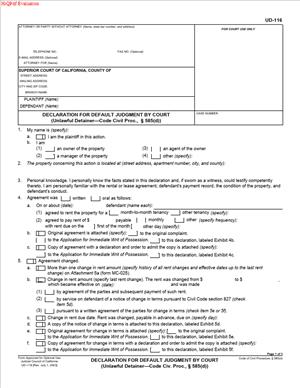
UD-116 – Declaration for Default Judgment by Court
Fill out nowJurisdiction: Country: United States | Province or State: California
The UD-116 Declaration for Default Judgment by Court is a court filing used in certain eviction cases. It comes into play after a tenant does not respond on time. The form asks the court to enter a default judgment based on that lack of response.
You are usually looking at this document right before submitting paperwork to the court. At that point, timing and accuracy matter. Each statement on the form is treated as a sworn declaration.
This document does not start a case. It appears after the earlier steps are already complete. It fits into a larger process that involves the service of papers and waiting periods.
People often find this form confusing because it sounds automatic. It is not. The court reviews what you submit and decides whether the requirements are met.
Understanding what the UD-116 Declaration for Default Judgment by Court does, and what it does not do, helps you avoid delays. It also helps you know what information the court expects to see.
What is the UD-116 Declaration for Default Judgment by Court?
Clear definition
The UD-116 Declaration for Default Judgment by Court is a written statement submitted to the court. It tells the court that the other side did not file a response within the allowed time. The declaration supports a request for the court to enter judgment without a trial.
This form is used in unlawful detainer cases. These are cases about possession of property, commonly involving landlords and tenants. The declaration focuses on procedural facts, not arguments.
The document is signed under penalty of perjury. That means the person signing is stating that the information is true and correct to the best of their knowledge.
The court uses this declaration to decide whether it can move forward without hearing from the non‑responding party.
Who typically uses this form/document?
This form is most often used by landlords or property owners. It may also be used by property managers or other authorized representatives.
Attorneys sometimes prepare and submit it, but self‑represented parties also use it. The form is designed to be completed without specialized legal writing.
The person completing the form is usually the one who filed the eviction case. In some situations, it may be completed by someone acting on that person’s behalf.
The form is not used by tenants who are responding to a case. It is used by the party asking the court to enter default.
Why you might need this form/document
You may need this document when the other party does not respond. Courts do not automatically enter judgment just because time passes. A filing is required to alert the court.
The UD-116 Declaration for Default Judgment by Court provides that notice. It lays out the key procedural facts the court must confirm.
Without this filing, the case may simply sit on the docket. Nothing moves forward until the court receives a proper request.
This document helps the court decide whether it can issue a judgment based only on the papers already filed.
Typical real-life scenarios
A landlord files an eviction case after serving a notice. The tenant does not file an answer within the required period. The landlord prepares this declaration to ask the court to enter judgment.
A property owner represents themselves in court. They track the response deadline and see that nothing was filed. They complete the form to move the case forward.
A manager handling multiple units submits the declaration after confirming service was completed correctly. The declaration summarizes what has already happened procedurally.
An attorney’s office prepares the form for a client when the tenant fails to appear or respond. The declaration becomes part of a packet requesting default judgment.
When would you use the UD-116 Declaration for Default Judgment by Court?
This form is used after a case is already filed and served. It comes after the waiting period for a response has expired. It does not apply if the other side has filed an answer or other permitted response.
The timing matters. The court expects that the deadline for responding has passed. The declaration is tied to that deadline, not to the original filing date.
This document is typically used by the party that initiated the eviction case. That party may be an individual, a business entity, or a representative.
You would not use this form at the beginning of a case. You also would not use it if the case is being actively contested. It fits a narrow procedural moment when the court is being asked to act without opposition.
Legal characteristics of UD-116 Declaration for Default Judgment by Court
This document works because it is a sworn declaration. The court relies on the accuracy of the statements. Incorrect or incomplete information can cause rejection or delay.
The form must match the case record. Dates, names, and service details are compared against earlier filings. Inconsistencies often lead the court to request corrections.
Common problems include missing signatures, incorrect case numbers, or unclear statements about service. Courts may also reject forms that are filed too early.
Procedures can vary slightly by court location. Some courts review these filings quickly, while others take more time. The core purpose remains the same across locations.
This document does not prove the merits of the eviction. It does not establish that the underlying claims are valid. It only addresses whether a response was filed.
Is it legally binding?
The declaration itself is not a judgment. It is a sworn statement submitted to the court. Its binding effect comes from the penalty of perjury attached to the signature.
Once accepted, the declaration can support a court order or judgment. The judgment, not the declaration, is what has legal force.
If the information in the declaration is false, there can be consequences. That is why courts treat these filings seriously.
How to fill out UD-116 Declaration for Default Judgment by Court
Step 1 – Review the case caption
Start by looking at the top portion of the form. This section identifies the court, the parties, and the case number. These details must match exactly what appears on earlier filings in the case.
Small differences can cause confusion. Courts rely on this information to connect the declaration to the correct file. Take time to copy names and numbers carefully.
Step 2 – Identify the declarant
The form asks who is making the declaration. This is the person signing and stating the facts. The declarant is usually the party who filed the case or an authorized representative.
This section clarifies the declarant’s role. It helps the court understand why that person has knowledge of the case details.
Step 3 – State the procedural background
You will describe what has already happened in the case. This typically includes that the case was filed and that the other party was served.
The focus is on process, not argument. The court is looking for confirmation that required steps occurred.
Clear, factual statements work best here. Avoid adding explanations that are not requested by the form.
Step 4 – Address service of the summons and complaint
This step covers how and when the other party was served. The court checks this carefully before entering default.
The information should align with any proof of service already on file. Discrepancies often slow the review.
This section helps the court confirm that the other party had notice of the case.
Step 5 – Confirm the lack of response
Here, you state that no response was filed within the allowed time. This is the key fact supporting default judgment.
The court relies on this statement to determine whether it can proceed without a hearing. Accuracy is essential.
This section does not ask for opinions or reasons. It is a factual confirmation.
Step 6 – Address any appearances or filings
Some versions of the form ask whether the other party appeared in any way. This includes filings other than a formal answer.
The court uses this information to decide whether default is appropriate. Even limited participation can affect the process.
Be clear and precise when completing this part.
Step 7 – Request court action
The form includes language asking the court to enter default judgment. This is a procedural request, not an argument.
You are signaling that all required conditions are met. The court decides whether to grant the request.
This step ties together the earlier statements in the declaration.
Step 8 – Review for completeness
Before signing, read the entire form again. Check dates, names, and boxes. Make sure nothing is left blank unless the form instructs otherwise.
Incomplete forms are a common reason for rejection. A careful review can prevent delays.
This step is about accuracy, not strategy.
Step 9 – Sign and date the declaration
The final step is signing the form. Your signature confirms that the statements are true under penalty of perjury.
The date shows when the declaration was completed. Courts use this to track timing.
Once signed, the form is ready for submission as part of the default judgment request.
Legal terms you might encounter in UD-116 Declaration for Default Judgment by Court
- Declarant: The declarant is the person who signs this form. In this document, the declarant is the one stating facts about what happened procedurally in the case. The court relies on the declarant’s personal knowledge or review of the case file.
- Default: Default means the other party did not file a response within the allowed time. On this form, default is a factual status, not a punishment. You are telling the court that the deadline passed without a response on record.
- Default judgment: A default judgment is the court’s decision entered without a trial. This document does not create the judgment by itself. It supports the court’s decision to issue one based on the lack of response.
- Proof of service: Proof of service is the record showing how and when the other party received the case papers. This form depends on that earlier filing. The dates and methods listed there must match what you declare here.
- Summons: The summons is the court-issued notice that a case exists. In this document, you are confirming that the summons was served and that the response clock started. The court checks this carefully before entering default.
- Complaint: The complaint is the document that states what the case is about. This declaration does not repeat the complaint’s claims. It only confirms that the complaint was served and not answered.
- Court record: The court record is the official file maintained by the clerk. This form becomes part of that record once filed. Judges compare it against what already appears in the file.
- Penalty of perjury: Penalty of perjury means you are swearing the information is true. When you sign this form, you accept responsibility for accuracy. This gives the declaration legal weight.
- Appearance: An appearance is any formal participation by the other party. On this form, you may be asked to state whether the other side appeared in any way. Even limited activity can affect whether default is proper.
FAQs
How do I know whether the response deadline has actually passed?
You confirm this by counting from the service date listed on the proof of service. Check the court record to see whether any answer, motion, or filing appears. This document records your confirmation that nothing was filed by the deadline.
Who is allowed to sign this form?
The signer must be someone with knowledge of the case record. That is usually the party who filed the case or an authorized representative. When you sign, you are personally confirming the procedural facts stated on the form.
Do the names on this document have to match earlier filings exactly?
Yes. This form must mirror the names used in the complaint, summons, and service papers. Even small differences can cause the clerk or judge to question whether the declaration applies to the same case.
What if the other party contacted me but did not file anything?
Private contact does not count as a response. This form focuses only on what appears in the court record. You are confirming that no response was filed, not whether there were conversations outside court.
Do I need to attach anything to this document?
You usually do not attach evidence to this form unless the court requires it. The declaration relies on documents already filed, such as proof of service. Check the form fields to see whether attachments are requested.
What happens if I discover an error after signing?
If you catch an error before filing, correct it and sign again. If the error is discovered after filing, you may need to submit a corrected declaration. Accuracy matters because the court relies on this document.
Will filing this form automatically give me possession or money?
No. Filing the UD-116 Declaration for Default Judgment by Court asks the court to consider entering judgment. The court must still review the paperwork and issue an order or judgment.
How will I know if the court accepted this document?
You check the court record or receive notice from the clerk. Acceptance means it is filed, not that judgment is granted. The next document you receive will tell you what the court decided.
Checklist: Before, During, and After UD-116 Declaration for Default Judgment by Court
Before
- Confirm the response deadline using the service date on file
- Review the court docket for any responses or appearances
- Locate the proof of service and check its details
- Verify the case number and party names exactly
- Decide who will act as the declarant
- Gather earlier filings for cross-checking
- Check whether the court requires additional forms
- Make sure you have the current version of the form
During
- Copy the case caption directly from the complaint
- Enter dates exactly as they appear in the court record
- Identify the declarant clearly and accurately
- State only procedural facts, not arguments
- Double-check service information against the proof of service
- Confirm no response appears in the record
- Complete every required field on the form
- Sign and date the declaration legibly
After
- Make copies for your records
- Submit the form using the court’s accepted filing method
- Confirm the filing was accepted by the clerk
- Monitor the docket for court action
- Calendar expected follow-up dates
- Prepare to receive a judgment or court notice
- Update your internal case file
- Keep the signed copy in a secure place
Common mistakes to avoid with UD-116 Declaration for Default Judgment by Court
- Mistake: Filing before the response deadline because the waiting period was miscounted, which leads to rejection; do not forget to calculate from the service date, not the filing date.
- Mistake: Using names that differ from earlier pleadings because of abbreviations or typos, which can confuse the court; do not forget to copy names exactly as filed.
- Mistake: Listing service details that do not match the proof of service, often from memory, which undermines credibility; do not forget to cross-check dates and methods.
- Mistake: Signing as a declarant without personal knowledge, which can invalidate the declaration; do not forget that the signer must know the procedural facts.
- Mistake: Leaving required fields blank because they seem repetitive, which delays processing; do not forget that every field signals completeness to the clerk.
- Mistake: Adding arguments about the case merits, which is not the purpose of this form; do not forget it is about procedure only.
- Mistake: Forgetting to sign under penalty of perjury, which makes the document unusable; do not forget the signature is essential.
- Mistake: Assuming filing equals judgment, which causes missed follow-up steps; do not forget to watch for the court’s decision.
What to do after filling out the UD-116 Declaration for Default Judgment by Court
Once the form is complete and signed, your focus shifts from preparation to follow-through. This stage is about making sure the court actually receives, files, and considers what you submitted. Many delays happen after the form is finished, not while it is being filled out.
Start by making clean copies of the signed document. Keep one for yourself and one for any internal case file you maintain. If you are working with someone else, make sure everyone is using the same version so dates and signatures stay consistent.
- Step 1: Make copies of the signed declaration for your records.
- Step 2: Submit the document using the court’s accepted filing method.
- Step 3: Confirm the clerk accepted and filed the document.
- After submission, check the court record. You are looking for a file stamp or docket entry showing that the declaration was received. Filing confirmation matters because the court will not act on documents that were submitted but not accepted.
- Step 4: Review the docket to confirm the filing appears correctly.
- Step 5: Note any deadlines or review dates associated with default requests.
- The court may take time to review the paperwork. During this period, monitor communications from the court. Notices may arrive by mail, electronically, or through the docket. Read them carefully, as they may request corrections or additional forms.
- Step 6: Watch for court notices requesting more information or corrections.
- Step 7: Respond promptly if the court identifies an issue.
- If the court grants default judgment, you will receive a judgment or order. This is the document that has legal effect. Keep it with your records and review what it says, including dates and relief granted.
- Step 8: Obtain and store a copy of any judgment or order issued.
- Finally, update your internal documents. Mark the case status, note the judgment date, and organize all related paperwork. Clear records help if you need to take further steps or answer questions later.
- Step 9: Update your case file and tracking notes.
- Step 10: Prepare for any next procedural steps required by the judgment.
Disclaimer: This guide is provided for informational purposes only and is not intended as legal advice. You should consult a legal professional.