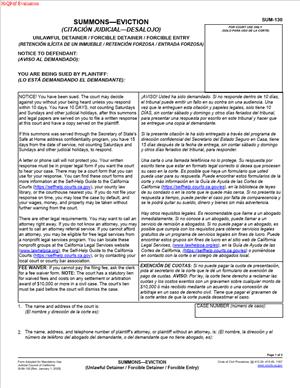
SUM-130 – Summons – Eviction (Unlawful Detainer / Forcible Detainer / Forcible Entry)
Fill out nowJurisdiction: Country: United States | Province or State: California
What is a SUM-130 – Summons – Eviction (Unlawful Detainer / Forcible Detainer / Forcible Entry)?
This is California’s official eviction summons. The Superior Court issues it after you file an eviction complaint. The Landlord and Tenant Division uses this form in eviction cases. It covers unlawful detainer, forcible detainer, and forcible entry claims.
Think of it as the court’s formal notice. It tells the tenant or occupant that a case has started. It also sets strict response deadlines. Without a valid summons, the court cannot move your case forward.
Who typically uses this form?
Landlords, property owners, and property managers use it when filing an eviction case. Attorneys use it for clients in residential and commercial disputes. Tenants and other occupants receive it when they are sued. Business entities and their registered agents also receive it when named in a case.
Why would you need this form?
You need it to start a California eviction lawsuit. You must file your complaint first. The clerk then issues this summons. You serve the summons and complaint together on each defendant. That service gives the court power over the people in the case. If you are the person served, you need the summons to understand your deadline and next steps.
Typical usage scenarios include unpaid rent, lease violations, and holdover after a notice expires. It also applies after foreclosure sales, unauthorized occupants, or squatters. Forcible entry and forcible detainer claims involve entry by force or refusal to leave after demand. Commercial landlords use it when a tenant stays or defaults under a lease. Residential landlords use it when a tenant breaches a rental agreement or fails to pay rent.
The form speaks directly to defendants. It warns that you have a short window to respond. In unlawful detainer, that is five court days after service. The form also explains the risk of default. If the defendant does not respond, you can seek judgment for possession and other relief allowed by law.
This form is not the complaint. The complaint states your claims. The summons tells the defendant the case exists and when to act. The court clerk signs and seals the summons. You never sign it yourself. You complete the caption details. The clerk issues it once your case is filed.
In some cases, you include unnamed occupants. When you want a judgment binding all occupants, you use an additional claim form. You must serve that claim with the summons and complaint. The SUM-130 includes a section that alerts occupants about that process. That can bring all occupants into the case if they do not timely respond.
When Would You Use a SUM-130 – Summons – Eviction (Unlawful Detainer / Forcible Detainer / Forcible Entry)?
You use it after serving a proper termination notice, and the time has expired. For nonpayment, which may follow a three-day notice to pay or quit. For other defaults, you may use a three-day notice to perform or quit. For no-fault evictions, longer notices may apply. Once the notice period ends without compliance, you can file your eviction complaint. The court will then issue this summons.
Use it when a residential tenant fails to pay rent. Use it when a tenant keeps an unauthorized pet after notice. Use it when a tenant allows unapproved occupants. Use it when a tenant commits a nuisance or illegal activity. Use it when the lease ends and the tenant holds over. For commercial tenancies, use it when a business stays past the lease term. Use it when a business breaches the lease and fails to cure after notice.
You also use it in post-foreclosure cases. After a foreclosure sale, the new owner may need to evict the former owner or occupants. The complaint type remains unlawful detainer. The summons for eviction is still SUM-130.
Use it if someone took possession by force or intimidation. That is a forcible entry claim. Use it if someone refuses to surrender possession after you demanded possession. That is a forcible detainer claim. These paths are less common but still covered by the same summons.
Typical users include landlords, property owners, REO holders, and property managers. Attorneys for owners use it routinely. If you are a tenant or other occupant, you see this form when served. If you are a business, your registered agent or officer may be served. If you are an unnamed occupant, you may still be pulled into the case. That happens if a special occupant claim form is served with the summons.
This form is not for small claims or general civil debt suits. It applies only to eviction claims. Possession is the core relief. Damages for holdover and rent can also be included. The summons fits the unique timelines used in eviction cases. The deadlines are faster than general civil cases.
Legal Characteristics of the SUM-130 – Summons – Eviction (Unlawful Detainer / Forcible Detainer / Forcible Entry)
This is a court-issued document. It is legally binding because the clerk signs and seals it. Filing the complaint first is required. The court then issues the summons in your case. Service of the summons and complaint gives the court jurisdiction over the defendants.
Enforceability depends on proper service. Personal service starts the five-court-day clock immediately. Substituted service requires a follow-up mailing. Service is complete on the tenth day after mailing. The defendant then has five court days to respond. Service by posting and mailing needs a court order first. It follows strict rules. You must show prior, reasonable attempts to find the defendant.
The form’s warnings are mandated. It states the deadlines and the risk of default. It also warns that a sheriff can enforce a writ of possession after judgment. That notice meets due process standards for eviction cases. The language is direct and clear. It appears in multiple languages on the form. The English text controls.
The form always lists the court name and address. That ensures the case lands in the proper venue. Eviction cases must be filed in the county where the property sits. The branch is usually the one serving that location. The document includes the case number once issued. That number tracks your case in all filings.
You do not notarize a summons. The clerk’s signature and court seal validate it. You cannot change the form’s preprinted language. You may only complete the caption and a few checkboxes. The judicial council designs and approves the form. The court will reject an altered or outdated version.
To bind all occupants, you must serve the special occupant claim form. The summons references this option. If properly served, unnamed occupants can be bound by the judgment. If not served, only named defendants are bound. That affects who can be removed later. Courts take this requirement seriously.
If you name a business defendant, service rules differ. You must serve the agent for service of process. You can also serve certain officers. On the summons, the server must mark the box showing service on behalf of a business. That links the service to the correct code section. It ensures valid service on the entity.
Corporations and LLCs should appear through counsel. Individuals can appear pro se. Deadlines are strict either way. If a defendant misses the deadline, you may request a default. Default can lead to a judgment for possession. The court can also award holdover damages and costs if pleaded and proven.
How to Fill Out a SUM-130 – Summons – Eviction (Unlawful Detainer / Forcible Detainer / Forcible Entry)
Follow these steps to complete and use the form correctly.
1) Confirm you can file.
- Verify you served a valid termination notice.
- Confirm the notice expired without compliance.
- Confirm the property is in California.
- Confirm you will file in the correct county branch.
2) Identify the parties.
- Name the owner or authorized landlord as the plaintiff.
- List all known adult tenants as defendants.
- Include former owners if a post-foreclosure case.
- Identify any business tenant by its correct legal name.
- Decide if you will include unnamed occupants.
- If yes, plan to serve the special occupant claim with the summons.
3) Complete the top left caption.
- If you have an attorney, enter their name and bar number.
- If you are self-represented, enter your name and address.
- Add your phone and email. Email is optional.
- Use a mailing address where you reliably receive documents.
4) Enter the court information.
- Put the full name: Superior Court of California, County of [County Name].
- Add the branch street address and mailing address.
- Include the city and zip code.
- Use the branch that handles landlord-tenant matters for the property location.
5) Complete the case caption.
- Enter Plaintiff/Petitioner name exactly.
- Enter Defendant/Respondent names exactly as known.
- Use full legal names. Avoid nicknames.
- If you plan to bind all occupants, do not add “All Occupants” here.
- That step happens through the separate occupant claim process.
6) Identify the property.
- The form prompts for the property address.
- Enter the full street address.
- Include unit number, city, state, and zip.
- Accuracy here is critical. This is the premises at issue.
7) Mark the occupant section, if applicable.
- The form has a section about all occupants.
- If you are serving the occupant claim form, mark the appropriate box.
- This warns occupants that they can be part of the case.
- If you are not serving that claim, leave that unchecked.
8) Do not sign the summons.
- The clerk dates and signs it.
- The clerk applies the court seal.
- Leave the date and signature lines blank for the court.
9) File the complaint and summons.
- Prepare your eviction complaint.
- Attach any required verifications or exhibits.
- Bring the completed summons with your complaint.
- Pay the filing fee or submit a fee waiver request.
- The clerk will assign a case number and issue the summons.
10) Make copies.
- Make a copy set for each defendant.
- Make a set for each unnamed occupant if using that process.
- Keep at least one conformed copy for your records.
- Your process server will need service copies.
11) Arrange for service.
- You cannot serve the papers yourself.
- Use a registered process server or any adult not in the case.
- Personal service is best.
- If personal service fails, consider substituted service.
- Do not post or mail without a court order.
- Confirm the server understands eviction deadlines.
12) Include required documents with the service.
- Always serve the complaint and summons together.
- Include any required attachments.
- Include the occupant claim form if binding all occupants.
- Include any court notices required by local rules.
13) Use the “Notice to the person served” properly.
- The summons has a section for service details.
- The server checks a box to show how the person was served.
- For an individual, check the individual box.
- For an occupant not named, check the “as occupant” box.
- For a business, check “on behalf of” and identify the entity type.
- The server may also note the applicable code section.
14) File the proof of service.
- After service, file a proof of service with the court.
- The proof must show the who, when, where, and how.
- For substituted service, include the mailing details.
- File promptly to avoid delays.
15) Track deadlines.
- For personal service, the defendant has five court days.
- Court days exclude weekends and court holidays.
- The last day extends if it falls on a closed day.
- For substituted service, the service is completed on the tenth day after mailing.
- The defendant then has five court days to respond.
- For posting and mailing, follow the court’s order and deadlines.
16) Prepare for next steps.
- If no response arrives, consider the default.
- Confirm service was valid before seeking default.
- If a response is filed, prepare for trial.
- The court will set a quick trial date.
17) Avoid common mistakes.
- Do not use the wrong court branch.
- Do not misspell party names.
- Do not leave out the unit number or zip code.
- Do not change preprinted language on the form.
- Do not sign for the clerk.
- Do not serve by posting without a court order.
- Do not forget to include the occupant claim form if you intend to bind all occupants.
- Do not rely on service by mail alone.
- Do not ignore entity service rules for business defendants.
18) Special notes for business defendants.
- Serve the registered agent or a qualifying officer.
- Mark the “on behalf of” box on the summons.
- Identify the entity type correctly.
- Expect the business to appear through counsel.
19) Special notes for unnamed occupants.
- If you want judgment binding every occupant, include the occupant claim form.
- Serve it with the summons and complaint on the premises.
- The summons instructs occupants about their rights and deadlines.
- If they do not act, they can be bound by the judgment.
20) Keep your records organized.
- Keep copies of the filed summons and complaint.
- Keep proofs of service.
- Keep delivery receipts for mailings after substituted service.
- Keep notes of attempts at personal service.
- You may need these at a motion or trial.
Example: You file an eviction for nonpayment in Los Angeles. The clerk issues the SUM-130. You serve the tenant personally on Monday. The five-court-day clock starts on Tuesday. If no response by the end of the following Monday, you may request a default. If you used substituted service with a follow-up mailing, the service is completed ten days after mailing. Add five court days after that to set your response date.
Example: You evict a commercial tenant in San Diego. You serve the corporation’s registered agent. Your server marks the “on behalf of” box. The five-day court deadline applies after valid service. The corporation should respond through counsel. If it fails, you can pursue default for possession and damages.
Example: You face squatters at a vacant home. You obtain a court order allowing posting and mailing. You follow the order exactly. Service completes as the order states. You compute the response deadline after service completes. If no one responds, you proceed to default and writ of possession.
If you follow these steps, your summons will be valid and enforceable. The key points are proper filing, correct completion, and valid service. Track the short deadlines closely. Eviction cases move fast. Small errors with the summons can delay your case. Careful preparation helps you avoid that.
Legal Terms You Might Encounter
- Summons. This is the official notice that a lawsuit has started. For this form, the summons tells each named occupant that you filed an eviction case and that they must respond by the deadline printed on the form.
- Unlawful detainer. This is the legal name for an eviction case. Your SUM-130 is tailored to this type of case, so do not use a general civil summons.
- Plaintiff. This is the party filing the case. On the form, you list your name and contact information as the plaintiff or the plaintiff’s attorney.
- Defendant. This is the party you are suing. On the summons, you must list each tenant, subtenant, or occupant you want the court’s judgment against. The names here must match the complaint.
- Unknown occupants. These are unnamed people who may be living at the property. If your complaint includes unknown occupants, carry that language forward and list them the same way on the summons.
- Complaint. The complaint is the document that explains your claims and what you want the court to order. The SUM-130 accompanies your complaint and tells defendants they must respond to it.
- Service of process. Service means officially delivering court papers to the defendants. You must serve a court-issued SUM-130 with the complaint and any required attachments. You cannot serve an unsigned or unissued summons.
- Proof of service. This is the form or declaration your server completes to confirm proper delivery. Your case moves forward only after you file valid proof of service for each defendant you served with the SUM-130.
- Clerk’s seal and signature. The court clerk issues the summons by dating, signing, and sealing the form. Check that your copy shows the clerk’s signature and court seal before you serve it.
- Case number. The court assigns a number when you file your complaint. The same case number must appear on the SUM-130. If it’s missing or wrong, fix it before service.
- Response or answer. This is the defendant’s written reply to the complaint. The SUM-130 explains where and when to file it. The timeline in eviction cases is short, so you should calendar it immediately.
- Default. If a defendant does not respond on time, you may ask the court to enter default. Serving a properly issued SUM-130 is a condition to seeking default against that defendant.
- Personal service. This means handing the summons and complaint directly to the defendant. Your process server will document how service was made. The method of service affects response deadlines, so keep accurate records.
- Substitute service. If personal service fails after reasonable attempts, the law allows alternate methods. For example, leaving papers with a responsible adult at the residence and mailing a copy. If used, your proof of service must show the required steps were followed.
- Posting and mailing. In some cases, the court may allow posting the documents at the property and mailing copies. This option has extra steps and timing rules. If you use it, confirm your packet includes the SUM-130.
- Possession only vs. money claims. Some eviction cases seek only possession of the property. Others seek rent, damages, or fees. Your complaint controls the claims, but the SUM-130 must go to every defendant for all claims to move forward.
FAQs
Do you need one SUM-130 per defendant?
You need one issued summons for the case that lists all defendants exactly as in the complaint. You then serve a copy of that issued summons on each defendant. Many filers prepare a separate service packet for each person or entity.
Do you sign the SUM-130 yourself?
No. The court clerk issues the summons by signing and sealing it. You complete the party and court information before filing. Do not serve any copy that lacks the clerk’s signature and seal.
Do you list “unknown occupants” on the summons?
Yes, if your complaint names unknown occupants or all occupants. Use the same wording on the SUM-130 that you used in the complaint. This keeps the parties consistent across your documents.
Do you serve the summons before or after filing?
After filing, you file the complaint and a completed SUM-130 for issuance. Once the clerk issues the summons, you serve the issued copy with the complaint and required attachments.
Do you serve business tenants differently?
Business entities are served through their authorized agent or an appropriate officer. Confirm the entity’s correct legal name and service agent before preparing the summons. List the entity’s full legal name on the SUM-130.
Do you include the property address on the summons?
The property address appears in the complaint. Ensure the case caption and party information on the summons align with the complaint. Use the exact spelling and formatting to avoid confusion.
Do you need to attach other documents to the summons?
You must serve the issued summons and the filed complaint together. Depending on local rules, you may need to include additional required forms. Assemble complete packets for each defendant to avoid service disputes.
Do you have to re-serve if you correct the summons?
Yes, if you amend party names or obtain an amended summons, you must serve the corrected documents. Make sure every defendant receives the version the court will rely on.
Checklist: Before, During, and After the SUM-130
Before submission
- Confirm you are using the eviction-specific summons (SUM-130), not the general civil summons.
- Verify the correct court location for the property’s address.
- Gather the full legal names of all tenants, subtenants, and occupants you intend to sue.
- Decide whether to include unknown occupants and ensure the complaint reflects that choice.
- Identify each business entity’s exact legal name and authorized agent for service.
- Prepare the complaint with claims that match what you intend to pursue.
- Have your plaintiff and attorney contact details ready and consistent across all forms.
- Create a service list for each defendant with their best-known addresses.
- Set up a system to track service attempts and response deadlines.
- Plan how you will make copies: one original for filing, plus service copies for each defendant.
During issuance and review
- Check the court name, branch, and street address on the SUM-130.
- Confirm the case caption exactly matches the complaint.
- List every defendant exactly as named in the complaint, including any “also known as” entries.
- Ensure your plaintiff or attorney contact fields are complete and accurate.
- Leave the clerk’s signature and seal areas blank for the court to complete.
- After issuance, confirm the case number appears on the summons.
- Confirm that the clerk’s signature, the date issued, and the court seal are present and clear.
- Read the response instructions printed on the summons so you can calendar deadlines.
- Review that the formatting is legible and that no names are cut off.
After issuance
- Make clean, single-sided copies of the issued SUM-130 for each defendant.
- Assemble service packets: issued summons, filed complaint, and any required attachments.
- Choose a qualified process server or other allowed server who is not a party.
- Provide your server with distinct packets labeled for each defendant.
- Give your server precise addresses and any access instructions for the property.
- Instruct your server to document the method of service for each defendant.
- File a proof of service for each defendant as soon as you receive it back.
- Calendar each response deadline based on the method of service used.
- Store the court-stamped originals and proofs of service in a secure, organized file.
- Keep spare copies of all filings for court hearings and settlement talks.
Common Mistakes to Avoid
Using the wrong summons form
- Don’t forget to use the eviction-specific summons. Using a general civil summons can delay issuance or lead to service challenges.
Misnaming defendants
- Don’t abbreviate or guess at names. A mismatch between the complaint and the SUM-130 can block default and complicate trial proof.
Leaving out unknown occupants
- Don’t omit unknown occupants if you need them in the judgment. If they are in the complaint but not on the summons, you may need to re-serve.
Serving an unissued or altered summons
- Don’t serve a copy without the clerk’s seal and signature. Service with an unissued summons is invalid and will be set aside.
Listing the wrong court or case number
- Don’t overlook the caption block. An incorrect court or case number causes filing rejections and can void service.
What to Do After Filling Out the Form
- File for issuance. Submit the completed SUM-130 with your complaint to open the case. The court will assign a case number and issue the summons.
- Review the issued summons. Confirm the clerk’s signature, court seal, date, and case number. Correct any issues before you serve anyone.
- Prepare service packets. Make a separate packet for each defendant. Include the issued summons, the filed complaint, and any materials your court requires.
- Arrange service. Select a qualified server who understands eviction timelines. Provide clear instructions and the list of defendants and addresses.
- Track deadlines. Note the response time printed on the summons. Calculate deadlines based on the method of service used. Build in time for mailing if applicable.
- File proofs of service. As each defendant is served, file a separate proof of service. Confirm that the proof identifies the defendant, the documents served, the date, and the method.
- Monitor responses. If a defendant files a response, prepare for the next procedural step, which often includes setting the case for a prompt hearing. Keep your file current and organized.
- Consider default if no response. If a defendant does not respond by the deadline, evaluate whether to request a default. Make sure your proofs of service support the request.
- Coordinate next filings. If you amend parties or claims, obtain an amended summons and re-serve affected defendants. Keep the record clear and consistent.
- Maintain records. Keep stamped copies of the issued summons, complaint, proofs of service, and any notices in a secure, indexed file. Bring these to every appearance.
- Plan for resolution. Whether you seek a settlement or a court judgment, use the information on the SUM-130 to manage communications, deadlines, and court appearances. Accurate service and clean paperwork make every next step faster.
Disclaimer: This guide is provided for informational purposes only and is not intended as legal advice. You should consult a legal professional.