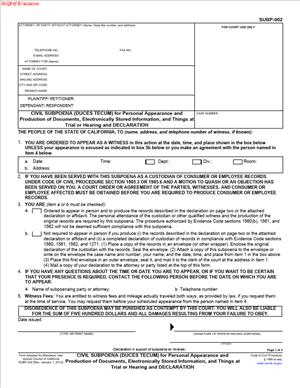
SUBP-002 – Civil Subpoena (Duces Tecum) for Personal Appearance and Production of Documents, Electronically Stored Information, and Things at Trial or Hearing and Declaration
Fill out nowJurisdiction: Country: United States | Province or State: California
The SUBP-002 – Civil Subpoena (Duces Tecum) for Personal Appearance and Production of Documents, Electronically Stored Information, and Things at Trial or Hearing and Declaration is a court form used in California civil cases. It orders a person to appear at a trial or hearing and bring specific documents or other items with them.
If you are preparing for trial and need records or evidence from someone who is not a party to the case, this form may become part of your preparation. It creates a formal, court-backed request. It is more than a simple letter asking for cooperation.
You might be representing yourself. You may feel unsure about how to get documents from a business, employer, or other third party. This form gives you a structured way to request those materials for use in court.
Because this document involves compelling someone’s attendance and production of evidence, accuracy matters. Small mistakes in dates, names, or descriptions can create delays. Understanding what the form does and how it works will help you complete it with confidence.
What is SUBP-002 – Civil Subpoena (Duces Tecum) for Personal Appearance and Production of Documents, Electronically Stored Information, and Things at Trial or Hearing and Declaration?
Clear definition
The SUBP-002 – Civil Subpoena (Duces Tecum) for Personal Appearance and Production of Documents, Electronically Stored Information, and Things at Trial or Hearing and Declaration is a subpoena used in California civil court. It requires a person to appear at a specific trial or hearing and to bring the listed materials with them.
“Duces tecum” means “bring with you.” In this context, it refers to documents, electronically stored information, or physical items. Electronically stored information can include emails, digital files, text messages, or database records.
This form is issued in connection with a pending court case. It includes details about the court, the case number, the parties involved, and the exact date and location where the person must appear. It also contains a declaration section that supports the request for the documents.
Who typically uses this form?
This form is commonly used by plaintiffs or defendants in civil cases in the California Superior Court. Attorneys often prepare and issue it as part of trial preparation.
Self-represented litigants also use it. If you are handling your own case and need records from a third party, this form may be the method available to formally request them for trial.
It is directed to non-parties in many situations. For example, a business, school, employer, or medical provider that is not part of the lawsuit may receive this subpoena.
Court clerks are involved in processing it. A judge does not usually need to sign it in routine situations, but it must be properly issued and served to take effect.
Why might you need this form?
You may need this form when important evidence is in someone else’s possession. Informal requests do not always work. A subpoena creates a legal obligation to respond.
If you expect a witness to testify and you also need their records, this form combines both requirements. It directs the person to appear and to bring specified materials at the same time.
This can be useful when documents are central to your claim or defense. Financial records, contracts, photographs, inspection reports, or communication logs are common examples.
The declaration section supports the request. It explains the relevance of the documents and helps show why the production is appropriate in connection with the hearing or trial.
Typical real-life scenarios
- In a personal injury case, you may need surveillance footage from a store where an accident occurred. The store is not a party to the case. A subpoena can require a representative to appear and bring the footage to court.
- In a contract dispute, a bank may hold records showing payments or transfers. If those records are essential to proving your claim, you may use this form to require a bank custodian to appear with certified copies.
- In an employment case, payroll records or internal communications may be important. If the employer is not directly part of the lawsuit, this subpoena can compel the appropriate person to bring those records to trial.
- In a property dispute, a contractor or inspector may have reports or photographs that clarify the condition of the property. The form can require their appearance along with the relevant documents or files.
- In a case involving digital communications, electronically stored information such as emails or system logs may be needed. The form allows you to describe those electronic materials specifically.
When would you use SUBP-002 – Civil Subpoena (Duces Tecum) for Personal Appearance and Production of Documents, Electronically Stored Information, and Things at Trial or Hearing and Declaration?
You would typically use this form when your case is moving toward a specific court date. The form is designed for use at a trial or a hearing, not just for general discovery.
If a hearing is scheduled on a motion and you need a third party to bring documents that support or oppose that motion, this form may be used. It ties the request directly to that court event.
If a trial is approaching and you realize a key witness holds documents you do not have, this form allows you to require both the witness and the materials to be present. It helps ensure the evidence is available when the judge or jury is listening.
It may also be used when prior informal requests were unsuccessful. If someone did not respond to a written request for records, a subpoena provides a formal mechanism backed by the court’s authority.
Plaintiffs, defendants, cross-complainants, and cross-defendants may all use this form, depending on who needs the evidence. The key factor is that there is an active civil case in the California Superior Court and a scheduled trial or hearing.
Timing matters. The subpoena must allow enough time for proper service and for the recipient to gather the requested materials. Late preparation can create practical challenges.
Legal characteristics of SUBP-002 – Civil Subpoena (Duces Tecum) for Personal Appearance and Production of Documents, Electronically Stored Information, and Things at Trial or Hearing and Declaration
This form has legal force because it is issued in connection with a court case. It includes the name of the court, the case title, and the case number. Those elements link it to an active proceeding.
For the subpoena to be effective, it must be properly completed and served. Service usually requires personal delivery to the named individual. Simply mailing it may not be enough in many situations.
The description of the requested documents must be clear and specific. Vague language can lead to objections or confusion. Overly broad requests may create disputes or motions to quash.
Errors in the hearing date, department number, or courtroom location can cause problems. If the subpoena lists the wrong time or place, the recipient may not appear, and enforcement becomes more complicated.
The declaration portion is also important. It typically explains why the documents are relevant to the issues in the case. In some circumstances, this explanation supports compliance and reduces challenges.
This form does not replace other types of subpoenas. There are separate forms for deposition subpoenas and for business records without personal appearance. Choosing the correct form depends on whether you need the person to appear in court and whether you need live testimony.
It also does not guarantee that the evidence will be admitted at trial. Even if documents are produced, the judge decides whether they meet evidentiary rules. The subpoena secures attendance and production, not automatic admissibility.
Procedural requirements may vary slightly depending on the type of records requested. For example, records that contain personal or confidential information can trigger additional notice requirements. Those differences often depend on the nature of the documents rather than the form itself.
Is it legally binding?
Yes, once properly issued and served, this subpoena is generally legally binding. It carries the authority of the court where the case is pending.
If the person named in the subpoena fails to appear or fails to bring the requested materials, the court may address that failure. Courts have the power to enforce subpoenas and, in some cases, impose consequences.
However, the obligation arises only if the subpoena is valid. If it was not properly issued, contains serious defects, or was not properly served, the person may challenge it. A motion to quash or modify a subpoena is a common procedural response.
The binding nature also depends on jurisdiction. A California state court subpoena generally applies within California. If the person or records are located outside the state, additional procedures may be required.
How to fill out SUBP-002 – Civil Subpoena (Duces Tecum) for Personal Appearance and Production of Documents, Electronically Stored Information, and Things at Trial or Hearing and Declaration
Step 1 – Complete the court and case information
At the top of the form, enter the name of the California Superior Court handling your case. Include the street address, city, and branch if applicable. Then fill in the case title exactly as it appears on other filings. Add the case number without changing any characters.
Step 2 – Identify the person being subpoenaed
In the section directing the subpoena, write the full legal name of the individual or entity being required to appear. Use a complete and accurate name. If you are directing it to a business, include the specific person or custodian of records if known.
Step 3 – State the date, time, and location of the trial or hearing
Enter the exact date, time, and department of the trial or hearing. Copy this information directly from the court’s notice or scheduling order. Accuracy here is critical because this tells the recipient when and where to appear.
Step 4 – Describe the documents, electronically stored information, or things to be produced
List the items the person must bring. Be specific. Identify categories by date range, subject matter, and type of record when possible. Clear descriptions reduce confusion and limit disputes about what is required.
If you are requesting electronic information, describe the format if relevant. For example, you might identify emails between certain dates or digital files stored in a particular system. Precision helps the recipient understand the scope.
Step 5 – Review the declaration section
Complete the declaration that explains the relevance of the requested materials. Provide a concise explanation of how the documents relate to the issues in the case. Keep the explanation factual and connected to the claims or defenses in dispute.
Sign and date the declaration where indicated. Your signature confirms that the statements are true to the best of your knowledge.
Step 6 – Arrange for issuance and service
After completing the form, follow the required process for issuing the subpoena in your case. This may involve the court clerk or an attorney of record. Once issued, arrange for proper service on the person named in the subpoena.
Service is usually carried out by someone who is not a party to the case and who meets the legal requirements for service. Provide that person with all necessary copies and instructions for delivery.
Step 7 – Prepare for the court date
After service, keep proof of service for your records. Bring a copy of the subpoena and proof of service to the trial or hearing. On the court date, be ready to identify the documents produced and explain their relevance as part of presenting your evidence.
Legal terms you might encounter in SUBP-002 – Civil Subpoena (Duces Tecum) for Personal Appearance and Production of Documents, Electronically Stored Information, and Things at Trial or Hearing and Declaration
- Subpoena: A court order that requires someone to do something, such as appear in court or produce evidence. In this document, the subpoena commands a person to attend a trial or hearing and bring specific items with them. It is not a request. It is a formal legal directive.
- Duces Tecum: A Latin phrase meaning “bring with you.” On this form, it means the person must not only appear but also bring documents, electronically stored information, or physical items listed in the subpoena. If the items are not brought, the person may be considered noncompliant.
- Electronically Stored Information (ESI): Digital data such as emails, text messages, spreadsheets, photos, databases, or files stored on computers or phones. When you list ESI on this form, you should describe it clearly, including date ranges and formats if relevant. Vague requests can cause objections or delays.
- Personal Appearance: The requirement that the person physically attend the trial or hearing. This form is different from a records-only subpoena because it requires the witness to show up in person. The appearance is tied to a specific date, time, and courtroom.
- Declaration: A written statement signed under penalty of perjury. This section confirms that the subpoena is properly issued and that the information provided is accurate. You must review this part carefully before issuance.
- Proof of Service: A separate document showing that the subpoena was properly delivered to the person named. Service must follow court rules. Without valid proof of service, the subpoena may not be enforceable.
- Witness Fees: Payment that must be provided to the person being subpoenaed at the time of service. These fees cover attendance and, in some cases, mileage. If you do not provide the required fees, the subpoena may be invalid.
- Custodian of Records: The person responsible for maintaining records for a business or organization. If you are subpoenaing documents from a company, you may name the custodian of records to ensure someone authorized brings the materials.
- Objection: A formal statement that the person being subpoenaed disagrees with the request. Objections may be based on privacy, privilege, burden, or relevance. If an objection is raised, you may need court involvement before enforcing the subpoena.
- Privilege: A legal protection that allows certain communications or records to be withheld. Common examples include attorney-client communications or certain medical records. If privileged materials are requested, they may not be produced unless a court orders it.
FAQs
Do I need a judge’s signature before using this document?
In many cases, the court clerk issues the subpoena once you complete it properly. You must check that the case number, court name, and party information match the official court record before submission. After issuance, confirm that the clerk has signed or stamped it as required, because an unsigned subpoena is not enforceable.
What exact information do I need to enter about the person being subpoenaed?
You must enter the person’s full legal name and a complete service address. If you are naming a business, identify an individual such as the custodian of records. Make sure the name matches public records or employment records so there is no confusion about who must comply.
How specific do I need to be when describing the documents or electronically stored information?
Be precise. Include date ranges, subject matter, and document types. For example, list “emails between January 1 and March 31 regarding contract negotiations” instead of “all emails.” Specific descriptions reduce objections and make enforcement easier if there is a dispute.
What happens if the trial date changes after I issue SUBP-002 – Civil Subpoena (Duces Tecum) for Personal Appearance and Production of Documents, Electronically Stored Information, and Things at Trial or Hearing and Declaration?
If the hearing date changes, the original command may no longer be valid for the new date. You will likely need to issue and serve a new subpoena with the updated information. Always confirm the current court date in the docket before serving this form.
Do I have to include witness fees when serving this document?
Yes, required witness fees and mileage must usually be provided at the time of personal service. Confirm the correct amount before arranging service. If fees are missing or incorrect, the person may refuse to comply.
Can I email or mail the subpoena instead of having someone personally deliver it?
Personal service is typically required for this type of subpoena. That means someone who is not a party to the case must physically hand it to the person named. Check that the proof of service form is completed accurately and filed if required.
What should I do if the person objects to producing certain records?
Review the written objection carefully. Compare it to the exact wording you entered in the description section of this document. If the objection relates to privilege or privacy, you may need to narrow your request or ask the court to resolve the dispute before the trial date.
Does filing SUBP-002 – Civil Subpoena (Duces Tecum) for Personal Appearance and Production of Documents, Electronically Stored Information, and Things at Trial or Hearing, and Declaration with the court automatically notify the other side?
Issuance alone does not always satisfy notice requirements. You may need to provide notice to other parties before serving the subpoena, depending on the type of records requested. Review the case rules to confirm you have met any notice obligations before proceeding.
Checklist: Before, During, and After SUBP-002 – Civil Subpoena (Duces Tecum) for Personal Appearance and Production of Documents, Electronically Stored Information, and Things at Trial or Hearing and Declaration
Before
- Confirm the exact trial or hearing date, time, and department.
- Verify the full legal name and service address of the witness.
- Draft a clear and specific list of documents or items to be produced.
- Check whether an advance notice to other parties is required.
- Calculate the correct witness fees and mileage.
- Prepare copies of the completed subpoena for service and your records.
- Review the declaration section for accuracy.
- Confirm you have the correct case number and party names as shown in court records.
During
- Submit the completed form to the court clerk for issuance if required.
- Confirm that the clerk signs or stamps the subpoena.
- Arrange for personal service by a non-party adult.
- Ensure witness fees are delivered at the time of service.
- Have the server complete a proof of service form.
- Monitor any objections received from the witness.
- Communicate professionally with the witness if clarification is needed.
After
- File the proof of service if the court requires filing.
- Calendar the appearance date and confirm it has not changed.
- Prepare to review the documents when produced.
- Bring copies of the subpoena to court on the hearing date.
- Be ready to explain the relevance of the requested items if questioned.
- Keep all correspondence related to compliance organized.
- Follow up promptly if the witness fails to appear or produce items.
Common mistakes to avoid with SUBP-002 – Civil Subpoena (Duces Tecum) for Personal Appearance and Production of Documents, Electronically Stored Information, and Things at Trial or Hearing and Declaration
- Mistake: Listing “all documents” without limits, which happens when you rush drafting, can trigger objections for overbreadth and delay your case; do not forget to narrow by date, subject, and document type.
- Mistake: Using an outdated court date because you relied on memory instead of checking the docket, which can invalidate the command; do not forget to confirm the current hearing information before issuance.
- Mistake: Failing to include witness fees at service, often due to overlooking payment rules, which can make the subpoena unenforceable; do not forget to verify and deliver the correct amount.
- Mistake: Naming only a business without identifying a responsible person, which creates confusion about who must appear; do not forget to specify a custodian of records or authorized representative.
- Mistake: Skipping proper personal service because mailing seems easier, which can result in noncompliance with no penalty; do not forget that personal delivery by a non-party is typically required.
- Mistake: Ignoring written objections from the witness, which happens when you assume compliance is automatic and can leave you without evidence at trial; do not forget to address objections promptly and seek court guidance if needed.
- Mistake: Forgetting to keep a copy of the signed and issued subpoena, which can create proof problems later; do not forget to store a complete copy with attachments and proof of service.
- Mistake: Describing electronically stored information without specifying format, which can lead to unusable data at trial; do not forget to state if you need native files, PDFs, or printed copies.
What to do after filling out SUBP-002 – Civil Subpoena (Duces Tecum) for Personal Appearance and Production of Documents, Electronically Stored Information, and Things at Trial or Hearing and Declaration
Once you complete the form, slow down and review every entry. Check spelling of names, accuracy of the case number, and the hearing details. Small errors can cause big delays.
Make at least two copies of the completed subpoena. One copy is for service. One is for your records. If you attach additional pages describing documents, copy those as well.
- Step 1: Submit the original subpoena to the court clerk for issuance if required in your case.
- Step 2: Confirm the clerk signs, stamps, or otherwise issues the subpoena.
- Step 3: Arrange for personal service by someone who is not involved in the case.
- Step 4: Provide the required witness fees and mileage at the time of service.
- Step 5: Ensure the server completes a proof of service form immediately after delivery.
- Step 6: File the proof of service with the court if filing is required.
- Step 7: Calendar the hearing date and set reminders to confirm it has not changed.
- Step 8: Organize a folder with the subpoena, proof of service, correspondence, and any responses.
- Step 9: Review any objections or communications from the witness and prepare to address them.
- Step 10: Prepare questions for the witness and plan how you will introduce the produced documents at trial.
Keep your records organized. If the witness brings documents to court, label and review them promptly. If items are delivered before the hearing, store them securely and maintain their condition.
Finally, prepare to explain to the judge why the testimony and documents matter. A subpoena gets the evidence to court. You are responsible for showing how that evidence supports your case.
Disclaimer: This guide is provided for informational purposes only and is not intended as legal advice. You should consult a legal professional.