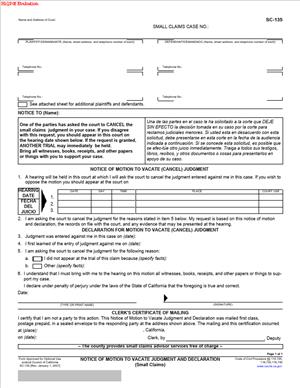
Form SC-135 – Notice of Motion to Vacate Judgment and Declaration
Fill out nowJurisdiction: United States — California
What is a Form SC-135 – Notice of Motion to Vacate Judgment and Declaration?
Form SC-135 is a California small claims court form. You use it to ask the court to cancel (vacate) a small claims judgment. It also lets you explain, under oath, why the judgment should be set aside. If the court grants your motion, the case is reopened. The court then sets a new hearing or takes other ordered steps.
You typically use this form if you missed the hearing. You also use it if you were never properly served with the claim. In other words, you did not get legal notice of the lawsuit before the hearing. You may also use this form if a serious mistake or surprise kept you from defending your case.
The form combines two things. It is a notice of your request to the court. It is also your declaration of facts to support that request. The court uses your declaration to decide whether to cancel the judgment.
You might need this form if the court entered a default judgment against you. That happens when you do not appear, and the other side wins. You might also need it if the court dismissed your claim when you did not appear. In either case, you ask the court to undo that result and reset the case.
Typical usage scenarios
You never received the small claims papers. You moved, and the plaintiff used an old address. You were in the hospital on the hearing date. Your car broke down on the way to court. You mixed up the date after getting conflicting notices. You sent a representative who could not present evidence. You had no notice of the judgment until weeks later. You discovered the judgment when your wages were garnished.
This form is specific to small claims cases. It does not apply to unlimited or limited civil cases. It also does not replace an appeal. If you appeared and lost, you likely need to consider the appeal process, not this motion. If you did not appear, Form SC-135 is the correct path to seek relief.
When Would You Use a Form SC-135 – Notice of Motion to Vacate Judgment and Declaration?
You use this form when you want the court to set aside a small claims judgment or dismissal. The most common trigger is a default judgment. That means you did not attend the small claims hearing, and the court ruled against you. If you had no fair chance to appear, this form is your remedy.
You also use it if you have never received proper service of the claim. For example, the plaintiff served an old address where you no longer live, or the service went to a business location that had closed. If you can show a lack of proper service, the court can vacate the judgment, even months later.
Tenants often use this form. A tenant might not get the court papers after a quick move, or the papers were left with a roommate who did not pass them on. Landlords use it too. A landlord might miss a hearing due to a medical emergency. Contractors and small business owners also use the form. They may be on job sites and miss a notice. Sole proprietors may receive mail at a shop location that has closed.
Drivers in car accident claims use it if the insurance mail got lost. Freelancers use it if a client sued at an old address. New business owners use it if they inherited mail problems after buying a company. Out-of-state defendants use it if they were not served in a way the law allows.
You can also use this form if your claim was dismissed because you did not appear. For example, a plaintiff misses the hearing due to the flu. The court dismisses the claim. The plaintiff can file to vacate the dismissal and reset the hearing.
Timing matters. You file quickly after you learn about the judgment. If you were served but missed the hearing, you must file within a short window after the court mailed the judgment. If you were never served, you can file within a longer window after you first learned of the judgment. You explain when and how you found out in your declaration.
If you did appear at the hearing, this form is not the right tool to correct a legal error. You would use other procedures for post-judgment relief or appeal. This form focuses on missed hearings, lack of notice, or excusable failure to appear.
Legal Characteristics of the Form SC-135 – Notice of Motion to Vacate Judgment and Declaration
This form is a sworn motion and declaration. When you sign it, you declare under penalty of perjury that your statements are true. That makes it legally significant. The court relies on your facts to decide whether to cancel the judgment. False statements can lead to penalties or sanctions.
The motion asks the court to exercise its authority to vacate a judgment. Small claims judges have the power to grant this relief. The law allows relief when you were not properly served. The law also allows relief for mistake, inadvertence, surprise, or excusable neglect. Your declaration shows how your situation fits those grounds.
Enforceability comes from the court’s order. If the judge grants the motion, the prior judgment is voided or set aside. The court then sets a new hearing or issues instructions. Both parties are bound by the new order. If the judge denies the motion, the original judgment stays in place. The judgment creditor can continue to collect, unless the court orders a stay.
Filing the motion does not always stop collection automatically. Some courts pause enforcement once a motion to vacate is filed. Others do not. You can ask the court for a stay of enforcement until your hearing. You can also reach out to the other side to pause collection by agreement. Do not assume a pause without confirmation.
Deadlines are strict. If you missed the hearing but were served, you must act quickly after the judgment notice was mailed. If you were not served, you must file within a set period after you first learned of the judgment. Your declaration should state the date you learned of the judgment and how you learned it. The judge will consider your timing.
This motion is not a chance to reargue a case you attended. If you were present and lost, use the appeal process if available. In small claims, appeal rights are limited. Only certain parties can appeal certain claims. Understand those limits before choosing a path. If you use the wrong tool, you risk missing your true deadline.
The court has options when ruling. It may grant the motion and reset the trial. It may partially grant relief. It may deny the motion. If it grants the motion, you must be ready to present your case at the new date. If it denies, collection may continue. Plan for both outcomes.
How to Fill Out a Form SC-135 – Notice of Motion to Vacate Judgment and Declaration
Follow these steps to complete and file the form properly.
1) Confirm your eligibility and deadline.
- Identify why you need relief. Missed hearing? No service? Serious mistake?
- Check when the court mailed the judgment. Look at the Notice of Entry of Judgment.
- If you were never served, note the date you first learned of the judgment.
- Act immediately. The clock starts when you receive notice or discover the judgment.
2) Gather basic case information.
- Case number from the judgment.
- Exact names of all parties, as listed on the small claims case.
- Date of the original hearing and date of the judgment.
- Your current mailing address, phone, and email for court notices.
3) Collect supporting proof.
- Copies of envelopes, mail forwarding notices, or returned mail.
- Proof of address change or move-in/move-out dates.
- Hospital or emergency records if illness caused your absence.
- Flight delays, tow receipts, repair bills, or weather alerts for travel issues.
- Work schedules, dispatch logs, or calendar screenshots showing conflicts.
- Any documents showing when you learned of the judgment (for example, a bank levy notice).
4) Complete the case caption at the top of the form.
- Enter the county name where the small claims case was filed.
- Enter the courthouse address exactly as on the judgment.
- Write the case number correctly. Double-check digits and letters.
- List plaintiff and defendant names exactly as shown on the case.
5) Identify yourself clearly.
- Check whether you are the plaintiff or defendant.
- If you are an authorized agent for a business, state your role.
- Use the business’s exact legal name if you appear for a business.
6) State what you are asking for.
- Check the box requesting to vacate (set aside) the judgment or dismissal.
- If you need a new trial date, say so.
- If you need more time to respond or prepare, explain briefly.
7) Explain why the judgment should be vacated.
- If you did not appear, state the reason in plain language.
- If you were not served, say you did not receive legal notice of the claim.
- Describe what went wrong: mistake, surprise, or excusable neglect.
- Keep facts specific: dates, times, locations, and who said what.
- Avoid conclusions. Stick to facts the judge can verify.
8) Give the timeline clearly.
- State the date you first learned about the judgment.
- Explain how you learned it, such as a mailed notice or a bank levy.
- If you were served late or wrongly, describe the defect with specifics.
- If you moved, list move dates and the new address.
9) Attach your evidence.
- Label each attachment (for example, “Exhibit A: Hospital Discharge Summary”).
- Refer to each exhibit in your declaration by its label.
- Include only relevant pages. Highlight key parts if allowed.
- Do not staple original evidence that you cannot replace. Attach copies.
10) Ask for a stay of enforcement if needed.
- If the collection has started, ask the court to pause enforcement.
- Explain any hardship that the collection will cause before your hearing.
- State that you will attend the motion hearing and the reset trial.
11) Request an interpreter if you need one.
- Tell the clerk early if you need language assistance.
- Note any disability accommodation you require to attend.
12) Review and sign the declaration.
- Read every line. Make sure facts are correct and complete.
- Sign under penalty of perjury. Date the form.
- Use blue or black ink if filing a paper original.
- If you are an agent, include your title and authority.
13) Make copies.
- Make at least two copies: one for you, one for each other party.
- Keep a full copy of everything you file and attach.
14) File with the small claims clerk.
- File at the same courthouse where the case was heard.
- Submit the original and your copies. Pay the filing fee.
- If you cannot afford the fee, ask the clerk how to request a fee waiver.
- Get a field-endorsed copy back for your records.
15) Confirm how the notice will be sent.
- Ask the clerk how the other side will be notified of your motion.
- Some courts mail your motion to the other parties.
- Other courts require you to arrange service by mail or in person.
- If service is your job, use a server who is over 18 and not a party.
- File a proof of service before the hearing if required.
16) Calendar your hearing.
- The clerk will set a hearing date for your motion.
- The date will appear on the filed copy or be mailed later.
- Make sure the hearing is on your calendar. Plan to attend.
17) Prepare for the hearing.
- Bring your filed motion, exhibits, and the judgment notice.
- Bring witnesses, photos, invoices, and messages, if helpful.
- Be ready to explain why you missed court or were not served.
- Be ready to show that you moved quickly to file once you learned of the judgment.
18) Attend the motion hearing.
- Arrive early. Check in with the courtroom clerk.
- When called, speak clearly and stick to facts.
- Answer the judge’s questions directly.
- Do not argue the entire case merits unless the judge invites it.
19) After the ruling, follow court orders.
- If granted, write down the new trial date and next steps.
- Ask if the court stayed the enforcement. Get clarity on the record.
- If denied, ask the judge about any further options or deadlines.
- Get a copy of the signed order for your records.
20) Prepare for the reset trial, if granted.
- Update your evidence and organize exhibits.
- Subpoena key witnesses early if needed.
- Practice your presentation. Keep it short and focused.
- Confirm all addresses for service of any new documents.
Practical tips:
- Be honest. Judges can spot gaps in timelines and facts.
- Keep the declaration tight. Use dates, names, and places.
- Explain why your reason counts as excusable. For example, a sudden hospital stay is excusable. Oversleeping usually is not.
- File as soon as you can. Delay weakens your motion.
- If the other party agrees, consider a stipulation. Some courts accept agreed vacatur. You still need a judge’s order.
- If you run a business, show how mail handling failed and what you fixed. Judges want to see that the problem will not happen again.
- Bring proof of identity and case documents to the clerk’s office.
- Keep your contact info current with the court. File any address change.
Common mistakes to avoid:
- Missing the deadline. File within the allowed time.
- Vague declarations. “I was busy” is not enough. Provide details.
- Forgetting proof. Attach documents that support your story.
- Skipping service. Make sure the other party gets notice as required.
- Assuming a stay. Confirm whether the collection is paused.
- Re-arguing the case merits at the motion stage. Focus on notice and excuse.
What success looks like:
- Your motion is timely and well-supported.
- You gave a clear, credible reason for missing the hearing or not getting served.
- Your evidence backs your reason and your timeline.
- You asked for reasonable relief: vacate judgment and reset trial.
- You are ready for the new hearing, with organized evidence.
By following these steps, you give the court what it needs to decide. You show diligence, honesty, and readiness to proceed. That increases your chances of getting the judgment vacated and your day in court.
Legal Terms You Might Encounter
- Motion means you are asking the court to take action. On this form, you ask the court to cancel a judgment.
- Vacate means cancel. When you ask to vacate a judgment, you want the court to set it aside.
- Judgment is the court’s final decision in your case. This form asks the court to undo that decision and reopen the case.
- Default judgment happens when you did not appear or respond. The court may have ruled without hearing from you. This form lets you ask for another chance.
- Service of process means how legal papers are delivered. You must serve your motion on the other party. The court needs proof of that.
- Proof of service is a document that shows you served the other party. You will attach or file it to confirm proper notice.
- Good cause is a valid reason the court accepts. You must show good cause for missing court or not responding.
- Excusable neglect means a reasonable mistake or oversight. You must explain what happened and why it was excusable.
- Declaration is your written statement under penalty of perjury. You sign this form to swear that the facts are true.
- Hearing is the date and time the court will consider your motion. The court may schedule it when you file.
- Stay means a pause in enforcing the judgment. You can ask the court to pause collection while your motion is pending.
- Opposition is the other party’s response to your motion. They may file reasons why the judgment should not be vacated.
- Clerk is the court staff member who takes in and processes filings. The clerk gives you dates, stamps, and basic instructions.
- Notice means formal written information about the motion or hearing. You must give notice to the other side and prove it.
FAQs
Do you need to use Form SC-135 for a default judgment?
Yes. If a judgment was entered without your participation, use this form. You ask the court to cancel the judgment and reopen the case. You must explain why you did not participate and why that reason is valid.
Do you have to attach proof of what happened?
Yes. Attach documents that support your reason. Use texts, emails, letters, medical records, travel records, or notices. Attach copies, not originals. Label each page. Explain how each document supports your reason in your declaration.
Do you need to serve the other party?
Yes. You must give the other party timely notice of your motion. Use a person over 18 who is not involved in the case. Or use a qualified service method that the court accepts. File a proof of service to show the court that service happened.
Do you have to pay a fee?
Often yes. There is usually a filing fee for a motion. If you cannot afford it, you can request a fee waiver. Ask the clerk for the right fee and waiver forms. File the waiver at the same time as your motion if needed.
Do you get a hearing on your motion?
In most cases, yes. The court sets a date and time to decide your motion. The clerk may give you a hearing date when you file. If not, you will receive a notice of hearing. You must appear and be ready to explain your reasons.
Do you need to act within a deadline?
Yes. Strict deadlines apply to motions to vacate a judgment. Do not wait. Check your judgment notice for dates. Ask the clerk about timelines if you are unsure. File as soon as you can.
Do you need to ask to pause the collection?
Yes, if you want the collection paused. You can ask the court to stay enforcement while the court decides your motion. Put the request on the form or in an attached declaration. The court decides whether to grant a pause.
Do you file one Form SC-135 per case?
Yes. You file one motion per case. Use the correct case number, party names, and court location. If you have multiple judgments in different cases, file separate motions.
Do you need to appear if you already explained everything on the form?
Yes. You should plan to attend the hearing. The judge may have questions. Bring proof and any witnesses. Be ready to answer questions about what happened and why you did not appear earlier.
What if the court denies your motion?
Ask the clerk what options exist. Options can include renewing your request in limited situations, filing another request based on new facts, or taking other post-judgment steps. Act quickly because timelines are short.
Checklist: Before, During, and After the Form SC-135
Before signing:
- Gather your case information. You need the case number, party names, and the judgment date.
- Collect the judgment notice you received. Note the mailing date and any service date.
- Write a clear reason for your request. Focus on why you missed the hearing or could not respond.
- Collect documents that prove your reason. Use copies of letters, emails, medical or travel records, or notices.
- Confirm current addresses for all parties. Check mailing and service instructions.
- Identify who will serve the papers. Choose a person over 18 who is not a party or a qualified server.
- Ask the clerk about the filing fee. Prepare a fee waiver request if you cannot afford the fee.
- Calendar deadlines. Filing deadlines are strict.
- Plan your request to pause enforcement if needed. Prepare a short statement explaining why a stay is needed.
- Make a checklist of exhibits. Label each exhibit and reference it in your declaration.
During signing:
- Check the court name and address on the form. Use the same court that issued the judgment.
- Match party names exactly as they appear in the case.
- Enter the correct case number on every page.
- State the judgment date accurately. Use the date on the notice or docket.
- Clearly explain why you did not appear or respond. Keep your explanation specific and factual.
- Connect each fact to an exhibit. For example, “See Exhibit A, airline receipt.”
- Select any boxes that ask for relief. Include a stay request if you want the collection paused.
- Provide your contact details. Include phone, email, and current mailing address.
- Sign and date the declaration. You sign under penalty of perjury. Check the date format.
- Review for errors. Confirm all attachments are included.
After signing:
- Make copies of the signed form and all exhibits. Keep one full set for yourself.
- File the form with the court. Pay the filing fee or submit your fee waiver.
- Ask the clerk for the hearing date. Write it down and calendar it.
- Serve a filed copy on the other party. Use a person over 18 who is not a party.
- Complete a proof of service. File it with the court before the hearing.
- Prepare your hearing packet. Include the filed motion, exhibits, and proof of service.
- Organize your testimony outline. Keep it short and focused on your reason and proof.
- Arrange time off for the hearing. Confirm travel and parking plans.
- Monitor your mail and email. Read any opposition from the other party.
- Bring two extra sets of exhibits to the hearing. One for the judge and one for the other party.
Common Mistakes to Avoid
- Don’t forget to explain the reason clearly. Vague statements like “I had an emergency” are not enough. The court needs specific facts and proof. If you are unclear, the court may deny your motion.
- Don’t miss the filing deadline. Deadlines for these motions are strict. Late motions can be rejected without a hearing. File as soon as possible.
- Don’t skip service or proof of service. If the other party is not served correctly, the court may not hear your motion. Always file a proof of service.
- Don’t file in the wrong court or with the wrong case number. The court will not process it. Use the same court and case number that issued the judgment.
- Don’t attach disorganized exhibits. Judges need clear labeling. If exhibits are messy, the judge may miss key proof. Label and reference each item in your declaration.
What to Do After Filling Out the Form
- File the form and exhibits. Bring two sets of copies. Ask the clerk to stamp your copies. Pay the fee or submit your fee waiver.
- Get a hearing date. The clerk may set a date at filing. If not, the court will send notice. Calendar the date and set reminders.
- Serve the other party. Use a server over 18 who is not a party. Mail or personal service may be required. Choose a method that the court accepts.
- File your proof of service. Use a proof of service form that matches your service method. File it before the hearing. Keep a copy for your records.
- Request a stay of enforcement if needed. If you want the collection paused, make the request in your motion. If not included, submit a short supplemental declaration. Explain the risk of harm if the collection continues.
- Prepare for the hearing. Outline your story in three parts. First, what happened before the judgment? Second, why you could not attend or respond. Third, what proof supports your reason? Practice a short, clear presentation.
- Organize your exhibits. Use tabs and a table of contents. Highlight the dates and names that matter. Mark each exhibit as you reference it. Bring spare copies for the court and the other party.
- Plan for witnesses. If someone can confirm your reason, ask them to attend. If they cannot attend, ask for a signed statement. The court decides how much weight to give written statements.
- Arrive early. Allow time for security and check-in. Dress neatly. Bring your ID, filed motion, exhibits, and proof of service.
- At the hearing, stay focused. Answer the judge’s questions first. Keep answers short and factual. Do not interrupt the other party.
- If your motion is granted. The court vacates the judgment. The case reopens. The court may set a new hearing on the claims. Prepare to present your full case. Bring all evidence on the original dispute, not just the motion.
- If your motion is partially granted. The court may adjust deadlines or narrow issues. Ask the judge to confirm the next steps. Write down new dates and requirements.
- If your motion is denied, ask the judge what happens next. Note any deadlines to pursue other options. Act quickly if you plan to take the next step. Keep copies of the order and calendar for all dates.
- Consider settlement. You can settle with the other party at any time. If you reach an agreement, tell the court in writing. Ask about forms to dismiss the motion or the case if it is resolved.
- Update your contact information. If you move or change numbers, tell the court in writing. This ensures you receive all notices.
- Store your records. Keep a full set of the filed motion, exhibits, proof of service, and the court’s order. Save digital copies as backup.
- If you cannot attend the hearing. Contact the clerk as soon as possible. Ask how to request a new date. Provide a written reason and proof if needed. The court may or may not continue the hearing.
- If the other party did not receive service. Fix it fast. Re-serve and file a new proof of service. Ask the clerk whether the court will keep or move the hearing date.
- If the collection continues during your motion. Confirm whether a stay was granted. If not, consider renewing your stay request. Provide updated facts that show harm from the ongoing collection.
- If you discover new facts after filing. Prepare a short supplemental declaration. File and serve it before the hearing. Bring copies to court and explain why the new facts matter.
- If the court needs more information. The judge may ask for more proof or declarations. Follow the instructions and deadlines exactly. Serve any new documents on the other party.
- If your address for the other party is unknown, use any last known address you have. Search recent communications for updates. Ask the clerk about acceptable service methods. Document your efforts to find a current address.
- If you want an interpreter, ask the clerk early. Do not wait until the hearing. Confirm whether you need to bring someone or if the court provides one.
- If you hired a server. Confirm they meet service rules. Ensure they give you a completed proof of service. Review it for accuracy before filing.
- If the judgment involved wage garnishment or bank levy. Tell the court if those actions are causing hardship. This can support a stay request. Bring proof of garnishment or levy.
- If the other party files an opposition. Read it carefully. Prepare a short response for the hearing. Bring documents that address each point they raise.
- If the judge rules from the bench. Ask for a copy of the signed order. Confirm the next hearing date or deadlines. Follow all instructions in the order.
- If the court mails the ruling later. Watch your mail. When you get the order, read it right away. Calendar all listed dates.
- If the motion is granted and the case reopens. Prepare your evidence on the original dispute. Identify witnesses and key documents. Organize invoices, contracts, photos, and communications. Be ready for the merits hearing.
- If you settle after the judgment is vacated. Put the agreement in writing. File a dismissal or tell the court the case is resolved. Confirm whether any funds must be returned.
- If the motion is denied and collection is ongoing. Keep proof of all payments or garnishments. Ask about options to challenge or modify the collection. Act within any deadlines.
- If you need certified copies, ask the clerk for certified copies of filings or orders. Keep them for employers, banks, or agencies if needed.
- If you need more time to gather proof. Ask the clerk how to request a continuance. File a short declaration that shows a good reason. Serve the other party.
- If you made a mistake on the form. File an amended motion if allowed. Mark it “Amended” and explain the correction. Serve it and file a new proof of service.
- If you used the wrong court location. Withdraw the filing and refile in the correct location. Ask the clerk how to correct the record. Calendar the new hearing date.
- If you move after filing. File a notice of change of address. Serve it to the other party. Keep proof of service.
- If you want to withdraw your motion. File a written request to take it off the calendar. Serve the request on the other party. Confirm the cancellation with the clerk.
- If you are unsure about any step. Ask the clerk what the local process requires. Follow the form instructions closely. Keep copies of everything you submit.
Disclaimer: This guide is provided for informational purposes only and is not intended as legal advice. You should consult a legal professional.