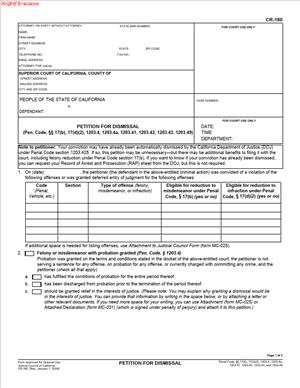
CR-180 – Petition for Dismissal
Fill out nowJurisdiction: Country: United States | Province or State: California
The CR-180 – Petition for Dismissal is a court form used in California criminal cases. It allows you to ask the court to dismiss a conviction from your record under specific legal rules. If you are preparing to fill it out, you are likely trying to clear or improve your criminal record after completing certain requirements.
This form is filed with the Superior Court of California in the county where your case was handled. It is not used to challenge a conviction or argue that you were not guilty. Instead, it is a request for relief after your case is already closed.
For many people, this document is part of moving forward. A dismissal can improve employment opportunities and reduce barriers in housing or licensing. Understanding what the form does and what it does not do is essential before you begin filling it out.
When you complete CR-180 – Petition for Dismissal, you are formally asking a judge to review your case history and determine whether you qualify for dismissal under California law. The form collects information about your conviction, sentence, and compliance with court terms.
What is CR-180 – Petition for Dismissal?
Clear definition
CR-180 – Petition for Dismissal is a written request submitted to a California Superior Court asking that a criminal conviction be dismissed. It is commonly used after probation has been completed or after certain sentencing conditions have been satisfied.
A dismissal under this process does not erase or seal your record. Instead, it changes the status of the conviction. In many situations, the court withdraws your plea of guilty or no contest and enters a plea of not guilty, then dismisses the case.
This form is part of a formal court procedure. The judge reviews your eligibility and decides whether to grant or deny the request. Filing the document starts the review process.
Who typically uses this form?
People who have been convicted of certain misdemeanors or felonies in California often use this form after completing probation. It is frequently used by individuals who did not serve time in state prison for the offense, although there are exceptions.
You might use this form if you completed probation successfully and met all court-ordered conditions. In some cases, people who were not placed on probation may also qualify if they completed their sentence and remained law-abiding for a required period.
Self-represented individuals commonly file this document on their own. Others may have assistance from a legal professional, but the form is designed so individuals can complete it directly.
Why might you need this form?
You may need this form if you are applying for a job and want to show that your conviction was dismissed. Many employers ask about criminal history, and a dismissal can affect how you respond.
You might also need it when applying for professional licenses. Licensing boards often review criminal records carefully. A dismissal can show that you completed court requirements and sought formal relief.
Housing applications are another common reason. Landlords sometimes conduct background checks. While a dismissal does not remove the record, it may demonstrate rehabilitation.
In some cases, people pursue dismissal for personal reasons. Clearing the case status can provide a sense of closure and recognition of compliance with court orders.
Typical real-life scenarios
- You completed three years of probation for a misdemeanor offense. You paid all fines, attended required classes, and had no new arrests. Now you want the court to dismiss the conviction so your record reflects that you met your obligations.
- You were convicted of a felony that was later reduced to a misdemeanor. After finishing probation, you seek dismissal to improve your employment prospects. Filing this form starts that process.
- You were not placed on probation, but completed your sentence and remained law-abiding. Enough time has passed that you may qualify for dismissal. You use the form to ask the court to review your eligibility.
- You are applying for a state license, and the application asks about dismissed convictions. You decide to request a dismissal before submitting your licensing paperwork, so you can accurately report the updated case status.
When would you use CR-180 – Petition for Dismissal?
You would use CR-180 – Petition for Dismissal after your criminal case is finished and you believe you meet the legal requirements for dismissal. The case must already be closed. This form is not used while charges are pending.
Many people file it after completing probation successfully. Completion usually means you followed all conditions, paid fines or restitution, and did not violate probation terms. If probation was terminated early, that may also affect timing.
In some situations, you may use the form even if you did not receive probation. Eligibility may depend on the type of offense, the sentence imposed, and the amount of time that has passed since you completed the sentence.
You would not use this form to seal juvenile records. That is a different process. You also would not use it to challenge the conviction itself. Appeals and motions to withdraw a plea involve separate procedures.
Typically, the person who files the form is the defendant in the original criminal case. The prosecutor may review the request, and a judge ultimately decides whether to grant it.
If you have multiple cases, you generally file a separate form for each case number. Each conviction is reviewed individually by the court.
Legal characteristics of CR-180 – Petition for Dismissal
This form is a formal court filing. It becomes part of your criminal case record. Accuracy and completeness matter because the court relies on the information you provide.
For the petition to be effective, it must be filed in the correct county and reference the correct case number. The charges, conviction date, and sentencing details must match the court’s records. Even small errors can delay processing.
The judge reviews statutory eligibility requirements. These often include successful completion of probation, payment of fines, and no current charges or sentences. If you do not meet eligibility standards, the court may deny the request.
Common problems include listing the wrong code section, failing to indicate whether restitution was paid, or leaving required sections blank. Missing signatures or incorrect case information can also cause rejection or delay.
High-level differences may exist depending on the type of conviction. Some offenses are not eligible for dismissal under standard procedures. Certain serious or violent offenses may have separate rules or may not qualify at all.
This form does not automatically restore firearm rights. It also does not prevent certain government agencies from accessing your conviction record. The dismissal changes the status of the conviction but does not erase the historical fact that it occurred.
It also does not seal or destroy records. Background checks may still show the case, often with a notation that it was dismissed. Different agencies and employers may interpret that information differently.
Is it legally binding?
When a judge signs an order granting dismissal, that order becomes legally effective. The court record is updated to reflect the dismissal. At that point, the change in status is official.
The binding effect comes from the judge’s signed order, not from the petition itself. Filing the form does not automatically grant relief. The court must approve it.
If the petition is denied, the original conviction remains in place. In some cases, you may be able to file again later if circumstances change, such as completing outstanding obligations.
The legal impact of a dismissal depends on context. For many private employment situations, a dismissed conviction may be treated differently from an active conviction. However, certain government entities may still consider the conviction for specific purposes.
How to fill out CR-180 – Petition for Dismissal
Step 1 – Identify the court and case information
At the top of the form, enter the name of the Superior Court and the county where your case was handled. Fill in your full name and current contact information in the space provided. Carefully write the exact case number as it appears on your court documents. Accuracy here ensures the court can locate your file without delay.
Step 2 – Provide your conviction details
List the specific charges for which you are requesting dismissal. Include the code section numbers and the date of conviction. Make sure these details match the court’s records. If you have more than one conviction in the same case, identify each one clearly in the space provided.
Step 3 – Indicate your eligibility basis
The form asks you to show why you qualify for dismissal. This often includes confirming that you completed probation or fulfilled all sentence requirements. Read each option carefully and mark the one that applies to your situation. Only select statements that accurately reflect your case history.
Step 4 – Address restitution and compliance
You may need to confirm that all fines, fees, and restitution have been paid. If restitution was ordered, ensure your records reflect payment or a completed payment plan. The court considers compliance with financial obligations when reviewing the petition.
Step 5 – Sign and date the petition
After reviewing all entries for accuracy, sign and date the form where indicated. Your signature confirms that the information is true to the best of your knowledge. An unsigned form may be rejected or returned.
Step 6 – Prepare for filing and court review
Make copies of the completed form for your records before submission. File the original with the appropriate Superior Court clerk’s office. After filing, the court may set a hearing date or review the request without a hearing, depending on the circumstances. The judge will then issue a decision granting or denying the dismissal.
Legal terms you might encounter in CR-180 – Petition for Dismissal
- Petitioner: This is you, the person asking the court to dismiss a conviction. Your name must appear exactly as it does in the court’s records. If your name has changed, you still list the name used in the criminal case and make sure the case number matches.
- Conviction: A conviction means the court found you guilty, either because you pleaded guilty or no contest, or because you were found guilty at trial. This form asks you to list each conviction you want dismissed. You must identify the correct code section and the date of conviction.
- Probation: Probation is a period of supervision instead of jail or prison. The court will look at whether you successfully completed probation. This form asks you to confirm that you met all conditions or explain if probation was terminated early.
- Early Termination of Probation: This means the court ended your probation before the scheduled date. If that happened, you may need to note it in your request. It can affect your eligibility for dismissal.
- Restitution: Restitution is money you were ordered to pay to a victim for losses related to the crime. The court may check whether restitution was paid or is still owed. Dismissal does not automatically erase restitution obligations.
- Interests of Justice: This phrase refers to the court’s discretion to grant relief if it believes doing so is fair and appropriate. In some cases, even if you did not meet every technical requirement, you may ask the court to consider the interests of justice. You may need to provide facts that support why dismissal is appropriate.
- Case Number: The case number is the unique identifier assigned to your criminal case. You must enter it exactly as shown on court documents. A wrong number can delay processing or result in rejection.
- Relief Requested: This section tells the court exactly what you want. On this form, you are asking the court to withdraw your plea or set aside the verdict and dismiss the case. The wording matters because it determines what the court will order if your request is granted.
- Declaration: A declaration is a written statement you sign under penalty of perjury. By signing, you confirm that the information you provided is true and correct. False statements can lead to serious consequences.
- Order for Dismissal: If the judge approves your request, the court will issue an order dismissing the conviction. This order becomes part of your official court record. You may need certified copies for employment or licensing purposes.
FAQs
Do I need to list every case on this form or just one?
You must list each case you are asking the court to dismiss. If you have multiple convictions in different case numbers, you may need a separate form for each case number. Check that the case number, conviction date, and code section match exactly what appears in your court record.
What information do I need in front of me before completing CR-180 – Petition for Dismissal?
You should have your sentencing paperwork, probation order, and proof of completion of any required programs. You will need the exact charge, code section, conviction date, and confirmation of whether probation was completed or terminated early. Having these documents helps you avoid mistakes in the details you enter.
What if I still owe restitution when I file this document?
You must be honest about the status of restitution. The court may still consider your request, but unpaid restitution can affect how the judge views your compliance with court orders. This form does not erase restitution balances, and you should not assume payment obligations disappear after dismissal.
How do I know if I am eligible to file this form?
Eligibility depends on factors such as the type of conviction, how you completed probation, and whether you have new charges. You need to confirm that you fulfilled the terms of probation or that the court terminated probation early. Review your court record carefully to make sure you meet the stated requirements before filing.
Will a dismissal completely erase my record?
A dismissal changes how the conviction is shown in your record, but it does not completely erase the case. The record will still show that a case existed, but it will indicate that the conviction was dismissed. You should understand what changes in the public record before you rely on it for employment or licensing purposes.
Who signs this document?
You must sign it yourself unless you have an attorney representing you. Your signature appears under a declaration that the information is true. Make sure you sign and date the form where indicated, or the clerk may reject it.
What happens after I submit CR-180 – Petition for Dismissal?
The court will review your request and may set a hearing or decide based on the paperwork. If the judge grants the request, the court will issue an order of dismissal. You should obtain a copy of that order for your records and confirm it has been entered into the case file.
Can I correct the form if I realize I made a mistake after filing?
If you notice an error, act quickly. You may need to file an amended document or notify the clerk before the judge reviews it. Make sure any corrected version clearly references the same case number and replaces the earlier filing to avoid confusion.
Checklist: Before, During, and After CR-180 – Petition for Dismissal
Before
- Confirm you are eligible based on probation status and the type of conviction.
- Gather court documents showing conviction date, code section, and case number.
- Verify whether probation was completed or terminated early.
- Check the status of restitution and other financial obligations.
- Make sure there are no pending charges that could affect your request.
- Review your criminal history to ensure all information is accurate.
- Prepare any supporting documents that explain special circumstances.
During
- Enter the court name exactly as shown on your prior paperwork.
- Write your full legal name as it appears in the case record.
- Double-check the case number for accuracy.
- List each conviction with the correct code section and date.
- Clearly indicate how you completed probation.
- Answer every section; do not leave required fields blank.
- Sign and date the declaration where required.
- Review the entire form for spelling and number errors.
After
- Make at least two copies of the completed form.
- File the original with the correct court location.
- Request a filed-stamped copy for your records.
- Calendar any hearing date if one is scheduled.
- Monitor the case status to confirm the judge’s decision.
- Obtain a copy of the signed dismissal order if granted.
- Keep copies of all documents in a safe place.
- Update personal records or background check files as needed.
Common mistakes to avoid with CR-180 – Petition for Dismissal
- Mistake: Entering the wrong case number because you rely on memory, which can lead to rejection or dismissal of the wrong case; always verify directly from official court paperwork, and do not forget to match every digit.
- Mistake: Listing the wrong code section due to confusion about amended charges, which can delay review; check the final conviction statute, and do not forget that the original charge may have changed.
- Mistake: Claiming probation was completed without confirming court records, which can damage credibility; verify dates, and do not forget to account for extensions or violations.
- Mistake: Forgetting to sign the declaration, often because you focus on the main sections first, which results in the clerk refusing to file it; always review the signature line before submitting.
- Mistake: Assuming dismissal erases restitution automatically, which can create financial and legal problems; remember that payment obligations may remain, and do not forget to check your balance.
- Mistake: Filing in the wrong courthouse because you moved, which causes delays and returned paperwork; confirm the original sentencing court and do not forget that jurisdiction stays with that court.
- Mistake: Leaving sections blank because you think they do not apply, which can result in incomplete filings; write “not applicable” where appropriate, and do not forget to address every required field.
- Mistake: Waiting until a job offer is pending to start the process, which creates time pressure and stress; plan ahead, and do not forget that court processing times can vary.
What to do after filling out CR-180 – Petition for Dismissal
Once you complete the form, slow down and review it line by line. Check names, dates, and numbers. Small errors can cause delays.
- Step 1: Make at least two clean copies of the signed form, one for you and one for your records after filing.
- Step 2: Organize any supporting documents you plan to submit with the petition.
- Step 3: Submit the original to the Superior Court of California in the county where you were convicted.
- Step 4: Ask the clerk to file-stamp your copies so you have proof of filing.
- Step 5: Confirm whether a hearing will be scheduled or if the judge will decide based on the paperwork.
- Step 6: Check your mail and court docket regularly for updates or notices.
- Step 7: If a hearing is set, prepare a short, clear explanation of why you meet the requirements and bring proof of completed probation or programs.
- Step 8: After the judge makes a decision, obtain a copy of the signed order.
- Step 9: Store the dismissal order with your important records in both paper and digital form.
- Step 10: If the dismissal is granted, consider requesting an updated copy of your criminal record to confirm it reflects the change.
Keep everything organized. Create a simple folder labeled with your case number. Include the petition, copies, proof of filing, and the final order. If you apply for jobs or licenses in the future, you may need quick access to these documents.
Stay proactive. Follow up if you do not receive confirmation within a reasonable time. Courts process many requests, and tracking your case helps you avoid missed deadlines or misunderstandings.
Disclaimer: This guide is provided for informational purposes only and is not intended as legal advice. You should consult a legal professional.