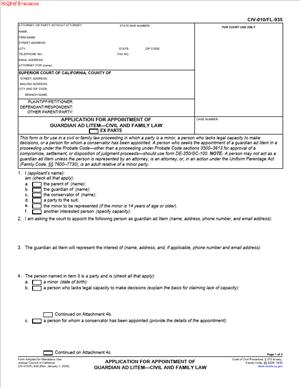
CIV-010 or FL-395 – Application for Appointment of Guardian Ad Litem—Civil and Family Law
Fill out nowJurisdiction: Country: United States | Province or State: California
If you are involved in a court case in California and a child or a legally incapacitated person is part of the case, the court may require a responsible adult to step in and act on that person’s behalf. The CIV-010 or FL-395 – Application for Appointment of Guardian Ad Litem—Civil and Family Law is the form used to ask the court to approve that arrangement.
This document is filed in the California Superior Court. It formally requests that the judge appoint a guardian ad litem for someone who cannot legally represent themselves in a lawsuit or family law matter.
You might be filling this out because a minor is suing someone, being sued, or is part of a custody or support case. You might also be involved in a case where an adult lacks legal capacity due to disability or other limitations.
The form is not about becoming a long-term guardian. It is specific to one court case. It allows someone to make decisions and act within that case only.
When you are about to complete this filing, you need to understand who qualifies, what the court expects, and how the appointment affects the case. The details matter because the court relies on this information before allowing someone to speak and act for another person.
What is CIV-010 or FL-395 – Application for Appointment of Guardian Ad Litem—Civil and Family Law?
Clear definition
The CIV-010 or FL-395 – Application for Appointment of Guardian Ad Litem—Civil and Family Law is a court form used to ask a judge to appoint a guardian ad litem in a civil or family law case.
A guardian ad litem is an adult appointed by the court to represent the interests of a minor or a person who lacks legal capacity during a specific lawsuit. This role exists only for the duration of that case.
In California, minors generally cannot file or defend a lawsuit on their own. Similarly, adults who are legally incapacitated may not be able to make decisions in court proceedings. This form starts the process of giving someone authority to act on their behalf in that case.
The form identifies the person who needs representation, the proposed guardian ad litem, and the nature of the case. It also includes a declaration explaining why the appointment is necessary.
Who typically uses this form?
Parents commonly use this form when their child is involved in a lawsuit. For example, if a minor is injured in an accident and a claim is filed, a parent may apply to be appointed as guardian ad litem.
Relatives or close family friends sometimes use it when a parent is unavailable or unable to serve. In those cases, the court reviews the relationship and the reasons for the request.
Attorneys may prepare the form on behalf of a client, but the proposed guardian ad litem must sign it personally. The role is not automatic, even for a parent.
In family law cases, a party may use this form if a minor is a named party in the case. This is less common in custody matters but can arise in certain support or property issues.
Adults seeking to represent an incapacitated adult in a civil case may also use the form. The court will look closely at the nature of the incapacity and the relationship between the parties.
Why might you need this form?
You need this form when the person involved in the case cannot legally represent themselves. Courts require a formal appointment before someone can file papers or make decisions for a minor or incapacitated adult.
Without a guardian ad litem, the court may refuse to proceed with the case. Filings submitted without proper authority may be rejected.
The appointment protects the rights of the person who lacks capacity. It ensures that someone responsible is making informed decisions about settlements, court appearances, and legal strategy.
The court also uses this process to prevent conflicts of interest. It wants to be sure the proposed guardian ad litem is acting in the best interest of the person they represent.
Typical real-life scenarios
- A child is injured in a car accident. A parent wants to file a personal injury lawsuit on the child’s behalf. Before the case can move forward, the parent must be appointed as guardian ad litem through this form.
- A minor is named as a defendant in a property damage claim. The court requires an adult to step in and respond to the lawsuit on the minor’s behalf.
- An adult with a developmental disability is involved in a contract dispute. A trusted family member applies to be appointed guardian ad litem so they can manage the litigation decisions.
- A family law case involves property held in a minor’s name. The court requires formal representation for the minor before approving any agreement affecting their interest.
- A settlement is reached in a civil case involving a child. Before the court can approve the settlement, it confirms that a properly appointed guardian ad litem is in place.
When would you use CIV-010 or FL-395 – Application for Appointment of Guardian Ad Litem—Civil and Family Law?
You would use this form at the beginning of a case or as soon as it becomes clear that a minor or incapacitated person is involved as a party. Timing matters because the court generally expects the appointment before substantive steps are taken.
In civil cases, this often happens when filing the complaint. If the minor is the plaintiff, the application may be submitted at the same time as the initial filing. If the minor is the defendant, it may be filed after service of the lawsuit.
In family law cases, the need may arise when a minor is formally named as a party. This is different from custody disputes, where children are usually not direct parties. Instead, this form is used when the law requires a minor’s independent representation in the case.
You may also use this form if an adult party becomes unable to participate due to incapacity. The court may require documentation or explanation supporting the need for a guardian ad litem.
If you are already in the middle of a case and realize that a party lacks legal capacity, the application can be filed at that stage. The court will review whether previous actions need to be confirmed or corrected after the appointment.
Legal characteristics of CIV-010 or FL-395 – Application for Appointment of Guardian Ad Litem—Civil and Family Law
This form is a formal request to the court. It becomes effective only after a judge signs the order appointing the guardian ad litem. Simply completing and filing it does not create authority.
The document requires identification of the minor or incapacitated person, the proposed guardian ad litem, and the nature of the relationship between them. The court evaluates whether the proposed guardian is suitable and free of conflicts.
Common reasons for rejection include incomplete information, missing signatures, or failure to clearly explain why the appointment is necessary. Inaccurate case numbers or party names can also delay approval.
The court may look for signs of a conflict of interest. For example, if the proposed guardian could benefit financially at the expense of the minor, the judge may deny the request.
California procedures may vary slightly between civil and family law departments, even within the same Superior Court. Some courts require additional local forms or hearings. The basic purpose of the application remains the same.
This form does not create permanent guardianship. It does not grant custody rights or control over the person’s property outside the lawsuit. Its authority is limited to the specific case listed in the caption.
It also does not decide the outcome of the case. The guardian ad litem represents the person’s interests, but the judge still makes all legal rulings.
Is it legally binding?
The application itself is not legally binding until the court approves it. Once the judge signs the order appointing the guardian ad litem, that appointment becomes legally effective.
After the appointment, the guardian ad litem has the authority to make decisions within the case. This can include hiring an attorney, approving settlements, and filing documents.
The authority lasts for the duration of the case unless the court removes or replaces the guardian ad litem. It does not automatically extend to other legal matters.
Because the appointment is made by court order, it carries legal weight. Other parties and the court must recognize the guardian ad litem as the representative for the minor or incapacitated person in that case.
How to fill out CIV-010 or FL-395 – Application for Appointment of Guardian Ad Litem—Civil and Family Law
Step 1 – Identify the court and case information
At the top of the form, enter the name of the California Superior Court where the case is filed. Include the street address, city, and branch name if required. Fill in the case number exactly as it appears on other court documents. Accuracy here prevents filing delays.
Step 2 – List the parties
Write the full legal names of the plaintiff and defendant exactly as shown in the case caption. If the case has already been filed, match the spelling and formatting used in prior filings. Consistency is important because the court tracks cases by these names.
Step 3 – Identify the person who needs a guardian ad litem
Provide the full name of the minor or incapacitated person. Indicate whether the person is a minor or an adult lacking legal capacity. This section clarifies who will be represented and why the appointment is required.
Step 4 – Provide information about the proposed guardian ad litem
Enter the full name, address, and contact information of the person seeking an appointment. State the relationship to the minor or incapacitated person, such as parent, relative, or family friend. The court uses this information to assess suitability.
Step 5 – Explain the reason for the appointment
In the space provided, briefly describe why the person cannot represent themselves. For a minor, this is typically based on age. For an adult, you may describe the nature of the incapacity in general terms. Keep the explanation factual and clear.
Step 6 – Disclose any potential conflicts
Some versions of the form require a statement confirming that the proposed guardian has no interests adverse to the person being represented. Read this section carefully and complete it truthfully. The court relies on this declaration.
Step 7 – Signature of the proposed guardian ad litem
The proposed guardian must sign and date the form. By signing, they confirm their willingness to serve and to act in the best interest of the person they represent. Unsigned forms are typically rejected.
Step 8 – Attorney information, if applicable
If an attorney is involved, the attorney’s name, address, and contact information may need to be included in the designated section. If there is no attorney, that portion may be left blank or marked accordingly, depending on the form’s layout.
Step 9 – Review for completeness and accuracy
Before submitting, read through the entire document. Check spelling of names, the case number, and all signatures. Make sure every required section is filled in. Incomplete forms often cause delays.
Step 10 – File the form with the court
Submit the completed form to the clerk of the California Superior Court handling the case. The court will review the application and, if approved, issue an order appointing the guardian ad litem. The appointment becomes effective once the judge signs that order.
Legal terms you might encounter in CIV-010 or FL-395 – Application for Appointment of Guardian Ad Litem—Civil and Family Law
- Guardian ad litem: A guardian ad litem is a person appointed by the court to act for someone who cannot represent themselves in a case. This is often a minor child or an adult who lacks legal capacity. On this form, you identify who will serve in that role and confirm they agree to take on the responsibility.
- Minor: A minor is a person under 18 years old. If a minor is a party in a lawsuit, they cannot appear in court on their own. The form requires you to clearly state the minor’s name and confirm that a guardian ad litem is needed to act on their behalf.
- Incompetent person: This refers to an adult who cannot understand the nature of the legal proceedings or assist in their own case. The form may use this term when the appointment is for someone over 18 who lacks legal capacity. You must indicate the reason the person cannot represent themselves.
- Proposed guardian: The proposed guardian is the individual you are asking the court to appoint. On the form, this person must provide identifying information and confirm they are willing to serve. The court will review this information before approving the appointment.
- Party: A party is someone directly involved in the case, such as a plaintiff, defendant, petitioner, or respondent. The guardian ad litem steps into the case on behalf of a party that cannot act alone. The form requires you to identify the role the person holds in the case.
- Petitioner: In family law matters, the petitioner is the person who started the case by filing the initial paperwork. If the person needing a guardian ad litem is the petitioner, you must state that clearly on the form.
- Respondent: The respondent is the person responding to a case filed by someone else. If the respondent is a minor or lacks capacity, the form must reflect that and request appointment of a guardian ad litem for them.
- Conflict of interest: A conflict of interest exists if the proposed guardian’s interests differ from or oppose the person they would represent. The form asks you to disclose any potential conflicts. The court wants to ensure the guardian can act solely in the best interests of the person they represent.
- Declaration: A declaration is a written statement made under penalty of perjury. When the proposed guardian signs the form, they are making a declaration that the information is true and that they agree to serve.
- Appointment order: The appointment order is the court’s official approval of the guardian ad litem. Filing the application does not automatically create the appointment. The guardian’s authority begins only after the judge signs and the order is entered into the court record.
FAQs
Do I need a court order before the guardian ad litem can act?
Yes. Submitting this document does not give the proposed guardian authority. The judge must review the information and sign an order approving the appointment. Only after the signed order is entered into the court record can the guardian ad litem file papers, appear in court, or make decisions in the case.
Who can be listed as the proposed guardian on this form?
The person must be an adult and capable of understanding the responsibilities. Many people choose a parent, close relative, or trusted adult. You must enter the person’s full legal name and contact details exactly as they appear on identification so the court record is accurate.
What information must match the existing court case?
The case number, court name, and party names must match the original petition or complaint exactly. Even small spelling differences can cause delays. Before you file, compare this form line by line with your earlier filings to confirm consistency.
Does the proposed guardian have to sign the CIV-010 or FL-395 – Application for Appointment of Guardian Ad Litem—Civil and Family Law?
Yes. The proposed guardian must sign to confirm they agree to serve. Without that signature, the court will usually reject or delay the application. Make sure the signature is placed in the correct section and dated properly.
When does the appointment become effective?
The appointment becomes effective on the date the judge signs the order, and it is filed by the court clerk. The effective date is important because actions taken before that date may not be recognized. Always confirm the signed order appears in the case docket.
Will the guardian ad litem’s name become part of the public court record?
Yes. Once appointed, the guardian’s name appears in the case record. This means court documents and hearing notices may list them as acting for the minor or incapacitated person. You should confirm that the spelling and contact information are correct before filing.
Can the same guardian ad litem serve for more than one child in the same case?
Often, yes, if there is no conflict of interest between the children. You must clearly list each child’s name in the appropriate section. The court will review whether one person can fairly represent all listed minors.
What happens if the court rejects this document?
If the clerk or judge finds missing information, unsigned sections, or inconsistencies, the court may return it for correction. You will need to fix the specific issues noted and resubmit. Review every field carefully before filing to reduce the risk of rejection.
Checklist: Before, During, and After CIV-010 or FL-395 – Application for Appointment of Guardian Ad Litem—Civil and Family Law
Before
- Confirm the correct case number and court location.
- Verify the full legal names of all parties from prior filings.
- Choose a proposed guardian who understands the responsibilities.
- Discuss the role and time commitment with the proposed guardian.
- Check for any potential conflicts of interest.
- Gather accurate contact information for the proposed guardian.
- Review previous court documents for consistency.
- Make sure you understand why the appointment is required.
During
- Enter the court name exactly as it appears on prior documents.
- Write the case number clearly and completely.
- Identify whether the person needing representation is a petitioner or a respondent.
- Spell the minor’s or incapacitated person’s name correctly.
- Provide full details for the proposed guardian.
- Complete every required checkbox and line.
- Ensure the proposed guardian signs and dates the form.
- Double-check that no required sections are left blank.
After
- Make at least two copies of the completed form.
- File the original with the court clerk.
- Confirm the clerk stamps your copies as filed.
- Monitor the case for a signed appointment order.
- Obtain a copy of the signed order once issued.
- Provide copies of the order to all relevant parties.
- Keep a copy in a secure file for your records.
- Update any case management notes to reflect the appointment.
- Bring the signed order to future hearings if needed.
Common mistakes to avoid with CIV-010 or FL-395 – Application for Appointment of Guardian Ad Litem—Civil and Family Law
- Mistake: Listing a nickname instead of a full legal name, which happens when people copy informal documents; this can lead to confusion in the court record, so do not forget to use the exact legal names shown in earlier filings.
- Mistake: Leaving the case number incomplete because you assume the clerk will fill it in; this often causes rejection, so do not forget to copy the full and correct number from your original case paperwork.
- Mistake: Forgetting the proposed guardian’s signature, which happens when forms are prepared quickly; without the signature, the court cannot approve the request, so do not forget to review the signature section before filing.
- Mistake: Failing to disclose a potential conflict of interest because it seems minor; this can result in denial of the application, so do not forget to carefully consider and disclose any relationships that could affect neutrality.
- Mistake: Assuming the appointment is automatic upon filing, which leads people to act too soon; actions taken before the judge signs the order may not count, so do not forget to wait for the entered order.
- Mistake: Submitting outdated contact information for the guardian, often due to recent moves; incorrect details can delay notices and hearings, so do not forget to confirm current address and phone information.
What to do after filling out CIV-010 or FL-395 – Application for Appointment of Guardian Ad Litem—Civil and Family Law
Once you complete the form, pause and review it slowly. Check every name, number, and signature. Compare it against your original petition or complaint. Small errors can delay the appointment.
- Step 1: Make at least two clean copies of the signed form before you file it.
- Step 2: Organize the original and copies so the clerk can easily review them.
- Step 3: File the original with the court clerk in the same courthouse handling your case.
- Step 4: Ask the clerk to stamp your copies as filed for your records.
- Step 5: Calendar a reminder to check whether the judge has signed the appointment order.
- Step 6: Review the court docket or contact the clerk to confirm the order has been entered.
- Step 7: Obtain a copy of the signed appointment order once it is available.
- Step 8: Provide a copy of the signed order to the guardian ad litem and keep one in your case file.
- Step 9: Update any personal records to reflect that the guardian now acts on behalf of the minor or incapacitated person.
- Step 10: Bring the signed order to any upcoming hearings in case the judge or courtroom staff requests proof of appointment.
After the order is entered, the guardian ad litem can begin acting in the case. That includes signing documents, participating in hearings, and making decisions related to the lawsuit. Keep clear communication between you and the guardian. Good coordination helps prevent missed deadlines and misunderstandings.
Store both digital and paper copies of the filed form and signed order in a safe place. You may need them later if questions arise about when the authority began or who was authorized to act.
Disclaimer: This guide is provided for informational purposes only and is not intended as legal advice. You should consult a legal professional.