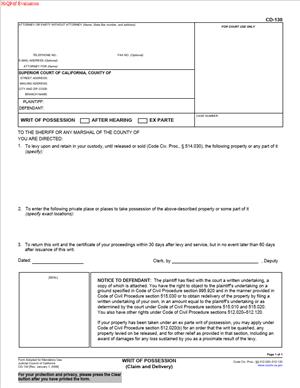
CD-130 – Writ of Possession
Fill out nowJurisdiction: Country: United States | Province or State: California
The CD-130 – Writ of Possession is a court-issued document used in California to restore possession of real property to a party who has won that right in court. You use it after you already have a judgment. It is not the document that starts a case. It enforces a court’s decision.
This form matters most in landlord-tenant cases. After a court enters judgment for possession, the CD-130 – Writ of Possession authorizes law enforcement to carry out the court’s order. Without it, the judgment alone does not physically remove occupants.
If you are filling this out, you are likely the party who won possession in an unlawful detainer or similar property case. You are asking the court clerk to issue a writ based on the judgment that already exists in the case file.
Understanding how this document works helps you avoid delays. Small errors can slow down issuance. Missing information can cause rejection. The form is short, but every field has a purpose.
What is CD-130 – Writ of Possession?
Clear definition
CD-130 – Writ of Possession is a court form issued by the Superior Court of California that directs a sheriff or marshal to restore possession of real property to the party named in a judgment. It is an enforcement tool.
The writ is based on a prior court judgment. It repeats key details from that judgment, such as the names of the parties, the court, the case number, and the property address. Once issued, it authorizes law enforcement to act.
This document does not decide who is right. That decision already happened in court. The writ carries out that decision in a practical way.
Who typically uses this form?
Most often, a landlord uses this form after winning an unlawful detainer case. The landlord is usually called the plaintiff in the case. After judgment, the landlord seeks possession of the rental property.
In some situations, a property owner who prevails in another type of real property dispute may use it. The key factor is that the court has entered a judgment awarding possession.
Attorneys frequently prepare and submit this document. Self-represented individuals also use it, especially in straightforward eviction matters. If you are representing yourself, you complete the form and submit it to the clerk for issuance.
Why might you need this form?
You may need CD-130 – Writ of Possession if the occupant does not leave voluntarily after the court awards you possession. A judgment alone does not remove someone from the property.
If the tenant remains after the court date, you request the writ so law enforcement can enforce the judgment. The sheriff posts a notice and, if necessary, carries out the lockout.
You also need this form if the judgment includes possession and possibly other relief. The writ focuses specifically on restoring control of the property to you.
Typical real-life scenarios
- A landlord files an unlawful detainer case for nonpayment of rent. The court enters judgment for possession in favor of the landlord. The tenant does not move out by the date of judgment. The landlord then requests a writ so the sheriff can enforce the order.
- A property owner buys a property at a foreclosure sale. An occupant refuses to leave. The owner brings a case and obtains a judgment for possession. The owner then seeks a writ to regain physical control of the property.
- A commercial landlord wins a dispute with a business tenant whose lease was terminated. The court awards possession to the landlord. The business remains on the premises. The landlord requests the writ to complete the eviction process.
- In a dispute between co-owners, one party obtains a judgment granting exclusive possession. The other party stays in the property. The prevailing party requests a writ so the court’s decision can be enforced through law enforcement.
When would you use CD-130 – Writ of Possession?
You use this form after the court enters a judgment awarding possession of real property to you. It is not filed at the start of a case. It comes at the enforcement stage.
Timing matters. There is usually a short period after judgment before enforcement begins. In some cases, a stay of execution may temporarily pause enforcement. The writ is requested when you are ready to move forward with enforcement, and no stay prevents it.
If the judgment includes both possession and money damages, you may use different enforcement tools for different parts of the judgment. The writ of possession focuses only on the property. Other writs may apply to collecting money.
In landlord-tenant cases, the plaintiff typically files the request for issuance of the writ. The court clerk reviews the form to ensure it matches the judgment. Once issued, it is forwarded to the sheriff or marshal for service.
You would not use this form if the case is still pending. You also would not use it if the judgment did not award possession. The writ must reflect an existing court order granting that specific relief.
Legal characteristics of CD-130 – Writ of Possession
The CD-130 – Writ of Possession becomes effective when the court clerk issues it. The clerk signs and seals the document. That issuance makes it an official court directive to law enforcement.
Accuracy is critical. The case number must match the court file exactly. The names of the parties must be consistent with the judgment. The property address must be complete and clear. Any mismatch can result in rejection or delay.
The writ is limited in scope. It authorizes law enforcement to restore possession of the described property. It does not automatically collect unpaid rent or damages. Separate enforcement methods may apply for monetary awards.
Different California counties may have slight procedural variations in how the writ is processed or transmitted to law enforcement. The core legal function remains the same across the state. The form itself is standardized for use in the Superior Court of California.
Common problems include incomplete property descriptions, missing signatures, or requesting possession for property not covered by the judgment. If the judgment does not clearly award possession, the clerk may not issue the writ.
The writ also has a limited lifespan. It must generally be enforced within a specific time period after issuance. If it expires, a new writ may be required. This ensures enforcement remains tied to a current and valid judgment.
Is it legally binding?
Yes, once issued by the court, the writ is legally binding on law enforcement. It directs the sheriff or marshal to carry out the court’s order regarding possession.
Its authority comes from the underlying judgment. The writ does not stand alone. It is enforceable because the court has already determined that you are entitled to possession.
For the occupant, the binding effect arises when the sheriff serves or posts the required notice. The process gives the occupant a defined period before lockout. After that period, law enforcement may proceed under the authority of the writ.
If there is an active stay of execution or a court order delaying enforcement, the writ may not be carried out until the stay is lifted. The binding nature of the writ operates within those court-imposed limits.
How to fill out CD-130 – Writ of Possession
Step 1 – Identify the court and case information
At the top of the form, enter the name of the Superior Court of California where your case was filed. Include the branch name and address if required. Fill in the case number exactly as it appears on the judgment. Accuracy here ensures the writ matches the correct case file.
Step 2 – List the parties as they appear in the judgment
Write the names of the plaintiff and defendant exactly as stated in the court’s judgment. Do not shorten or alter names. If there are multiple defendants, include each one as listed in the case caption.
Step 3 – Specify the type of writ requested
Indicate that you are requesting a writ of possession of real property. Confirm that the judgment awards possession. The form may include checkboxes or designated sections to reflect the relief granted in the judgment.
Step 4 – Provide the property description
Enter the full address of the property to be recovered. Include unit or apartment numbers if applicable. The description must clearly identify the premises so law enforcement can locate them without confusion.
Step 5 – Reference the judgment details
State the date the judgment was entered. Confirm that the judgment includes an award of possession in your favor. The information must align with the court record. This step ties the writ directly to the existing court order.
Step 6 – Complete any additional required declarations
Some versions of the form may include statements confirming that no stay of execution is in effect. Review each section carefully. Fill in all required fields. Leave no mandatory line blank.
Step 7 – Sign and date where required
Sign the form in the designated area if your signature is required before issuance. Print your name clearly. Dating the document helps establish the timeline for processing and enforcement.
Step 8 – Submit the form for clerk issuance
File the completed form with the court clerk in the same court that issued the judgment. The clerk reviews the information. If everything matches the court record, the clerk signs and issues the writ. Once issued, it can be delivered to the appropriate law enforcement agency for service and enforcement.
Legal terms you might encounter in CD-130 – Writ of Possession
- Writ: A writ is a formal written order issued by a court. In this document, the writ directs a law enforcement officer to take a specific action. It is not a request. It is a command backed by the authority of the court.
- Possession: Possession refers to the right to physically control property. In this context, it usually means control of real property such as a house, apartment, or land. The writ enforces a court judgment that says you are entitled to that possession.
- Judgment Creditor: This is the party who won the case and is entitled to enforcement. On this form, the judgment creditor is typically the landlord or property owner seeking to recover possession. You must list the name exactly as it appears in the judgment.
- Judgment Debtor: This is the party who lost the case and must comply with the judgment. In eviction matters, this is usually the tenant. The name must match the court’s judgment precisely.
- Levying Officer: The levying officer is the law enforcement officer responsible for carrying out the writ. This is often the sheriff or marshal. The writ directs this officer to restore possession to the judgment creditor.
- Abstract of Judgment: An abstract of judgment is a summary of the court’s judgment. While more common in money judgments, it may be referenced in enforcement documents. It confirms key details such as the case number and parties.
- Execution: Execution means the process of enforcing a court judgment. The writ is a tool of execution. It authorizes the officer to act so that the judgment is carried out in real life.
- Real Property Description: This is the legal or street address description of the property involved. The form requires a clear and complete description. An incorrect or incomplete address can delay enforcement.
- Clerk Issuance: Clerk issuance refers to the court clerk officially signing, sealing, or stamping the writ. The writ is not effective until the clerk issues it. You cannot enforce it before that step is complete.
FAQs
What information from the judgment do I need to complete this form?
You need the exact case number, court name, and the full legal names of all parties as shown on the judgment. You must also confirm the date the judgment was entered and what it awarded, specifically the right to possession. Keep a copy of the signed judgment in front of you and copy the details carefully so nothing conflicts.
Do the names on this document have to match the judgment exactly?
Yes. The names must match the judgment character for character, including middle initials, business names, and any “doing business as” designations. If you shorten or change a name, the clerk may reject the form or the levying officer may refuse to act. Always compare the completed form against the judgment before filing.
When does CD-130 – Writ of Possession become legally effective?
It becomes effective only after the court clerk issues it. That usually means the clerk signs, stamps, or seals the writ. A completed but unissued document has no enforcement power. You must confirm that the issued version includes the clerk’s official endorsement before delivering it to law enforcement.
What property details do I need to include?
You must include a complete and accurate property description. This typically means the full street address, including unit number if applicable. If the judgment identifies a specific portion of property, such as a particular apartment or room, you must repeat that description clearly.
Do I need to attach a copy of the judgment?
Courts often require a valid underlying judgment to support enforcement. Even if not attached directly to this document, you should have a conformed copy available when filing. If the clerk cannot confirm the judgment details, issuance may be delayed.
Can I correct a mistake after the writ is issued?
If you notice an error after issuance, you usually need to request a corrected writ. Law enforcement relies on the exact details printed on the issued document. Do not try to cross out or handwrite changes on an issued writ, as that can invalidate it.
What happens after the court issues this document?
Once issued, you deliver it to the appropriate levying officer. The officer follows statutory procedures to restore possession according to the court’s order. You do not personally remove occupants or property unless authorized by law enforcement.
Does this form affect the public record?
Yes. This document reflects the enforcement of a court judgment and becomes part of the case file. It shows that you are moving forward with the execution of the judgment. Anyone reviewing the case docket can see that enforcement was requested and issued.
Checklist: Before, During, and After CD-130 – Writ of Possession
Before
- Confirm a final judgment awarding possession has been entered.
- Obtain a conformed copy of the signed judgment.
- Verify the case number and court name exactly as listed.
- Confirm the full legal names of all parties.
- Double-check the complete property address, including unit numbers.
- Make sure no automatic stay or court order prevents enforcement.
- Gather any required filing fees for issuance.
- Review local court instructions for submission requirements.
During
- Enter the court name and branch exactly as shown on the judgment.
- Copy the case number without changing formatting.
- List the judgment creditor and judgment debtor names exactly.
- Specify that you are requesting a writ for possession of real property.
- Provide a clear and complete property description.
- Review the judgment date and confirm it matches your entry.
- Check every field for blanks or inconsistencies.
- Sign and date the form where required.
After
- Submit the form to the court clerk for issuance.
- Pay any required issuance fees.
- Obtain the issued writ with the clerk’s stamp or seal.
- Make multiple copies of the issued writ.
- Deliver the issued writ to the appropriate levying officer.
- Confirm receipt with the levying officer’s office.
- Keep a copy in your records with the judgment.
- Track deadlines related to enforcement timelines.
Common mistakes to avoid with CD-130 – Writ of Possession
- Mistake: Entering a nickname or shortened party name because it feels simpler, which happens when you rely on memory instead of the judgment, leading to rejection or enforcement delays; do not forget to copy names exactly as printed in the judgment.
- Mistake: Listing an incomplete property address because you assume the court already knows the location, which can cause the levying officer to refuse action; do not forget to include unit numbers and any specific identifiers.
- Mistake: Submitting the form before the judgment is final, often due to confusion about appeal periods, resulting in denial of issuance; do not forget to confirm the judgment is enforceable.
- Mistake: Leaving required sections blank because they seem repetitive, which can trigger clerk rejection; do not forget to review each field and confirm nothing is missing.
- Mistake: Trying to alter the writ after issuance to fix a small typo, which can invalidate the document in the eyes of law enforcement; do not forget to request a corrected writ instead of handwriting changes.
- Mistake: Delivering an unissued copy to the sheriff, often because you printed a draft version, causing refusal of service; do not forget to check for the clerk’s official stamp or seal.
- Mistake: Failing to keep copies for your records, which creates confusion later about what was issued and when; do not forget to store a complete set of stamped documents.
- Mistake: Ignoring local submission rules about fees or formatting, which can delay processing; do not forget to confirm procedural requirements before filing.
What to do after filling out CD-130 – Writ of Possession
Once you have completed the form, pause and review it carefully. Small errors can slow the process. Compare every entry to the judgment. Make sure the names, case number, and property description match exactly.
Next, prepare the form for submission to the court clerk. Some courts accept filings at the counter. Others may require electronic submission. Follow the court’s filing process and pay any required issuance fee.
- Step 1: Make at least two copies of the completed but unsigned form for your records before submission.
- Step 2: Submit the original to the clerk for review and issuance.
- Step 3: Pay the required issuance fee and obtain a receipt.
- Step 4: Wait for the clerk to sign, stamp, or seal the writ.
- Step 5: Confirm that the issued writ includes the court seal or official endorsement.
- Step 6: Make several copies of the issued writ immediately.
- Step 7: Deliver the issued writ to the appropriate levying officer.
- Step 8: Confirm the officer’s intake requirements and provide any additional documents they request.
- Step 9: Keep written confirmation of delivery to the levying officer.
- Step 10: Monitor the enforcement timeline and stay available for follow-up communication.
After delivery to law enforcement, your role shifts. You do not carry out the eviction or removal yourself. The levying officer follows legal procedures, including notice requirements and scheduling. Stay in contact so you know when possession will be restored.
Keep all documents together in a secure file. Include the judgment, the issued writ, proof of delivery to the officer, and any correspondence. If questions arise later, you will have a clear paper trail.
If something changes, such as a court order staying enforcement, notify the levying officer immediately. Clear communication prevents unnecessary action and protects you from complications.
Treat the process as a sequence. Judgment first. Issuance second. Enforcement third. Staying organized at each step helps ensure the court’s order is carried out smoothly and without avoidable delay.
Disclaimer: This guide is provided for informational purposes only and is not intended as legal advice. You should consult a legal professional.