POS-015 – Notice and Acknowledgment of Receipt—Civil
Fill out nowJurisdiction: Country: United States | Province or State: California
If you are serving court papers in a California civil case, the POS-015- Notice and Acknowledgment of Receipt—Civil is a form you may encounter early in the process. It is used to confirm that someone received legal documents by mail. This confirmation becomes part of the court record.
The POS-015- Notice and Acknowledgment of Receipt—Civil is not the lawsuit itself. It is a separate document that travels with the papers you are sending. The person receiving the documents signs it to acknowledge receipt.
This form is commonly used when one party wants to avoid personal service by a process server. It allows service by mail, but only if the receiving party agrees by signing and returning the acknowledgment.
Understanding how this document works helps you avoid delays. If it is completed incorrectly or not returned, the service may not be valid. That can affect deadlines and case progress.
What is POS-015- Notice and Acknowledgment of Receipt—Civil?
Clear definition
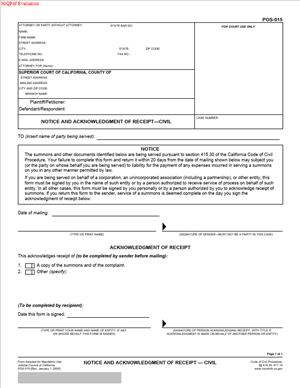
The POS-015- Notice and Acknowledgment of Receipt—Civil is a Judicial Council form used in California civil cases. It confirms that a party received legal documents by mail. Once signed and returned, it serves as proof of service.
This form typically accompanies documents such as a summons, complaint, or other court filings. It includes a section for the sender to identify what was mailed and a section for the recipient to acknowledge receipt.
The completed document is filed with the Superior Court of California. It becomes part of the official court file to show that service was completed in a manner accepted under court rules.
Who typically uses this form?
Plaintiffs often use this form at the start of a lawsuit when serving the summons and complaint. It may also be used later in a case when serving certain motions or other pleadings.
Defendants, cross-complainants, and other parties can also use it when they need to serve documents by mail and want written confirmation of receipt.
The person who receives the documents signs the acknowledgment portion. This may be an individual party or an authorized representative, such as someone accepting service on behalf of a business entity.
Why might you need this form?
You may need this form if you want to serve documents by first-class mail instead of arranging personal delivery. Mailing is often less expensive and easier to coordinate.
However, service by mail under this method only works if the receiving party signs and returns the acknowledgment. Without a signed acknowledgment, service is not considered complete under this approach.
Using this form can simplify the service process. It may reduce scheduling issues and eliminate the need for a process server in some situations.
Typical real-life scenarios
- You file a civil complaint and need to serve the defendant. Instead of hiring someone to personally deliver the summons and complaint, you mail them along with the acknowledgment form. The defendant signs and returns it, confirming receipt.
- You represent yourself in a contract dispute. After filing a motion, you mail the motion papers to the other party with the acknowledgment form enclosed. They sign and return it, allowing you to file proof that they received the documents.
- A small business is named as a defendant. The registered agent receives the mailed lawsuit papers and signs the acknowledgment on behalf of the company. This confirms that the company was properly served.
- During ongoing litigation, one party mails amended pleadings to another party. The receiving party signs the acknowledgment, which helps avoid arguments later about whether the documents were received.
When would you use POS-015- Notice and Acknowledgment of Receipt—Civil?
You would use this form when you want to serve legal documents by mail and need written confirmation that the other party received them. It is commonly used at the beginning of a case for serving a summons and complaint.
It may also be used later in the case for serving cross-complaints or certain amended pleadings. The form is generally used in civil matters handled by the Superior Court of California.
This method is often used when the recipient is cooperative or when there is reason to believe they will sign and return the acknowledgment. It is less reliable if you expect the other party to ignore mailed documents.
The form can be used by plaintiffs, defendants, cross-complainants, or any party required to serve documents. The key factor is that the recipient must be willing to sign and return the acknowledgment for service to be effective.
Legal characteristics of POS-015- Notice and Acknowledgment of Receipt—Civil
This form becomes effective only when the recipient signs and dates the acknowledgment section and returns it to the sender. Service is considered complete on the date the acknowledgment is signed.
The document must clearly identify the papers being served. If the description of the documents is incomplete or inaccurate, disputes may arise about what was actually received.
Timing matters. If the acknowledgment is not returned within the time allowed by court rules, the sender may need to arrange another method of service. An unsigned form does not establish proof of service.
Common problems include failing to include all served documents with the mailing, sending the form to the wrong address, or not filing the signed acknowledgment with the court. Any of these issues can delay the case.
This form does not replace the requirement to serve documents properly. It is simply one method of proving that service occurred. It does not extend deadlines unless the court rules specifically allows for additional time based on service by mail.
Court procedures can vary depending on the type of civil case. While the general structure of this form is consistent statewide, local court practices may affect how filings are processed after the acknowledgment is returned.
Is it legally binding?
Yes, once signed and returned, the acknowledgment is legally significant. It serves as proof that the recipient received the listed documents. Courts rely on this signed form to confirm that service was completed.
The signature does not mean the recipient agrees with the contents of the documents. It only confirms receipt. The underlying claims or defenses remain separate issues in the case.
If the recipient signs the acknowledgment, they are generally treated as having been served as of the date indicated on the form. That date can trigger deadlines for responding to the lawsuit or motion.
If the acknowledgment is never signed and returned, it does not create a valid service on its own. In that situation, another legally recognized method of service may be required to move the case forward.
How to fill out POS-015- Notice and Acknowledgment of Receipt—Civil
Step 1 – Fill in the court and case information
At the top of the form, enter the name of the Superior Court of California handling your case. Include the court’s address and branch name if required. Then complete the case title exactly as it appears on your other filed documents, including the names of the parties and the case number.
Step 2 – Identify the sender
In the section for the sender, provide the name and address of the person mailing the documents. This may be you or another adult who is serving the papers. The mailing address should match the address used to send the documents.
Step 3 – List the documents being served
Clearly list every document enclosed in the mailing. Use the exact titles of the forms or pleadings, such as summons, complaint, cross-complaint, or notice of motion. Make sure the list matches what is actually placed in the envelope.
Step 4 – Complete the notice section
Review the notice language printed on the form. This section explains to the recipient that they are being asked to acknowledge receipt of the documents. Do not alter this language. It informs the recipient that failure to sign and return the form may result in other service methods being used.
Step 5 – Leave the acknowledgment section for the recipient
Do not sign the acknowledgment portion yourself if you are the sender. That section is for the person receiving the documents. It includes space for their signature and the date of receipt.
Step 6 – Mail the documents and form together
Place the completed form and all listed documents in the same envelope. Mail them to the correct address for the recipient. Keep a copy of everything you send for your records.
Step 7 – Wait for the signed acknowledgment
After mailing, allow time for the recipient to receive, sign, and return the form. When you receive the signed acknowledgment, check that it includes a signature and a date.
Step 8 – File the signed form with the court
Once the acknowledgment is signed and returned, file it with the Superior Court of California in your case. This filing shows that service was completed as of the date indicated on the acknowledgment.
Legal terms you might encounter in POS-015- Notice and Acknowledgment of Receipt—Civil
- Service by Mail: A method of delivering court documents by sending them through the postal service instead of personal delivery. On this form, it means the sender mailed the documents along with the acknowledgment for the recipient to sign and return. The date of service depends on when the acknowledgment is signed, not when the envelope was mailed.
- Acknowledgment of Receipt: The signed confirmation by the receiving party that they received the documents listed. This section is completed by the person served. Once signed and dated, it proves to the court that service was successful.
- Proof of Service: Written evidence filed with the court to show that documents were properly delivered. When the signed acknowledgment is returned, this form becomes your proof of service. Without it, the court may treat service as incomplete.
- Party Served: The individual or entity receiving the documents. This could be the opposing party, their attorney, or another required participant in the case. The name must match exactly how it appears in the case caption or court records.
- Case Caption: The heading at the top of the form that lists the court name, case number, and names of the parties. It must match the existing court file exactly. Any mismatch can cause delays or rejection when filing.
- Declarant: The person who completes and signs the acknowledgment portion. By signing, the declarant confirms receipt of the documents listed. This signature is not an agreement with the contents—only confirmation of delivery.
- Date of Receipt: The date the receiving party signs the acknowledgment. This date can affect deadlines in cases such as when a response must be filed. It becomes part of the official court record once filed.
- Responsive Pleading: A formal written reply to a complaint or motion. The clock for filing a responsive pleading usually starts when service is considered complete. The signed acknowledgment establishes that starting point.
- Filing: Submitting the completed and signed form to the court clerk. Filing makes the proof of service part of the official case record. Until it is filed, the court may not recognize that service has been completed.
FAQs
What if the other party refuses to sign and return this form?
If the recipient does not sign and return the acknowledgment, service by mail is not complete. You cannot file this document as proof of service without their signature. You may need to arrange another method of service so you can move your case forward.
Does signing this document mean the recipient agrees with the lawsuit?
No. Signing only confirms receipt of the listed documents. It does not admit fault, accept claims, or waive defenses. The recipient still has the right to respond or challenge what was served.
When does the response deadline start after the POS-015- Notice and Acknowledgment of Receipt—Civil is signed?
The response period usually begins on the date the acknowledgment is signed and dated by the recipient. That date becomes the official date of service. Always check the signed date carefully before calculating any deadlines.
Can I sign the acknowledgment section myself if I mailed the documents?
No. The acknowledgment section must be signed by the person who received the documents or their authorized representative. If you sign it yourself as the sender, the court will not accept it as valid proof of service.
What if the name on the acknowledgment does not exactly match the case caption?
The name should match the court record. If there is a spelling error or a missing middle initial, it can create confusion. Make sure the signed name clearly identifies the correct party before filing the form.
Do I file this form even if I never receive the signed acknowledgment back?
No. You should only file it after it has been signed and returned. Without the signature, this document does not prove service, and the court will treat service as incomplete.
Can an attorney sign this form on behalf of a client?
Yes, if the attorney is authorized to accept service for that client. The attorney’s signature confirms receipt on behalf of the party. The signature should clearly indicate the attorney’s name and capacity.
What documents should be listed on this form?
You must list every document included in the mailing. Use the exact titles as they appear on the documents. If you leave something off the list, it may not be considered properly served, even if it was in the envelope.
Checklist: Before, During, and After POS-015- Notice and Acknowledgment of Receipt—Civil
Before
- Confirm that service by mail is permitted for the documents you are sending.
- Verify the correct mailing address for the party or their attorney.
- Double-check the exact case name and number from the court file.
- Prepare complete copies of every document you plan to serve.
- Ensure someone over 18 who is not a party will mail the documents.
- Review deadlines to understand how timing may affect your case.
- Make at least two copies of the unsigned form for your records.
During
- Attach the acknowledgment form to the documents being mailed.
- List every document included in the envelope by its exact title.
- Confirm that the server signs any required declaration section.
- Mail the documents using reliable postage and correct addressing.
- Record the date the documents were placed in the mail.
- Keep proof of mailing for your personal records.
- Track when the signed acknowledgment is returned.
After
- Check that the recipient signed and dated the acknowledgment clearly.
- Confirm the signed date is complete and legible.
- Make copies of the fully signed form.
- File the original signed form with the court clerk.
- Verify that the filing is accepted and stamped by the court.
- Update your case calendar with any new response deadlines.
- Store copies in a safe and organized case file.
Common mistakes to avoid with POS-015- Notice and Acknowledgment of Receipt—Civil
- Mistake: Mailing the form without including the acknowledgment page because you assume the other party already knows about the case, which leads to no signed proof of service and delays. Do not forget to include the full acknowledgment section in the envelope.
- Mistake: Listing documents vaguely, such as “court papers,” because it feels quicker, which can cause disputes about what was actually served—do not forget to use the exact document titles.
- Mistake: Filing the form before it is signed and returned, often due to deadline pressure, which results in rejection by the clerk—do not forget that the recipient’s signature is required.
- Mistake: Allowing a party to the case to mail the documents, which invalidates service under court rules—do not forget that the server must be at least 18 and not a party.
- Mistake: Ignoring the date the acknowledgment was signed, which can cause you to miscalculate response deadlines—do not forget to calendar deadlines from the signed date.
- Mistake: Failing to check that the case number matches the court record, often due to copying from an old document, which can cause filing errors—do not forget to verify the case caption before mailing.
- Mistake: Not keeping copies of the signed form, which creates problems if the original is lost—do not forget to store both digital and paper copies for your records.
- Mistake: Sending documents to an outdated address because you relied on old contact information, which prevents the acknowledgment from being returned—do not forget to confirm the current address before mailing.
What to do after filling out POS-015- Notice and Acknowledgment of Receipt—Civil
Once the acknowledgment has been signed and returned, your next actions matter. The court does not automatically know service is complete. You must take deliberate steps to finalize the process and protect your case timeline.
- Step 1: Review the signed acknowledgment carefully. Confirm that the signature is present and the date is filled in.
- Step 2: Check that the documents listed on the form match what you actually mailed.
- Step 3: Make at least two copies of the fully signed form—one for your records and one as a backup.
- Step 4: Prepare the original signed form for filing with the court clerk handling your case.
- Step 5: Submit the form for filing using the method allowed in your case, such as in person or electronically if available.
- Step 6: Confirm that the clerk stamps or officially accepts the filing. If filed electronically, confirm receipt through the system confirmation notice.
- Step 7: Calendar any response deadline triggered by the signed date of receipt.
- Step 8: Organize the filed copy in your case binder or digital file, keeping it with related service documents.
- Step 9: Monitor the case docket to ensure the filing appears in the court record.
- Step 10: Prepare for the next procedural step in your case, such as awaiting a response or preparing a motion if no response is filed by the deadline.
Keep your documentation organized. Courts rely on written proof. If there is ever a dispute about whether service was completed, your filed acknowledgment is your protection. Staying organized and attentive to dates will help you avoid unnecessary delays and procedural setbacks.
Disclaimer: This guide is provided for informational purposes only and is not intended as legal advice. You should consult a legal professional.