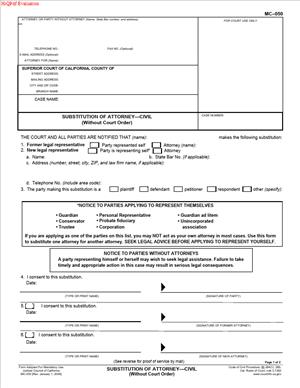
MC-050 – Substitution of Attorney-Civil (Without Court Order)
Fill out nowJurisdiction: Country: United States | Province or State: California
MC-050 – Substitution of Attorney—Civil (Without Court Order) is the form you use when you want to change who represents you in a California civil court case. It records the switch from one attorney to another, or from an attorney to yourself, without asking a judge to sign an order.
If you are involved in a lawsuit and your legal representation changes, the court needs written notice. This document provides that notice in a clear and official way. It updates the court and the other parties about who now has authority to act for you.
You might be hiring a new lawyer, ending your relationship with your current lawyer, or deciding to represent yourself. This form captures that transition. It ensures that court communications and filings go to the correct person.
Understanding how this document works helps you avoid delays. If representation is not updated properly, you may miss important notices or deadlines. Filing this form keeps your case record accurate and current.
What is MC-050 – Substitution of Attorney—Civil (Without Court Order)?
Clear definition
MC-050 – Substitution of Attorney—Civil (Without Court Order) is a court filing used in California civil cases to formally change the attorney of record. It allows a party to substitute a new attorney in place of the current one, or to move from attorney representation to self-representation, without needing a judge’s approval.
The form identifies the case, the party whose representation is changing, the former attorney, and the new attorney or self-represented party. Once properly completed and filed, it updates the official court record.
This document is administrative in nature. It does not argue the case or request a ruling. Its purpose is to reflect a change in representation.
Who typically uses this form?
This form is commonly used by plaintiffs and defendants in civil lawsuits. Either side in a case may file it when their representation changes.
Attorneys also use this form when they agree to take over a case from another lawyer. In that situation, the outgoing and incoming attorneys coordinate with the client to complete and sign the document.
Self-represented individuals use this form when they decide to handle their own case after previously having a lawyer. It may also be used when someone hires a lawyer after initially representing themselves.
Businesses, trusts, and other entities may be involved in substitutions as well. In many situations, these entities must be represented by an attorney, so the form may reflect a change from one lawyer to another rather than to self-representation.
Why might you need this form?
You may need this form if you and your current attorney end your professional relationship. This can happen for many reasons, including cost concerns, communication issues, or strategic differences.
You might also need it if you hire a new attorney who agrees to take over your case. The court must know who now has the authority to file documents and appear at hearings on your behalf.
Another common reason is a decision to represent yourself. If you no longer have an attorney and plan to handle the case personally, the court record must show that change.
Without filing this form, the court will continue to recognize the previous attorney as the attorney of record. That can lead to confusion about who receives notices and who is responsible for case actions.
Typical real-life scenarios
- You filed a personal injury lawsuit and hired an attorney. Months later, you decide to work with a different lawyer who focuses more on trial work. The substitution form documents the transfer of representation to the new attorney.
- You are a defendant in a contract dispute. After reviewing your legal costs, you decide to represent yourself. Filing this form updates the court so that future documents are sent directly to you.
- Your attorney retires or closes their practice while your case is still pending. A new attorney agrees to continue your case. The substitution form ensures a smooth transition in the court file.
- You initially filed a lawsuit on your own. As the case becomes more complex, you hire an attorney. The form is used to show that you are no longer self-represented and that your new lawyer is now responsible for filings and appearances.
- In a business dispute, your company replaces its outside counsel with a different law firm. The substitution form reflects that the new firm is now the attorney of record for the company.
When would you use MC-050 – Substitution of Attorney—Civil (Without Court Order)?
You use this form when there is a voluntary change in representation and all required parties agree to the substitution. It is typically used during an ongoing civil case in the Superior Court of California.
This form is appropriate when the current attorney and the client both consent to the change. It is also used when a party chooses to move from attorney representation to self-representation, and the attorney agrees to be relieved.
It is commonly filed before important case events such as hearings, depositions, settlement conferences, or trial. Updating representation in advance helps ensure that the correct person receives notice of those events.
If there is a breakdown in the attorney-client relationship and the attorney does not agree to the substitution, a different process may be required. In those situations, a court order may be necessary. This specific form is designed for substitutions made without asking the court to intervene.
The timing matters. Courts expect the substitution to be filed promptly after the decision to change representation. This keeps the case record accurate and reduces administrative issues.
Legal characteristics of MC-050 – Substitution of Attorney—Civil (Without Court Order)
This form becomes effective when it is properly completed, signed by the required parties, and filed with the court. The signatures confirm that the outgoing attorney, the incoming attorney, or the self-represented party, and the client agree to the change.
Accuracy is essential. The case name, case number, and court information must match the existing court record. Errors in these details can delay processing or cause confusion in the file.
The form does not require a judge’s signature because it reflects a mutual agreement. If all required signatures are present and the filing is accepted, the substitution updates the attorney of record automatically.
Common problems include missing signatures, incorrect case numbers, or failure to properly serve the form on other parties. If the substitution is not properly served, other parties may not recognize the change, which can affect communication and scheduling.
This document does not change any deadlines in your case. It does not pause proceedings or extend time limits. It only changes who is responsible for handling the case going forward.
In California civil practice, the attorney of record has the authority to act on behalf of the client in court. Once the substitution is filed, the new attorney or the self-represented party assumes that role. The former attorney no longer has authority to file documents or appear in the case, unless separately authorized.
Is it legally binding?
Yes, this form is legally binding once it is properly signed and filed. The signatures indicate agreement to the change in representation, and the court relies on that filing to determine who speaks for the party.
The binding effect applies to procedural matters. The court and opposing parties treat the newly listed attorney or self-represented party as the official contact for the case. Future notices, motions, and documents are directed accordingly.
If the form is incomplete or not properly filed, the substitution may not be recognized. Until the court processes the filing, the previous attorney may still be considered the attorney of record.
The form does not bind the parties to any settlement or legal position. It only binds them to the change in representation reflected in the document.
How to fill out MC-050 – Substitution of Attorney—Civil (Without Court Order)
Step 1 – Identify the court and case
Enter the name of the court exactly as it appears on prior filings. Include the branch name if applicable. Fill in the case name and case number precisely as shown on other court documents. This ensures the substitution is matched to the correct file.
Step 2 – Identify the party making the substitution
Indicate which party is changing representation. This may be the plaintiff, defendant, petitioner, respondent, or another party in the case. Be clear and consistent with how that party is listed in earlier documents.
Step 3 – Provide information about the former attorney
List the name, address, phone number, and other required contact details of the attorney who is being replaced. This identifies the outgoing attorney of record. The information should match the court’s existing records.
Step 4 – Provide information about the new attorney or self-represented party
If a new attorney is taking over, enter that attorney’s full name, State Bar number, firm name if applicable, and contact information. If the party will represent themselves, provide the party’s name, address, and contact details in the space for the new representative.
This section tells the court who will now receive notices and file documents in the case.
Step 5 – Confirm consent to the substitution
Review the section that reflects agreement to the change. The form requires signatures from the client, the former attorney, and the new attorney if one is involved. Each signature confirms consent to the substitution without a court order.
Make sure each person signs in the correct place. Signatures are a key part of making the document effective.
Step 6 – Date and sign the form
Each required signer must date and sign the form in the designated areas. The dates help establish when the substitution was agreed upon. Use consistent and legible signatures to avoid processing delays.
Step 7 – Complete the proof of service
After the form is signed, it must be served on other parties in the case. Fill out the proof of service section to show how and when the document was delivered. This confirms that all parties were notified of the change in representation.
The person who serves the document completes and signs the proof of service. This is typically someone who is not a party to the case and meets general service requirements.
Step 8 – File the completed form with the court
Submit the signed and completed form to the court clerk for filing. Once filed, the court updates the case record to reflect the new attorney of record or self-represented party. After filing, future case activity proceeds under the updated representation.
Legal terms you might encounter in MC-050 – Substitution of Attorney—Civil (Without Court Order)
- Substitution of Attorney: This means replacing the current lawyer in your case with a new lawyer, or choosing to represent yourself instead. On this document, it refers to a formal change in who speaks for a party in court. It does not change the claims, defenses, or status of the case. It only changes who is officially recognized as the party’s legal representative.
- Party: The party is the person or entity involved in the case. This could be a plaintiff, defendant, petitioner, respondent, or another named participant. On this form, you must clearly identify which party is making the substitution so the court updates the correct record.
- Attorney of Record: The attorney of record is the lawyer currently listed in the court file as representing a party. Until the substitution is filed and accepted, that attorney remains responsible for the case. The form removes this designation from the former attorney and transfers it to the new attorney or to the self-represented party.
- Self-Represented (In Pro Per): This means you are acting as your own lawyer. If you are replacing your attorney and choosing to represent yourself, you will be listed as self-represented. The court will send all future notices directly to you.
- Consent: Consent means agreement. This document requires signatures showing that the outgoing attorney, the incoming attorney (if any), and the party agree to the change. Without proper consent, the substitution may not be processed.
- Proof of Service: Proof of service shows that a copy of the filed document was delivered to other parties in the case. Even though this is a substitution, other parties must be notified. The proof section confirms when and how they were served.
- Case Caption: The case caption is the heading at the top of the first page. It lists the court name, the parties, and the case number. You must copy this information exactly as it appears in previous filings to avoid confusion.
- Bar Number: The bar number is the unique license number assigned to an attorney. If a new attorney is taking over the case, this number must be included. It helps the court confirm the lawyer is authorized to practice.
- Court Record: The court record is the official file maintained by the court. Filing this document updates that record to show who represents the party. Once updated, all future court communications follow the new information.
- Service Address: The service address is the mailing address where legal documents will be sent. If you become self-represented, your address becomes the official contact point. It is important that this address is accurate and current.
FAQs
When does the substitution become effective?
The substitution becomes effective when the completed document is filed with the court and accepted for filing. Signing it is not enough. The court must process and enter it into the case record before the new attorney or self-represented party is officially recognized.
Do all signatures have to be on MC-050 – Substitution of Attorney—Civil (Without Court Order)?
Yes. This document requires the signature of the party, the former attorney, and the new attorney if one is being added. If any required signature is missing, the clerk may reject it. Always confirm that each signature line is completed and dated before filing.
What if my former attorney refuses to sign this form?
If the outgoing attorney does not sign, you generally cannot use this specific document to make the change. This form is designed for substitutions without a court order, which means all sides agree. Without that agreement, a different procedure may be required to request court approval.
Do I need to attach anything to this document?
Usually, no attachments are required. However, you must complete the proof of service section or attach a separate proof of service if needed. Make sure all required information, including addresses and case number, appears directly on this form.
Will the case number or hearing dates change after I file this?
No. This document does not change your case number, court location, or scheduled hearings. It only updates who represents a party. You remain responsible for attending all scheduled hearings unless the court orders otherwise.
How do I know the court accepted the MC-050 – Substitution of Attorney—Civil (Without Court Order)?
After filing, you should receive a filed-stamped copy from the clerk. This shows the date it was accepted into the court record. If you file electronically, you may receive a confirmation notice. Keep this proof for your records.
What address should I list if I am representing myself?
You must list the mailing address where you want to receive court papers. This should be a reliable address where you can consistently receive mail. If your address changes later, you must update the court separately so notices are not missed.
Does filing this document automatically notify the other parties?
No. Filing updates the court’s record, but you must also properly serve a copy on other parties. The proof of service confirms when and how you delivered it. Without service, other parties may claim they were not informed of the change.
Checklist: Before, During, and After MC-050 – Substitution of Attorney—Civil (Without Court Order)
Before
- Confirm that all parties agree to the substitution.
- Verify the correct court name and case number from prior filings.
- Gather full contact details for the former and new attorney.
- Confirm the correct spelling of all party names.
- Decide whether you will hire a new attorney or represent yourself.
- Check upcoming hearing dates so representation is clear.
- Make sure you have the current service addresses for all parties.
During
- Complete the case caption exactly as it appears in the case file.
- Clearly identify which party is making the substitution.
- Enter full contact information for the former attorney.
- Enter full contact information and bar number for the new attorney, if any.
- List your mailing address if you are becoming self-represented.
- Obtain all required signatures and dates.
- Complete the proof of service accurately.
- Review the entire document for missing fields.
After
- Make copies of the signed document for your records.
- File the original with the court clerk or through the approved filing system.
- Serve copies on all other parties.
- Keep a filed-stamped copy in your case file.
- Confirm that future court notices reflect the updated representative.
- Inform your new attorney of any upcoming deadlines.
- Monitor your mail or electronic notifications closely.
- Update your personal case calendar if you are now self-represented.
Common mistakes to avoid with MC-050 – Substitution of Attorney—Civil (Without Court Order)
- Mistake: Leaving out a required signature because you assumed one signature was enough, which happens when people rush the process, and it can lead to rejection by the clerk; do not forget that the party, former attorney, and new attorney must all sign when applicable.
- Mistake: Using an incorrect case number because you copied it from memory, which often happens in multi-case situations, and this can cause filing errors or delays; do not forget to match the number exactly as it appears on prior court documents.
- Mistake: Forgetting to complete the proof of service because you think filing is sufficient, which is common for self-represented parties, and this can create disputes about notice; do not forget to properly serve all other parties and document it.
- Mistake: Listing an outdated mailing address because you recently moved, which happens during transitions, and this may result in missed court notices; do not forget to provide a current and reliable service address.
- Mistake: Filing too close to a hearing date because you delayed signing, which can create confusion about who appears in court, and this may complicate proceedings; do not forget to complete and file the substitution well before important deadlines.
- Mistake: Assuming the court automatically updates all systems immediately, which happens when people expect instant processing, and this may lead to missed communications; do not forget to confirm that you received a filed-stamped copy.
- Mistake: Failing to keep a copy for your records because you rely on the court file, which can create problems if you need proof later; do not forget to store a complete copy in your personal case file.
- Mistake: Not informing your new attorney about pending motions or deadlines because you think they will see everything in the file, which can lead to missed filings; do not forget to communicate key dates and documents directly.
What to do after filling out MC-050 – Substitution of Attorney—Civil (Without Court Order)
Once you complete the document, your next steps focus on filing, notifying others, and confirming the update. The form itself does not change representation until it is properly processed. You must follow through carefully.
- Step 1: Review every section one more time for accuracy, including names, addresses, and signatures.
- Step 2: Make at least two copies of the signed document before filing.
- Step 3: File the original with the Superior Court handling your civil case, either in person, by mail, or through an approved electronic filing system if available.
- Step 4: Obtain a filed-stamped copy from the clerk or save the electronic confirmation notice.
- Step 5: Serve a copy on every other party in the case using an approved method of service.
- Step 6: Complete and retain the proof of service showing when and how service was made.
- Step 7: Confirm that the court’s future notices list the correct attorney or your name if you are self-represented.
- Step 8: Notify your new attorney immediately of any upcoming hearings, deadlines, or pending motions.
- Step 9: If you are now representing yourself, create a calendar of all known court dates and filing deadlines.
- Step 10: Store your filed-stamped copy and proof of service in a safe, organized case file.
If you are transitioning to self-representation, take time to review the status of your case. Identify any motions awaiting decision, discovery deadlines, or scheduled appearances. You are now fully responsible for meeting all court requirements.
If a new attorney is taking over, provide them with a complete copy of your case file. This includes prior pleadings, correspondence, evidence, and court notices. A smooth transition reduces the risk of missed deadlines.
Finally, monitor your mail and electronic notifications closely for the next several weeks. Representation changes are administrative, but they affect communication. Staying organized ensures the substitution works as intended and your case continues without interruption.
Disclaimer: This guide is provided for informational purposes only and is not intended as legal advice. You should consult a legal professional.