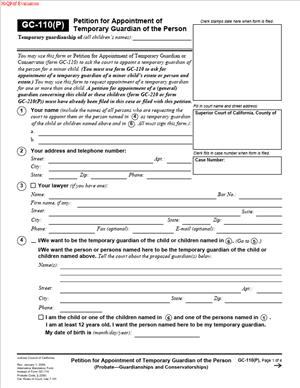
GC-110(P) – Petition for Appointment of Temporary Guardian of the Person
Fill out nowJurisdiction: Country: United States | Province or State: California
The GC-110(P) – Petition for Appointment of Temporary Guardian of the Person is a court form used in California guardianship cases involving minors. You use it to ask the court to appoint a temporary guardian for a child before a full guardianship hearing takes place.
This form is designed for urgent situations. It allows someone to request short-term legal authority to care for a child when waiting for a regular guardianship order could put the child at risk.
If you are filling this out, you are likely facing a time-sensitive problem. The court uses this document to understand why immediate action is needed and who is asking for authority over the child’s personal care.
This form does not create a guardianship by itself. A judge must review your request and sign an order before any temporary authority begins.
What is GC-110(P) – Petition for Appointment of Temporary Guardian of the Person?
Clear definition
The GC-110(P) – Petition for Appointment of Temporary Guardian of the Person is a formal written request to the Superior Court of California. It asks the court to appoint someone as a temporary guardian of a minor’s person.
“Guardian of the person” refers to responsibility for a child’s daily care. This includes decisions about housing, food, medical care, and education. It does not automatically include control over the child’s money or property.
The form is part of a larger guardianship case. It is typically filed together with, or shortly after, a petition for general guardianship of the person. The temporary request is meant to cover the gap before the full hearing.
Who typically uses this form?
This form is commonly used by relatives of a minor. Grandparents, aunts, uncles, or adult siblings often file it when a child’s parents are unable to provide care.
Non-relatives may also use it in certain situations. For example, a close family friend who has been caring for the child may seek temporary authority if the child’s living situation becomes unstable.
Sometimes more than one adult requests an appointment. In those cases, the court reviews the relationship between the child and each proposed guardian.
In most situations, the person filing the form is also asking to be appointed as the temporary guardian.
Why might you need this form?
You may need this form when a child needs immediate protection or supervision. The court process for general guardianship can take several weeks. A temporary order addresses urgent concerns during that period.
The form allows you to explain what is happening right now. It gives the judge a focused summary of the emergency and why waiting would not be in the child’s best interest.
Without a court order, you may not have legal authority to make decisions for the child. Schools, doctors, and other institutions often require proof of guardianship before accepting instructions from a non-parent.
This filing gives the court a structured way to review your request quickly and decide whether short-term authority is necessary.
Typical real-life scenarios
- A parent may be hospitalized unexpectedly and unable to arrange care. The child may already be staying with a grandparent who needs legal authority to enroll the child in school or approve medical treatment.
- A parent may be incarcerated, and no other legal custodian is available. A relative steps in to provide care and needs immediate authority to manage the child’s daily needs.
- There may be concerns about neglect, substance abuse, or unsafe living conditions. A responsible adult may seek temporary guardianship to remove the child from harm while a longer-term solution is considered.
- In some cases, both parents are temporarily unavailable due to travel, immigration issues, or other serious disruptions. A temporary guardian ensures the child has stable supervision and access to services.
When would you use GC-110(P) – Petition for Appointment of Temporary Guardian of the Person?
You would use GC-110(P) – Petition for Appointment of Temporary Guardian of the Person when there is an urgent need for someone to assume legal responsibility for a minor’s personal care. The key factor is timing. The situation cannot wait for the standard guardianship process to finish.
Temporary guardianship is often requested at the same time as a petition for general guardianship. The temporary request bridges the period before the court holds a full hearing on the long-term arrangement.
This form is commonly used when a child’s health, safety, or stability may be at risk without immediate action. The person filing is usually the proposed guardian, but it may also be someone acting on behalf of the child’s best interests.
Courts treat temporary guardianship as short-term relief. The judge reviews the urgency, the relationship between the child and the proposed guardian, and whether the appointment appears necessary to protect the child.
If the matter is not urgent, the court may decide that a regular guardianship hearing is sufficient. The temporary request is meant for situations where a delay could cause harm or serious disruption.
Legal characteristics of GC-110(P) – Petition for Appointment of Temporary Guardian of the Person
The GC-110(P) – Petition for Appointment of Temporary Guardian of the Person is a formal court pleading. It must be completed accurately and filed with the Superior Court handling guardianship matters in the county where the child lives or is present.
For the court to consider it, the form must clearly identify the minor, the proposed temporary guardian, and the reasons for urgency. Incomplete information can delay review or result in rejection by the clerk.
The document becomes effective only if a judge signs an order granting the temporary guardianship. Filing alone does not create authority. The court may set a hearing or review the request based on the written information provided.
Common problems include missing attachments, failing to describe the emergency clearly, or not filing related guardianship forms. Courts may require supporting declarations that explain the facts in detail.
Temporary guardianship is limited in scope and duration. It is not a permanent decision about custody. The court retains oversight and may terminate or modify the temporary appointment at any time.
This form does not address the financial management of the child’s estate. If control over money or property is needed, a separate request for guardianship of the estate is typically required.
Procedural details may vary slightly by county. Some courts have additional local requirements or scheduling procedures for temporary requests. The core purpose of the form remains the same across California.
Is it legally binding?
The form itself is not legally binding until the court acts on it. It is a request, not an order. The legal authority begins only after a judge signs the corresponding order appointing a temporary guardian.
Once signed, the temporary guardianship order gives the appointed person legal authority over the child’s personal care. Third parties, such as schools and healthcare providers, generally rely on certified copies of that order as proof of authority.
The temporary appointment lasts only for the period stated in the order or until the court makes a further decision. It does not automatically convert into a general guardianship. A separate court determination is required for long-term authority.
How to fill out GC-110(P) – Petition for Appointment of Temporary Guardian of the Person
Step 1 – Review the case caption and court information
At the top of the form, enter the name of the Superior Court and the county where the guardianship case is or will be filed. Include the minor’s name exactly as it appears on related documents. If a case number has already been assigned, write it in the designated space. If not, the clerk typically provides it after filing.
Step 2 – Identify the petitioner
Provide your full legal name and contact information in the section for the petitioner. This identifies you as the person asking the court to appoint a temporary guardian. Make sure your name matches your identification and any related guardianship filings.
Step 3 – Identify the minor
Enter the child’s full legal name and date of birth. Accuracy matters here. The court uses this information to confirm the child’s identity and age. If more than one child is involved, check whether additional forms are required for each minor.
Step 4 – Identify the proposed temporary guardian
State the name of the person you are asking the court to appoint. This may be you or another adult. Include the proposed guardian’s relationship to the child, such as grandparent, aunt, or family friend. The court considers the existing relationship when reviewing the request.
Step 5 – Describe the urgency
Explain clearly why temporary guardianship is needed right away. Focus on current facts. Describe what is happening, why the situation cannot wait, and how the child may be affected without immediate authority. Be specific about dates and events.
Step 6 – Describe the parents’ situation
Provide information about the child’s parents, including their names and current status. If a parent is unavailable due to illness, incarceration, absence, or other circumstances, describe that briefly. The court evaluates whether parental rights are affected by the temporary request.
Step 7 – State the type of authority requested
Indicate that you are requesting guardianship of the person, not the estate, unless separate filings are involved. This clarifies that the request concerns personal care decisions rather than financial control.
Step 8 – Reference related guardianship filings
If you have filed, or plan to file, a petition for general guardianship of the person, note the connection where the form requests it. Temporary guardianship is usually linked to a broader guardianship case. The court looks for consistency between the filings.
Step 9 – Review for completeness and sign
Read through the entire form carefully before signing. Confirm that names, dates, and descriptions are accurate. Sign and date the petition where indicated. Your signature confirms that the information provided is true to the best of your knowledge.
Legal terms you might encounter in GC-110(P) – Petition for Appointment of Temporary Guardian of the Person
- Temporary Guardian: A person the court appoints for a short period to care for a minor’s personal needs. On this form, you identify who will serve in this role and explain why immediate authority is necessary. The appointment does not last indefinitely and is meant to address urgent issues.
- Minor: A child under 18 who needs protection or supervision. This document requires you to provide the minor’s full legal name, date of birth, and residence information. Accuracy matters because the court record must match other filings.
- Petitioner: The person asking the court to appoint a temporary guardian. You may be a relative, family friend, or another concerned adult. The form records your contact information and your relationship to the minor.
- Guardianship of the Person: Legal authority over a child’s care, custody, education, and medical decisions. This form deals only with personal care, not financial control of the child’s property. Make sure you understand that distinction before you file.
- Ex Parte: A request made to the court on an emergency basis, often without a full hearing first. Temporary guardianship petitions are sometimes handled this way due to urgency. The form asks you to describe why immediate action is needed.
- Notice: The requirement to inform parents and other interested parties about the court request. Even in urgent cases, the court wants to know who has been notified and how. The document may require you to state whether notice was given or explain why it was not.
- Best Interest of the Child: The legal standard the court uses to decide whether to grant your request. Your explanations in this form should focus on the child’s safety, stability, and well-being. The court evaluates your statements through this lens.
- Proposed Guardian: The individual you are asking the court to appoint. This could be you or someone else. The form records their name, address, and relationship to the child.
- Authority: The specific powers the temporary guardian will have. The form allows you to request authority over areas like schooling and medical care. You must clearly indicate what decision-making power is needed.
- Expiration: The date or event that ends the temporary guardianship. Temporary appointments typically last until a scheduled court hearing or for a limited time. The form connects your request to the broader guardianship case timeline.
FAQs
What is the difference between temporary guardianship and permanent guardianship?
Temporary guardianship gives someone short-term authority to care for a child during an urgent situation. It is meant to bridge a gap until a full court hearing can be held. Permanent guardianship, by contrast, is decided after more formal notice and proceedings. In this document, you are only asking for limited, immediate authority.
Do I need to file anything else with GC-110(P) – Petition for Appointment of Temporary Guardian of the Person?
Yes. This document is usually tied to a general guardianship petition that starts the full case. You should confirm that the main guardianship paperwork is completed and filed or ready to file at the same time. The court will look for consistency between the temporary request and the broader case file.
What if I do not know where one of the parents is?
You must state what you know about the parents’ location. If you cannot locate them, you typically need to explain the efforts you made to find them. The court reviews this information when deciding whether it can move forward without that parent’s immediate participation. Do not leave parent information blank without explanation.
How specific do I need to be when describing the emergency?
Be concrete. State what happened, when it happened, and why the child cannot safely wait for a regular hearing. Avoid vague phrases like “unstable situation.” Instead, describe the actual risk or disruption affecting the child’s daily life. The court relies on these details to decide whether urgent action is justified.
Can the temporary guardian make medical decisions right away?
Only if the court grants that authority. In this document, you must clearly request the power to consent to medical treatment if that is needed. If the order is signed, the temporary guardian can act within the scope the court approves. Always check the signed order to confirm what authority was granted.
When does the temporary guardianship take effect?
It generally takes effect once a judge signs the order appointing the temporary guardian. Filing this form alone does not create authority. You must wait for the court’s signed order before acting on behalf of the child. Keep a filed copy of the order as proof of authority.
What happens if the judge denies the request?
If the judge denies the temporary request, the regular guardianship case may still move forward. You may receive instructions about providing more information or attending a hearing. Review any court notice carefully so you understand the next steps and deadlines.
Will this form change the child’s legal relationship with their parents?
No. A temporary guardianship does not terminate parental rights. It temporarily transfers certain decision-making powers to the appointed guardian. The court’s order will specify the scope and duration of that authority.
Checklist: Before, During, and After GC-110(P) – Petition for Appointment of Temporary Guardian of the Person
Before
- Confirm the minor’s full legal name matches their birth certificate or prior court records.
- Gather complete contact information for both parents.
- Prepare a clear written summary of the emergency situation with dates.
- Identify the proposed temporary guardian and confirm their willingness to serve.
- Check that the general guardianship petition is completed or in progress.
- Collect any supporting documents that show urgency, such as school or medical records.
- Review prior court orders involving the child, if any.
- Verify the correct court location for filing.
During
- Print or type all names exactly as they appear in other filings.
- Answer every question; write “unknown” or “not applicable” if necessary.
- Clearly describe the immediate risk to the child.
- Specify the exact powers you are requesting for the temporary guardian.
- Double-check addresses and phone numbers for accuracy.
- Review the form for consistency with the main guardianship petition.
- Sign and date the document where required.
- Make the required number of copies.
After
- File the original and copies with the court clerk.
- Pay any required filing fee or submit a fee waiver request.
- Obtain stamped copies for your records.
- Follow instructions about giving notice to parents and relatives.
- Calendar the hearing date, if one is scheduled.
- Keep the signed court order in a safe place.
- Provide copies of the signed order to schools or medical providers if needed.
- Monitor deadlines for the full guardianship hearing.
Common mistakes to avoid with GC-110(P) – Petition for Appointment of Temporary Guardian of the Person
- Mistake: Giving vague reasons for urgency because you assume the court understands your situation, which can lead to denial, since the judge needs specific facts, so do not forget to include dates, events, and clear risks to the child.
- Mistake: Listing nicknames or incomplete legal names, which happens when you rely on memory, causing mismatches with court records, so do not forget to verify full legal names from official documents.
- Mistake: Failing to address notice to parents because you think an emergency removes that requirement, which can delay your case, so do not forget to explain who was notified or why notice was not possible.
- Mistake: Requesting broad authority without stating why it is necessary, which may result in limited or denied powers, so do not forget to connect each requested power to the child’s immediate needs.
- Mistake: Forgetting to sign and date the form, often due to rushing, which can cause the clerk to reject your filing, so do not forget to review signature lines before submitting.
- Mistake: Not filing the related general guardianship petition, which happens when you focus only on the emergency, leading to procedural issues, so do not forget that temporary relief is tied to a larger case.
- Mistake: Acting as a guardian before the judge signs the order, which can create legal problems, so do not forget that authority begins only after the court issues a signed order.
- Mistake: Ignoring follow-up hearing dates because you believe the temporary order is final, which can result in dismissal, so do not forget to track and attend all scheduled hearings.
What to do after filling out GC-110(P) – Petition for Appointment of Temporary Guardian of the Person
Once you complete the form, slow down and review it line by line. Confirm that every name, date, and address matches your other court documents. Courts often reject filings for small inconsistencies.
- Step 1: Make at least two copies of the completed form—one for you and one for each required party.
- Step 2: Assemble the temporary petition with any related guardianship documents that must be filed together.
- Step 3: File the documents with the appropriate clerk’s office, either in person or through the court’s accepted submission method.
- Step 4: Pay the filing fee or submit an approved fee waiver request if you qualify.
- Step 5: Ask the clerk how and when the judge will review the temporary request.
- Step 6: Obtain filed-stamped copies for your records immediately after submission.
- Step 7: Follow all instructions regarding notice to parents and other interested individuals, and document how notice was provided.
- Step 8: Monitor your mail, email, or online case portal for updates or hearing information.
- Step 9: If the judge signs the temporary order, obtain certified copies if schools or medical providers require official proof.
- Step 10: Update the child’s school, healthcare providers, and caregivers by providing a copy of the signed order so they know who has authority.
- Step 11: Prepare for the full guardianship hearing by organizing evidence and maintaining records of the child’s care during the temporary period.
Keep everything organized in a dedicated folder. Include filed copies, proof of notice, and any court correspondence. Staying organized helps you respond quickly if the court requests more information. It also prepares you for the next stage of the guardianship process.
Disclaimer: This guide is provided for informational purposes only and is not intended as legal advice. You should consult a legal professional.