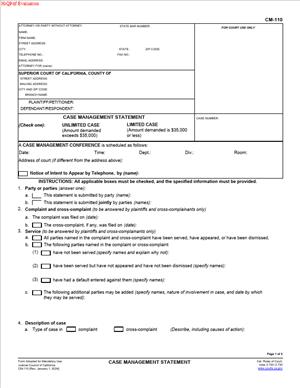
CM-110 – Case Management Statement
Fill out nowJurisdiction: Country: United States | Province or State: California
The CM-110 – Case Management Statement is a court form used in civil cases in California state courts. You file it to tell the court where your case stands and what needs to happen next. It is part of the court’s case management process.
If you are representing yourself, this form may feel detailed and technical. In reality, it is a structured status report. You answer specific questions about service, discovery, settlement, and trial readiness.
The court uses this document before a case management conference. The judge reviews it to understand the issues and plan how the case will move forward. Both sides usually file their own statements.
Filling it out carefully matters. Incomplete or unclear answers can delay your case or create confusion at the conference. When you understand what each section is asking, the form becomes much easier to complete.
What is CM-110 – Case Management Statement?
Clear definition
The CM-110 – Case Management Statement is a standardized California court form used in civil cases to provide the court with an overview of the status of the case. It covers procedural details such as whether all parties have been served, what claims are involved, whether discovery has begun, and whether the case is ready for trial.
It is not a pleading like a complaint or an answer. You are not arguing your case in this form. Instead, you are giving factual updates and practical information about how the case is progressing.
The form also asks about alternative dispute resolution, possible motions, and estimated trial length. This helps the court manage its calendar and avoid unnecessary delays.
Who typically uses this form?
Plaintiffs and defendants in California civil cases use this form. If you filed the lawsuit, you will usually submit one. If you were sued and filed a response, you will also submit your own statement.
Self-represented individuals commonly complete this form without a lawyer. Attorneys also use it regularly. The questions are the same regardless of whether you have legal representation.
The form applies to many types of civil cases. These may include contract disputes, personal injury cases, property disputes, business disagreements, and other non-criminal matters handled in civil court.
Why might you need this form?
You typically need this form because the court scheduled a case management conference. When that happens, each party is usually required to file and serve a completed statement before the conference date.
The court relies on your responses to decide how to manage deadlines. For example, the judge may set dates for discovery cutoffs, motion hearings, or trial based on what you report.
If you do not provide complete information, the court may continue the conference or issue orders that do not reflect your situation. Accurate information allows the judge to make realistic scheduling decisions.
Typical real-life scenarios
- You filed a lawsuit after a business failed to pay you under a written agreement. The defendant filed an answer. The court then set a case management conference. Before that hearing, you complete this form to inform the court that service is complete, no cross-complaint has been filed, and you are beginning discovery.
- You were injured in a car accident and sued the other driver. The insurance company hired a lawyer to respond. The court scheduled a conference a few months after the complaint was filed. You use the form to explain that medical treatment is ongoing and that you expect to conduct depositions.
- You are being sued for alleged breach of contract. You filed an answer denying the claims. On the form, you indicate that you believe the case may be resolved through mediation and that you expect to file a motion addressing certain legal issues.
- You and a former business partner are in a dispute over ownership interests. Both of you filed claims against each other. Each side submits its own statement explaining the number of causes of action, anticipated witnesses, and estimated trial length.
- In each of these situations, the form gives the judge a snapshot of the case. It is not about proving who is right. It is about organizing the next steps.
When would you use CM-110 – Case Management Statement?
You use this form after a civil case has been filed and before or in connection with a scheduled case management conference. The court usually sets this conference early in the life of the case.
The timing often depends on when the complaint was filed and when the defendant was served. Once the court sets the conference date, it also sets a deadline for filing and serving the statement. Each party generally files its own form.
You may also need to use this form if the court continues the case management conference to a later date. In some situations, the court may require an updated statement to reflect changes in the case, such as newly added parties or completed discovery.
If you filed a cross-complaint, you still complete your own statement. The same applies if you are one of several plaintiffs or defendants. Each party or each separately represented party may submit a statement.
The form is used in unlimited and limited civil cases. The specific procedures may vary slightly depending on the type of civil case, but the overall purpose remains the same: to inform the court about the status and needs of the case.
Legal characteristics of CM-110 – Case Management Statement
This form is part of the court’s case management system. It becomes part of the official court record once it is filed. The information you provide is treated as representations to the court.
Accuracy matters. If you state that all parties have been served when they have not, that can create procedural problems. If you estimate a one-day trial but the case realistically requires several days, the court’s schedule may be affected.
Common issues that lead to problems include leaving sections blank, failing to sign the form, missing the filing deadline, or not properly serving the other parties. Clerical errors, such as incorrect case numbers or party names, can also cause confusion.
The form does not replace other required filings. For example, it does not substitute for serving a complaint, filing a proof of service, or submitting motions. It is a status report, not a motion or pleading.
The court may rely on what you write when setting deadlines. If your position later changes, you may need to inform the court. The form does not lock you into a permanent strategy, but it does reflect your current understanding of the case.
Is it legally binding?
The CM-110 – Case Management Statement is not a contract between the parties. It does not create new legal rights or obligations by itself. However, it is a formal filing made under penalty of perjury.
When you sign the form, you are declaring that the information is true and correct to the best of your knowledge. Providing false information can have serious consequences in a court proceeding.
Statements in the form can influence how the judge manages the case. For example, if you indicate that you are ready for trial within a certain timeframe, the court may schedule dates accordingly. While this is not a binding agreement, it can shape the procedural path of the case.
The form does not decide the outcome of the dispute. It does not prove or disprove your claims. It functions as an administrative and procedural tool used by the court.
How to fill out CM-110 – Case Management Statement
Step 1 – Caption and Court Information
Start at the top of the form. Enter your name, address, and contact information in the space provided. If you are representing yourself, you indicate that you are self-represented.
Next, fill in the court name and branch location exactly as it appears on your other court documents. Write the case number and the full case name, including all listed parties. This information must match the complaint and any subsequent filings.
Step 2 – Party Identification
Indicate whether you are the plaintiff, defendant, or another party, such as a cross-complainant. If there are multiple parties on your side, make clear which party you are submitting the statement for.
If you are filing on behalf of more than one party, ensure the names are correctly listed. The court needs to know exactly who the statement represents.
Step 3 – Case Status
Answer the questions about the type of case and the status of the pleadings. Indicate whether the complaint and any cross-complaints have been filed and served.
If any parties have not yet been served, provide the requested details. The court uses this information to determine whether the case is ready to move forward or whether service issues remain.
Step 4 – Description of the Case
Briefly describe the nature of the case. Summarize the claims in plain language. You are not arguing the facts. You are identifying the type of dispute and the general issues involved.
Keep this section focused and factual. For example, you might describe it as a contract dispute over unpaid services or a personal injury claim arising from a vehicle collision.
Step 5 – Jury or Nonjury Trial
Indicate whether you are requesting a jury trial or a nonjury trial. This should match any prior demand made in your pleadings.
The choice between jury and nonjury affects scheduling and courtroom resources. Make sure your selection is consistent with the case record.
Step 6 – Trial Estimate
Provide an estimate of how long the trial will take. This is usually stated in days or hours. Base your estimate on the number of witnesses, complexity of issues, and expected evidence.
Be realistic. An accurate estimate helps the court allocate sufficient time on its calendar.
Step 7 – Trial Availability and Dates
State the dates when you are unavailable for trial within the timeframe requested by the court. List specific periods if you have conflicts.
This information allows the court to avoid setting a trial date when you cannot attend.
Step 8 – Alternative Dispute Resolution
Respond to the section addressing mediation, settlement conferences, arbitration, or other dispute resolution methods. Indicate whether you have participated in any of these processes or plan to do so.
The court often encourages early resolution. Your answers inform the judge whether the case may settle without trial.
Step 9 – Discovery Status
Provide information about the discovery completed and the discovery you plan to conduct. This may include written questions, document requests, or depositions.
You do not need to attach evidence. Simply state what has been done and what remains. This helps the court understand how much preparation is still required.
Step 10 – Related Cases and Additional Issues
Disclose whether there are related cases in the same or another court. Also, indicate any anticipated motions or procedural issues.
If there are factors that could affect scheduling, such as pending motions, note them clearly. This gives the judge a complete picture of the procedural posture.
Step 11 – Meet and Confer
Confirm whether you have met and conferred with the other parties about the matters in the statement. Many courts expect parties to discuss scheduling and potential settlement before the conference.
If discussions occurred, briefly indicate the outcome. This demonstrates that communication has taken place.
Step 12 – Signature and Service
Sign and date the form where indicated. Your signature confirms that the information is accurate to the best of your knowledge.
After completing the form, follow the required process for filing it with the court and serving a copy on all other parties. Ensure that proof of service is properly completed so the record shows that all parties received the document.
Legal terms you might encounter in CM-110 – Case Management Statement
- Case Management Conference (CMC): This is the court hearing where the judge reviews the status of your case. On this form, you provide details that help the judge prepare for that conference. The information you list guides what will be discussed, including deadlines and trial plans.
- Proof of Service: This is a statement confirming that you delivered a copy of this document to the other parties in the case. The form includes a section where you declare how and when the service was completed. Without proper proof of service, the court may not consider your filing complete.
- Alternative Dispute Resolution (ADR): ADR refers to methods like mediation or arbitration used to resolve disputes without a full trial. The form asks whether you are willing to participate in ADR and whether you have already scheduled it. Your answers show the court whether the case might settle early.
- Discovery: Discovery is the process of exchanging evidence and information before trial. In this document, you estimate what discovery has been completed and what remains. This helps the judge set realistic deadlines.
- Jury Trial Demand: This indicates whether you or another party has requested a jury. The form asks you to confirm if a jury trial has been demanded. This affects scheduling and how long the trial may take.
- Trial Estimate: This is your estimate of how many days the trial will last. The court relies on this number to allocate courtroom time. An unrealistic estimate can cause scheduling problems later.
- Related Cases: These are other court cases involving the same parties or similar issues. The form asks you to identify related matters so the court can coordinate them if necessary. Failing to disclose related cases may create conflicts or delays.
- Meet and Confer: This refers to the requirement that parties communicate before the conference to discuss case status and possible settlement. The form asks you to confirm that this conversation happened. The court expects meaningful discussion, not just a brief exchange.
- Settlement Conference: This is a structured meeting, often supervised by a judge, to attempt resolution. You may need to indicate whether you are willing to participate. This shows the court your openness to resolving the dispute.
- Service by Mail or Electronic Service: These are approved methods for delivering court documents to other parties. The proof of service section asks you to specify which method you used. You must follow court rules for timing and accuracy.
FAQs
Do I have to file CM-110 – Case Management Statement if I already filed a complaint or answer?
Yes. This document is separate from your complaint or answer. It gives the court updated information about the status of the case before the Case Management Conference. Even if nothing significant has changed, you still need to complete and file it by the deadline set in your court notice.
What date should I use when signing this form?
Use the actual date you sign the document. The signature date should match the day you review the final version and confirm that all information is accurate. Do not predate or postdate it, because the court relies on that signature to confirm the current case status.
Who is allowed to sign this document?
You may sign if you are representing yourself. If you have an attorney, your attorney signs instead. Make sure the name printed under the signature matches the party name listed in the caption, or clearly identifies you as the attorney for that party.
What happens if I forget to serve the other party?
The court may refuse to consider your filing complete. Service ensures that all parties have the same information before the conference. You must complete the proof of service section accurately and file it with the rest of the document.
Can I change information after I file it?
Yes, but you must update the court and serve the other parties. If something important changes—such as trial availability or completion of discovery—you may need to file an updated statement or be prepared to explain the change at the conference.
What if I am not ready for trial, but the form asks for a trial date estimate?
You still need to provide your best estimate. Look at how much discovery remains and how complex the issues are. The judge uses your estimate to manage the court calendar, even if the actual trial happens later.
Does filing this document make my statements public?
Yes. Information you include becomes part of the court record. Be accurate and professional in your descriptions. Avoid including unnecessary personal details that are not relevant to the case status.
What should I bring to the Case Management Conference after submitting this form?
Bring a copy of what you filed, your notes about discovery progress, and a proposed timeline for remaining steps. The judge may ask about ADR plans, settlement discussions, and trial readiness, so be prepared to discuss the details you listed in the CM-110 – Case Management Statement.
Checklist: Before, During, and After CM-110 – Case Management Statement
Before
- Review the court’s notice for the Case Management Conference date and filing deadline.
- Gather your case number, party names, and judge assignment.
- Review all pleadings filed so far to accurately describe the case status.
- Make a list of completed and pending discoveries.
- Confirm whether a jury trial has been demanded.
- Check your calendar for trial availability conflicts.
- Speak with the other party to meet and confer about the case status and settlement.
- Identify any related cases involving the same facts or parties.
During
- Enter the exact court name and case number as shown on prior filings.
- Clearly identify yourself as plaintiff, defendant, or other party.
- Provide a concise but specific description of the case.
- Mark whether you request a jury or nonjury trial.
- Estimate the number of trial days realistically.
- Indicate your willingness to participate in ADR.
- List discovery is completed, and what remains.
- Complete the meet and confer declaration honestly.
- Sign and date the form.
After
- Make at least two copies of the completed document.
- Serve a copy on all other parties using an approved method.
- Complete and attach the proof of service.
- File the original with the court before the deadline.
- Confirm that the court accepted the filing.
- Keep a stamped copy for your records.
- Add the conference date and any deadlines to your calendar.
- Prepare notes for issues you want to raise at the conference.
Common mistakes to avoid with CM-110 – Case Management Statement
- Mistake: Leaving sections blank because you are unsure what to write, which happens when you feel uncertain about legal terms, leading to incomplete filings and possible court rejection. Do not forget to provide clear responses or indicate “not applicable” where appropriate.
- Mistake: Failing to meet and confer before filing, which often occurs due to scheduling conflicts, resulting in judicial frustration or continuances, so do not forget to document your efforts to communicate with the other side.
- Mistake: Giving an unrealistic trial estimate, usually because you underestimate preparation time, causing scheduling conflicts later, so do not forget to consider witnesses, evidence, and complexity before listing trial days.
- Mistake: Forgetting to serve the other parties, which happens when you focus only on filing with the court, leading to procedural defects, so do not forget to complete and attach the proof of service.
- Mistake: Missing the filing deadline, often due to confusion about counting days, which can result in sanctions or loss of credibility, so do not forget to verify the exact due date in your court notice.
- Mistake: Using outdated party names or case numbers from earlier drafts, which happens when copying templates, causing processing delays, so do not forget to match the caption exactly to the court’s records.
- Mistake: Overloading the case description with arguments instead of status information, which occurs when emotions run high, leading the judge to refocus the discussion. Do not forget that this document reports progress, not detailed legal arguments.
- Mistake: Signing without reviewing for accuracy, which often happens when filing close to the deadline, risking incorrect statements on the court record, so do not forget to carefully review every section before signing.
What to do after filling out CM-110 – Case Management Statement
Once you finish the form, pause and review it carefully. Check every section for completeness. Make sure your case number, party names, and conference date match the court notice exactly.
- Step 1: Print the completed document and review it line by line for accuracy.
- Step 2: Sign and date the form in the appropriate section.
- Step 3: Make at least two copies—one for yourself and one for each other party.
- Step 4: Arrange for service on all parties using an approved method, such as mail or electronic service if permitted.
- Step 5: Complete the proof of service section accurately, including the date and method of service.
- Step 6: File the original form and proof of service with the court before the stated deadline.
- Step 7: Confirm acceptance by checking for a filed stamp copy or electronic confirmation.
- Step 8: Keep your filed copy in a dedicated case folder, either physical or digital.
- Step 9: Update your calendar with the Case Management Conference date and any discovery or ADR deadlines you listed.
- Step 10: Prepare a short outline of key points you want to raise at the conference.
After filing, stay organized. Keep all related documents together, including prior pleadings and discovery requests. Review what you stated about trial length and discovery so you can answer questions confidently. If circumstances change before the conference, be ready to explain the updates clearly. Preparation makes the conference more productive and shows the court you are managing your case responsibly.
Disclaimer: This guide is provided for informational purposes only and is not intended as legal advice. You should consult a legal professional.